

IVD Firms Seek Sustainable Growth After Reaping a Decade’s Profits in One Pandemic Year
Driven by demand for COVID-19-related products, the in vitro diagnostics (IVD) market, particularly the molecular diagnostics segment, experienced a surge in 2020, propelling the industry into a period of explosive growth.
Data shows that the market size of China's in vitro diagnostics (IVD) industry exceeded RMB 90 billion in 2019. Following the COVID-19 pandemic in 2020, the market reached the RMB 100 billion mark, making China one of the fastest-growing IVD markets globally. By segment, molecular diagnostics witnessed a growth rate exceeding 25% prior to 2020, establishing it as the fastest-growing sector within the IVD landscape. In 2020, driven by the demand for precision medicine and the specific impacts of the fight against COVID-19, the growth of the molecular diagnostics market further accelerated.
The COVID-19 pandemic has drawn significant attention to the in vitro diagnostics (IVD) industry, enabling a large number of IVD companies to achieve substantial growth and reap excess returns. In 2020, companies such as Sansure Biotech, ZJ Bio-Tech, Wantai Biological Pharmacy, and Orient Gene went public. Meanwhile, the valuations of several listed companies, including KingMed Diagnostics and BGI Genomics, reached record highs. The industry also witnessed numerous large-scale financing rounds; for instance, MGI Tech secured over $1 billion in funding, Vazyme Biotech completed its RMB 550 million Series C financing, and 3D Medicines raised RMB 280 million.
What changes occurred in the in vitro diagnostics (IVD) industry in 2020, and what trends emerged? Annual reports serve as the most reliable data source for reflecting industry shifts. Recently, major IVD companies have successively released their 2020 annual reports. Based on the 2020 annual report information disclosed by Sansure Biotech, Daan Gene, and Wondfo—three companies closely associated with the COVID-19 pandemic—VCBeat attempts to outline the key development points of the IVD industry for the new year.
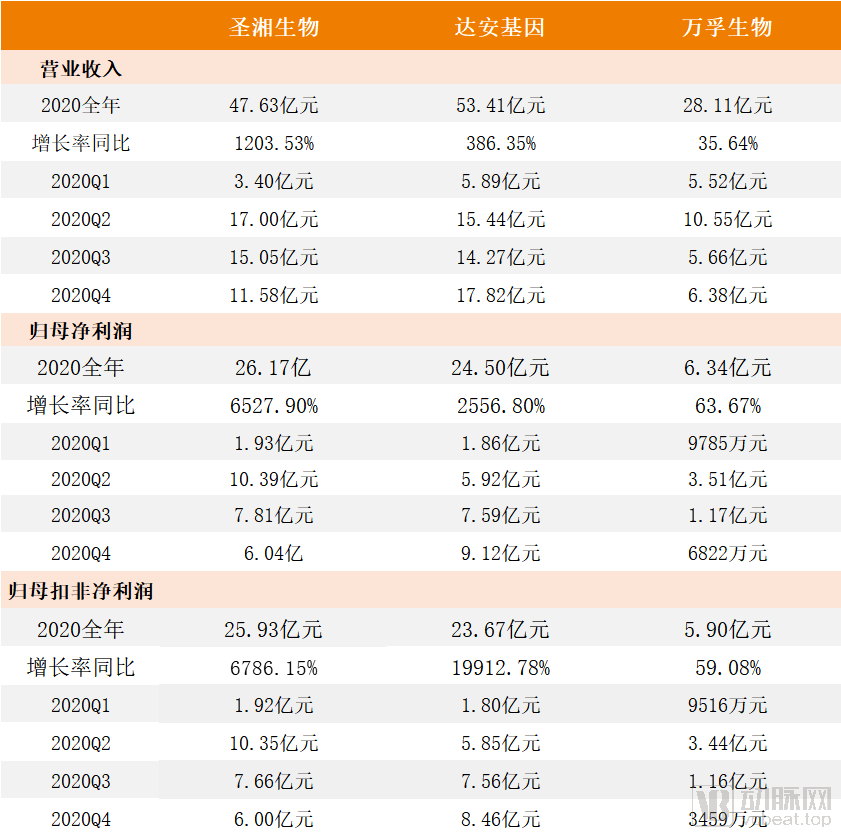
Sansure Biotech, Da An Gene, and Wondfo: Revenue and Growth Rates
In 2020, global demand for novel coronavirus (SARS-CoV-2) testing was substantial. China conducted multiple rounds of mass nucleic acid testing across its population, with negative test results becoming a mandatory travel pass. It is reported that conducting a single round of citywide testing in a city with a population of ten million costs approximately RMB 1 billion. Cities such as Beijing and Ruili in Yunnan Province carried out mass nucleic acid testing, creating a vast market for SARS-CoV-2 testing. In vitro diagnostic companies, including Sansure Biotech, Daan Gene, and Wondfo Biotech, achieved significant revenue growth by leveraging their SARS-CoV-2 testing products.
Following the outbreak of the COVID-19 pandemic, Sansure Biotech developed a nucleic acid detection kit for SARS-CoV-2 in just 72 hours. The company subsequently launched a series of anti-pandemic products, including “minute-level” rapid nucleic acid testing equipment, SARS-CoV-2 antigen test kits, triple-test nucleic acid detection kits for SARS-CoV-2, Influenza A, and Influenza B (antigen detection), and diagnostic kits for identifying SARS-CoV-2 variants. Leveraging its comprehensive, all-scenario COVID-19 testing solution, Sansure Biotech sold 189 million person-tests of nucleic acid detection kits in 2020, representing a year-on-year increase of 761.31%. The total number of instruments shipped reached 6,122 units, nearly six times the cumulative volume shipped from the company’s inception through 2019.
In 2020, Sansure Biotech reported annual revenue of RMB 4.763 billion, representing a year-on-year increase of 1,203.53%. The net profit attributable to shareholders of the listed company surged by 6,527.90% year on year, while the net profit attributable to shareholders after deducting non-recurring gains and losses rose by 6,786.15% year on year. In contrast, the company’s full-year revenue in 2019 was only RMB 360 million.
Another star enterprise in nucleic acid testing, Da An Gene, reversed the trend of declining performance from previous years in 2020.
Da An Gene is one of the first seven enterprises in China to enter the National Medical Products Administration’s expedited approval channel, and it is the only company in China that won all bids in the centralized procurement of COVID-19 test kits across all provinces. Currently, Da An Gene’s production capacity has exceeded 1.5 million tests per day, with approximately 150 million COVID-19 nucleic acid testing kits shipped throughout 2020.
Since 2017, Da An Gene’s revenue growth rate has turned negative. In 2019, the company’s operating revenue was RMB 1.1 billion, a decrease of RMB 400 million from the previous year. The net profit attributable to shareholders in 2019 was RMB 92 million, representing a 9.25% decline compared to the same period of the previous year.
In 2020, Daan Gene experienced a remarkable turnaround, with annual revenue reaching RMB 5.341 billion, a year-on-year increase of 386.35%; total profit amounted to RMB 2.902 billion, surging by 47,877.92% compared to the same period of the previous year; and net profit attributable to shareholders of the parent company increased by 2,556.80% year on year. Among this, revenue from the Novel Coronavirus (2019-nCoV) Nucleic Acid Detection Kit (Fluorescent PCR Method) reached RMB 2.975 billion.
Wondfo Biotech is one of the leading domestic enterprises in chemiluminescence-based point-of-care testing (POCT). In response to the COVID-19 pandemic, Wondfo Biotech developed six COVID-19 testing products based on its colloidal gold immunochromatography, immunofluorescence, and molecular diagnostics technology platforms, establishing a comprehensive COVID-19 testing system that covers initial screening, laboratory differential diagnosis, and confirmed diagnosis. The company’s R&D and manufactured COVID-19 antibody test kits (colloidal gold method) received emergency approval from China’s National Medical Products Administration (NMPA) on February 22 and obtained EU CE certification on March 6.
In 2020, Wondfo Biotech achieved annual revenue of RMB 2.811 billion, a year-on-year increase of 35.64%. The net profit attributable to shareholders of the listed company was RMB 634 million, up 63.67% from the same period last year; the net profit attributable to shareholders of the listed company after deducting non-recurring gains and losses was RMB 590 million, representing a year-on-year increase of 59.08%. Driven by strong sales of its COVID-19 test kits, the company’s infectious disease testing products generated revenue of RMB 1.453 billion, a year-on-year surge of 151.19%, with a gross profit margin of 76.57%, an increase of nearly 6 percentage points compared to the previous year.
It is evident that three representative in vitro diagnostics (IVD) companies all achieved significant growth during the pandemic. Although Wondfo Biotech’s revenue growth scale in 2020 was smaller compared to Sansure Biotech and Daan Gene, Wondfo Biotech has maintained a steady performance growth trajectory over the years. From 2015 to 2020, its year-over-year growth rates in net profit after deducting non-recurring gains and losses were 34.9%, 20.17%, 45.83%, 49.6%, 38.28%, and 59.08%, respectively, demonstrating strong sustainability.
The conventional workflow for SARS-CoV-2 nucleic acid testing is cumbersome and time-consuming, typically requiring 8–12 hours from sample collection, specimen transport, and nucleic acid extraction to detection and final report issuance. Within this process, nucleic acid extraction alone takes approximately two hours, followed by about 1.5 hours for amplification, resulting in very low efficiency. Furthermore, the traditional testing model imposes stringent requirements on facilities, environmental conditions, and personnel, demanding substantial investments in equipment, space, and labor. Consequently, it fails to meet the need for rapid and simplified testing in scenarios such as emergency care, fever clinic management, entry/exit screening, and food safety testing.
In particular, as China conducted multiple rounds of mass nucleic acid testing for the entire population and the National Health Commission announced that travelers returning to their hometowns during the Spring Festival would need to present negative nucleic acid test results, large-scale nucleic acid testing became an essential requirement. This surge in demand spurred the growth of the grassroots nucleic acid testing market, making it evident that traditional equipment requiring manual operation and offering low extraction efficiency could no longer meet the needs.
The pandemic has exposed the shortcomings of insufficient testing capacity in primary healthcare institutions across China. According to statistical reports by CCTV’s “News 1+1,” 80% of COVID-19 cases originated from rural areas. In April, June, and July 2020, the National Health Commission repeatedly issued policies calling for strengthened laboratory infrastructure. In September, the Joint Prevention and Control Mechanism of the State Council released the “Work Plan for Further Advancing the Construction of Nucleic Acid Testing Capacity for COVID-19,” emphasizing that “by the end of September 2020, all tertiary general hospitals, specialized infectious disease hospitals, disease prevention and control institutions at all levels, and at least one county-level hospital within each county should have nucleic acid sampling and testing capabilities. By the end of 2020, all secondary general hospitals should have nucleic acid sampling and testing capabilities, and the construction of urban testing bases and public testing laboratories should be completed.”
The grassroots nucleic acid testing market holds immense potential but faces two major challenges: a shortage of operational personnel and a lack of professional laboratories. Consequently, automated SARS-CoV-2 detection equipment has emerged to address these needs.
Sansure Biotech has comprehensively laid out the development of automated nucleic acid extraction instruments, launching a series of automated nucleic acid extraction systems including iPonatic, Natch 48, Natch 96, Natch S, Natch CS, Natch CS2, Fast DP01, and Fast DP02. These systems enable one-stop automated operation for the entire laboratory workflow, from primary sample pretreatment to room-temperature lysis, nucleic acid extraction, and PCR reaction setup, thereby creating an integrated, high-throughput, high-precision, and high-efficiency solution for modern molecular laboratories. Among these, the Natch S can process up to 96 samples simultaneously, while the Natch CS and Natch CS2 can process up to 48 and 96 samples simultaneously, respectively.
Meanwhile, Sansure Biotech has innovatively developed and registered a POCT mobile nucleic acid testing system capable of delivering “minute-level” nucleic acid detection. This system breaks through the limitations of traditional PCR laboratories and expands application scenarios, providing on-site, rapid nucleic acid testing solutions for fever clinics, emergency departments, primary healthcare institutions, health management, military security, biological emergency response, and other fields.
Industry leader MGI Tech has launched the ultra-high-throughput MGISP-NE384 Fully Automated Nucleic Acid Extraction and Purification System, which efficiently processes nucleic acid extraction and purification for 96, 192, 288, or 384 samples. Equipped with a negative-pressure filtration system and a UV disinfection system, it prevents aerosol contamination, ensuring safety and reliability. With its ultra-high-throughput and high-efficiency nucleic acid extraction capabilities, the MGISP-NE384 can achieve a daily testing throughput of up to 10,000 samples per unit. It is also the first fully automated nucleic acid extraction and purification system on the market to have been validated during the pandemic response.
Currently, companies have long focused primarily on COVID-19 diagnostic reagents, with insufficient attention and investment devoted to automated platforms. In the future, enterprises need to devote greater efforts to innovative automated products, such as automated platforms for nucleic acid testing of pooled samples.
After years of development, China’s in vitro diagnostics (IVD) industry has not only achieved import substitution in multiple niche segments but also seen many companies become capable of expanding their products overseas. Among them, Mindray Medical has cultivated overseas markets for many years and stands as one of the most successful Chinese enterprises in global expansion. In 2020, it broke into more than 700 high-end hospitals worldwide that previously lacked its products, with a future goal of increasing the proportion of overseas revenue to 70%. Wondfo Biotech also laid out its overseas strategy as early as 2004 by establishing a U.S. subsidiary responsible for marketing and management in the North American market.
However, expanding into overseas markets is no easy feat. The first challenge lies in selecting the appropriate target markets, followed by securing market access, which demands substantial investments of time, human resources, and capital. Consequently, prior to the pandemic, few companies possessed the capability to establish a presence in international markets, and even fewer managed to generate profits abroad. Data from 2018 on the export revenues of China’s 21 listed in vitro diagnostics (IVD) companies reveals that, excluding Mindray Medical, which has long maintained an overseas footprint, the combined export revenue of the remaining firms amounted to only RMB 2.135 billion, representing merely 10% of their total operating revenue.
Amid the pandemic, companies accelerated their internationalization efforts.
In 2020, the pandemic swept across the globe, spurring a surge in demand for COVID-19 testing products. To alleviate shortages of epidemic prevention supplies, several countries, notably Russia and the United States, opened emergency registration pathways for COVID-19-related products. The Russian Ministry of Health announced an acceleration of the registration process for medical devices and in vitro diagnostic (IVD) products related to the COVID-19 pandemic. Resolution No. 430/2020 permitted the importation of COVID-19-related products without further registration until the end of 2020. The U.S. Food and Drug Administration (FDA) issued a series of temporary policies to rapidly authorize compliant COVID-19-related products, thereby increasing the supply of epidemic prevention products in the U.S. market.
Sansure Biotech is one of the leading Chinese enterprises in terms of export volume of COVID-19 nucleic acid testing reagents, helping thousands of laboratories domestically and internationally to establish nucleic acid testing capabilities from scratch or achieve multi-fold to dozens-of-fold increases in capacity. The “Sansure Solution” for COVID-19 has become the dominant nucleic acid testing strategy for epidemic control in many countries worldwide, including France, the United Arab Emirates, the Philippines, and Serbia, with market share exceeding 80% in some nations. Its six-panel respiratory virus pathogen test, seven-panel respiratory bacterial pathogen test, and combined test for COVID-19 and influenza A and B viruses have all obtained CE certification.
Driven by the global fight against COVID-19, Sansure Biotech has significantly accelerated its international expansion. Its product and service coverage has rapidly expanded from over 40 countries in 2019 to nearly 160 countries and regions, with the proportion of overseas revenue increasing from 4.98% in 2019 to 53.49%.
Da An Gene also actively expanded its overseas market during the pandemic. The company’s novel coronavirus nucleic acid detection kit became the first product of its kind globally to receive EU CE certification on February 5, 2020, and was subsequently included in the World Health Organization’s Emergency Use Listing on May 14. To date, the company’s products related to novel coronavirus nucleic acid testing have been shipped to more than 140 countries and regions worldwide.
Wondfo’s overseas business also achieved rapid growth in 2020, with its products now covering more than 140 countries. Notably, as an early entrant into international markets, Wondfo has built substantial expertise and presence abroad. Its overseas revenue growth was driven not only by COVID-19 testing kits but also by drug-testing operations through its U.S. subsidiary and the immunofluorescence platform managed by its International Business Division. In particular, the U.S. subsidiary’s drug-testing product line recorded year-over-year revenue growth in 2020, with strong sales performance from new products helping Wondfo’s drug-testing segment achieve counter-trend growth amid the pandemic, up 4.63% compared to the same period last year.
It is evident that overseas markets have recognized Chinese in vitro diagnostic (IVD) products, particularly nucleic acid testing kits for SARS-CoV-2, with cumulative exports reaching hundreds of millions of test kits. The COVID-19 pandemic has further expanded the global market for IVD products. Leveraging the opportunities brought by the pandemic, a significant number of Chinese enterprises will expand internationally over the coming years, with more products being sold globally. This trend will give rise to a cohort of highly competitive companies on the international stage, driving the IVD export trade into a period of rapid growth.
Now, with the widespread administration of COVID-19 vaccines and the stabilization of the pandemic, demand for SARS-CoV-2 testing is declining, signaling the end of the explosive growth period in the in vitro diagnostics (IVD) industry. Was the record-high revenue generated in 2020 a harbinger of new opportunities or merely a fleeting boom? In the post-pandemic era, how can companies avoid stagnating growth? We examine the strategic moves of several leading enterprises to gain insights into these questions.
1. Improve Product Portfolio. For companies with an incomplete product lineup that rely solely on “COVID-19” related businesses, the ebbing of the COVID-19 testing market will naturally lead to their elimination. Take Wondfo Biotech as an example; with POCT as its core, it is one of the companies in the industry with the most technological platforms and the richest product portfolio. For enterprises like Wondfo Biotech, which already had a well-established product portfolio and deep market presence before the pandemic, legacy products can return to normal growth after the COVID-19 outbreak.
Sansure Biotech also boasts a comprehensive portfolio of reagent products. In addition to its COVID-19 testing product line, the company has established offerings in hepatitis, blood screening, and comprehensive respiratory disease solutions. Although these products currently contribute relatively little to the company’s revenue, Sansure Biotech shipped more than 6,000 nucleic acid testing instruments in 2020. Going forward, the company can leverage the growth in its installed base to drive incremental sales across its entire range of reagents.
II. Strengthen R&D of Upstream Raw Materials. Raw materials are the source of innovation in the in vitro diagnostics (IVD) industry and have a significant impact on the performance of diagnostic reagents. To develop advanced diagnostic technologies, it is essential to first master advanced raw material technologies. In recent years, many companies have been strategically investing in IVD reagent raw materials to reduce their reliance on imported supplies.
III. Automation and Simplification Are the Major Development Trends. The pandemic has accelerated the rapid development of automated equipment. Beyond supporting COVID-19 prevention and control, these devices can be extended to specialized fields such as infectious disease testing (e.g., respiratory infections, HIV/AIDS, and viral hepatitis), chronic disease management, and oncology diagnosis and treatment, thereby enabling faster and more convenient testing for a broader range of assays.
IV. Overseas markets are the future growth engine for enterprises. According to statistics from CACLP, there are currently over 1,500 in vitro diagnostic (IVD) companies, with increasingly fierce market competition; certain segments have already entered a "red ocean" phase. Meanwhile, as centralized procurement of IVD products is gradually implemented in China, overseas markets will undoubtedly become a significant source of revenue for these companies. Expanding into overseas markets has become a consensus. Sansure Biotech stated in its annual report that it will accelerate the expansion of its seven major global regional centers and establish localized entities abroad. Da An Gene also indicated that it will continue to strengthen its overseas market capabilities, expedite overseas certifications such as CE and FDA for its scaled-up products, and accelerate its global layout and business expansion in overseas markets.