

AI and Accelerated Computing Usher in a New Era for Healthcare
NVIDIA
Artificial Intelligence Computing Service Provider
At the J.P. Morgan Healthcare Conference, Kimberly Powell, Vice President of Healthcare at NVIDIA, discussed how AI and accelerated computing are driving advancements in new drug development and clinical practice.
Kimberly Powell, Vice President of Healthcare at NVIDIA, stated that the current moment is critical—AI is ushering research and development and the field of medicine into a new era.
At the J.P. Morgan Healthcare Conference held online in recent days, Kimberly discussed in her speech how to leverage AI and accelerated computing to help scientists harness the surge in biomedical data, accelerate research breakthroughs, and deliver more comprehensive patient care.
She stated that humanity has long been committed to understanding diseases and seeking therapies, with the multi-trillion-dollar drug discovery industry underscoring the severity of this challenge.
The typical drug development process takes approximately ten years, costs $2 billion, and has a clinical failure rate as high as 90%. However, in recent years, the growing volume of data in the healthcare sector has enabled us to leverage AI to better utilize these statistical insights.
She said, “Today, we can acquire more biomedical data in approximately three months than has been generated across the entire healthcare sector over the past 300 years. The challenge is that such vast volumes of data cannot be processed manually, necessitating the use of AI.”
Kimberly describes AI as “the most powerful technological force of our time, enabling software to write code that humans cannot.”
However, AI performs best in specific domains when combined with data and algorithms tailored to those areas (such as radiology, pathology, or patient monitoring). The NVIDIA Clara application framework bridges this gap by providing researchers and clinicians with GPU-accelerated AI tools for medical imaging, genomics, drug discovery, and smart hospitals.
Kimberly noted that downloads of NVIDIA Clara grew fivefold last year, as developers began adopting NVIDIA’s new platform for conversational AI and federated learning.
Kimberly pointed out that the application of AI in healthcare accelerated during the COVID-19 pandemic. It is estimated that startups raised over $5 billion in early 2020. The NVIDIA Inception Program includes more than 1,000 healthcare startups, a fourfold increase since 2017. Last year, PubMed received over 20,000 AI-related healthcare papers, indicating exponential growth over the past decade.
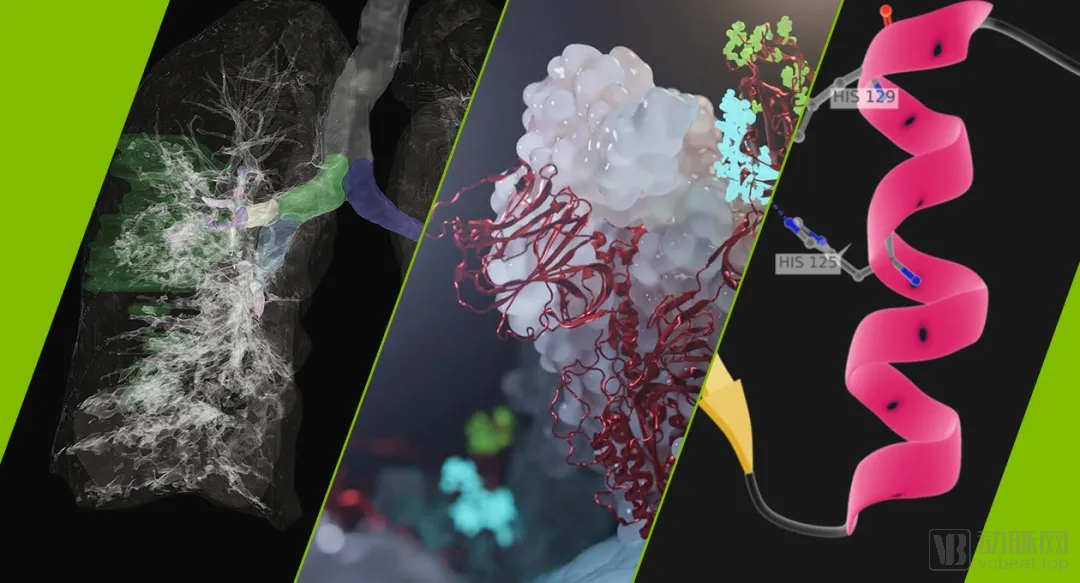
Leading research institutions such as the University of California, San Francisco are leveraging NVIDIA GPUs to advance their work in cryo-electron microscopy, enabling the study of molecular structures—such as the spike protein in the COVID-19 virus—and accelerating drug and vaccine development.
Pharmaceutical companies, including GSK, and major healthcare systems such as the UK’s National Health Service (NHS), will leverage Cambridge-1—a NVIDIA DGX SuperPOD system and the fastest AI supercomputer in the UK—to process large-scale data, improve patient care and diagnosis, and accelerate the delivery of critical drugs and vaccines.
Kimberly believes that software-defined instruments—devices that can be regularly updated to leverage the latest scientific knowledge and AI algorithms—are key to integrating the latest research breakthroughs into medical practice.
“AI, much like medical practice, is constantly learning. We aim to learn from data and from the ever-changing environment,” said Kimberly.
She stated that by developing software-defined medical devices, it is possible not only to rapidly deploy tools such as smart cameras for patient monitoring and AI-guided ultrasound systems, but also to ensure their sustained value through continuous improvement and enhancement over time.
UK-based sequencing company Oxford Nanopore Technologies is a leader in the field of software-defined instruments, having deployed next-generation DNA sequencing technology on its electronic platform. Its nanopore sequencers have been used in more than 50 countries and regions to sequence and track new variants of the COVID-19 virus, as well as for large-scale genomic analysis to study the biological characteristics of cancer.
The company has adopted NVIDIA GPUs across a range of instruments, from the handheld MinION Mk1C to the ultra-high-throughput PromethION. The PromethION can generate sequencing data for more than three human genomes in a single run. To support the next-generation PromethION, Oxford Nanopore employs the NVIDIA DGX Station, enabling its real-time sequencing technology to meet the demands of rapid, high-precision genomic analysis.
For years, the company has been using AI to improve the accuracy of basecalling, the process of determining the sequence of molecular DNA bases from tiny electrical signals as they pass through a nanopore.
Kimberly stated that base-calling technology has truly penetrated deep into medical practice, whether in the context of COVID epidemiology or in human genetics and long-read sequencing. Through deep learning, her base-calling model achieves an accuracy of 98.3%, while AI-based single-nucleotide variant identification reaches an accuracy of 99.9%.
Kimberly stated that amid the pandemic, AI-driven breakthroughs like this are becoming increasingly important.
She stated, “In 2020, major challenges such as COVID-19 prompted us to focus intensively on AI and helped us identify all areas that could benefit from its application. The insights we have gained over the past year will undoubtedly drive future progress. The lessons we have learned are applicable to all future drug development projects.”
In numerous areas such as genomic analysis, computational drug discovery, and clinical diagnostics, major players in the healthcare sector have made significant strides by leveraging GPU-accelerated AI.