

Who Should Take Center Stage in Internet Healthcare: Online or Offline?
Since the "Internet Plus" technology penetrated the medical field,Online “Acquiring” Offline, or Offline “Forcing Out” Online, has long been a subject of heated debate in the field of internet healthcare, and to this day, no consensus has been reached. However, with the onset of the pandemic, there are signs that this dichotomy is gradually being broken.
As the pandemic severely restricted travel, “online healthcare,” supported by cutting-edge technologies such as AI, 5G, and cloud computing, has gained the upper hand. It is exerting pressure on traditional “offline healthcare” from multiple dimensions, sparking a widespread trend of “online replacing offline” in the medical field.
This is not without reason. With technological advancements and the accumulation of experience, "online healthcare" is currently in a stage of rapid development, yielding more pronounced benefits than before and better aligning with market demands. Specifically, in segmented sectors, "online healthcare" has demonstrated significant application value in areas such as lightweight consultations, remote monitoring, health management, and pharmaceutical e-commerce, effectively addressing current challenges including uneven distribution of medical resources, low efficiency in medical care, difficulties in patient monitoring, and low levels of information integration.
But even so,“Can ‘online healthcare’ truly completely replace ‘offline healthcare’?”Can This Path Truly Be Fully Realized in the Healthcare Sector? VCBeat Has Conducted a Corresponding Analysis to Address These Questions.
Since the outbreak of the pandemic, the term “online healthcare” has increasingly appeared on the front pages of major media outlets. Overnight, it became a buzzword, drawing widespread public attention. But fundamentally, what is driving online healthcare to break into the mainstream?
First, there is enormous market demand.The pandemic “locked” people into extremely small, enclosed environments, plunging many sectors into a “winter.” In stark contrast, the healthcare sector experienced a surge in demand, further straining already scarce medical resources. Moreover, “online healthcare,” known for its convenience, precision, and efficiency, has effectively addressed the long-standing issue of uneven distribution of medical resources in China, thereby gaining widespread recognition and market acclaim.
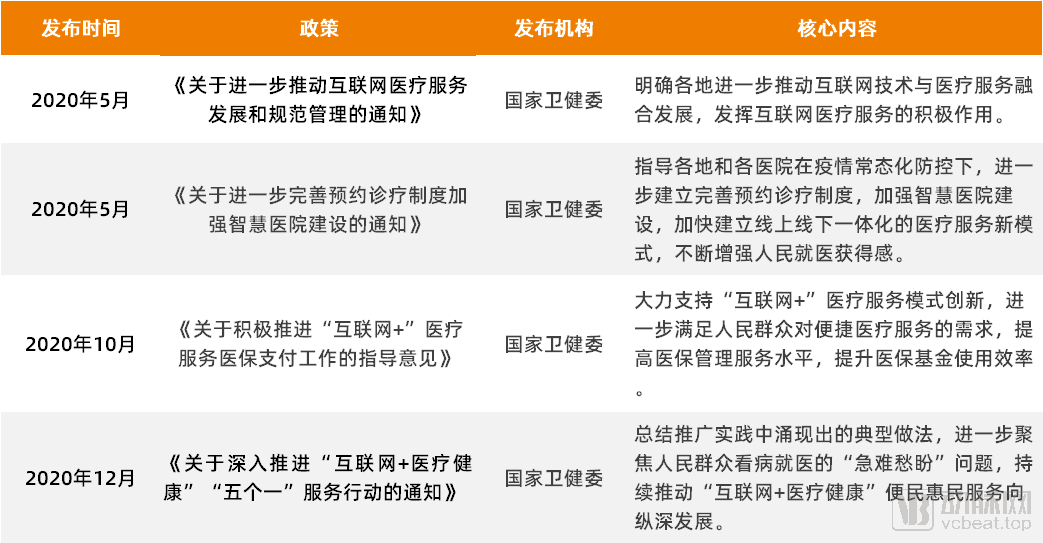
Summary of Selected Policies on Internet Healthcare in 2020
Next is the active guidance of policies.Since February 2020, functional departments led by the National Health Commission have successively issued multiple policies to vigorously promote internet-based medical services and encourage patients to seek online referrals.Policies primarily target the five core segments of the pharmaceutical value chain—diagnosis, treatment, medication, drug delivery, and payment—to progressively enhance online services.
Currently, cutting-edge technologies such as artificial intelligence, the Internet of Things (IoT), and cloud computing have matured and are widely applied in the healthcare sector. These technologies demonstrate strong integration capabilities, have been deeply interconnected across multiple business touchpoints, and exhibit significant application value.
Overall,Demand has opened up vast market opportunities for online healthcare, while policies have provided essential conditions for its development. However, whether it can truly take root depends on actual application outcomes, and the continuous penetration of cutting-edge technologies undoubtedly provides the final impetus for online healthcare.
It is undeniable that “online healthcare” played a significant role during the pandemic; however, this was merely an exceptional measure adopted under extraordinary circumstances and does not reflect the norm. Although “online healthcare” continues to accelerate even as the pandemic stabilizes, it has not yet reached a stage where it can completely replace “offline healthcare.” So, what exactly is hindering the further advancement of “online healthcare”?
First, the unique attributes of the healthcare sector.Currently, China’s high-quality medical resources are predominantly concentrated in public hospitals, indicating that the vast majority of healthcare encounters occur in offline settings. This fundamentally establishes the irreplaceability of “offline healthcare.”
Second, online healthcare poses “safety risks.”Patient safety is the most fundamental baseline in the medical field., although relevant national authorities have established stringent regulatory frameworks governing physician credentialing, prescription review, and information traceability, numerous non-compliant practices persist in actual implementation, resulting in a relatively low safety index. Furthermore, there is currently no clear consensus on how to delineate the respective liabilities of patients, physicians, and online platforms in the event of safety incidents during online medical consultations.
Third, online fee standards are inconsistent and lack regulatory oversight.First,Per-Service Fees Vary Across Major Platforms, Lacking Detailed Standardization, users are unable to make comparisons; secondly,The profit-sharing arrangement between the platform and physicians is unclear., it is difficult to motivate physicians in the short term; finally,Monitoring of Diagnostic and Therapeutic Value, the extent to which online healthcare can assist patients and whether it reflects its intended value remain largely unexplored.
Fourth, users’ medical consultation habits are difficult to change in the short term.From the patient’s perspective, engaging in medical consultations via smartphones or computers, without face-to-face interaction with physicians, makes it difficult to establish mutual trust. Furthermore, for middle-aged and elderly individuals, mastering the use of online medical devices is inherently challenging.
Therefore, it is not difficult to see that although “online healthcare” has advanced at a rapid pace and generated certain social benefits,At present, it cannot fully replace “offline medical care” and remains in a developmental stage that supplements and strengthens “offline medical care.”
Since it is irreplaceable and its value cannot be entirely ignored, where should the two distinctly different models of “online healthcare” and “offline healthcare” head? Is there an “optimal solution” to this challenging problem?
From a macro perspective,“Online Healthcare” and “Offline Healthcare” are not entirely opposing; rather, they should engage in a collaborative relationship characterized by mutual complementarity and deep integration to generate greater value.; andFrom a micro perspective, in certain specific business segments, the value generated by their combination is more efficient and safer than “going it alone.”, for instance, the most basic medical consultation. If it is conducted exclusively online, significant safety risks arise; however, if it is limited to offline settings, consultation efficiency tends to be lower, leading to a certain degree of waste of medical resources.
Therefore, the deeply integrated “online + offline” collaborative model represents the standard pathway for the advancement of internet healthcare. How, then, should such a cooperative mechanism be established? The answer can be found by examining the development trajectories of leading enterprises in the field.
With the advancement of the times, the healthcare sector is moving more resolutely toward improved service quality, greater accessibility, and more transparent medical costs. The integration of data technologies with clinical practice has evolved from superficial applications to deep-level interaction. Consequently, companies operating in this sector are now focusing on building a comprehensive service closed loop encompassing “patients, physicians, pharmaceuticals, and insurance,” while competition has long since shifted from the “online” realm to the “offline” space.
First, in the realm of internet hospitals: the “online” component focuses on building efficient platforms, while “offline” hospitals are beginning to see widespread implementation.withJD HealthTaking JD Health as an example, as one of the first platform-based internet companies in China to obtain an internet hospital license, it has successively established a number of specialized centers offline—including a Heart Center, Mental Health Center, Traditional Chinese Medicine Hospital, Respiratory Center, and Otolaryngology Center—since the pandemic stabilized, further deepening its “Internet + Healthcare” services. AndAlibaba HealthFocusing on patient needs, we are gradually extending the service chain beyond hospital walls. For instance, in oncology care, Alibaba Health is actively collaborating with the LinkDoc Cancer Patient Service Center to establish an integrated online and offline consultation and follow-up center, aiming to provide patients with comprehensive, end-to-end professional services.
"As China's largest one-stop chronic disease management and smart healthcare platform,"Zhiyun Health"Specifically developed for hospital needs, with the highest coverage rate among mainstream hospitals in China."The chronic disease management SaaS platform “Zhiyun Yihui” and China’s largest online communication service platform for chronic disease patients, doctors, and hospitals, “Zhiyun Internet Hospital”. The former focuses on building platforms for hospitals to enhance their overall operational efficiency, while the latter emphasizes providing services to patients, optimizing treatment outcomes by strengthening communication between doctors and patients.
Next is medication procurement: “online” efforts focus on opening up market channels, while “offline” initiatives cast a wide net to establish a comprehensive service network.Originating from pharmaceutical e-commerceJD HealthAs early as 2019, JD.com vigorously developed its O2O medication delivery service, “JD Medicine Express.” To date, “JD Medicine Express” has covered more than 300 cities across China. In addition, for special medications such as oncology drugs, “JD Medicine Express” has created one-on-one operational solutions and launched a “same-city delivery” model. As its competitor,Alibaba HealthIt has also made significant efforts in pharmaceutical retail. By the end of 2019, Ali Health publicly announced its ambitious strategy to expand into offline pharmaceutical services. To date, Ali Health has signed cooperation agreements with more than 5,000 offline pharmacies, with its services covering 82 major cities across China.
So, how is the layout for chronic disease management, which requires long-term medication? As“Benchmark Enterprises” for Chronic Disease Management in China,Zhiyun HealthMeticulously crafted to deliver the most cost-effective solution in China, driven by the actual needs of patients and pharmacies.Zhiyun Health Pharmacy SaaS SystemThis is Zhiyun Health’s third core product, designed to enhance the operational efficiency and profitability of pharmacies. It provides professional and compliant pharmaceutical and medical services to offline pharmacies, while establishing and delivering 24/7 health management services across the pharmacy ecosystem, thereby helping residents return to a healthy lifestyle in a more convenient and inclusive manner.
Finally, in terms of insurance: leveraging “offline” health management as an entry point to empower “online” payment.Focused on Chronic Disease ManagementZhiyun HealthTailored to users' actual needs, the Zhiyun Insurance business has been developed, achieving“Chronic Disease Management + InsurTech”an innovative closed-loop insurance ecosystem.
Thus, it is clearly evident that to adapt to new market demands, leading internet healthcare companies have fully taken into account the personalized needs of patients, doctors, hospitals, and pharmacies in crafting their service models, andBy adopting a new collaborative model with “online” as the supplement and “offline” as the core, we are gradually integrating the service loop encompassing healthcare providers, patients, pharmaceuticals, and insurance. This approach enables integrated management services, empowers partners to reduce costs and enhance efficiency, improves diagnostic and treatment efficiency as well as operational capabilities, and ultimately achieves win-win cooperation.
The business model has gradually become clear, and the business ecosystem has been established. However, whether it can truly succeed depends on the actual performance of internet healthcare giants in their operational practices.
First, take JD Health as an example.According to the annual report released on March 29, 2021, JD Health2Total revenue in 2020 was RMB 19.38 billion, a year-on-year increase of 78.8%., with non-IFRS profits reaching RMB 750 million, a year-on-year increase of 117.7%. In terms of the crucial user base, JD Health’s annual active users reached 89.8 million as of December 31, 2020, representing a net increase of 33.7 million over the year, a growth rate exceeding one-third.
Next, let's look at Ali Health.According to the interim results report released by Alibaba Health on November 26, 2020,As of September 30, 2020, the Group recorded revenue of RMB 7.162 billion and gross profit of RMB 1.86 billion, representing significant year-on-year increases of 74.0% and 80.3%, respectively., achieving a turnaround to profitability during the same period, with a profit of RMB 279 million. The adjusted net profit reached RMB 436 million, representing a year-on-year increase of 286.4%. Among this, revenue from proprietary pharmaceutical business amounted to RMB 6.036 billion, a year-on-year growth of 75.7%. Revenue from online retail of over-the-counter (OTC) and prescription drugs accounted for 61.7% of the proprietary pharmaceutical business revenue. The annual active consumers of online proprietary stores exceeded 65 million, an increase of 17 million compared to six months prior.
Finally, let’s look at Zhiyun Health, which focuses on chronic disease management.. First, at the corporate level, as of nowZhiyun Health has completed six rounds of financing, with its overall valuation exceeding RMB 10 billion, establishing it as a leading unicorn enterprise in the industry.; Second, in terms of business expansion, as of now, “Zhiyun Yihui” has been adopted by more than 1,800 hospitals across China, and the “Zhiyun Health Pharmacy SaaS System” has been integrated into a network of over 120,000 pharmacies nationwide. The internet hospital platform currently has more than 50,000 registered physicians, facilitating online communication and interaction between doctors and a broad base of patients with chronic diseases. Third, in terms of actual outcomes, the average length of hospital stay for patients managed by the “Zhiyun Yihui” system was reduced by 3.6 days, and the postoperative length of stay was shortened by 1.2 days. Among chronic disease patients using the internet hospital platform, self-management capabilities improved by more than 15% compared to the control group, and glycated hemoglobin (HbA1c) levels decreased by 1.53.
It is not difficult to discern from these data that the three internet healthcare companies, relying on their meticulously crafted“Inside and Outside the Hospital, Online and Offline”innovative ecosystem, achieving remarkable results in revenue figures, user growth, and business expansion. The three giants have each carved out a modern development path aligned with their own strengths and market demands within their respective areas of expertise, establishing themselves as “industry benchmarks” in the field.
Since the outbreak of the pandemic, online healthcare has experienced rapid business growth, driven by the dual forces of policy guidance and technological penetration. It has already delivered significant social and economic benefits across all sectors of the healthcare industry. Consequently, in this broader context, calls for “online replacing offline” have continued to emerge from various quarters.
However, it should be clearly recognized that healthcare is a relatively specialized service sector. On one hand, it requires close coordination among multiple stakeholders; on the other hand, it demands extremely high safety standards and is subject to stringent regulation. Based on this,While vigorously developing online medical services, internet healthcare platforms must also prioritize integration with offline services, as this constitutes their foundation and the core of their ultimate value creation.