

Accelerating Fragmentation of Sales Contribution Drives Qingyun Tech to Build an AI and Big Data-Centric Digital Marketing Closed Loop for Pharma Companies
From April 16 to 18, 2021, the “5th Future Healthcare Top 100” Conference, hosted by VCBeat, co-hosted by the People’s Government of Wujiang District, Suzhou City, and the Guangdong Zhong Nanshan Medical Foundation, with Suzhou Wujiang Dongfang State-owned Capital Investment and Operation Co., Ltd. as a supporting organizer, and Alibaba Health as the exclusive strategic partner, was grandly opened in Wujiang, Suzhou.
Qingyun Technology specializes in providing pharmaceutical companies with full-stack marketing solutions centered on virtual medical representatives. As a highly efficient, compliant, and sustainable technology platform in China, it has become the preferred service provider for major domestic and foreign pharmaceutical enterprises. The company has long been responsible for the digital marketing of key products, including blockbuster drugs, medical devices, and vaccines, for leading pharmaceutical companies, ranking first in the industry for contract-confirmed revenue recognition rate. On April 17, at the Pharmaceutical Digital Marketing Forum,Yan Guowei, Founder of Qingyun TechnologyWith"How to Unlock the Maximum Value of Digital Marketing in the Pharmaceutical Industry"as the title, sharing Qingyun Technology's practical achievements in the digital pharmaceutical marketing industry. VCBeat has compiled its insightful perspectives.

Digital transformation has become an inevitable trend in the evolution of the pharmaceutical marketing landscape. China’s pharmaceutical industry is undergoing significant policy reforms and resource redistribution. Accelerated approval of new drugs and the rolling negotiations for inclusion in the National Reimbursement Drug List have intensified market competition, while mature and off-patent drugs face pressure from price reductions through national negotiations and volume-based procurement. Furthermore, as healthcare resources are decentralized to lower-tier institutions, patient resources are becoming more localized and dispersed, leading to growing demand among physicians and patients for digital and scientifically grounded medical education.
“Recently, many investors have been asking, ‘What is the endgame for this industry?’ I believe the endgame will be the emergence of a new business model.A novel model featuring no direct transfer of benefits, no non-compliant sales expenses, and no sales quotas for medical representatives.“Yan Guowei stated. So, under the aforementioned circumstances, how should marketing be conducted? Yan Guowei believes that the key lies in returning to the essence of academic promotion and leveraging efficient digital marketing tools to capture physicians’ attention and time.”
In recent years, the shift in physicians’ omnichannel touchpoints has become increasingly pronounced. Last year’s physician surveys conducted by IQVIA and Kantar both revealed a strong willingness among doctors to engage in remote communication and participate in online academic conferences. Under these circumstances, how can remote detailing be conducted efficiently? Yan Guowei stated,Compared with one-to-many models such as mass digital platforms, WeChat Official Accounts, and online conferences, one-on-one communication and visits via channels like telephone, WeChat, and WeCom are more precise and efficient.
Previously, many pharmaceutical companies adhered to a classic marketing strategy: seizing the high ground in both academic influence and sales volume. A significant portion of sales was concentrated in urban hospitals, where department heads, hospital directors, and experts often served as academic leaders. This created an overlap between the high ground of sales volume and the high ground of academic influence, with scattered sales occurring on the periphery of this overlapping zone. In the past, the combination of academic and sales high grounds accounted for 80% of total sales, while the remaining 20% originated from primary care institutions.
However,As drug prices continue to decline and patients gradually shift toward primary care settings, a divergence has emerged between the academic high ground and the sales volume peak.“At this point, we realized that the experts from large hospitals who endorse our products are not necessarily your high-prescription-volume customers. When there is a divergence between academic leadership and sales performance, we need digital marketing to help us maintain relationships with experts at major hospitals while simultaneously expanding into the primary care market.”
In other words, different promotional strategies should be adopted for hospitals of varying tiers across different cities. For hospitals in first- and second-tier cities, pharmaceutical companies can deploy field sales representatives for coverage; for county-level hospitals, a dual approach combining field representatives and VR technology can be utilized; and for primary care institutions, VR-only coverage may be employed.
Furthermore, many people have raised questions about the differences between using offline representatives and virtual representatives for promotion. Yan Guowei stated that, from a theoretical perspective, these are two entirely distinct promotional models.
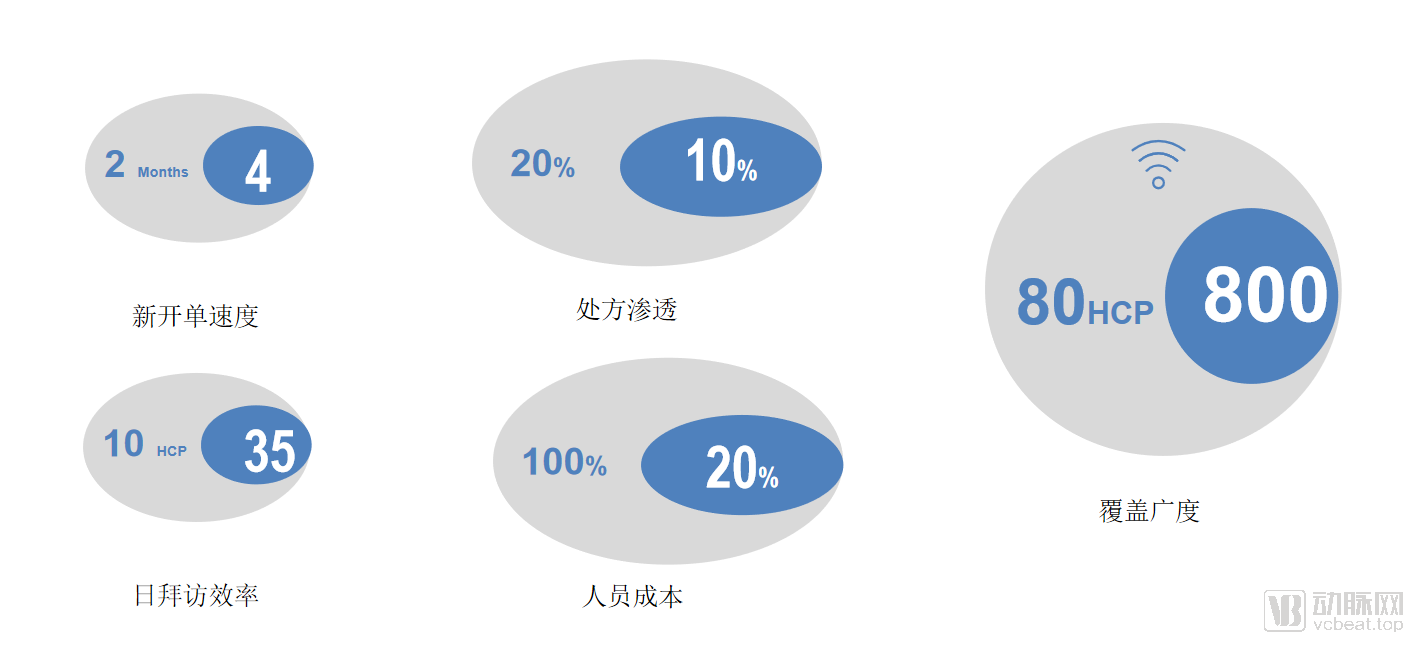
Offline representatives follow the key account model.The coverage radius of offline medical representatives is limited; typically, one representative can cover around 80 physicians, including a mix of key prescribers and general prescribers. Consequently, offline representatives place strong emphasis on per-physician prescription volume, aiming to maximize the number of their own products prescribed by each physician, which necessitates substantial promotional expenditures.
Yan Guowei willVirtual Representatives Are Referred to as the Fan Economy Model. Virtual representatives provide lightweight services to physicians online, resulting in low penetration rates; however, due to their extensive coverage, even if each physician writes only a small number of prescriptions,The overall sales volume of fan physicians represented by a single virtual representative (VR) outperforms that of a single offline representative.
Yan Guowei proposed a hypothesis: “If offline representatives cover 80 physicians, comprising 20% key prescribers, 60% general prescribers, and 20% non-prescribers, and we calculate based on a specific patient volume, the monthly prescription volume would be 1,184. By adopting virtual representatives for promotion, coverage can extend to 800 physicians, including 50% general prescribers and 50% non-prescribers, achieving a monthly prescription volume of 1,600.”
Furthermore, there are significant differences between field representatives and virtual representatives in multiple aspects, including the speed of new prescription generation, prescription penetration rate, daily sales per visit, and personnel costs.
Therefore, given limited future promotional budgets and increasingly stringent compliance requirements, digital marketing will play a pivotal role in enabling broader physician coverage and extending reach into the vast primary care market. This is the only path toward the long-term, sustainable development of pharmaceutical marketing.
The closed-loop digital marketing system for pharmaceuticals includesData, Models, and Execution. By leveraging online and offline behavioral data of physicians collected from the broad market, along with Qingyun Technology’s research on physicians, logical frameworks and algorithms are developed to generate personalized physician visitation plans.
Leveraging AI and big data, Qingyun Technology has built an intelligent digital marketing system. Taking the scheduling of physician visits as an example, the system analyzes historical call times, past answer rates, and physicians’ outpatient schedules to determine the optimal timing and frequency for telephone communications. For first-time contacts with physicians about whom no prior information is available, the system intelligently recommends optimal times for remote visits by referencing data from physicians in the same city, specialty, and age group.
It is worth noting that pharmaceutical companies had previously established numerous independent systems to support offline visits, including conference management systems, online physician behavior platforms, and WeChat official account platforms. However, these platforms operated as silos, resulting in fragmented data. Qingyun Technology’s intelligent digital marketing system consolidates all data onto a single platform, thereby enabling a comprehensive understanding of physicians and delivering data-driven academic services.
Currently, Qingyun Technology has served over 30 clients and provided digital marketing services for more than 50 brand projects, with 90% of its clients being foreign enterprises.Whether for newly reimbursed products under the National Reimbursement Drug List (NRDL), drugs subject to volume-based procurement (VBP), or newly launched products, intelligent digital marketing systems have delivered significant sales growth.
Many people are puzzled about what role AI engines can actually play in digital marketing. Yan Guowei explained, “AI engines are a very important function in digital marketing.”The AI engine can create physician profiles, generate tags based on physician behavior, understand communication preferences through these tags, and provide intelligent recommendations for optimal outreach channels, timing, content, and frequency., thereby enabling sales representatives to engage in targeted interactions and communications with physicians, achieving intelligent outreach."Currently, Qingyun Technology has provided AI engines to multiple clients."
Finally, Yan Guowei summarized: “It is evident that the digital evolution of pharmaceutical companies is complex and diverse, facing significant resistance. Meanwhile, the initiators of digital transformation vary across pharmaceutical enterprises, each with distinct objectives. Nevertheless, it must be clearly recognized that we are undergoing a transformative shift, leveraging new technologies to reach a broader base of physicians and provide them with diverse, precise, and personalized online services. This is undoubtedly the essential path toward compliant, sustainable, and long-term development in the pharmaceutical industry.”
At the conference, VCBeat conducted an exclusive interview with Yan Guowei, founder of Qingyun Technology.
VCBeat:How do you think virtual representatives and field representatives should collaborate to achieve better marketing results?
Yan Guowei:Combining virtual representatives with field representatives is currently the optimal promotional strategy. The key challenge lies in determining how to effectively integrate these two approaches. Digital marketing comprises three core elements: data, models, and execution, with the execution phase encompassing both online and offline activities. Regarding the integration of online and offline channels, several factors must be considered. First, physician preferences play a crucial role; some physicians are comfortable with telephone communication, while others prefer face-to-face interactions. Second, the nature of the content being communicated is vital, as certain topics are less effective when discussed over the phone and require in-person explanation. Finally, the frequency of communication is also a relevant factor. In summary, the choice between using virtual representatives, field representatives, or a hybrid approach depends on the target physicians’ preferred communication channels and their preferences regarding the type of content delivered.
Furthermore, the greatest challenge in integrating online and offline operations lies in data exchange. How can offline representatives be informed of online activities? Conversely, how can online representatives be apprised of offline developments? While online interactions are relatively straightforward to track—with records maintained for communications via phone calls or WeChat—the content of face-to-face discussions between offline representatives and physicians is extremely difficult to document. Consequently, establishing an effective feedback loop from offline to online channels remains a significant unresolved issue.
VCBeat:Is there high acceptance of digital marketing among primary care physicians?
Yan Guowei:Previously, the high cost of reaching primary care hospitals made them a blind spot in pharmaceutical companies’ offline marketing efforts. As national medical resources have been decentralized and investment in primary care institutions has increased, a large number of patients have flocked to these facilities. Primary care physicians are increasingly prioritizing the enhancement of their professional capabilities, resulting in substantial demand for academic information. Qingyun Technology enables primary care physicians to access such information conveniently and efficiently, earning widespread recognition among them. Currently, Qingyun Technology has established close connections with primary care physicians and accumulated behavioral data from 330,000 of them, thereby helping pharmaceutical companies achieve efficient coverage of this physician segment.
VCBeat:What is the stance of national regulators toward digital marketing in the pharmaceutical industry?
Yan Guowei:Digital marketing in the pharmaceutical industry ensures compliance and is highly recognized by regulatory authorities. This model offers a high degree of transparency, addressing two key challenges in national regulation: it eliminates sales practices involving kickbacks and enables traceability of activities. Nevertheless, continuous attention must be paid to safeguarding data security and physicians’ privacy. Qingyun Technology has made substantial efforts in data security and has obtained Level 3 Certification for Classified Protection of Cybersecurity.
VCBeat:In your view, does volume-based procurement represent a significant boon for the pharmaceutical digital marketing industry? Which types of enterprises have a greater need for precision digital marketing?
Yan Guowei:Overall, this is a positive development. However, the demand for digital marketing varies among enterprises. Some companies already have substantial brand awareness and do not require precise digital marketing; media placement alone suffices. Similarly, enterprises with single products that have won bidding tend to hold high market shares, resulting in limited demand for digital marketing. In contrast, companies with insufficient brand awareness need to leverage digital marketing to provide one-on-one education and personalized services, thereby rapidly enhancing their visibility.
VCBeat:As the digital pharmaceutical marketing sector gains momentum, a large number of companies have entered the market, resulting in a highly diverse landscape of enterprise types. How do you view this phenomenon?
Yan Guowei:Many companies are currently in a state of uncertainty, with some believing that any activity related to the internet can be termed “digital marketing.” In reality, digital marketing is characterized by data-driven decision-making, which stands in stark contrast to traditional marketing’s reliance on experience-based decisions. This is the defining feature of digital marketing.
VCBeat:How would you summarize the methodology of digital marketing in the pharmaceutical industry?
Yan Guowei:Digital marketing in the pharmaceutical industry boils down to three core elements: data, models, and execution. When you have abundant data, powerful algorithms, and rich models, your team’s professional capabilities will be significantly enhanced. This enables the delivery of a large volume of high-quality medicines to patients, improves treatment outcomes, drives pharmaceutical sales for enterprises, enhances physicians’ academic expertise, and ultimately benefits patients across China.