

GAIA Agora: Pioneering Global Digital Therapeutics Innovation with Over 20 Market-Approved Products

Gaia Agora
Digital Therapeutics Developer
In January this year, a research project named Nervermind was featured in the EU’s official “Success Story Yearbook 2020,” as one of nine EU-funded projects related to digital technologies.
This project, conducted in collaboration between GAIA Agora and the Karolinska Institutet in Europe, focuses on researching digital therapeutics that integrate digital health applications with smart sensor technology to detect and treat depression. The study is based on GAIA Agora’s digital therapeutic for depression, Deprexis, and a smart shirt.
Although global digital therapeutics are still in their early stages of development, they have already begun to gain prominence. GAIA Agora embarked on its exploratory journey even earlier. This article introduces GAIA Agora (hereinafter referred to as “GAIA”), an early entrant in the digital therapeutics sector.
Why Is GAIA a Pioneer in Digital Therapeutics?
GAIA is a research-oriented public health company founded in Hamburg, Germany, in 1997, and is a pioneer in the global digital therapeutics field.There are three reasons why it is called a pioneer.
First, Gaia Agora entered the digital therapeutics market early.Since its inception, it has focused on information systems for nursing management and innovation in the medical field. It boasts over 12 years of R&D experience in digital therapeutics.
Second, GAIA offers a rich portfolio of digital therapeutics products.According to official website data, it has more than 20 products with CE and FDA certifications, covering fields such as immunology, oncology, and central nervous system (CNS).
Third, the efficacy of GAIA digital therapeutics is outstanding.First, its digital therapeutics have been proven effective in multiple randomized controlled trials (RCTs). Statistics show that more than 7,000 patients have participated in these RCTs. Second, it performs exceptionally well in narrowing healthcare disparities and reducing medical costs. Gaia Agora’s digital therapeutics leverage the convenience of the internet to provide patients with timely interventions at home, thereby reducing the frequency of hospital and clinic visits and generating substantial savings in medical expenses.
Technological “Pillar”: Broca®, an AI-Based Software Technology Platform
Broca is GAIA’s AI technology platform, empowering more than 70 products under the GAIA umbrella.
The platform offers one-on-one coaching, training, and therapeutic courses required for GAIA’s various digital therapeutics. In these courses, AI virtual experts engage users in personalized, continuous, and intensive interactive exchanges, thereby facilitating rapid learning, in-depth mastery of relevant skills, and transformation of thought processes, ultimately helping users achieve their therapeutic goals step by step.
Specifically, the platform collects and captures extensive patient data for analysis and evaluation based on the “quantified-self” approach. These data parameters are then automatically integrated into the product via AI, thereby enabling more targeted and customized interventions and treatment plans for patients.
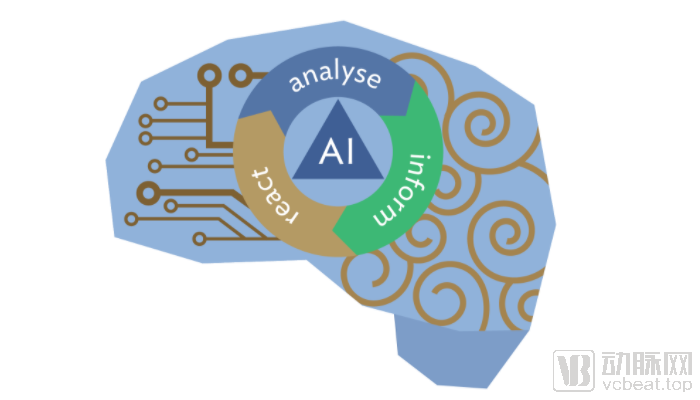
Source: Gaia Agora Official Website
Currently, Broca has been updated to version 4.0 and is compatible with the vast majority of network devices, including virtual reality (VR) applications.
Product “Xiutai”: Large quantity, with a wide distribution across research fields
1. Deprexis®, the most extensively studied digital therapeutic for depression
Deprexis is one of the most extensively studied products by GAIA, a digital therapeutic designed to treat mild to severe depression. ItBased on cognitive behavioral therapy, it provides personalized, fully automated, AI-driven digital therapeutics for users, with the following features and advantages:
First, it is easy to integrate.Deprexis’s fully automated AI technology enables seamless integration into patients’ existing care plans; it is also accessible via internet-enabled devices, allowing patients to engage in self-management anytime and anywhere.
Second, the treatment is trustworthy.Deprexis has received FDA and CE certification and has been proven effective in 14 randomized controlled trials (RCTs). Its efficacy is comparable to other evidence-based treatments for depression, offering patients a safe and effective therapeutic option.
Third, effectively reduce medical costs.Studies have shown that adding Deprexis to existing treatment regimens can reduce patients’ total medical costs by an average of 34%. This is because Deprexis does not require additional physician supervision; instead, it provides personalized modules to patients during use, helping them gradually modify their lifestyles and achieve therapeutic goals.
Currently, Deprexis is available in nine languages, including English, German, Spanish, Greek, French, Italian, Portuguese, and Swedish. In 2016, GAIA licensed Deprexis to the global pharmaceutical company Servier to promote its clinical application internationally. In May 2020, GAIA entered into a partnership with Orexo, granting Orexo exclusive patent rights for Deprexis in the United States.
2. Other Digital Therapeutics Products
GAIA’s research scope encompasses the central nervous system, immunology, oncology, and other fields. Its product development pipeline covers a series of digital therapeutics, as briefly summarized in the table below (partial):
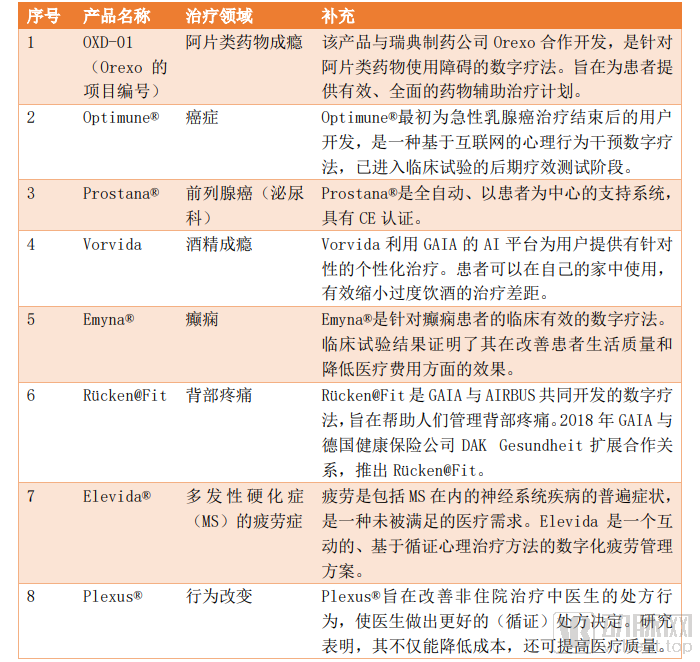
Source: Compiled from information on the official GAIA website
In addition to the products listed in the table above, there are other products such as Priovi® for borderline personality disorder, Velibra® for anxiety disorders, and Covivio® for adherence support, most of which are currently in Phase II and Phase III clinical trials.
3. Four Key Collaborative Projects
GAIA’s mission is to provide physicians, payers, and patients with safe and convenient digital therapeutic solutions—leveraging advanced software and technologies to transform diagnostic and treatment protocols, thereby improving patient outcomes and quality of life.Currently, there are four key projects under continuous development or testing, all characterized by collaborations between world-leading scientists and internal experts at GAIA.
Nevermind
The Nevermind project, supported by the European Commission under the Horizon 2020 programme for GAIA, was completed through collaboration between GAIA and universities and research centers in Pisa, Turin, Madrid, Lisbon, Stockholm, and Essex. The project leverages physiological data collected via sensor technology and AI algorithms to estimate the risk of depression in patients with certain conditions, such as cardiovascular disease and kidney failure, and provides appropriate interventions to encourage these patients to adopt healthier lifestyles.
Evident
This is a multicenter randomized controlled trial (RCT) investigating the standard of care for Deprexis, sponsored by the German Ministry of Health. Universities and medical centers in Hamburg, Lübeck, Berlin (Charité), Trier, Bielefeld, Tübingen, Bern (Switzerland), and other locations assisted GAIA in conducting the study. With over 1,000 adult participants exhibiting depressive symptoms, this trial is the largest of its kind. Follow-up studies to determine the optimal implementation strategies for Deprexis are currently underway.
Overcoming anxiety
GAIA has developed Velibra for three major anxiety disorders: panic disorder, generalized anxiety disorder, and social phobia. The English version of Velibra is currently being finalized, and studies will soon be launched in the United States, the United Kingdom, and other English-speaking regions. Collaborators on this project include the University of Texas, Palo Alto University in Virginia, Sheffield Hallam University, and City, University of London.
MS Interventions
GAIA has developed Elevida and MS-deprexis to specifically target fatigue and depressive symptoms in multiple sclerosis. Currently, MS-deprexis is being investigated in a large international, multicenter randomized controlled trial (RCT) sponsored by the National Multiple Sclerosis Society. This study is being conducted in collaboration with GAIA by university medical centers in Hamburg and Berlin, King’s College, as well as universities and medical centers in the United States.
Not a One-Person Battle: GAIA Succeeds Through Collaboration
As with the four initiatives mentioned above, GAIA’s outstanding achievements in the digital therapeutics sector are inseparable from its extensive collaboration network. This includes support from universities and research institutions during the early R&D phase, as well as backing from major global commercial companies and healthcare organizations during the product commercialization phase.
First, in the research and development of digital therapeutics, GAIA has established close collaborations with leading universities and researchers worldwide., partner details are as follows in the table.
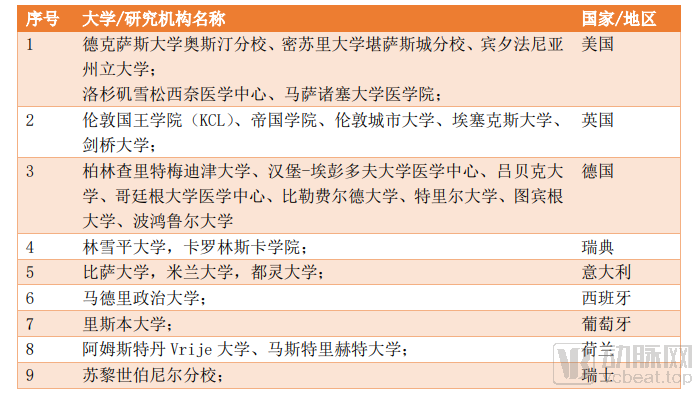
Source: GAIA Official Website
Secondly, in terms of product promotion and business collaboration, GAIA jointly develops and implements digital therapeutic projects with partners such as pharmaceutical companies and medical institutions.Including AbbVie, Airbus, AOK, B. Braun, DAK, Ferring, J&J, Eli Lilly, Lundbeck, Merz, Orexo, Pfizer, and Servier.
Notably, GAIA partnered with the Swedish publicly listed pharmaceutical company Orexo in August 2019 to jointly develop a digital therapeutic for opioid use disorder (OUD). Shortly thereafter, the two parties expanded their collaboration, with GAIA granting Orexo exclusive U.S. distribution rights for Vorvida, a digital therapeutic for alcohol use disorder (AUD), and exclusive U.S. patent rights for Deprexis, a digital therapeutic for depression.
GAIA and its partners have achieved a win-win outcome through their collaboration.In addition to extensive external collaborations, GAIA’s success is even more dependent on internal team collaboration.Its multidisciplinary team of experts comprises experienced physicians, psychotherapists, clinical scientists, IT and software engineers, regulatory affairs specialists, and market access experts, integrating all the capabilities required for the market development, launch, and maintenance of top-tier products.