

NeuroStora Medical's Chairman Ning Yihua: Solving Brain Disorder Therapies Through Independent Innovation

SceneRay
Innovative High-Tech Medical Device R&D and Manufacturer
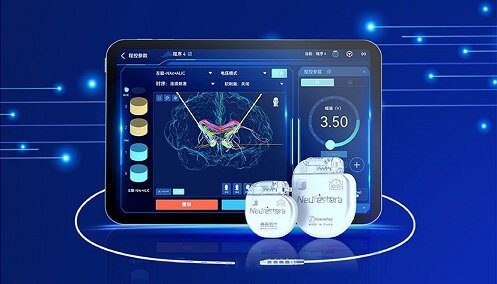
Sceneray's NeurestoraTM Invasive Brain-Computer Interface System (Company Photo)
Focus on Unmet Needs
Sceneray, founded in Suzhou in 2011, is one of the few companies globally capable of developing and providing brain-computer interface DBS products. Relying on core technologies such as neuromodulation chips, invasive brain-computer interfaces, and dual-target combined stimulation, the company has built a product pipeline covering multiple indications including Parkinson's disease, drug addiction, and obsessive-compulsive disorder. Among these, Neurestora, the world’s first invasive brain-computer interface system approved for treating opioid addiction, has achieved breakthrough certifications from both China’s NMPA and the U.S. FDA, filling the technical gap in physical intervention for drug addiction. The core of this achievement is the "deep brain dual-target electrical stimulation therapy theory" proposed and validated by Yi Hua Ning.
Two heavyweight products of the company have achieved clinical implementation: The Aaxon series brain pacemaker was approved for marketing in 2016, and the 8-contact product launched the DBS 2.0 era in August 2024. It currently covers more than 300 diagnosis and treatment centers across China, and relevant indications have been included in the medical insurance directories of many regions; The Neurestora system was approved in December 2025, and complete clinical trials have been carried out in many tertiary hospitals across China.
"Drug addiction is not a moral defect but a chronic brain disease, which is the fundamental starting point of our research and development," said Ning Yihua. Traditional treatments have long been plagued by high relapse rates, while dual-target technology can break the vicious cycle at its root—one target quickly alleviates the physiological discomfort of withdrawal, and the other gradually weakens addictive memories, allowing patients to no longer experience uncontrollable impulses when faced with related scenarios. This ability to precisely meet clinical needs stems from his unique interdisciplinary educational background: six years of undergraduate study, during which he pursued engineering and medical foundational disciplines at both Shanghai Jiao Tong University and Shanghai Medical University, forming a comprehensive and systematic understanding of medicine. In graduate school, he focused on biophysics and neurophysiology, during which he was exposed to acupuncture anesthesia research. In the 1960s and 1970s, Academician Han Jisheng discovered that stimulating acupuncture points could produce endorphins for pain relief. Ning Yihua’s graduate research centered on the mechanisms of acupuncture anesthesia, through which he deeply recognized the potential of neuromodulation technology. This allowed him to bridge the gap between engineering and medicine, transforming clinical pain points into technological solutions.
Global Layout with Dual Efforts
Ning Yihua stated that the full industrial chain's self-controllability is Sceneray's core confidence in participating in global competition. The company’s global strategy adheres to the dual approach of "technology export + clinical collaboration," strengthening its technical barriers while actively engaging in the formulation of global medical standards.
As the first company in China to own an independent brain-computer interface DBS neuromodulation chip, Sceneray has achieved independent iteration of its chips: from the Parkinson's disease modulation chip ASICs 1.0, to the combined stimulation chip ASICs 2.0, to the dual-target stimulation chip ASICs 3.0. Currently, the brain-computer interface AI feedback chip ASICs 4.0 is under development. Building on this foundation, the company has created core technological innovations such as dual-frequency stimulation chips, 8-contact electrodes, dual-target electrode locking, the world’s first remote programming control, and globally leading visualized programming control. It has cumulatively applied for over 600 patents, including more than 100 international patents, obtained 38 product registration certificates, and built a GMP production line with an annual capacity of 5,000 sets. From chip design to complete device assembly, all processes are independently controlled. Its remote programming service has been updated to the fourth generation, and the "Brain-Guiding Star" visualized programming system can "reveal" electrode positions, significantly improving diagnostic and treatment efficiency.
In terms of clinical and international expansion, Sceneray is advancing several international multi-center clinical trials, with related products already sold in many countries and regions worldwide. The "Gemini System," scheduled for release in 2025, adopts a 16-channel IPG + dual octupole contact electrode, enabling multi-neural circuit combined modulation. Clinical trials targeting treatment-resistant obsessive-compulsive disorder and other psychiatric conditions are proceeding in an orderly manner.
Build a Sustainable Development Model
Sceneray's commercialization process is accelerating, with the "product sales profit reinvested in R&D" sustainable development model becoming the core path for the company’s transformation into a full-industry-chain biomedical enterprise. Currently, indications related to the Aaxon series of brain pacemakers have been included in the medical insurance directories of multiple regions in China. Leveraging a service network covering 28 provinces, municipalities, and autonomous regions across China, as well as over 300 diagnostic and treatment centers, the company collaborates with clinical neurology experts to promote academic activities, continuously increasing market penetration. The Neurestora system is actively advancing in national medical insurance negotiations, striving to expand the beneficiary population as soon as possible.
For commercialization layout, Ning Yihua formulated the strategy of "short-term collaborative expansion and long-term independent deep cultivation." Relying on the clinical synergy of two core products, a self-owned commercialization team has been established. Currently, the team size has steadily expanded, with plans to further optimize personnel allocation to achieve full coverage of core medical institutions in major provinces and cities in China. At the same time, cooperation with leading domestic distribution enterprises has been reached to ensure rapid product deployment. The company has also built a comprehensive service model of "device treatment + psychological intervention + long-term follow-up," collaborating with top-tier hospitals to establish a ten-year long-term follow-up database. This provides postoperative maintenance for patients while accumulating core clinical data to feed back into research and development, forming a virtuous closed loop of "clinical-research-commercial."
"Sceneray's innovation has not only commercial value but also profound social value," said Ning Yihua. Solving the problem of drug addiction can help patients get rid of the disease, return to society, reduce the burden on families, and create value for society. This is also an important original intention for enterprises to deeply cultivate in this field. When talking about the development plan for the whole year, he clearly stated three core goals: promoting the inclusion of the Neurestora system in the national medical insurance catalog, accelerating the advancement of international multicenter clinical trials, and expanding the clinical indications range of the 'Gemini System.'
In Ning Yihua's vision, Sceneray will continue to build a sustainable development pattern through independent innovation, making neuroregulation technology a beacon of hope for patients with brain function disorders worldwide.