

How Huoshu Technology's DRG Practice in Zhejiang Won the Trust of Zhejiang University's Top Hospitals
On April 23, 2021, the 2021 China Hospital Information Network Conference (hereinafter referred to as CHINC) opened in Hangzhou, Zhejiang Province. As an annual event, CHINC has long been a premier academic gathering for healthcare information technology (HIT), as well as an innovative showcase for evaluating the implementation outcomes and promotional applications of HIT solutions. Notably, this marks the second time in the past four years that CHINC has been held in Hangzhou, indirectly reflecting Zhejiang’s leading position in China’s healthcare informatization industry. Zhejiang ranks among the top nationwide in both the quantity and quality of healthcare informatization enterprises. Meanwhile, a growing number of high-potential companies are continuously joining this sector, further strengthening Zhejiang’s healthcare informatization cluster.
From ancient times to the present, Zhejiang has long been recognized as a prosperous region in China, with reform, opening-up, and innovation deeply ingrained in its DNA. Promoting grassroots entrepreneurship and innovation is one of the key methodological pillars of the “Zhejiang Model.” Amidst each wave of reform, the “Zhejiang Model” crafted by Zhejiang has consistently come to the fore.
Zhejiang has also dared to be a pioneer in healthcare reform. In November 2019, Zhejiang Province issued the Interim Measures for DRG Point-Based Payment of Inpatient Expenses under Basic Medical Insurance in Zhejiang Province, stipulating that starting from January 1, 2020, inpatient medical services provided by designated medical institutions under the province’s basic medical insurance scheme would uniformly implement Diagnosis-Related Groups (DRGs) combined with point-based payment under global budget management. Currently, Zhejiang has taken the lead in entering the phase of actual province-wide payment implementation. Thus, amidst the wave of DRG payment reform, Zhejiang has become a well-deserved trailblazer.
Why Has Zhejiang Province Taken the Lead in Healthcare Insurance Payment Reform? On one hand, policy support has played a key role. As early as 2016, Zhejiang Province pioneered pilot programs for Diagnosis-Related Group (DRG)-based payment nationwide, providing valuable experience for the subsequent national DRG payment scheme. On the other hand, hospitals in Zhejiang Province lead the country in management awareness and health information technology capabilities. Represented by The First Affiliated Hospital and The Second Affiliated Hospital of Zhejiang University School of Medicine, the “Zhejiang University-affiliated” hospital group ranks among the top nationwide in the application of informatization and intelligent technologies.
Taking the First Affiliated Hospital of Zhejiang University School of Medicine as an example, the hospital established a clear team objective of “quality-centric lean management” during its exploration of Diagnosis-Related Groups (DRG). By advancing DRG implementation through measures such as strengthening infrastructure, enhancing internal capabilities, emphasizing coordination, and ensuring effective execution, the hospital significantly improved its medical care quality. Key initiatives included establishing standardized diagnosis and surgical procedure databases, implementing terminal quality control for medical record front sheets, and promoting the comprehensive competency development of specialty coders.
In the recently released national monitoring and assessment results for the performance evaluation of tertiary public hospitals across China, comprehensive Western medicine hospitals ranking in the top 1% of participating institutions were classified as A++. The First Affiliated Hospital, Zhejiang University School of Medicine (FAHZU) achieved an A++ rating, securing the sixth position nationwide and the first position province-wide based on national monitoring indicators, thereby placing it among the “first tier” of the national team.
As a leading hospital in the province, The Second Affiliated Hospital of Zhejiang University School of Medicine (SAHZU) launched an internal “Efficiency Healthcare” reform to adapt to DRG payment reforms. By promoting integrated coordination across pre-hospital, in-hospital, and post-hospital stages, and by implementing Huoshu’s MDT-style system solution to support the transformation, the hospital has achieved remarkable results.
In the recently released national monitoring and assessment results of the performance evaluation for tertiary public hospitals across China,The Second Affiliated Hospital of Zhejiang University School of Medicine ranks seventh nationwide among 2,413 tertiary public hospitals in China, retaining its A++ rating reserved for the top 1% of hospitals nationwide, and becoming the only hospital in Zhejiang Province to rank among the top ten nationally for two consecutive years.
Zhejiang Taizhou Enze Medical Center (Group) (hereinafter referred to as “Taizhou Enze Medical Center”) is a leading hospital among prefecture-level hospitals in China and a pioneer in lean hospital management domestically. It was an early adopter of Huoshu’s MDT-style system solution to implement DRG-based lean management. This has enabled Taizhou Enze Medical Center to deliver medical services on par with other top-tier hospitals in Zhejiang Province. In the DRG performance evaluation for Grade A tertiary hospitals in Zhejiang Province, the Case Mix Index (CMI) of Taizhou Hospital, under Taizhou Enze Medical Center, ranks among the highest, matching the performance of other leading hospitals in the province.
Particularly in the management of clinical pathways, the DRG information system has provided substantial benefits to Taizhou Enze Medical Center. By integrating staged cost control based on DRG grouping and cost structure analysis, effective cost containment within clinical pathways can be achieved. Clinical pathway analysis enables the evaluation of pathway implementation and its impact on DRG-related costs. Furthermore, clinical pathway optimization assesses whether pathways adhere to DRG cost-containment principles and refines them by incorporating insights from DRG performance metrics and key cost drivers.
It is worth noting that the hospitals achieving outstanding results in DRG exploration have all adopted Huoshu Technology’s DRG solutions. In fact, Huoshu Technology holds a 95% market share among hospitals in Zhejiang Province for DRG systems, making it the undisputed leader. As a startup founded in 2016, how it has gained consistent recognition from hospitals in such a critical field naturally arouses curiosity.
Focus is one of Huoshu’s key strengths. Since committing to enter the DRG sector, Hangzhou Huoshu Technology Co., Ltd. has concentrated on deepening its hospital-side DRG solutions, avoiding distraction even during periods of uncertainty. To shield itself from external pressures and influences while implementing a long-term strategic plan, Huoshu has chosen not to raise external financing, despite attracting significant attention from the capital markets. This focused, long-term strategy is now yielding substantial results.
Leveraging the founders’ technical expertise, Hangzhou Huoshu Technology Co., Ltd. places significant emphasis on R&D, allocating substantial resources to it. The company’s staffing structure and R&D intensity differ fundamentally from those of its peers, with R&D expenditure accounting for 70% of its total investment, thereby ensuring the achievement of its “deploy one generation, develop one generation, and pre-research one generation” strategy. Furthermore, by focusing exclusively on the hospital-side DRG niche, Huoshu Technology maintains a rapid pace of technological iteration and leads the industry with innovative solutions, including the pioneering introduction of an MDT (Multidisciplinary Team) system solution. Currently, Huoshu’s hospital-side DRG/DIP solution has been upgraded to version 2.0.
Data-driven approaches and algorithms constitute another major advantage of Huoshu Technology. Prior to entering the DRG sector, Huoshu primarily focused on hospital BI data governance, accumulating practical experience and in-depth understanding in hospital data governance and mining, as well as in AI algorithms based on data. Even after transitioning into the DRG industry, Huoshu has retained its core competency in data governance, with its R&D team composed almost entirely of data analysts and algorithm engineers. As a result, when providing solutions to hospitals, Huoshu Technology goes beyond merely delivering proposals; it helps hospitals build data centers and leverages data to drive hospital management.
The importance of data has gained higher-level recognition. To understand the impact of DRG implementation on healthcare quality and hospital operations, the Hospital Management Institute of the National Health Commission began preparing for the project “Evaluation of the Impact of DRG-PPS Implementation on Healthcare Quality and Improvement of Hospital Refined Management” in mid-2020. The project aims to systematically monitor the impact of DRG implementation on the quality of care in Chinese hospitals, analyze data to study the effects of DRGs on healthcare quality and hospital management, explore measures for refined hospital management, and provide evidence-based support for policy formulation and adjustment by relevant government departments as well as for the refined operational management of medical institutions. Hangzhou Huoshu Technology Co., Ltd. provided full-process support throughout the project.
Service is another major advantage of Huoshu. Huoshu Technology’s solutions adopt a service-fee model rather than a one-time buyout approach. As DRG is an entirely new field, most hospitals lack in-depth understanding of it. However, this is a critical domain that directly impacts whether hospitals can secure adequate reimbursement. The continuous service model helps hospitals adapt to and comprehend the underlying rules, respond swiftly to policy changes, and gradually establish their own internal systems.
These strengths of Hangzhou Huoshu Technology Co., Ltd. have resonated strongly with Zhejiang Hospital’s emphasis on management and lean operations, carving out a significant niche for the company.
In the field of healthcare informatization, there is a saying: “Win Zhejiang, win China.” This means that gaining recognition in Zhejiang, a leading region for healthcare informatization, ensures a solid foothold nationwide. Currently, Huoshu Technology is adopting a cross-cutting strategy of “depth plus breadth,” further deepening its presence in Zhejiang. In addition to collaborating closely with top-tier hospitals, it is extending its reach to grassroots hospitals.
Nationwide, the company has adopted a “broad-coverage” strategy. As of January 2021, Huoshu Technology had expanded to more than 60 cities across over 20 provinces in China, covering 65% of the DRG/DIP pilot cities. It partnered with more than 150 hospitals, most of which are leading benchmark institutions in their respective regions, leveraging these flagship hospitals to further penetrate local markets.
Compared with well-funded public hospitals, private hospitals have a more urgent need for management and cost control, making their choices perhaps more telling. Currently, many leading private hospitals have partnered with Huoshu, including Foshan Chancheng Central Hospital, which ranks first among private hospitals in China.
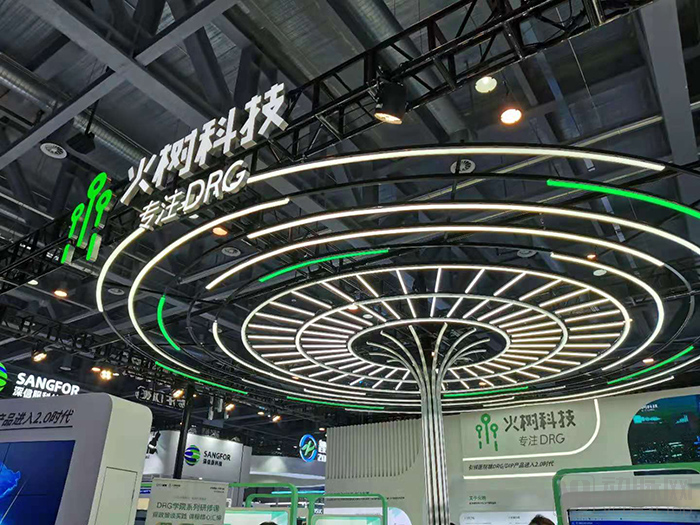
As a strategic partner of the CHINC conference, Huoshu Technology presented a comprehensive suite of solutions and exhibits to attendees. Its exhibition hall, located in Zone D and covering nearly 150 square meters, was one of the largest booths at the event. It opened to attendees with a new look as the DRG/DIP System 2.0 Solutions Exhibition Hall.
Meanwhile, as the exclusive technical support provider for the project, Huoshu Technology will co-host the “Forum on High-Quality Hospital Development in the DRG Era” with the Institute of Hospital Management on the afternoon of April 24. The forum, to be held in Conference Hall 307 at the China National Convention Center, will be attended by representatives from 50 project member units and 500 hospital administrators from across China.
National-level DRG experts, local healthcare security policymakers, presidents of leading hospitals across China, and heads of departments in healthcare security and health informatics convened to share insights on healthcare security policy interpretation and best practices from pioneering hospitals. The gathering aimed to further clarify strategies for refined hospital management under the DRG system, seize strategic opportunities, and achieve high-quality hospital development.
In addition to the dedicated “Zhejiang Model” sub-forum, Hangzhou Huoshu Technology Co., Ltd. arranged two special tour routes to DRG benchmark hospitals on the afternoon of April 25, organizing attending guests to visit The Second Affiliated Hospital of Zhejiang University School of Medicine and Hangzhou First People’s Hospital Affiliated to Zhejiang University School of Medicine for observational learning. Heads and key personnel from the departments of medical insurance, medical records, and information technology at both hospitals will share their expertise with the visiting delegates.