

China's Transcatheter Mitral and Tricuspid Valve Market Set to Reach RMB 100 Billion: Insights from Academician Ge Junbo on Emerging Interventional Therapies and Innovations
Cardiovascular disease is the leading cause of death in China. Within the supply chain for high-value cardiovascular consumables, the segment attracting the most industry attention is heart valves, encompassing transcatheter aortic valve replacement (TAVR) and interventional therapies for mitral and tricuspid valve diseases. In China, more than 20 companies have emerged in the heart valve sector, drawing investment from top-tier firms such as Hillhouse Capital, Sequoia Capital, and OrbiMed.
In 2010, the first TAVR procedure in China was performed by Academician Ge Junbo’s team, officially marking the introduction of this revolutionary medical technology to the country. Academician Ge Junbo is a cardiology specialist and an academician of the Chinese Academy of Sciences. He serves as Chief Physician, Professor, and Doctoral Supervisor at Zhongshan Hospital affiliated with Fudan University, where he also holds the positions of Director of the Department of Cardiology and Director of the Cardiac Catheterization Laboratory. Additionally, he is the Director of the Shanghai Institute of Cardiovascular Diseases. Renowned as a leading authority in the field of interventional cardiology, he has achieved numerous “firsts in China” and “firsts in Shanghai” in the diagnosis and treatment of heart disease.
Amidst the dominance of overseas giants in the heart valve sector, do domestic companies still have opportunities to break through? What are the new concepts in minimally invasive interventional therapy for valvular heart disease? VCBeat (WeChat ID: vcbeat) interviewed Academician Ge Junbo.

At present, the number of percutaneous coronary intervention (PCI) procedures in China has reached the million level, serving as a key pillar of the domestic market for high-value cardiovascular consumables. However, Academician Ge Junbo believes that interventional therapy for coronary heart disease will enter a growth plateau. Drawing on developments in the United States, where the annual volume of PCI procedures declined from 1 million to 800,000, the number of PCI procedures in China is also showing a year-on-year downward trend.
He stated, “As the growth in coronary artery disease surgeries slows, the market for valvular heart disease will become substantial. Against the backdrop of an aging population, the volume of surgical interventions for valvular heart disease is poised to rise rapidly. In 2018, the number of transcatheter aortic valve replacement (TAVR) procedures in the United States already reached 276,000 patients. In China, although the first commercial TAVR implantation was performed only in 2017, more than 6,000 cases have been completed to date. Therefore, I believe that as population aging intensifies, valvular heart disease will undoubtedly become a key focus for cardiologists.”
TAVR Market Has Spawned Industry Leaders; Where Lies the Next “Beat” for the Structural Heart Disease Market?
Academician Ge Junbo’s view aligns with the mainstream market perspective; he believes that the mitral and tricuspid valves will constitute the primary segments of the future structural heart disease market.
“In clinical practice, the patient population with mitral and tricuspid valve diseases is larger than that with aortic valve disease; however, the development of interventional therapies for mitral and tricuspid valves has been relatively lagging.”
According to the China Cardiovascular Disease Report 2019, the number of patients with valvular heart disease in China reached 36.3 million in 2019. Among these patients, those with aortic stenosis, mitral regurgitation, and tricuspid regurgitation accounted for 11.8%, 29.2%, and 25.1%, respectively. Valvular heart disease is becoming increasingly prevalent among the population aged 65 years and older in China.
How Much Growth Potential Lies Ahead for the Mitral and Tricuspid Valve Markets? According to Frost & Sullivan, the global transcatheter mitral valve intervention market is in its early stages and possesses substantial growth potential. By 2030, the market size is projected to reach USD 17.4 billion (RMB 117 billion), ultimately becoming three to four times the size of the transcatheter aortic valve intervention market.
In the field of mitral valve interventions, only seven transcatheter mitral valve repair and replacement products have currently received commercialization approval. Among these, Abbott’s MitraClip™, a transcatheter edge-to-edge repair (TEER) device, is the sole product to have obtained approvals from the U.S. Food and Drug Administration (FDA), China’s National Medical Products Administration (NMPA), and the CE mark. As a global leader, the MitraClip™ has been used in over 100,000 procedures to date.
In the tricuspid valve field, due to the high difficulty in developing effective treatments for tricuspid valve disease and the numerous challenges associated with surgical procedures, only three transcatheter tricuspid valve repair products have been launched in Europe to date, none of which have received approval in the United States or China.
In the global arms race for valve development, more than ten Chinese companies are participating. Major domestic enterprises concurrently developing both mitral and tricuspid valve products include Huihe Medical, MicroPort Medical, and Dejin Medical.
In the “arms race” of heart valve R&D, what is the situation faced by emerging Chinese companies?
Academician Ge Junbo candidly stated, “In the research and development of transcatheter aortic valves, we lag behind international counterparts by more than ten years. In the development of transcatheter interventional mitral valve products, the gap between China and foreign countries is gradually narrowing, but a certain disparity still remains. As for tricuspid valves, domestic and international enterprises are essentially starting from the same baseline.”
In the field of tricuspid valve technology, domestic and international companies are on a level playing field. This means that for Chinese enterprises engaged in tricuspid valve product development, the challenges extend beyond mere localization and engineering; they must also directly address clinical needs to achieve breakthroughs in research and development.
Taking the tricuspid valve as an example, China has a large population of patients with tricuspid regurgitation. A significant proportion of these patients present with symptoms at a late stage, by which time their general health condition is often poor, rendering them ineligible for open-heart surgery. There is therefore an urgent clinical need for products that enable tricuspid valve repair through minimally invasive approaches. However, the irregular geometry of the tricuspid annulus makes product design more challenging than that for aortic valves. Overcoming these barriers requires innovative solutions to facilitate the transition of tricuspid valve repair toward interventional procedures.
In the landscape of the cardiovascular intervention industry, Academician Ge Junbo has consistently been at the forefront of technological innovation, spanning from coronary artery disease to valvular heart disease. As a clinician, he has also participated in the research and development design of multiple interventional devices in China and led the formulation of clinical protocols.
In 2015, he also spearheaded the establishment of the CCI (China Cardiovascular Physicians Innovation Club). Founded with the philosophy of “From the doctors, by the doctors, for the doctors,” the CCI aims to promote innovation in medical devices within China.
As the leading enterprise in transcatheter tricuspid valve intervention and repair in China, Huihe Medical’s Chief Scientist, Academician Ge Junbo’s team, has not only participated in product research and development but also, this month, Academician Ge Junbo personally performed the procedure for the first patient enrolled in the clinical trial of the K-Clip™ Transcatheter Tricuspid Annuloplasty System.
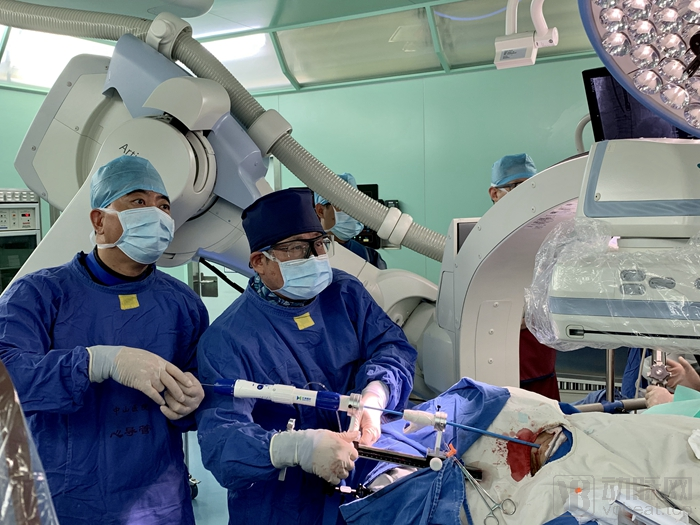
First Patient Enrolled in K-Clip™ Clinical Trial
K-Clip™ offers a new option for a broad population of patients with tricuspid regurgitation. Academician Ge Junbo has highly praised the design of K-Clip™.
Academician Ge Junbo commented, “The etiology of tricuspid regurgitation is highly complex, and product development poses significant challenges. Most cases are caused by right heart failure, with clinical presentations including hepatomegaly, ascites, peripheral edema, and poor overall condition.”K-Clip™ brings surgical open-chest tricuspid valve repair into the realm of interventional procedures by enabling precise positioning of the clip on the tricuspid annulus, thereby reducing annular area and improving tricuspid regurgitation through annuloplasty.”
Huihe Medical is the developer of K-Clip™. According to Academician Ge Junbo, Huihe Medical started from a high baseline and has consistently adhered to original innovation through in-depth collaboration with clinical experts. In the field of mitral and tricuspid valves, Huihe Medical has introduced numerous innovative concepts and provided a series of transcatheter products, including tricuspid annuloplasty repair, mitral annuloplasty repair, and mitral leaflet repair.
Academician Ge Junbo proposed: singlePure mitral valve leaflet clipping fails to provide patients with optimal benefit; instead, systematic mitral valve repair—more closely resembling surgical repair techniques, involving concomitant leaflet and annular repair—should be performed.
What Is the Breakthrough in Simultaneous Repair of the Mitral Valve Leaflets and Annulus?
In an interview, Academician Ge Junbo vividly likened the relationship between the valve annulus and leaflets to that of a door frame and door panels. Abbott’s MitraClip™ reduces mitral regurgitation by clipping the leaflets together but does not address the condition of the annulus. This is akin to repairing only the door panels without properly securing the door frame. During the heart valves’ continuous day-and-night operation, a loose “door frame” in certain patient populations can lead to inadequate valve closure.
Academician Ge Junbo still recalls the first trans-catheter “edge-to-edge” mitral valve repair (TMVR) using the MitraClip™ system performed in China, which he carried out in May 2012.
After the surgery, the patient told him, “For the first time in ten years, I feel so comfortable. For the past decade, I have been sleeping while sitting up, never daring to lie down.” At that time, the patient’s systolic blood pressure was below 80 mmHg, but it immediately rose to 110 mmHg after the surgery. However, the patient suffered from dilated cardiomyopathy. Since the underlying cardiac condition was not addressed and only the valve leaflets were repaired, regurgitation recurred adjacent to the repair site two years later. Due to the unavailability of devices capable of repairing the mitral annulus at that time, we could only watch helplessly as the patient progressed toward heart failure.
“Therefore, I believe that for patients with mitral regurgitation, concomitant repair of the leaflets and the valve may be more suitable for those with a prolonged disease course, as it more closely approximates the outcomes of surgical intervention; such patients are frequently encountered in clinical practice.”
Most companies worldwide developing minimally invasive interventional products for the mitral and tricuspid valves treat them as separate entities and develop products accordingly. While Huihe Medical also develops independent products for the mitral and tricuspid valves, it additionally views them as an integrated system, proposing the concept of combined mitral-tricuspid valve repair. The company has developed a “single-sheath, dual-valve” product that enables simultaneous repair of both the mitral and tricuspid valves via a single femoral venous access.
By opting for the highly challenging “single-sheath, dual-valve” design, Huihe Medical primarily aims to address clinical needs by striving to achieve tricuspid and mitral valve repair outcomes comparable to those of surgical interventions through a single transcatheter interventional procedure.
Academician Ge Junbo presented his perspective on Huihe Medical’s concept of combined interventional repair of the mitral and tricuspid valves, termed “Single Sheath, Dual Valves”:
Academician Ge Junbo stated, “In patients with mitral valve insufficiency, pulmonary congestion caused by regurgitation often leads to tricuspid regurgitation. The product developed by Huihe Medical enables concurrent interventional treatment of both the mitral and tricuspid valves, offering a new solution for patients.”
At this juncture, Huihe Medical showcased China’s original innovation capabilities on the global stage of structural heart disease interventions.
Overall, the global markets for mitral and tricuspid valves are nascent, with development still in its early stages. Compared to aortic valves, diseases involving the mitral and tricuspid valves are more complex, making the research and development of minimally invasive interventional devices more challenging. Meanwhile, the mitral and tricuspid valve sectors are highly competitive niche markets, where Chinese companies face competition from major global medical device manufacturers specializing in heart valve diseases. Several multinational corporations and domestic companies have heart valve disease medical devices nearing commercialization. Startups and other early-stage companies are also significant players.
However, much remains to be done before the market truly achieves significant volume growth.
Academician Ge Junbo also pointed out: “A successful product requires more than just innovation. To transform a medical device from an idea into a product endorsed by physicians, five key elements are essential: first, the R&D team must possess a profound understanding of medicine and clinical practice; second, engineers must be involved to translate physicians’ needs into technical solutions; third, support from investors is indispensable; fourth, policy support is needed to encourage innovation; and fifth, market expertise is crucial, as most scientists lack marketing capabilities.”
Historically, China lagged significantly behind international markets in both the application and manufacturing of innovative medical devices. Today, however, Chinese enterprises are emerging as key drivers of innovation, fueled by robust collaboration between outstanding engineers and clinicians. It is believed that Chinese innovators will secure a significant foothold in the vast global heart valve market.