

Qyuanyuan Tang's New Retail Partner Dai Mingwei: O2O as the Main Battlefield of Pharmaceutical Retail—Strategies to Attract and Retain Consumers
Tracing back its history, Quanyuantang Traditional Chinese Medicine Clinic was founded in 1902 by Li Xichen, a renowned physician from Pujiang, Chengdu, with the mission of practicing medicine and saving lives. After more than a century of development, Quanyuantang has successfully created a new business model for its Smart Pharmacies—characterized by “small storefronts, extensive product categories, high-frequency transactions, and quality service”—by integrating innovative online-to-offline (O2O) new retail technologies, thereby establishing a closed-loop pharmaceutical distribution system. As of December 2020, Quanyuantang operated nearly 300 Smart Pharmacies across seven cities in China.
As a benchmark for China’s new retail pharmaceutical industry, what experiences can Chengdu Quanyuantang Pharmacy Chain Joint Stock Co.,Ltd. share?
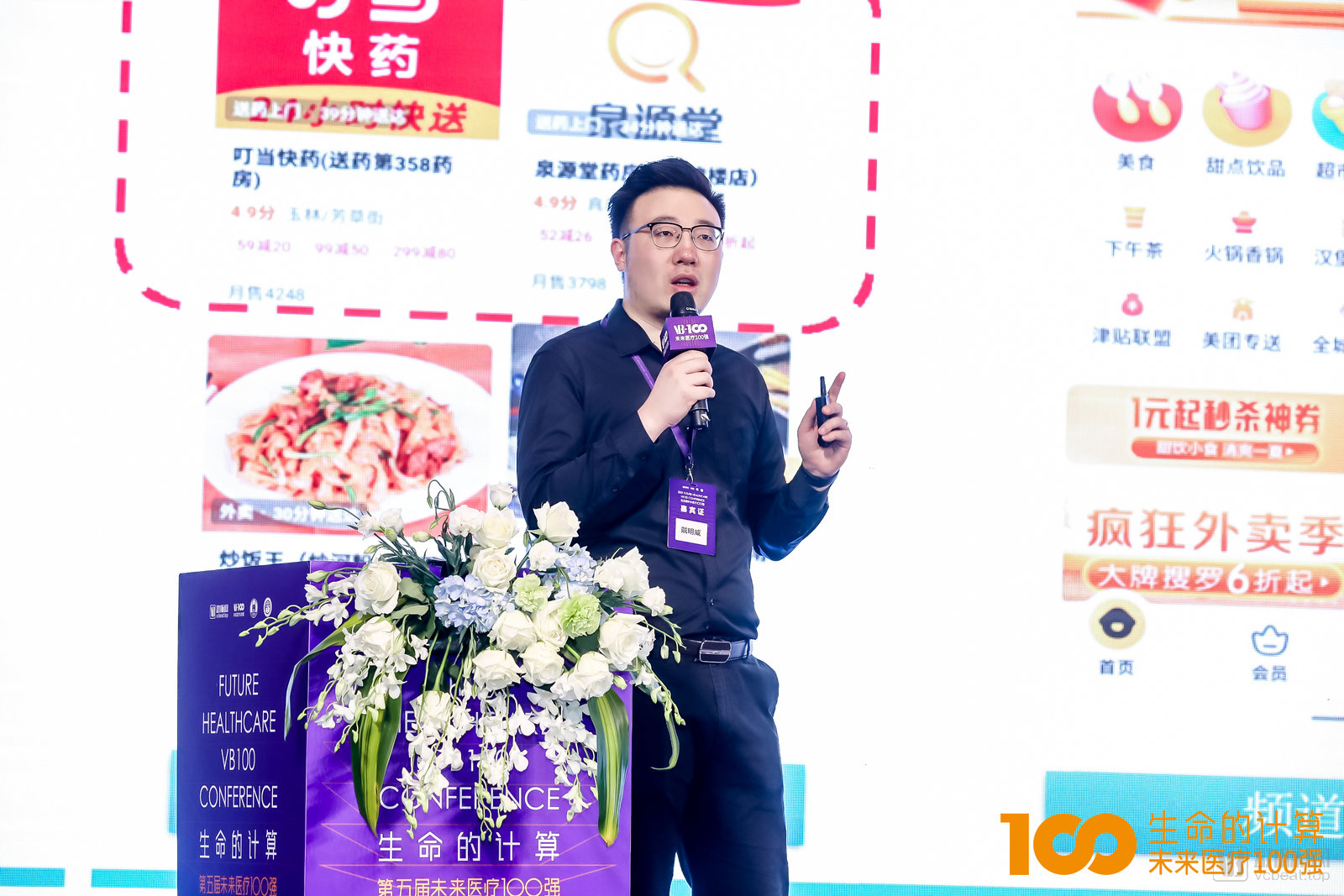
From April 16 to 18, 2021, the “5th Future Healthcare Top 100” Conference, hosted by VCBeat, co-hosted by the People’s Government of Wujiang District, Suzhou City, and the Guangdong Zhong Nanshan Medical Foundation, with co-organization by Suzhou Wujiang Dongfang State-owned Capital Investment and Operation Co., Ltd., and Alibaba Health as the exclusive strategic partner, grandly opened in Wujiang, Suzhou. On April 17, at the Pharmaceutical Company Digital Marketing Forum,Dai Mingwei, New Retail Partner of Quanyuantangwith“Exploration of New Retail Models Supported by Cloud Data”as the title, sharing Quanyuantang's successful experience in the new retail of pharmaceuticals. VCBeat has compiled its brilliant viewpoints.
The pharmaceutical retail industry in China has evolved from brick-and-mortar pharmacies to a B2C plus brick-and-mortar model, then to an O2O plus B2C plus brick-and-mortar model, and finally to an integrated model comprising O2O (Rx), O2O (OTC), B2C, and brick-and-mortar pharmacies.
Initially, as the internet had not yet penetrated the pharmaceutical sector, the industry was dominated by brick-and-mortar pharmacies, with convenient location serving as the primary competitive factor. Following the internet’s incursion into the pharmaceutical field, the B2C e-commerce model emerged, making product assortment breadth the key competitive driver. As logistics systems became more refined and same-city delivery gained widespread adoption, the O2O (Online-to-Offline) model was born, with delivery speed becoming the main competitive factor.With the formal liberalization of online prescription drug sales and the implementation of the “Internet + Healthcare + Pharmaceuticals” model, pharmaceutical retail has entered a phase of mainstream competition characterized by omnichannel access, 24/7 availability, and comprehensive product offerings.
New scenarios empower consumers with greater autonomy in decision-making, as constraints of time and space diminish, information (such as product details and pricing) becomes increasingly transparent, and services (including online consultations, pharmaceutical care advice, and 24-hour operations) grow more diverse. Traffic redistribution will be consumer-led, with customers deciding which platforms and stores to transact with. Pharmaceutical retail platforms and pharmacies with strong comprehensive capabilities are more likely to benefit.
As pharmaceutical retail scenarios continue to evolve, end-user traffic will be redistributed, the pharmaceutical retail sector will accelerate its consolidation, and O2O (Online-to-Offline) has become an irresistible trend. Through data analysis, Chengdu Quanyuantang Pharmacy Chain Joint Stock Co.,Ltd. believes thatOver the next 3–5 years, in China’s first- and second-tier cities, the Chinese pharmaceutical retail market will be divided as follows: 40% accounted for by new retail, 40% by traditional brick-and-mortar pharmacies, and 20% by online pharmaceutical e-commerce.
Initially, many people had a simple definition of pharmaceutical e-commerce: it was merely B2C, involving the establishment of flagship stores on platforms such as Tmall and JD.com to distribute products across China. Data shows that the current scale of B2C pharmacies stands at RMB 13.8 billion, with an annual growth rate of approximately 40% over the past three years, yet the market penetration rate remains only 3.3%. In contrast, the O2O new retail model has demonstrated strong momentum; O2O pharmacies achieved a remarkable 200% year-on-year growth in 2019, reaching a scale of RMB 9.8 billion. As consumer awareness continues to rise, this sector is projected to maintain a growth rate between 80% and 200% over the next three years, with its channel share expected to reach 25% by 2022. Therefore, we believeO2O will be the main battleground for China’s pharmaceutical retail in the future.
Taobao, JD.com, Pinduoduo, JD Daojia, Meituan, and Ele.me are currently the primary traffic channels for pharmaceutical O2O services. However, since last year, Ele.me has integrated its entire permissioned traffic into Taobao, meaning that Taobao has contributed its traffic to Ele.me. Furthermore, we have observed that ByteDance is already making strategic moves in this area, and we believe that Douyin will become a new O2O traffic channel in the near future.
Currently, many users primarily use Meituan and Ele.me for food ordering, but we believe that a growing number of users will gradually expand their usage from the dining segment to other categories such as pharmaceuticals. This raises the question: where will the traffic come from?
Users can observe that on the homepages of various channels or within each category,The top five stores essentially capture 80% of the customer traffic within a 2–3 km radius of this store’s location.Consequently, many retail pharmacies have focused their efforts on securing visibility on the homepage. Starting this year, Meituan has established in-depth collaborations with numerous pharmaceutical companies, leading an increasing number of them to allocate advertising budgets to high-traffic platforms like Meituan. This arrangement provides exclusive exposure slots when users search for specific products, representing a key point of integration between pharmaceutical companies’ digital transformation and platform ecosystems.
In the era of new retail, why do consumers come? It can be summarized in two simple words:Visible and Accessible.
Currently, the industry offers a wide array of channels that serve as significant traffic entry points. However, many people hold a misconception: because Meituan generates substantial traffic, it should be the primary focus for channel deployment. I advise against putting all your eggs in one basket. Previously, many believed that Ele.me’s traffic volume lagged behind Meituan’s. Yet, following the traffic exchange partnership between Ele.me and Taobao last year, I believe Ele.me’s traffic has considerable room for growth in the future. Therefore,Do not underestimate the power of any single channel; a multi-channel strategy is essential to solidify competitive barriers.
Moreover, when traditional brick-and-mortar enterprises embarked on their new retail strategies, they merely transferred their offline pharmaceutical products to online platforms and conducted some online promotional campaigns. However, as time went on, these companies often found themselves wondering: Why does our new retail segment always yield only mediocre results? We can seek answers from the consumer’s perspective. When consumers search for cold and fever medications via O2O (Online-to-Offline) channels, the brand that immediately comes to mind is invariably 999. Yet, many practitioners of new retail simply upload their entire product assortment online and set low prices. In reality, if consumers have zero brand awareness or recognition of these products, no one will purchase them regardless of how low the prices are.
Business hours are also a key factor in the new retail model for pharmaceuticals. In regions such as Northeast and Southwest China, few retail pharmacies operate 24 hours a day. When consumers have medication needs at night, they must either wait until pharmacies open in the morning or seek medical attention at hospitals. Quanyuantang addresses nighttime medication demands by maintaining 24-hour operations, which provides it with 10 additional hours of visibility compared to ordinary pharmacies. This can increase order volume, gross profit margins, and brand awareness. Internal data from Quanyuantang shows thatA 24-hour pharmacy can generate one-third of its daily revenue between 10 p.m. and 8 a.m. the following day.
Meanwhile, we believe that the primary consumer base of the pharmaceutical retail industry in the future will undoubtedly consist of individuals born in the 1990s, 2000s, and 2010s. This demographic exhibits more diversified demands, encompassing not only pharmaceuticals but also a broader range of health- and care-related consumption needs. In response, Chengdu Quanyuantang Pharmacy Chain Joint Stock Co., Ltd. has launched new product lines featuring cosmeceuticals, contact lenses, and lens care solutions to better align with the preferences of young consumers. Data indicates that female consumers account for 56% of the entire new retail sector, particularly within the O2O (Online-to-Offline) industry. Catering to female consumers’ preferences, Quanyuantang has repeatedly adjusted and iterated its online product structure, ensuring that customers can purchase both standard circulating products and specialized items through its platform.
Regarding how to retain consumers in the era of new retail, the answer is simple: more selection, greater savings, better quality, and faster delivery.
“Variety” refers to a sufficiently wide range of product categories, with standard stores carrying 1,000 SKUs, key stores carrying 2,000 SKUs, and 24-hour stores carrying 3,000 SKUs.
It is important to note that a wide product assortment is not merely a matter of accumulating quantities. Even if a pharmacy carries 3,000 SKUs, it will still fail to achieve substantial sales volume unless it adjusts its category mix based on consumer demand and develops personalized offerings. Consequently, many traditional enterprises have begun collaborating with new retail partners to develop personalized products that enhance customer retention. For example, in 2020, Chengdu Quanyuantang Pharmacy Chain Joint Stock Co., Ltd., Meituan, and Dong-E-E-Jiao jointly developed a ready-to-brew Ejiao (donkey-hide gelatin) beverage tailored to the attributes and sense of reliance of online consumers.
“Saving” refers to catering to consumers’ psychology by offering more discount promotions.
“Good” refers to high service quality.Receiving an order in 20 minutes with exquisite packaging versus 50 minutes with damaged packaging creates entirely different consumer experiences and vastly different impressions of the store. Therefore, service quality is key to retaining customers.Quanyuantang analyzed over 13 million O2O orders and found that online consumers are not price-sensitive when it comes to pharmaceuticals, but rather prioritize service quality.
“Fast” refers to rapid delivery speed.We consider 30 minutes to be a reasonable delivery time; deliveries exceeding this threshold are classified as overdue, which negatively impacts consumer experience and store repurchase rates.
Finally, regarding how merchants can generate revenue, we believe that merchants should conduct analyses based on online marketing data, set differentiated prices for different brands, stores, and time periods, and categorize products into traffic drivers, flagship products, profit generators, and long-tail items according to their contributions in terms of order volume, revenue, and gross margin. Different pricing strategies should be adopted for each product category.