

JD Health's Smart Healthcare Strategy: Building a Digital-Driven New Ecosystem
Worldwide, the healthcare sector is undergoing an unprecedented wave of digitalization, spanning from individual health to public hygiene, and from medical service institutions and their industrial chains to the global healthcare ecosystem.
How can hospitals, as healthcare service providers, and third-party medical service platforms better integrate into the digital wave to achieve their own development and provide better services to the general public?
At the Smart Hospital Innovation and Development Forum, part of the 5th Future Healthcare Top 100 Conference hosted by VCBeat, industry leaders shared their insights. Among them, Wang Dongyuan, General Manager of Smart Healthcare at JD Health, delivered a keynote speech titled “Digital Intelligence-Driven: Building a New Ecosystem for Smart Healthcare.”
How Can JD Health, Originating from Pharmaceutical Retail, Strengthen Its Healthcare Services and Build a New Ecosystem for Smart Healthcare? The Answer May Lie in Its Strategic Positioning: “A Supply Chain-Centric, Medically Driven, Digitally Enabled Health Management Platform Covering the Full User Lifecycle and All Scenarios.” Recognizing the importance of strategy, JD Health has long been committed to smart healthcare and has extensively explored the construction of a new ecosystem for smart healthcare.
Sunrise Health Industry, Far Outpacing GDP Growth
JD Health’s positioning of smart healthcare as one of its core strategic priorities is underpinned by its foresight into the development trends of the health industry.
The health services sector’s share of GDP remains persistently high. Last November, Zhang Yuhui, Deputy Director of the Health Development Research Center under the National Health Commission, stated that, according to calculations by the Center, “In 2018, the total scale of China’s health services sector (value added of the health industry) reached RMB 6,369.8 billion, a 12.4% increase from 2017, accounting for 7.08% of GDP.”
According to the “Healthy China 2030” Planning Outline issued in 2016, China planned to achieve a total market size of RMB 8 trillion for the health services industry by 2020, reaching RMB 16 trillion by 2030. However, a report by Frost & Sullivan conveys stronger confidence, projecting that the total market size of China’s health services industry is expected to reach RMB 21.8 trillion by 2030.
 Wang Dongyuan, General Manager of Smart Healthcare at JD Health
Wang Dongyuan pointed out, “In sunset industries, no matter how much intelligence and talent you possess, it is difficult to fully leverage them. However, the big health industry is a sunrise sector that must be strategically developed.” Policy support has not been limited to the strategic significance of building a Healthy China as proposed in the Outline of the Healthy China 2030 Plan. The approval of the 14th Five-Year Plan Outline in 2021 further prioritized key development tasks for the healthcare industry.
The healthcare industry is inherently unique, characterized by relatively inelastic patient demand. The onset of the pandemic disrupted in-person visits to physical medical institutions, further driving growth in demand for online medical services and subtly shifting patients’ attitudes and behaviors toward seeking care. According to JD Health statistics, its online consultation platform averaged more than 100,000 consultations per day throughout 2020. Growing user acceptance of internet-based medical services has further prompted JD Health to deepen its exploration of the smart healthcare sector.
Digital-Driven Health Management Across the User’s Full Lifecycle and All Scenarios
“It has become a near-consensus in the industry to continuously strengthen the industrial foundation of healthcare through technological innovation, and to leverage data accumulated via information systems to facilitate a paradigm shift in health concepts—from treating established diseases to preventing them. This requires healthcare providers to enhance the development of multi-dimensional systems, bolster their ‘Internet + Healthcare’ service capabilities, and continue addressing the persistent challenges patients face in accessing diagnosis and treatment,” said Wang Dongyuan.
JD Health is also reshaping and upgrading its existing medical ecosystem by building a digital-intelligent health service model that integrates new models, new services, and new business formats. This initiative aims to help doctors and medical institutions improve diagnostic and treatment capabilities, enhance hospital management efficiency, and increase the efficiency of medical services, thereby further promoting the development of the broader healthcare industry.
Wang Dongyuan, who previously served as the Head of Channel for Greater China in IBM’s Big Data Analytics Division and as the Channel Director for Northern China in Microsoft’s Enterprise Solutions Group, and currently serves as General Manager of Smart Healthcare at JD Health, is a seasoned IT industry professional. She fully recognizes the importance of top-level design, given that the healthcare industry is inherently subject to stringent regulatory oversight.
This attribute also requires JD Health to leverage technological innovation and standard systems as safeguards, thereby constructing a comprehensive ecosystem. By establishing digital-intelligence support platforms—including service platforms, application platforms, and data platforms—JD Health aims to empower grassroots digital-intelligence services, such as primary care talent development, family doctor contract services, chronic disease health management, and basic public health initiatives. Ultimately, this will enable the provision of services encompassing digital-intelligence medical care, health management, healthy living, and urban governance.
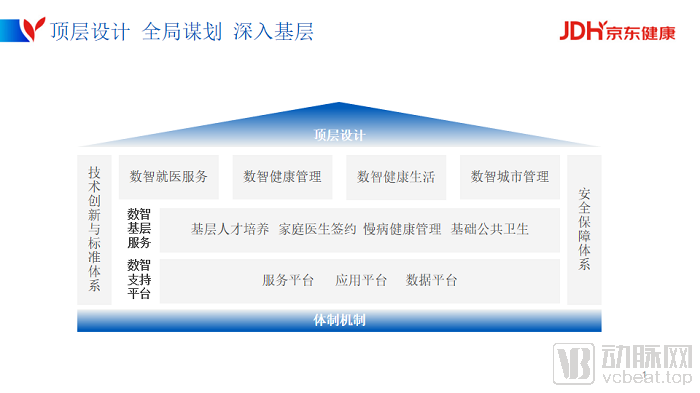
After comprehensive strategic planning, JD Health has structured its business operations into four key segments: a pharmaceutical supply chain business primarily focused on physical goods; consumer-facing (To C) services covering pharmaceuticals, healthcare, nutrition, and wellness products, alongside business-facing (To B) services such as the Yaojingcai B2B pharmaceutical procurement platform; an expanding internet healthcare service sector, exemplified by the launch of up to 18 specialized online medical centers; health management services extended from initial online consultation offerings; and smart healthcare solutions.
How Is JD Health Strategizing the Development of Its Smart Healthcare Business?
Wang Dongyuan emphasized that, compared with other business segments, JD Health’s Smart Healthcare places greater emphasis on serving both government entities and hospitals.
For governments, in the development of “Smart Healthy Cities,” JD Health leverages its supply chain advantages and technological capabilities to build regional medical and health big data infrastructure and interconnected network platforms. By collaborating with governments, hospitals, and communities, it delivers scientific and efficient medical services and health management, thereby establishing a regional digital-intelligent health ecosystem. Meanwhile, JD Health empowers grassroots healthcare with digital-intelligent medical capabilities, promoting the decentralization of high-quality medical resources and enhancing the level of primary medical and health services as well as the efficiency of the pharmaceutical supply chain. Currently, JD Health has established pilot programs in Beihai (Guangxi), Hebi (Henan), Suqian and Taicang (Jiangsu), among other locations, achieving initial success.
For hospitals, JD Health is fully leveraging the Group’s leading technological capabilities to continuously support hospitals in building internet hospitals, establishing data-driven research platforms, and operating specialized departments. For example, JD Health partnered with Tianjin Nankai Hospital to establish the “Nankai-JD Internet Hospital,” which serves as a model internet hospital in Tianjin and was among the first in the city to integrate online medical insurance payments and launch an “Internet + Nursing” service program. Additionally, the “JD Internet Hospital of the First Affiliated Hospital of Henan University of Chinese Medicine,” co-established with the First Affiliated Hospital of Henan University of Chinese Medicine, is the first traditional Chinese medicine (TCM) internet hospital in Henan Province. Its technological and AI capabilities, combined with its distinctive TCM features, have received widespread acclaim within the industry.
“Healthcare itself is a relatively low-frequency activity.” She pointed out, “By collaborating with governments and hospitals, we can accurately identify users with genuine medical needs. In the future, this will gradually help JD Health transition from chronic disease management to comprehensive health management.”
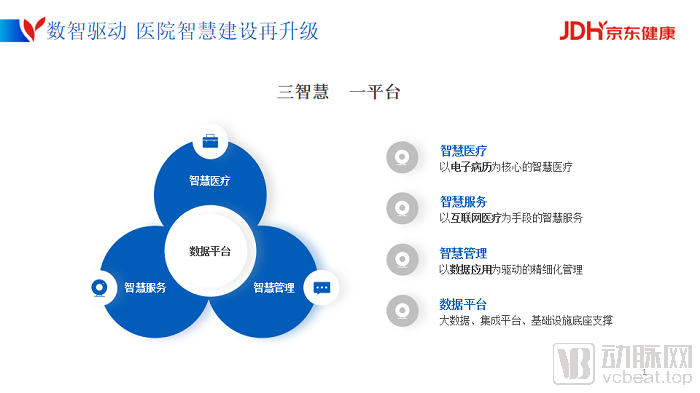
How Is JD Health Strategizing Smart Healthcare to Achieve Business-Level Implementation? Wang Dongyuan pointed out that JD Health has built a data platform as its foundation, upon which it has established smart healthcare centered on electronic medical records, smart services enabled by internet-based healthcare, and refined smart management driven by data applications.
>>>>
1. Smart Healthcare
Smart healthcare centered on electronic medical records (EMRs) aims to establish a closed-loop system for hospital medical information. JD Health divides its development into three stages, starting with business standardization and progressively advancing toward intelligent decision-making and routine scientific research. For instance, the informatization initiative at Tangshan Central Hospital is EMR-centric, continuously enhancing patients’ healthcare experience by standardizing clinical practices, ensuring high-quality care, and optimizing service workflows.
2. Smart Services
Smart services leveraging internet-based healthcare encompass a wide range of user-facing offerings and have also been independently developed and expanded as a distinct segment of internet medical services. In short, JD Health has gradually established an integrated online-offline, full-scenario healthcare service system by building its own internet hospitals, adopting a specialty-centered medical model, establishing an in-house family doctor team, and co-developing internet hospitals with partner hospitals.
Leveraging its connected patient and physician resources, JD Health has continuously expanded its pharmaceutical services to strengthen its service ecosystem. As of December 31, 2020, JD Health operated 14 dedicated pharmaceutical warehouses and more than 300 non-pharmaceutical warehouses across China. To enable users to access medical services with confidence and peace of mind, JD Health introduced features such as AI-powered prescription review and medication reminders. Furthermore, by leveraging IoT and wearable devices, JD Health has extended the reach of its medical services, ultimately achieving an integrated online-offline model, streamlined medical service processes, and full-lifecycle health management.
3. Smart Management
A significant number of hospitals and physicians have a strong demand for conducting clinical research. JD Health is assisting hospitals in building integrated platforms for clinical research, thereby supporting scientific inquiry while simultaneously feeding back into clinical practice to enhance physicians’ diagnostic and therapeutic capabilities. For instance, JD Health has collaborated with Tianjin Nankai Hospital on big data R&D initiatives for its Preventive Treatment Center, focusing on digitalization and intelligence within the hospital. By leveraging full-cycle patient data from pre-diagnosis, during diagnosis, and post-diagnosis stages, this collaboration drives clinical experts in delivering refined health management services. Furthermore, by establishing regional big data healthcare service platforms, local governments can coordinate both in-hospital and out-of-hospital data, thereby improving the efficiency of regional medical big data. Notable examples include the Smart Health Beihai Project and the Smart Health Hebi Project, both led by JD Health.
In implementing smart healthcare solutions, Wang Dongyuan has continuously explored and refined tactical approaches and methodologies. On one hand, by treating individual hospitals as points, medical consortia as lines, and healthy cities as planes, JD Health’s smart healthcare initiative achieves synergistic benefits through the integration of these three dimensions. This strategy has been deployed in projects such as Tianjin Nankai Hospital and the First Affiliated Hospital of Henan University of Chinese Medicine (points), the Taicang Regional Medical Consortium project in Jiangsu Province (line), and the Beihai Smart Health project (plane). Meanwhile, through ongoing experimentation, they have found that using the “plane” dimension as the core driver enables economies of scale. Therefore, Wang Dongyuan pointed out, “The layout and considerations of the ‘point-line-plane’ model in regional markets primarily revolve around balancing and defining the trade-off between economies of scale and synergistic benefits.”
Based on this, JD Health’s Smart Healthcare Initiative will prioritize urban projects, leveraging these to integrate its system and reach hospitals. Capitalizing on its industrial strengths, JD Health can drive the development and construction of local healthcare industry ecosystems in cities. As offline hospital support systems are established in various prefecture-level cities, the JD Health Internet Hospital Platform will maximize its effectiveness. For JD Health, there is still a long road ahead. Wang Dongyuan also expressed hope that partners within the entire ecosystem will join hands with JD Health to build a new digital and intelligent smart healthcare ecosystem, thereby accelerating industry development.