

TetraScience Files for IPO After 10-Fold Funding Surge in Two Years

TetraScience
Cloud Data Management Platform Developer
As life sciences advance at a rapid pace, big data and the broader health ecosystem have become closely intertwined with our daily lives in recent years. The close collaboration between the health sector and big data enables healthcare professionals not only to enhance the quality of medical services but also to reduce healthcare costs. Major technology giants, including IBM, Google, and Oracle, are highly optimistic about the prospects of this convergence, aiming to create greater market value through industrial upgrading.
On April 15, 2021, life sciences cloud computing company TetraScience announced the completion of an $80 million Series B financing round, co-led by Insight Partners and Alkeon Capital. Over the past two years, its total funding has surged more than tenfold, rising from $8.13 million to $99.13 million.
What kind of company is this? What legendary experiences does it have? Let’s find out.

Patrick Grady, Chairman and Chief Executive Officer (left)
Founder, President and Chief Technology Officer of Spin Wang (center)
Dr. Sal Savo, Co-founder (right)
(Image source: TetraScience official website)
Spin Wang and Sal Savo co-founded the original TetraScience, exploring how to transform researchers’ first-hand experiences into valuable scientific data. As the distributed model of scientific research continues to evolve, R&D in the life sciences has become increasingly driven by massive datasets, a volume of data that has intensified manualCompilationData complexity.
However, TetraScience initially misdirected its focus toward “market noise” rather than “customer signals.” In spring 2019, Patrick Grady assumed the role of CEO and began to devote full efforts to developing the data cloud. Nevertheless, the company incurred losses due to an overall lack of strategic focus, exhausted its cash reserves, and lost the confidence of investors and creditors. Faced with the absence of clear financial support, a rapidly deteriorating balance sheet, and attrition among both customers and employees, the company was forced to confront either dissolution or a successful yet arduous transformation.
The two remaining original founders, Spin and Savo, engaged in in-depth discussions with Patrick on how to integrate life sciences research and development (R&D) with a data cloud platform. At the time, they had only three options: shut down TetraScience and start anew; recapitalize and rebuild TetraScience; or reconstruct Tetra 2.0 within the corporate governance and capital structure of Tetra 1.0. Although the third approach was the most challenging to execute (as starting from a clean slate is always easier), they believed it was the right course of action for everyone who cared deeply about the company.
In May 2019, Patrick Grady partnered with Spin Wang to redesign and rebuild the company from the ground up. Patrick formulated a new strategic plan for TetraScience and collaborated with founder Spin to develop the Tetra R&D Data Cloud. By the end of 2020, TetraScience’s customer base had grown to more than 70 companies, including 12 of the world’s top 40 pharmaceutical companies.
Savo oversees product design for laboratory monitoring applications. Prior to founding TetraScience, Savo spent eight years in academia developing solutions for remote experiment monitoring. He earned his Ph.D. in metamaterials from the University of Naples Federico II in Italy and completed his postdoctoral fellowship at Harvard University.
Spin became the Chief Technology Officer of TetraScience in 2019. Spin graduated from Cornell University with a Bachelor’s degree in Applied Physics and Electrical Engineering, and holds a Master’s degree in Electrical Engineering and Computer Science from MIT. During his time at MIT, Spin was awarded the Lockheed Martin Scholarship. From 2019 to 2020, Spin served as a board member of the Pistoia Alliance, a global non-profit organization dedicated to reducing barriers to innovation in life sciences and healthcare R&D through collaboration.
Patrick is a highly esteemed CEO in the fields of cloud platforms and applications, commercial and data networks, business-to-business (B2B), and fintech, recognized as one of the leading CEOs and innovators in the B2B market. Patrick also received the 2006 “Fast Company Award,” which is typically bestowed upon the world’s top 50 individuals who “transform the way we live and work.” That year’s awardees included Bill Gates and the 42nd President of the United States, Bill Clinton.
Patrick helped pioneer multiple technologies—including Web services, service-oriented architecture (SOA), and software as a service (SaaS)—which have now given rise to a $100 billion B2B cloud market. He also played a key role in commercializing virtual assistant/artificial intelligence technologies, which are now widely used in consumer applications such as Siri, Alexa, and Google Assistant.
Spin states that four overarching trends in the pharmaceutical industry are prompting companies to rethink their R&D strategies. First, pharmaceutical companies are increasingly treating experimental data as core intellectual property (IP). This experimental data encompasses design parameters, metadata, raw data, analytical results, and numerous datasets previously overlooked. Second, automation of data flows: while robots have achieved automation at the physical level, digital tools are now enabling automation at the data level. Third, proactive restructuring of cloud infrastructure to gain greater flexibility. Fourth, pharmaceutical companies are leveraging artificial intelligence (AI) and machine learning (ML) to predict optimal experimental scales, thereby helping them reduce the number of experiments required.
Compared with other industries, research and development in the life sciences is exceptionally complex. Before conducting clinical trials, a typical workflow may involve more than twenty distinct steps, such as hypothesis generation, understanding disease pathophysiology, selecting analytical methods, designing validation protocols, and safety screening, among others. Each step further entails multiple substeps and workflows.
Life science research and development involve incredible multidimensionality, requiring substantial resources and time. Matters become even more complex when multiple departments and teams collaborate throughout the drug development process.
Moreover, different analytical tasks require distinct tools to yield varied results, yet most instrument manufacturers and informatics vendors lock pharmaceutical companies into specific data systems.
Pharmaceutical companies have established point-to-point, manual, and fragile connections between isolated data systems, a approach characterized by highly inconsistent architectures, high maintenance costs, and extremely complex change management processes.
Due to the presence of numerous heterogeneous and incompatible data silos, pharmaceutical companies have encountered significant bottlenecks in storing experimental and R&D data in accessible, centralized databases. Furthermore, these companies must ensure data consistency, uniformity, proper labeling, and interoperability across any other operating system.
The Tetra R&D Data Cloud centralizes research and development data from instruments, laboratory systems, and laboratory partners, featuring advanced capabilities for collecting, standardizing, analyzing, and sharing data with any other operating system. By alleviating the burden of data management, the Tetra R&D Data Cloud helps scientists accelerate development cycles and reduce R&D costs, making life sciences research and data development actionable and accessible.
Tetra R&D Data Cloud can automatically record all inbound data collection and apply metadata tagging to streamline compliance and traceability; it also automatically detects changes and additions to data sources and uploads them to the cloud, enabling scientists to focus on their experiments rather than on data capture and transmission.
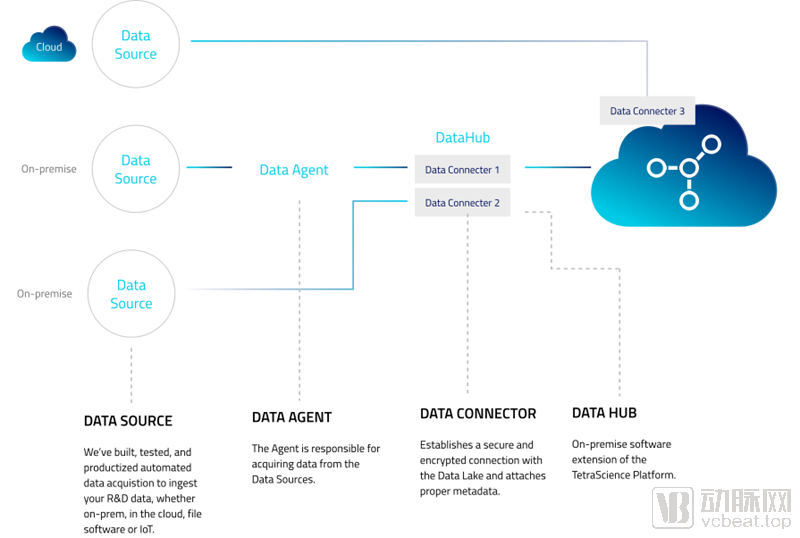
Figure: Data Collection Schematic. Source: TetraScience Official Website
Tetra R&D Data Cloud automatically unifies R&D data into vendor-neutral, open data formats; automatically prepares data for queries from big data tools (such as Elasticsearch, Python/R, Spark, Presto, Pandas, and Streamlit); and automatically converts IDS files into other formats of your choice, such as converting heterogeneous formats from the Tetra digital trunked communication system file converter application into standardized data formats.
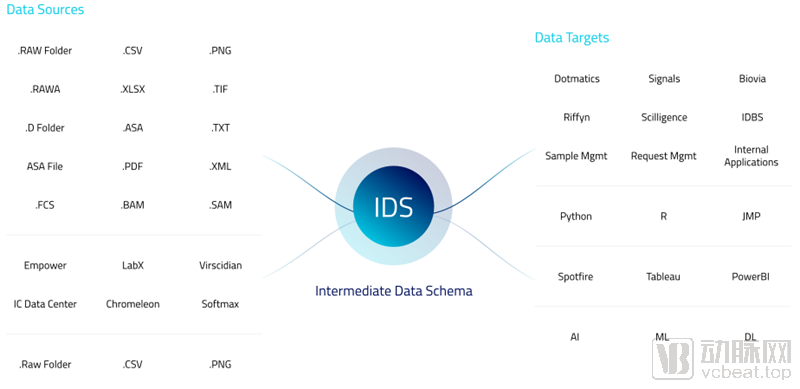
Data Input and Output. Image source: TetraScience official website
Data visualization can be achieved by leveraging TetraScience’s integrations with leading software platforms for business intelligence, analytics, visualization, and artificial intelligence/machine learning, such as Tableau, TIBCO Spotfire, Power BI, and Streamlit.
Spin stated that its partnership with Amazon Web Services (AWS) has enabled the company to focus on the data itself, rather than expending all efforts on building and maintaining on-premises data centers. Its unique achievements in this industry include the creation of data models, data pipelines, data integration solutions, and data applications. This allows the R&D data team to concentrate on enhancing data fluidity, thereby enabling the generation of greater value.
On April 15, 2021, life sciences cloud technology company TetraScience announced the completion of an $80 million Series B financing round, co-led by Insight Partners and Alkeon Capital.
Since the launch of “Tetra 2.0” in May 2019, TetraScience has become the fastest-growing cloud startup in history. TetraScience’s annual recurring revenue, customer acquisition cost, net retention and expansion rates, and capital efficiency metrics are all best-in-class.
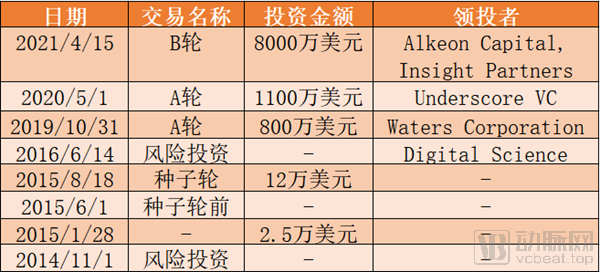
TetraScience’s Historical Funding Rounds (Source: Crunchbase)
Currently, as an emerging cloud technology company, TetraScience has provided data integration solutions to more than 80 pharmaceutical and biotechnology companies.
The White Paper on the Development Analysis and Outlook of China’s Medical Cloud Industry shows that since 2015, cloud computing has maintained a year-on-year growth rate of approximately 30%, with its scale demonstrating a trend of rapid expansion. The primary users of cloud computing are concentrated in the internet, transportation and logistics, and financial sectors, which account for 60.3%, 7.8%, and 6.2% of the market share, respectively. Other industries lag slightly behind; for instance, the healthcare sector accounts for only 3.1% of the market share.
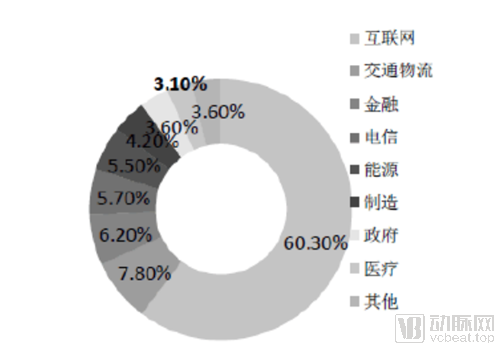
2018 Cloud Computing Industry Structure Source: White Paper on the Development Analysis and Outlook of China's Medical Cloud Industry
In 2019 and 2020, the demand for medical cloud construction continued to be unleashed. After three years of development, the medical cloud has gradually gained industry recognition, with government and hospital construction demands expected to be released progressively. In 2020, spurred by the pandemic, internet healthcare experienced significant growth. All secondary hospitals and above have a need to deploy internet healthcare platforms, providing another major application scenario for the implementation of medical clouds.
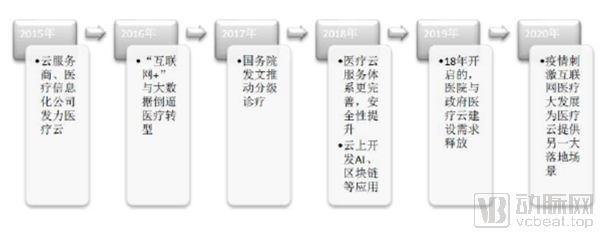
Timeline of Major Developments in China's Medical CloudImage source: White Paper on the Development Analysis and Prospects of China’s Medical Cloud Industry
From the customer perspective, medical cloud solutions can be applied to healthcare institutions, pharmaceutical companies, government agencies, and research organizations. For healthcare institutions, medical cloud applications include Digital Hospital Cloud, Medical Imaging Cloud, and Telemedicine. For pharmaceutical companies, applications encompass Health Management Cloud, Smart Hardware, and Pharmaceutical Distribution. For government agencies, applications involve Medical Consortia, Regional Medical Cloud, and Tiered Diagnosis and Treatment. For research organizations, applications include Genomic Big Data, Research Management, and Project Management.
Huawei Cloud’s Pharmaceutical Cloud Solution, built on the foundation of “Compliance + Pharmaceutical AI,” spans the entire process from drug R&D to distribution, focusing on scenario-based solutions to empower the pharmaceutical industry’s transformation and upgrading.
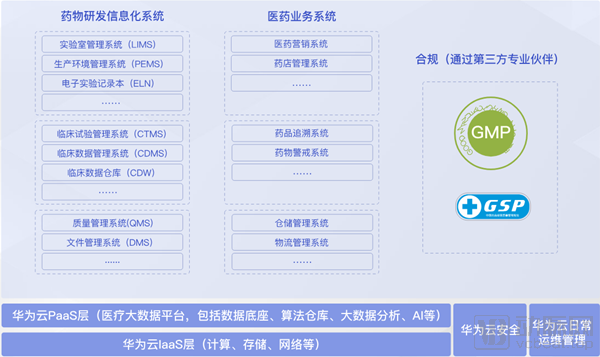
Huawei Cloud Solutions | Image Source: Huawei Cloud Official Website
According toWhite Paper on the Development Analysis and Outlook of China's Medical Cloud IndustryData shows that the global medical cloud market reached $20 billion in 2018. It is projected to maintain a compound annual growth rate (CAGR) of 15.7% over the next five to six years, reaching $55 billion by 2025. In 2018, the U.S. market size was $8.5 billion, accounting for 42.5% of the global total.
While China’s medical cloud market accounts for a relatively small share, it is experiencing rapid growth and is expected to maintain an upward trend in the coming years. In 2018, the overall size of China’s cloud computing market exceeded RMB 100 billion. As a vertical sector, healthcare represented a modest portion of this market, with its scale reaching RMB 3.6 billion, or just 3.1%. In terms of growth rate, the medical cloud segment recorded a year-on-year increase of 34% in 2018 and is projected to sustain this upward trajectory in the next few years. Furthermore, as industry barriers are gradually dismantled and supported by favorable policies, China’s medical cloud market is anticipated to reach a scale of tens of billions, or even hundreds of billions, of RMB in the future.