

Huoshu Tech Powers DRG-PPS Research Initiative, Leading Hospital-Side DRG/DIP Solutions into the 2.0 Era
From April 23 to 25, the Hangzhou International Expo Center was bustling with attendees as the 2021 China Hospital Information Network Conference (hereinafter referred to as CHINC) was in full swing. On the afternoon of the 24th, at the sub-forum titled “Forum on High-Quality Hospital Development in the DRG Era,” numerous national-level DRG experts, local healthcare security policymakers, presidents of leading hospitals across China, and heads of departments in healthcare security and information technology gathered together to share insights on healthcare security policy analysis and experiences from pioneer hospitals. The interim report on the research project “Evaluation of the Impact of DRG-PPS Implementation on Medical Quality and Research on Improving Refined Hospital Management” was also released at the sub-forum.
Huoshu Technology Exclusively Supports the DRG-PPS Project
Reforming the health insurance payment system with Diagnosis-Related Groups (DRG)-based payment at its core is a crucial safeguard for implementing the “Healthy China” strategy and a key step toward modernizing China’s healthcare security governance system and capabilities. Since 2019, the National Healthcare Security Administration has successively launched pilot programs for CHS-DRG and Big Data Diagnosis-Intervention Packet (DIP) payment models, conducting trials in 30 cities nationwide for CHS-DRG and 71 cities for DIP, thereby taking a significant step forward in the reform of health insurance payment methods.
Based on international experience, the implementation of Diagnosis-Related Groups (DRGs) exerts a profound impact on healthcare systems, particularly on hospital operations and management. However, in China, research on the effectiveness of DRG implementation remains limited in quantity and scope, with room for improvement in depth and standardization. The pilot program of China Healthcare Security Diagnosis-Related Groups (CHS-DRG) provides a rare historical opportunity to study the impact of DRGs on hospital operations and management within China’s medical environment.
To assess the impact of Diagnosis-Related Group (DRG) payment on healthcare quality and hospital operations, the Hospital Management Institute of the National Health Commission (hereinafter referred to as the Hospital Institute) began preparing for the research project titled “Evaluation of the Impact of DRG-PPS Implementation on Healthcare Quality and Improvement of Hospital Refined Management” in mid-2020. The project aims to systematically monitor the impact of DRG implementation on the quality of medical care in Chinese hospitals and, by exploring refined management measures in hospitals, provide an evidence base for policy formulation and adjustment by relevant government departments and for the refined operational management of healthcare institutions.
As of the end of March 2021, the project team conducted preliminary visits and surveys among member units, covering 21 provinces/municipalities across seven regions. This encompassed 65% of the national DRG pilot cities and numerous provincial-level pilot areas, demonstrating extensive coverage. The hospitals surveyed included five hospitals directly affiliated with the National Health Commission and more than 20 university-affiliated hospitals, 90% of which were leading regional hospitals with generally high levels of management proficiency.
Notably, the exclusive technical support provider for this research project is not a well-established industry veteran, but rather the young Hangzhou Huoshu Technology Co., Ltd. (hereinafter referred to as “Huoshu Technology”). Although founded in 2016 and relatively new, the company has experienced rapid growth in recent years, particularly in Zhejiang Province, where it has secured a 95% market share by being among the first to enter the actual payment phase of Diagnosis-Related Groups (DRG). Currently, Zhejiang Province has taken the lead in implementing the actual DRG payment system, establishing a standardized and mature operational management model that serves as a benchmark for similar hospitals.
Thus, it is not difficult to understand why Hangzhou Huoshu Technology Co., Ltd. has become the exclusive technical support provider for this project.
Hospital-Side MDT-Style DRG/DIP System Solution Leads the Industry into the 2.0 Era
Guided by a multi-departmental collaborative product philosophy, Huoshu’s MDT-style system solution integrates core products such as the DRG Operations Analysis System, the DIP Operations Analysis System, and the Medical Record Front Page Quality Control System. In response to strategic client needs, it continuously pre-researches new management system modules, enabling hospital-level leadership, clinical departments, medical records offices, health insurance offices, finance departments, information technology departments, and quality control departments to collaborate and implement precise measures. This provides one-stop empowerment for refined hospital management.
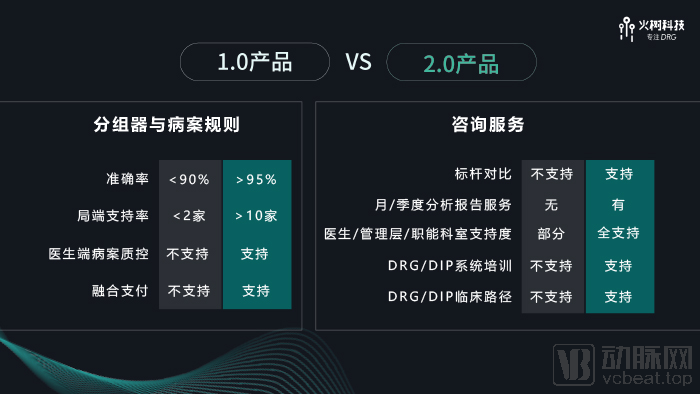
Huoshu 2.0 Hospital-Side DRG/DIP Solution Features Significant Upgrades Compared to Previous Versions (Image courtesy of Huoshu Technology)
Rapid iteration is a key reason why Huoshu’s solutions have gained favor among hospitals. Currently, Huoshu’s hospital-side DRG/DIP solution has been iterated to version 2.0. Compared with the 1.0 version, version 2.0 has achieved significant upgrades in the grouper, medical record rules, and consulting services, thereby attaining a high degree of adaptability. It can accommodate different payment policies, various types of hospitals, and policies at different stages. Specifically, Huoshu’s DRG/DIP Solution 2.0 has undergone major enhancements in its grouper, medical record quality control, integrated payment, and consulting services.
Packetizer Upgrade
2. The grouper in Version 2.0 has been upgraded from its predecessor, featuring three key enhancements: compatibility with all versions, improved adaptation efficiency, and higher accuracy. First is full-version compatibility. Currently, Huoshu Technology’s hospital-side solutions have integrated with more than 60 cities, covering over 10 versions of payer-side groupers. Whether for DRG or DIP, and regardless of the vendor-specific payer-side version, the system achieves seamless compatibility, thereby realizing full-version adaptation.
Secondly, the grouper adaptation efficiency has been upgraded. Version 2.0, leveraging big data and Payhon, has significantly reduced adaptation time, shortening it to just 1–2 days for new regions.
Finally, the grouper in version 2.0 achieved an improvement in enrollment accuracy, rising from 90% in version 1.0 to over 95%, thereby enabling precise group prediction and assisting clinical practice in more targeted process management.
Front-loaded Medical Record Quality Control
The enhancement of medical record front page quality control represents the second major improvement in Huoshu’s DRG/DIP Solution 2.0. Compared to previous versions, Version 2.0 shifts quality control of the medical record front page to the physician interface, offering unified coding, automated coding, and real-time quality control. By automatically encoding clinical terminology used by physicians, it ensures the quality of medical record front pages at the source. This establishes a three-tier quality control system involving clinicians, the medical records department, and the quality control department for the most critical component of DRG/DIP payment—the medical record front page.
In terms of quality control rules, this solution provides three major engines: knowledge base quality control, big data intelligent quality control, and basic information quality control. By leveraging five key scenarios—embedded physician-side quality control, risk medical record early warning, front-page PDCA, intelligent coding validation, and online clinical interoperability—it establishes a comprehensive, end-to-end quality control management system.
Integrated Payment
Currently, in regions within China piloting DRG-based payments, two payment methods are employed: the point-based method and the rate-based method. Meanwhile, DRG/DIP applies only to short-term inpatient care and does not encompass the entirety of medical payments. Furthermore, as healthcare insurance reforms remain in an exploratory phase, potential policy changes must be taken into account. Therefore, integrating support for multiple payment methods within a single solution facilitates easier deployment and use by hospitals.
Huoshu 2.0 DRG/DIP Solution upgrades payment methods to achieve integrated payment, fully adapting to various models including report-based DRG (point-based or rate-based), DIP, single-disease, per-diem, and fee-for-service.
Engineering Efficiency Improvement
Version 2.0 adopts the popular data middle-platform architecture and agile development methodology, significantly enhancing engineering efficiency. The implementation timeline for the entire solution has been substantially reduced from two months to just three to four weeks. Meanwhile, by introducing the data middle-platform architecture and the concept of standardized data governance, the system ensures data quality while improving efficiency. After all, the successful deployment of healthcare information systems heavily relies on customer service and data accuracy.
Customer-Centric Approach: Significant Upgrade to Consulting Services
Prior to its expansion into the DRG sector, Huoshu Technology primarily focused on hospital BI data governance and collaborated with Alibaba to explore hospital data governance and mining. Leveraging this experience, Huoshu has gained a deeper understanding of hospital needs, driving hospital management through data consulting services—a distinctive feature of its solutions. This philosophy is further embodied in the Version 2.0 upgrade.
Version 2.0 provides hospitals with services such as benchmarking, monthly/quarterly analysis reports, DRG/DIP system training, and DRG/DIP clinical pathways, delivering comprehensive support to physicians, management, and functional departments.
Currently, Huoshu’s service team comprises a core R&D team of over 150 members and a clinical professional medical team of more than 30 specialists, including professionals in medical records management and clinical practice. Notably, Huoshu Technology has also established a professional data analytics team of over 50 members, led by world-class data scientists. Its external healthcare management team consists of more than ten consultants from Grade A tertiary hospitals and an external expert pool comprising over one hundred experts. Across the entire organization, more than 90% of employees hold at least a bachelor’s degree, with master’s and doctoral degree holders accounting for 20%.
In addition, Huoshu provides hospitals with consulting services for refined management and offers a communication and observation platform for exchange. During the CHINC exhibition, Huoshu Technology collaborated with its partners to establish two DRG benchmark hospital visit routes, organizing attendees to visit The Second Affiliated Hospital of Zhejiang University School of Medicine and Hangzhou First People’s Hospital Affiliated to Zhejiang University School of Medicine to observe and learn about the operational implementation of this solution. Heads and key personnel from the medical insurance, medical records, and information departments of both hospitals shared their expertise with the visiting delegates. This initiative aims to help hospitals further clarify their strategies for refined management under the DRG system, seize strategic opportunities, and achieve high-quality development.
The meticulous refinement of its products has earned Huoshu Technology’s hospital-side solutions strong preference among hospitals, capturing a 95% market share in Zhejiang Province. Nationwide, as of January 2021, Huoshu Technology had expanded to more than 20 provinces and over 60 cities, covering 65% of the pilot cities for DRG/DIP payment reforms. The company has partnered with more than 150 hospitals, most of which are leading benchmark institutions in their respective regions.
Meanwhile, the choices of private hospitals, which have higher demands for management and cost control, may be more telling. Currently, many leading private hospitals have partnered with Huoshu, including Foshan Chancheng Central Hospital, which ranks first in competitiveness among China’s non-public hospitals.
As a strategic partner of the CHINC conference, Huoshu Technology presented a comprehensive suite of solutions and exhibits to attendees. Its exhibition hall, located in Zone D, covered an area of nearly 150 square meters, making it one of the largest booths at the event. The DRG/DIP System 2.0 solution was open for demonstration, attracting over 10,000 visits.
In the future, Huoshu Technology will continue to invest in research and development, maintaining its current R&D expenditure at a high level of 70% of total spending, thereby ensuring the achievement of its “deploy one generation, develop one generation, and pre-research one generation” strategy, and empowering hospitals to achieve lean management through DRG.