

How to Ensure the Reliability of Medical Science Communication? Douyin Has Something to Say!
The internet is a remarkable phenomenon—silent, intangible, and formless, yet possessing the power to transform everything. Today, it is reshaping how people access medical information.
During the COVID-19 pandemic, public awareness and understanding of the novel coronavirus were remarkably timely and comprehensive, a feat largely attributable to medical science popularization efforts on short-video platforms such as Douyin. By disseminating information online, these platforms made an indispensable contribution to epidemic prevention and control.
Medical science popularization is a key means to enhance the scientific literacy of the public and promote disease prevention. High-quality science communication can help shift the current medical paradigm from “treating established diseases” to “preventing diseases before they occur,” which is of great significance for improving the health status of China’s residents and serves as a concentrated embodiment of the Healthy China 2030 Planning Outline.
With the increasing advancement of internet technology, medical science popularization is no longer confined to traditional dissemination channels such as newspapers, television, and offline lectures. Instead, it has begun to migrate online, capitalizing on the momentum of the short-video era, giving rise to a succession ofZhang Wenhong, Sun Qiuning, Ji Yurong...and many other “internet-famous” physicians. By sharing professional insights in layman’s terms and actively addressing healthcare concerns of the general public, they fulfill their professional responsibilities through an alternative platform and identity, thereby laying a solid foundation for advancing the “Healthy China” initiative.
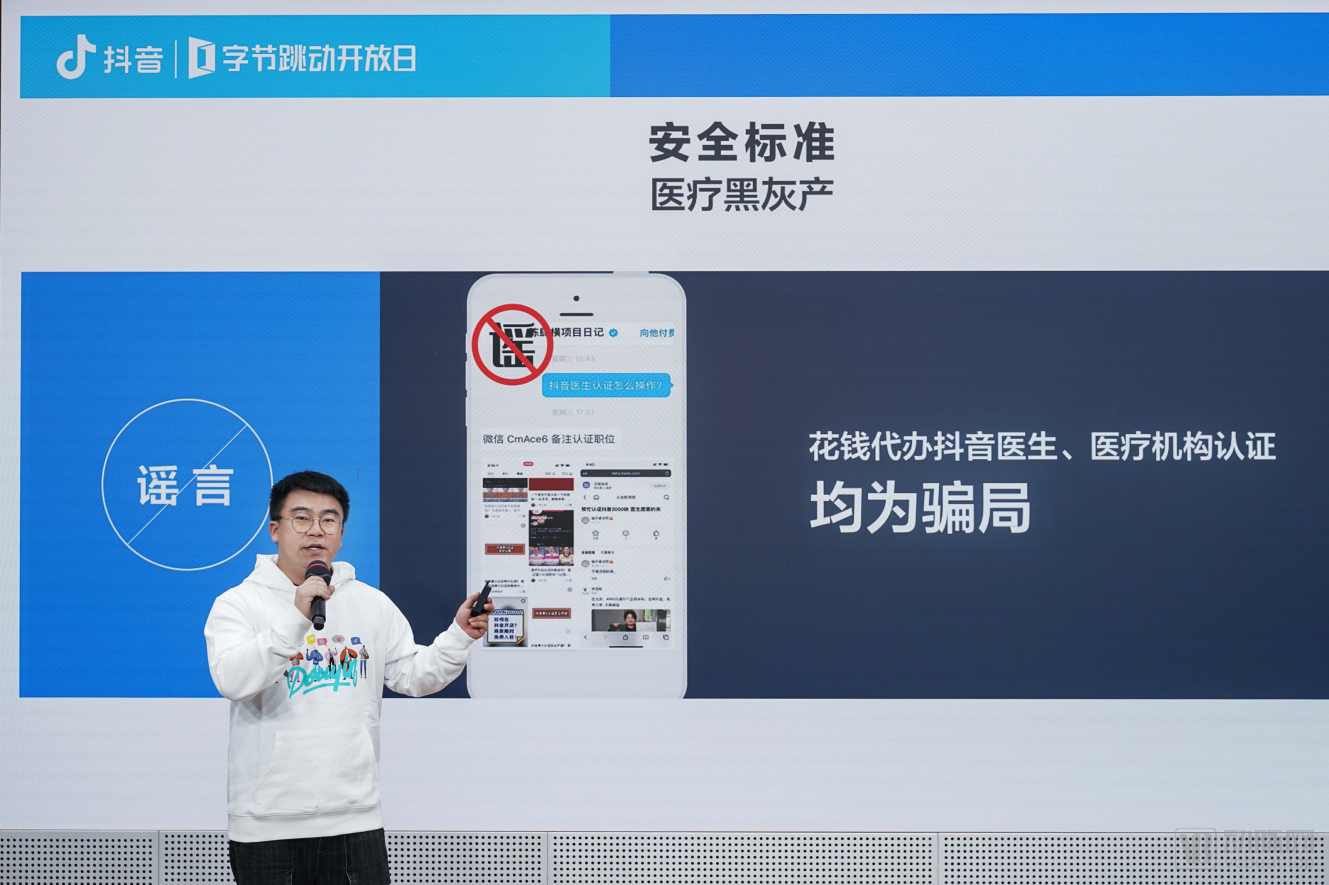
A relevant person in charge of Douyin Health
On the afternoon of April 27, Douyin held an event in BeijingPublic Communication Session on HealthcareAt the conference, participants conducted a comprehensive analysis and discussion of the ecosystem for medical science popularization, providing detailed explanations of Douyin’s certification and content moderation policies. VCBeat will leverage this event as a foundation to explore the developmental logic of medical science communication.
The history of human progress has eloquently demonstrated that science and technology are powerful historical drivers of human advancement and social development, while science popularization, as the bridge connecting science and technology to human society, remains an eternal theme in human history.
The medical field is characterized by its high degree of seriousness and strong academic nature, making it relatively unfamiliar to the general public and creating a sense of distance. On the other hand, it is closely intertwined with human life, representing an inevitable topic for everyone. In light of this, medical science popularization is of paramount importance, serving as a vital link that facilitates effective engagement between the public and medicine. Specifically, why is medical science popularization necessary?
First, the barrier to medical knowledge is high and cutting-edge.Medicine is a discipline that addresses various diseases and pathological conditions of life through scientific or technological means. It features high knowledge barriers and encompasses a vast array of specialized terminology, the complexity of which often poses significant challenges for medical students. Furthermore, medicine is a field characterized by continuous knowledge updates; practitioners must keep pace with the times and remain at the forefront of technological advancements to avoid becoming obsolete.
Second, to prevent the public from resorting to indiscriminate medical consultations in times of urgent illness.Medicine is a matter of life and death, yet incidents of unregulated medical practice still occur. This is particularly prevalent in some remote areas, where a lack of professional medical knowledge makes “desperate patients seeking any available help” the most compelling lure for decision-making, thereby leading to some irreversible medical accidents.
Third, it buys more time for emergency care.Emergency care is a race against time; even a one-second delay can mean missing the optimal window for resuscitation. For the vast majority of acute conditions, timely medical intervention during the early stages of onset significantly increases the likelihood of successful patient rescue.
Fourth, enhance public health literacy and build an invisible communication “bridge” between patients and doctors.One of the most vexing challenges in clinical practice is engaging in endless, yet minimally effective, communication with patients’ families despite limited energy and resources. Medical science popularization offers an effective solution to this problem. By enhancing public health literacy, it enables patients to better cooperate with physicians during future medical encounters, thereby maximizing benefits for both healthcare providers and patients.
In the past, medical science popularization was broadly categorized into three forms:One type consists of printed materials, primarily books and newspapers.;One is a television program focused on health and wellness; the other includes offline science popularization lectures or activities, among others., such a mode of dissemination has limited reach and yields negligible value.
However, the advent of the short-video era has breathed new life into the “old-fashioned” practice of medical science popularization. Currently, many doctors are entering the public eye through online platforms, giving rise to a cohort of “internet-famous” physicians such as Zhang Wenhong, Sun Qiuning, and Ji Yurong. By focusing on their respective specialties and explaining professional insights in accessible language and diverse formats, they have deepened doctor–patient communication and interaction from a new dimension.
However, popularizing medical science is no easy task. On one hand, itHighly specialized, requires science communicators to have a deep understanding and cognition in their respective fields; on the other hand,"Medical content is extremely dry and obscure.", replete with medical terminology, making it difficult to capture public attention.

It is undeniable that the path of integrating medical science popularization with short-form videos is fraught with challenges, but this does not mean there are no viable ways forward. When we analyze the success stories of “influencer doctors,” several common characteristics become evident:First, science communicators must possess genuine expertise and practical competence in their respective fields. Second, they should be adept at translating dry and obscure medical terminology into accessible, vivid, and plain language to facilitate public understanding. Finally, they need to establish effective communication channels and foster a close, interactive relationship with their followers.
Medical science popularization is an endeavor of profound significance. On one hand, it enables the general public to acquire medical knowledge; on the other, it plays a positive role in improving the overall healthcare environment. However, inappropriate content in such educational efforts can lead to severe consequences. Therefore, any form of falsification or misinformation in medical science communication is strictly impermissible.
On April 8, to encourage scientific and rigorous high-quality science popularization content, and to provide platform users with safe and effective health knowledge,Douyin has released the “Douyin Community Medical Guidelines,” explicitly stating that it will prohibit unscientific, imprecise, and unverified medical popular science content to reduce the harm such content may cause to platform users.
Prior to the release of the convention, Douyin had already taken action. According to statistical data, from January to March 2021, Douyin banned 1,278 accounts that violated regulations by diverting traffic off-platform to provide medical services, falsifying credentials, and other misconduct. Meanwhile, it removed 612,000 videos containing non-compliant medical science popularization content and 73,000 videos spreading health-related rumors. It is evident that Douyin is sending a “zero-tolerance” signal toward pseudoscientific medical content. So, specifically, how has Douyin built its protective barrier?
First Line of Defense: Only certified physicians or institutions are permitted to publish medical science popularization content.Currently, the Douyin platform only permits individual verification for attending physicians and above from public Grade 3A hospitals, and institutional verification for public hospitals at Grade 2 and above. Medical science popularization is allowed only after verification. Unverified accounts are prohibited from using any doctor-related descriptions and from publishing content related to disease diagnosis, treatment, medication, and other similar topics.
Second Line of Defense: Safety Review and Professional Review.Safety reviews focus on identifying and preventing baseline violations, such as the promotion of illegal surrogacy, fetal sex determination, and the unauthorized provision of medical services. In contrast, professional reviews primarily ensure the scientific accuracy of content. According to Zhao Wenwen, Head of Health Content Safety at Douyin, the professional review team comprises clinical practitioners of both traditional Chinese medicine and Western medicine, along with other medical professionals, who evaluate medical popular science content based on its scientific rigor, general applicability, objectivity, and safety.
Third Line of Defense: User Reports.Douyin hosts a large number of authoritative physicians dedicated to popularizing medical and health knowledge. However, there are also a small number of unverified accounts that, while lacking genuine medical credentials, falsely present themselves as doctors to disseminate pseudoscientific information. In response, Douyin employs security review models to strictly crack down on medical popularization activities and content produced by unverified users. Additionally, the platform has introduced a health rumor detection model; if health-related content posted by unverified users triggers this model, the relevant content will be removed. Furthermore, Douyin regularly publishes lists of health rumors to raise public awareness.