

Zhaoke Ophthalmology Lists on HKEX with a Pipeline of 25 Ophthalmic Drug Candidates

Zhaoke
Ophthalmic Drug Developer
Today, Zhaoke Ophthalmology Limited (abbreviated as “Zhaoke-B”, 06622.HK) officially listed on The Stock Exchange of Hong Kong Limited. In this listing, Zhaoke Ophthalmology issued a total of 123.6 million shares, including 74.1405 million shares under the international offering and 49.427 million shares under the Hong Kong public offering, with an additional 15% over-allotment option.
Zhaoke’s IPO was priced at HK$16.80 per share, with Goldman Sachs and Jefferies serving as joint sponsors.32% of the net proceeds from this IPO will be used for the clinical development and commercialization of Zhaoke Ophthalmology’s core products (Cyclosporine A and ZKY001); 46% will be allocated to the continued research and development and commercialization of other pipeline candidate drugs; 7% will be dedicated to production line expansion; and 15% will be used for business operations and other general corporate purposes.
Zhaoke Ophthalmology, a subsidiary of Lee's Pharmaceutical Holdings Group (00950.HK), is an ophthalmic pharmaceutical company dedicated to the research, development, and commercialization of therapies. Established on June 16, 2016, Lee's Pharmaceutical will remain its single largest shareholder following this IPO.
Lee's Pharmaceutical Holdings Group (hereinafter referred to as the "Group"), the single largest shareholder, was established in 1994. It is a Hong Kong-listed biopharmaceutical company driven by research and oriented toward the market, with its headquarters located in Hong Kong.
The Group’s core business focuses on the independent research and development, manufacturing, and sales of biopharmaceutical products, covering eight therapeutic areas: cardiovascular and cerebrovascular diseases, ophthalmology, oncology, women’s health and pediatrics, psychiatry, dermatology, rare diseases/critical care, and pain management. Currently, five self-developed products are on the market, with more than 70 new drug R&D projects at various stages of progress. The Group has established strategic partnerships with over 30 renowned pharmaceutical companies in the United States, Europe, Japan, and other regions, and has introduced more than 20 advanced products for market use.
Dr. Li Xiaoyi, Chairman of the Board, Executive Director and Chief Executive Officer of Zhaoke Ophthalmology Limited, also comes from Lee's Pharmaceutical Holdings Group. However, Dr. Li has resigned from his positions at Lee's Pharmaceutical prior to the listing of Zhaoke Ophthalmology, dedicating himself fully to the management and R&D of Zhaoke Ophthalmology.
Dr. Li Xiaoyi has over 25 years of experience in drug research and development, as well as in the management and strategic planning of pharmaceutical companies. In addition to serving as Chairman of the Board, Dr. Li holds several other positions, including Vice Chairman of the Hong Kong Biotechnology Organization and President of the Guangzhou Pharmaceutical Association, an academic and non-profit social organization composed of pharmaceutical researchers in Guangzhou.
In addition, the Board of Directors includes Mr. Dai Xiangrong, who has over 13 years of experience in preclinical research, clinical research, and new drug registration; Ms. Li Yeni, who has extensive experience in founding and operating multiple companies; Ms. Zhang Tiantian, who has over 10 years of experience in healthcare industry management and investment; as well as other professionals with relevant expertise.
Backed by Lee’s Pharmaceutical, Zhaoke Ophthalmology is innovation-driven, pursuing integrated development of high-end generics and improved new drugs. Through in-house R&D and licensed-in acquisitions, it has established a comprehensive ophthalmic drug pipeline comprising 25 candidate drugs.
Zhaoke Ophthalmology underwent two rounds of financing prior to its initial public offering: in June 2019, Zhaoke Ophthalmology completed a Series A financing round of USD 50 million, with investors including Coyote, Panacea, Smart Rocket Limited, and other minority equity investors. Upon completion of the global offering, Coyote will become a substantial shareholder of the Company and thus a connected person of the Company.
In November 2020, Zhaoke completed a USD 145 million Series B financing round. The investors included Hillhouse COFL, TPG Asia, Pure Heart Valley Capital, Aier Eye Hospital International (Hong Kong) Limited, OrbiMed, Bio Success Investments Limited, Lee’s Healthcare Fund, and other minority equity investors.
Zhengxin Valley Capital, an investor in the Series B financing round, stated that it would help streamline Zhaoke’s R&D strategy, introduce potential business development (BD) collaboration opportunities through its ecosystem, and leverage its experience and resources in the capital markets to support Zhaoke Ophthalmology’s growth. Additionally, Zhengxin Valley continued its investment in Zhaoke as a cornerstone investor in the company’s IPO, further supporting its development.
As the second ophthalmic biotechnology company listed on the Hong Kong Stock Exchange (the first being Ocumension Therapeutics-B, SEHK: 01477), Zhaoke may have targeted its development blueprint toward ophthalmic drugs because the Chinese ophthalmic drug market is currently experiencing rapid exponential growth.
According to the prospectus,The market size of ophthalmic drugs in China grew from US$1.8 billion in 2015 to US$2.6 billion in 2019, at a compound annual growth rate (CAGR) of 9.3%. It is projected to further grow from 2019 to US$7.2 billion in 2025 at a CAGR of 18.6%, and from 2025 to US$20.2 billion in 2030 at a CAGR of 22.9%, outpacing the growth of the global ophthalmic drug market over the same period.
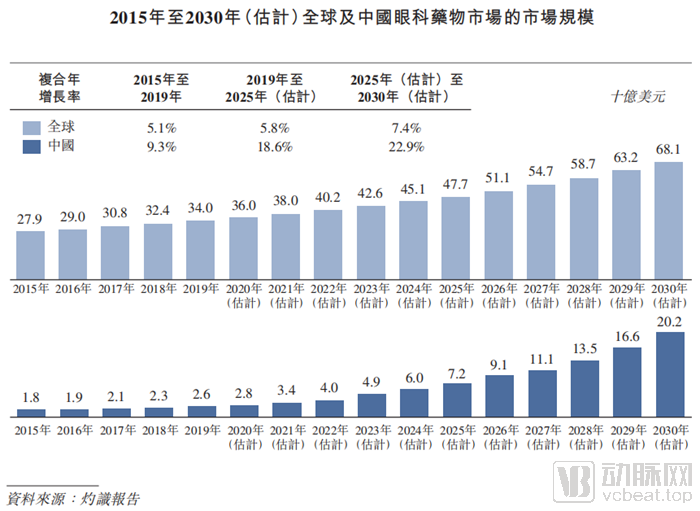
Comparison of Historical and Projected Market Sizes for Ophthalmic Drugs in China and Globally (Source: Prospectus)
The primary growth drivers and trends in China's ophthalmic drug market are reflected in four aspects:
The Large Population of Ophthalmic Diseases Caused by Aging and Environmental Factors
The primary symptoms of ophthalmic diseases are typically chronic, and their incidence increases significantly with age. Due to the rapid aging of China’s population, coupled with other variables contributing to a higher prevalence of ophthalmic diseases—such as excessive use of electronic devices, air pollution, and other risk factors—the large patient population with ophthalmic diseases in China is expected to continue growing rapidly.
Rising Demand for Ophthalmic Care
From 2015 to 2019, the number of ophthalmic visits per million population in China increased from 98 to 128, and the number of hospitalized patients receiving ophthalmic care rose from 4.2 million to 6.2 million. With continuous improvements in living standards, the increasing maturity of ophthalmic care infrastructure, and growing public awareness of the economic, occupational, social, and psychological burdens associated with visual impairment, the demand for ophthalmic care in China is expected to continue growing.
Favorable Policies Drive Rapid Growth of Innovative Drug Companies
In line with the global trend of innovative drug development, policy incentives driven by China’s pharmaceutical reforms are promoting the research, development, and commercialization of innovative drugs. Furthermore, during the 13th Five-Year Plan period, the national “Eye Health Plan (2016–2020)” was introduced, which increased resource allocation for ophthalmic care and reduced the costs associated with the control and management of eye diseases. These policies will accelerate the approval and registration of new drugs addressing urgent unmet clinical needs in the field of ophthalmology.
Growing Patient Affordability and Expanding Government Reimbursement Coverage for Ophthalmic Drugs
With the rapid growth of per capita annual income in China, patients’ willingness and ability to pay for more expensive medications, including innovative drugs, have been continuously increasing. Furthermore, the expansion of reimbursement coverage for the treatment of various diseases, including ophthalmic conditions, has further enhanced the affordability of ophthalmic drugs.
Zhaoke Ophthalmology leverages China’s vast demand for ophthalmic medical care as its entry point,Established a comprehensive ophthalmic drug pipeline comprising 13 innovative drugs and 12 generic drugs (classified in accordance with the National Medical Products Administration’s Measures for the Administration of Drug Registration). The innovative drug pipeline includes eight candidate drugs, each with the potential to become a leading product in the Chinese market upon approval. The generic drug pipeline includes six drugs that are potential first-to-market generics in China, which will generate near-term cash flow for Zhaoke Ophthalmology and provide significant advantages in commercial-scale manufacturing and marketing.
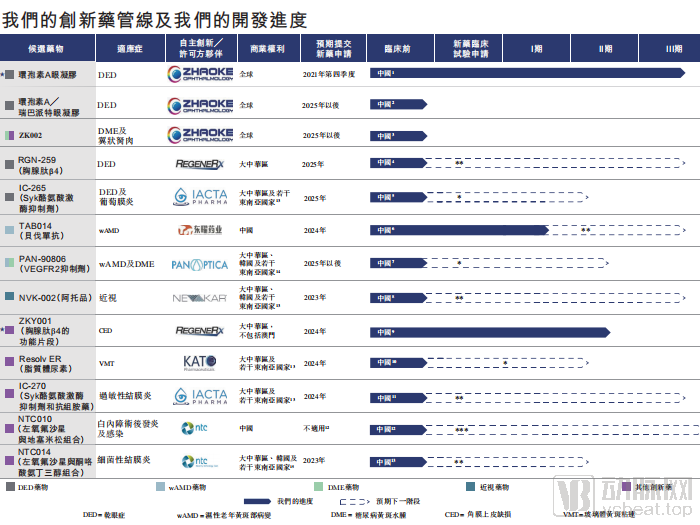
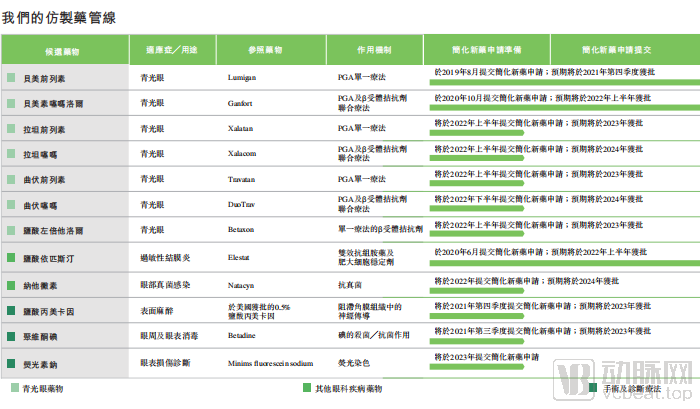
Drug Pipeline, Image Source: Prospectus
Zhaoke Ophthalmology’s pipeline focuses on five major ophthalmic indications in China: dry eye disease (DED), wet age-related macular degeneration (wAMD), diabetic macular edema (DME), myopia, and glaucoma.
Dry Eye Disease
Dry eye disease is one of the most common ocular disorders in China and worldwide. It is a complex ocular surface disease of multifactorial etiology, characterized by inflammation and a variety of symptoms. Moderate-to-severe cases of dry eye disease are typically treated with anti-inflammatory medications. According to data, the market size for dry eye disease therapeutics in China is projected to grow from USD 430.1 million in 2019 to USD 6.7 billion in 2030, representing a compound annual growth rate (CAGR) of 28.4%.
Zhaoke Ophthalmology has four innovative drug candidates in its pipeline, including: Cyclosporine A Ophthalmic Gel, RGN-259, Cyclosporine A/Rebamipide Ophthalmic Gel, and IC-265. Of particular note is Zhaoke Ophthalmology’s self-developed Cyclosporine A Ophthalmic Gel, which is an ophthalmic gel formulation of the world’s best-selling cyclosporine A compound and can serve as a foundational therapy for moderate to severe dry eye disease.
Cyclosporine A Ophthalmic Gel is Zhaoke Ophthalmology’s late-stage core product based on the cyclosporine A compound for the treatment of dry eye disease, with the ongoing Phase III clinical trial expected to be completed in the third quarter of 2021. Compared with Restasis, the first cyclosporine A ophthalmic drug approved in the United States (an oil-based emulsion), Zhaoke Ophthalmology’s cyclosporine A formulation is an innovative hydrogel that enables faster spread and prolonged retention on the ocular surface.
In relevant in vitro preclinical studies, Zhaoke’s cyclosporine A ophthalmic gel demonstrated significantly higher local bioavailability in the tear film and ocular surface tissues than Restasis. Additionally, it offers advantages such as less frequent dosing and no discomfort at the site of administration.
Wet Age-Related Macular Degeneration
Wet age-related macular degeneration is the leading cause of vision impairment and blindness among individuals aged 50 and older in China and worldwide. Data indicate that the market size for wet age-related macular degeneration drugs in China is projected to grow from USD 241.5 million in 2019 to USD 3.5 billion in 2030, representing a compound annual growth rate (CAGR) of 27.5%.
Wet age-related macular degeneration is a chronic, progressive disease. The standard treatment typically involves intravitreal injections of anti-VEGF drugs at one- or two-month intervals. Chronic treatment usually lasts for 4 to 5 years, imposing a significant burden on patients due to the invasive nature of intravitreal anti-VEGF therapy and the high cost of originator drugs.
In this regard, Zhaoke Ophthalmology has two corresponding drug candidates: PAN-90806, an anti-VEGF agent formulated as a novel eye drop, which is expected to significantly reduce the required injection frequency and become a convenient maintenance therapy for wet age-related macular degeneration; and TAB014, the first bevacizumab biosimilar antibody in clinical development in China for the treatment of wet age-related macular degeneration.
Diabetic Macular Edema
Diabetic macular edema is the leading cause of blindness among diabetic patients worldwide. China has a large population of individuals with diabetes, resulting in a high prevalence of diabetic macular edema. Data indicate that the market size for diabetic macular edema therapeutics in China is projected to grow from USD 250.0 million in 2019 to USD 2.6 billion in 2030, representing a compound annual growth rate (CAGR) of 23.8%.
Standard therapies for diabetic macular edema (DME) in China include anti-VEGF agents and anti-inflammatory corticosteroids, both administered via intravitreal injection at prescribed intervals. Zhaoke Ophthalmology currently has two related innovative drug candidates in development: ZK002, a protein utilizing a novel dual mechanism of action to inhibit inflammation and vascular fluid leakage; and PAN-90806, a novel anti-VEGF agent formulated as an eye drop.
Myopia
Myopia is one of the most common eye diseases worldwide. Data shows that in 2019, the number of myopia patients in China reached 700 million, accounting for approximately half of the global myopic population. The market size of myopia drugs in China is projected to grow to USD 3 billion by 2030. Among these patients, 162.8 million are adolescents and young adults (aged 6 to 22 years), a population in which pharmacological interventions can help slow the progression of myopia.
Currently, there are no effective drugs available in China to slow the progression of myopia. NVK-002, an investigational product from Zhaoke Ophthalmology, is an innovative, stabilized, low-concentration atropine formulation designed to delay or slow myopia progression. As a potential new drug, NVK-002 features a proprietary formulation that successfully addresses the instability issues associated with low-concentration atropine. NVK-002 is also one of the most advanced atropine candidates globally for controlling myopia progression and has the broadest target patient population (ages 3 to 17).
Glaucoma
Glaucoma is the second leading cause of blindness worldwide. Data indicates that the market size of glaucoma drugs in China is projected to grow from USD 162.7 million in 2019 to USD 2 billion in 2030, representing a compound annual growth rate (CAGR) of 25.4%. Glaucoma is a chronic, progressive disease associated with elevated intraocular pressure that leads to optic nerve damage. Intraocular pressure depends on the balance between the production of aqueous humor and its outflow from the eye.
Major glaucoma medications fall into two categories: prostaglandin analogs (which increase aqueous humor outflow) and beta-blockers (which reduce aqueous humor production). Glaucoma is a lifelong condition that generally cannot be controlled over time with monotherapy, necessitating the use of combination therapies. Zhaoke Ophthalmology has seven comprehensive glaucoma drug candidates in its pipeline, including three prostaglandin analogs (PGAs), one beta-blocker, and three fixed-dose combinations.
In addition, Zhaoke Ophthalmology’s core product portfolio includes ZKY001, which is currently in Phase II clinical trials. It treats corneal epithelial defects by exerting anti-inflammatory effects and stimulating epithelial cell migration. Compared with widely used growth factor therapies (such as rh-EGF and rb-bFGF agents) that stimulate angiogenesis and may induce edema and inflammation, ZKY001 demonstrated superior in vivo efficacy in reducing corneal edema and inhibiting abnormal ocular neovascularization in preclinical animal models. In a Phase I clinical trial, ZKY001 exhibited good tolerability across all concentration levels.
Currently, Zhaoke has no products approved for commercial sale and has not generated any revenue from product sales. For the years ended December 31, 2019 and 2020, Zhaoke recorded net losses of RMB122 million and RMB727 million, respectively, primarily due to the Company’s research and development expenses and finance costs (mainly referring to changes in the carrying amount of financial liabilities recognized in respect of the redemption amounts and conversion features of Series A Preferred Shares and Series B Preferred Shares).
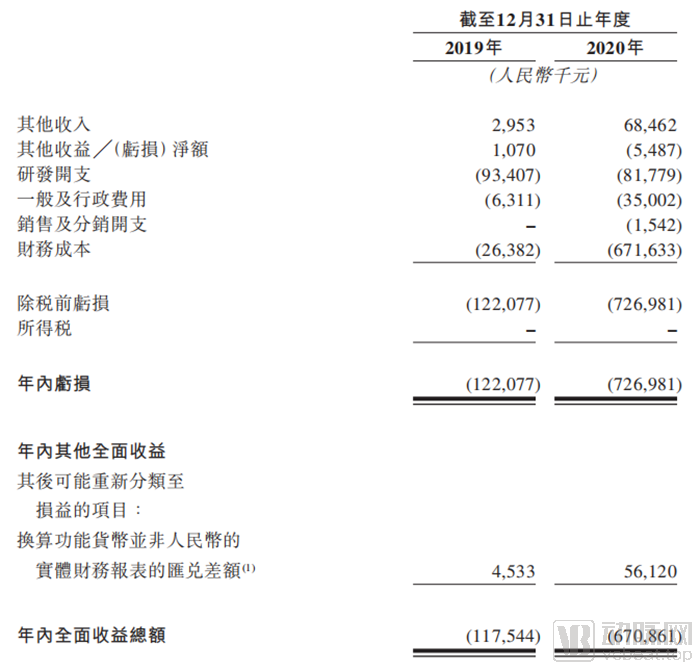
Source: Prospectus
Zhaoke Ophthalmology’s product pipeline includes candidate drugs at various stages of development.One of its core products, Cyclosporine A Ophthalmic Gel, is currently in Phase III clinical trials and is scheduled to submit a New Drug Application to the National Medical Products Administration in the fourth quarter of 2021.
In addition, another core product, ZKY001, initiated Phase II clinical trials in November 2020 to evaluate its efficacy and safety, with plans to commence Phase III clinical trials in the second half of 2022 and is expected to submit a New Drug Application to the National Medical Products Administration in 2024.
Zhaoke plans to submit Abbreviated New Drug Applications (ANDAs) for nine generic drug candidates over the next three years. The company expects to launch three generic drugs by 2022, namely bimatoprost, epinastine hydrochloride, and bimatoprost/timolol.
Recently, Zhaoke Ophthalmology signed an agreement with the Singapore Eye Research Institute (SERI) in January 2021. The agreement includes using SERI’s preclinical models for testing and collaborating with Zhaoke Ophthalmology’s compounds to establish a partnership in the field of ophthalmic drug research and development. In February 2021, Zhaoke Ophthalmology entered into a license and supply agreement with NTC regarding the exclusive licensing and distribution rights of NTC010, granting Zhaoke Ophthalmology the exclusive license to distribute and sell NTC010 in China.
Going forward, Zhaoke Ophthalmology will accelerate the clinical development, regulatory approval, and commercialization of innovative drug candidates through internal research and strategic partnerships. By rapidly commercializing its generic drug pipeline to establish a marketing foundation and gain market momentum, the company is committed to becoming a leader in the ophthalmic pharmaceutical markets of China and neighboring ASEAN countries.