

WeDoctor Targets Membership-Based Health Management as a New Growth Engine in the Healthcare Industry
An increasing number of enterprises are adopting membership models to deliver more precise services and identify their own growth frameworks. For instance, Amazon launched its Prime membership in 2005; it now boasts over 100 million members globally, with average spending 4.5 times that of non-Prime customers. Although paid membership programs started later in China, JD.com seized the early-mover advantage by introducing its PLUS membership in 2015. By the 2020 “Double 11” shopping festival, its member base had surpassed 20 million. Subsequently, other paid membership schemes were rolled out, including Taobao’s 88VIP and Pinduoduo’s Money-Saving Monthly Card.
In the healthcare sector, membership models have also proven effective. Last August, Livongo, a chronic disease management company acquired by digital health giant Teladoc, had over 400,000 members with chronic conditions, generating an average annual revenue per user (ARPU) of approximately RMB 3,700. In China, the digital healthcare service platform Weiyi provides health maintenance services to users through membership-based and customized service models. It is reported that as of December 31, 2020, its digital chronic disease management service had accumulated more than 145,000 members, with an ARPU of around RMB 3,600 in 2020. Recently, Weiyi upgraded its membership services and launched the “7+1” Health Maintenance Plan, which covers smart health devices, premium health check-ups, family physician services, health management plans, and exclusive insurance, offering members one-stop closed-loop medical services.
Currently, China is grappling with severe challenges, including an accelerating aging population, a surge in patients with chronic diseases, and rapidly escalating healthcare costs. Against this backdrop, the state has repeatedly emphasized that “health is the most important indicator of a happy life” and advocated for a shift from a “disease-centered” to a “health-centered” approach, aiming to meet the diverse health needs of different populations.
In the future, with rising disposable incomes and heightened health awareness, membership-based and customized service models will become the “backbone” of the healthcare sector.
Authoritative data indicate that China has over 300 million people living with chronic diseases, which account for more than 70% of the total disease burden. Relevant authorities have specifically formulated the Medium- and Long-Term Plan for Chronic Disease Prevention and Control in China, aiming to strengthen chronic disease prevention and control efforts, reduce the disease burden, and increase residents’ healthy life expectancy.
However, the comprehensive and complex nature of the etiological factors of chronic diseases determines that prevention and control efforts will be long-term and arduous. Precisely addressing the diverse needs of patients requires a foundation built on comprehensive, long-term, and dynamic understanding of each patient.
In the early stages of industry development, companies such as Lifesense Medical began to enter the chronic disease management sector through basic hardware, providing members with health monitoring, exercise assistance, health information, and health reminders via devices such as mobile apps, fitness trackers, blood pressure monitors, and glucose meters. Pharmaceutical e-commerce platforms like Ali Health also analyze user browsing habits to establish monthly Member Days, delivering targeted promotions and offering discounts on health supplements and medications for members.
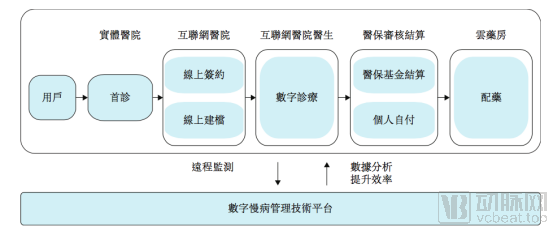
The emerging model of internet hospitals holds promise as an effective tool for the continuous management of chronic diseases. Taking WeDoctor, which established China’s first internet hospital, as an example, it leverages its internet hospital platform to provide users with membership-based health maintenance services aimed at improving health indicators.
Through data interoperability, internet hospitals can create digital health profiles for members, enabling physicians to regularly monitor and track their health status, implement personalized treatment and rehabilitation plans, provide prescription renewals and medication dispensing, monitor health indicators, and offer professional guidance on diet and exercise, thereby further improving members’ health outcomes.
Unlike the individual payment models prevalent in other sectors, membership-based health management services in the healthcare industry are primarily paid for by B-side entities, which ultimately bear the cost for members’ health outcomes.
Regardless of the sector, every successful membership model is underpinned by a virtuous cycle among service experience, cost, and service scale. When service providers deliver exceptional value in products, services, and experiences to members, they can achieve greater service scale; larger scale facilitates lower service costs while enabling the addition of diverse value-added services; lower costs make paying customers more willing to subscribe, thereby further expanding scale.
In August 2019, WeDoctor launched the first city-level digital chronic disease management service in Tai’an, Shandong Province. By fostering close collaboration between its internet hospital and offline public hospitals, the initiative provides local members with continuous and comprehensive digital chronic disease management services, including online follow-up consultations, remote monitoring, prescription renewals and medication dispensing, and health guidance.
In just over a year, WeDoctor helped Tai’an achieve an effective improvement in the efficiency of its citywide healthcare system, reducing the average consultation time for local patients with chronic diseases from 2–3 hours to 30 minutes, lowering the average prescription cost per visit for chronic diseases by 12.7%, and decreasing total public health insurance fund expenditures for chronic disease care.
Reforms to healthcare insurance payment methods are also building on a diversified payment framework, with a focused push toward diagnosis-related group (DRG) and capitation-based payments. By adopting bundled payment models, these reforms incentivize healthcare institutions to shift their focus from disease treatment to health protection and disease prevention, thereby paying for health outcomes. This membership-based management approach, which prioritizes improvements in health outcomes, aligns well with the prevailing reform trends.
Commercial insurance companies are also leveraging digital health platforms to explore innovative products aimed at improving health outcomes. Only by enhancing the health status of their members can commercial insurers achieve the goals of controlling medical expenditure, reducing claims and operational costs, and ultimately paying for better health outcomes. Taking the collaboration between WeDoctor and AIA Insurance as an example, they have launched single-disease health insurance products covering conditions such as female breast cancer and childhood leukemia. By providing members with end-to-end services spanning prevention, medical consultation, and medication, they have established a closed-loop online-offline service model for specific diseases, thereby improving members' health outcomes. In addition, regional inclusive insurance plans, represented by Shandong’s “Qilu Bao,” offer local enrollees flexible options for supplementary commercial medical insurance and digital health services, serving as a significant complement to basic medical insurance.
It is evident that the growing public demand for health services is compelling payers to adopt more effective membership-based health maintenance models. The evolution of such membership models—from inception and formation to achieving comprehensive scale—requires continuous advancement and accumulation of expertise. Amidst the current surge in health demands, digital-enabled membership-based health maintenance services are gradually emerging as a new growth engine for the healthcare industry. This shift truly enables users to benefit from industrial and societal development, realizing the vision of “health for all, well-being for all; happiness for every individual, prosperity for the entire population.”