

Cosmo Pharmaceuticals NV Files Prospectus Highlighting Breakthrough AI-Powered Colonoscopy System GI Genius™ and €60M+ Revenue
Cosmo Pharmaceuticals
Gastrointestinal Disease Drug Manufacturer
On April 12, Cosmo Pharmaceuticals NV (hereinafter referred to as “Cosmo”) announced that its GI Genius™, an AI-powered endoscopic detection system for colorectal lesion detection, has received FDA approval. This marks the first product in its class to gain FDA approval through the De Novo pathway.
Mauro Ajani, Chairman of Cosmo Pharmaceuticals, stated that FDA approval represents significant positive news for the company and serves as a major milestone in its multi-year investment in the field of gastrointestinal diseases, marking Cosmo’s position at the forefront of therapeutic innovation.
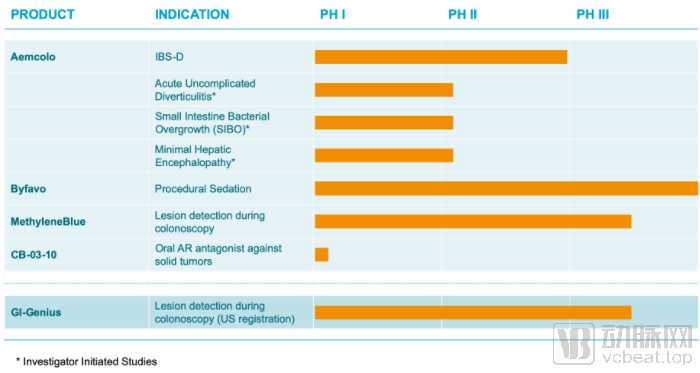
The company specializes in gastroenterology and endoscopy, with its current product pipeline as follows:
Source: Cosmo Official Website
Among them, Aemcolo is a novel antibiotic designed based on Cosmo’s MMX Technology®. ByFavo is a sedative indicated for all procedural sedation, including colonoscopy. Methylene Blue is a diagnostic agent that enhances the detection of precancerous lesions and cancer during colonoscopy. CB-03-10 is an oral androgen receptor (AR) antagonist for the treatment of solid tumors. GI Genius is an AI-powered endoscopic detection system.
GI Genius™, AI Detection of Colorectal Lesions
Colorectal cancer is one of the most common malignant tumors. According to the 2018 China Cancer Statistics Report, the incidence and mortality rates of colorectal cancer in China ranked third and fifth, respectively, among all malignant tumors. Most patients are diagnosed at an intermediate or advanced stage, with survival rates significantly lower than those for early-stage disease.
Yet it is actually the most preventable cancer, with early diagnosis and screening being key. Multiple large-scale studies have demonstrated that early diagnosis and screening for colorectal cancer yield significant benefits in reducing incidence and mortality rates, as well as alleviating the economic burden of the disease.
In early screening protocols, colonoscopy is one of the most common methods. In recent years, particularly with the advancement of new technologies, the integration of AI with colonoscopy has ushered in a new era for this procedure.AI-assisted colonoscopy not only efficiently aids physicians in performing colonoscopies, thereby improving efficiency, but also helps reduce the miss rate and enhance screening accuracy.
GI Genius™ is a novel AI-based endoscopic detection system that serves as an adjunctive aid for colonoscopy.It functions as a virtual second observer, meaning that during colonoscopy procedures performed by physicians, GI Genius™ can also identify and assess the intraluminal environment.
Second Observer: Enhancing the Accuracy of Colonoscopy Detection
GI Genius™ leverages the company’s established colonoscopy video database to perform deep learning on extensive lesion image data. It then employs computer-aided detection during colonoscopy for real-time analysis.Studies have demonstrated that its detection speed is 82% faster than that of physicians; it also exhibits exceptionally high sensitivity, with a misdiagnosis rate of less than 1%, regardless of lesion size or morphology.
It does not impose high demands on physicians’ technical skills; instead, it can mark the detected lesions, thereby improving diagnostic accuracy, reducing missed or undetected colorectal lesions, and increasing the adenoma detection rate (ADR). It is reported that for every 1% increase in ADR, the risk of patients developing colorectal cancer (CRC) decreases by 3%.
A randomized trial of GI Genius™ found that it increased the adenoma detection rate (ADR) by nearly 30% and boosted the likelihood of polyp detection by 50%, significantly enhancing the efficiency and accuracy of screening.
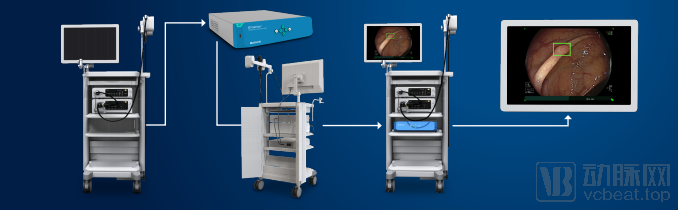
The GI Genius™ is simple and easy to use; it can be integrated with existing endoscopy equipment by simply connecting to the current endoscope, video processor, and monitor.。It is currently compatible with endoscopy equipment from major brands on the market, enabling seamless integration without requiring any changes to the colonoscopy procedure itself.
Source: Cosmo Official Website
CE and FDA certified, with market recognition
Cosmo and Medtronic have entered into a partnership to jointly launch GI Genius™. Under this agreement, Cosmo is responsible for the production of GI Genius™, while Medtronic handles its global sales.
GI Genius™ quickly garnered market attention upon its launch. Over the three years from 2019 to present, GI Genius™ has successively obtained CE marking, approvals in Australia, the United Arab Emirates, and Israel, and more recently, FDA clearance.
In April this year, after receiving FDA approval, Alessandro Della Ché, CEO of Cosmo, stated: “Through the global distribution partnership with Medtronic, we are pleased to secure an opportunity valued at least $1.1 billion. This opportunity lies in the AI-powered colonoscopy detection market, and we will leverage Medtronic’s substantial commercial advantages in the United States to rapidly develop this market.”
Multiple drug products focused on the treatment of gastrointestinal diseases
Cosmo's strength in product R&D lies in its close collaboration with physicians, which provides a continuous stream of clinical insights, enabling targeted product design.thereby enhancing the prevention and treatment of gastrointestinal diseases, improving endoscopic detection quality, and addressing unmet clinical needs.
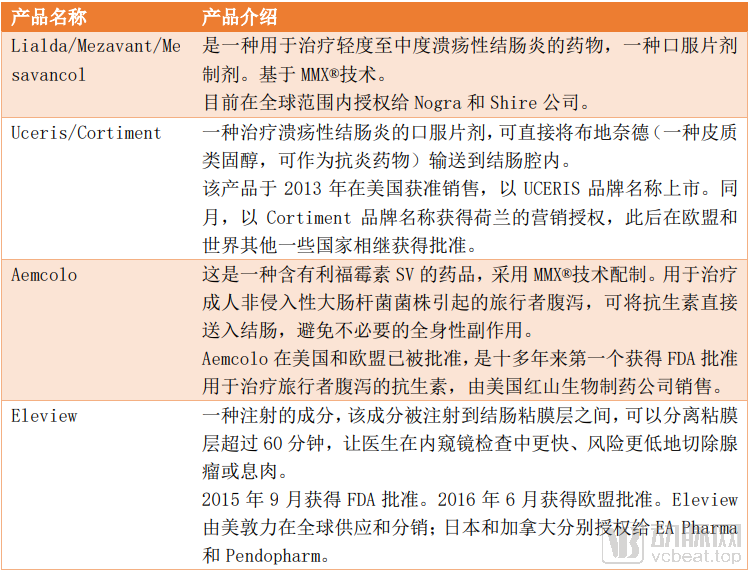
GI Genius™, as an intelligent medical device, is a crucial component of Cosmo’s portfolio and represents the direction of its future business expansion. Additionally, another key part of Cosmo’s portfolio comprises pharmaceutical products for gastrointestinal diseases, as shown in the table below:
Source: Cosmo Official Website
Cosmo Pharmaceuticals' MMX® patented technology is the core of its pharmaceutical products, this technology coats the surface of drug tablets with an acid- and alkali-resistant acrylic copolymer, enabling the majority of the active pharmaceutical ingredient (API) to reach the intestine smoothly and ensuring that the drug’s efficacy is fully realized.
24 Years of Dedication, Revenue Exceeding €60 Million
Cosmo Pharmaceuticals was founded in 1997, initially as a manufacturing facility in Milan acquired by the Cosmo S.p.A. Foundation from Parke-Davis (now part of Pfizer Inc.).After 24 years of development, it has now become a mature publicly listed company, with full-year revenue of €60.9 million in 2020 and cash and liquid investments exceeding €210 million.
Over the past decade, Cosmo has experienced rapid development, with simultaneous emphasis on product R&D and market expansion.According to data from its official website, the company conducts clinical studies on related products every year to demonstrate their efficacy and expand its product portfolio.
The next step in R&D is to continuously secure market approvals. Cosmo primarily promotes its products across various markets by signing distribution agreements or licensing deals with local companies. From individual countries to entire continents, and from obtaining CE marking in Europe to securing FDA approval in the United States, Cosmo has been expanding its market presence at a rapid pace.
For example, its collaboration with RedHill Biopharma. Following their initial partnership, the two companies expanded their cooperation for two consecutive years. In October 2019, they first established a strategic partnership, which included an exclusive U.S. licensing agreement for Aemcolo® and Cosmo’s $36.3 million investment in RedHill. The following year, they signed multiple exclusive licensing and manufacturing agreements for various products with RedHill, further expanding their strategic alliance to jointly develop a novel therapy for the eradication of Helicobacter pylori infection. This year, the two parties reached another agreement to expand the production of a novel oral inhibitor.
Furthermore, Cosmo has expanded its commercial footprint by holding equity stakes in multiple pharmaceutical companies through collaborations and spin-offs.It currently holds a 46.56% stake in Cassiopea, a 19.6% stake in Hongshan Biopharmaceutical Co., Ltd., a 20.52% stake in Acacia Pharma Group, and a 7.91% stake in PAION AG.
By 2024, Cosmo has grown into a major player in the field of gastrointestinal disease treatment.
The preceding section introduced Cosmo Pharmaceuticals’ AI-powered endoscopic detection aid, GI Genius™, for early colorectal cancer screening, noting its promising market prospects. This is due to the earlier emphasis on early colorectal cancer screening and the more mature market development in Europe and the United States.
Although China’s colorectal cancer early screening sector started late, it has experienced rapid growth in recent years, evolving into a market worth hundreds of billions of yuan and fostering numerous leading players.
According to VCBeat’s previous article on the colorectal cancer early screening industry (“A Trillion-Yuan Market: The Colorectal Cancer Early Screening Industry Heats Up Rapidly, with Innovative Detection Methods Such as Blood Tests, Stool-Based Assays, and AI Imaging Gaining Momentum”) Introduction: On the one hand, China’s policies are vigorously promoting the development of early screening for colorectal cancer; on the other hand, new technologies and approaches have emerged in this field, attracting significant interest from investors.
New technologies for early screening of colorectal cancer include blood tests, stool tests, and AI-assisted detection. Among these, Genetron Health, Bo’ercheng, and Junshan Biotechnology primarily employ methods to detect circulating tumor DNA (ctDNA) fragments in the blood; New Horizon Health, ClearMed Biotech, and RayBiome mainly identify colorectal cancer by extracting human cells from stool samples to perform methylation mutation analysis. In the field of AI-based medical imaging, Tencent Miying launched China’s first real-time AI screening system for colorectal tumors in 2018.
In addition to the colorectal cancer early screening technologies that have already been developed or launched on the market, many teams in China are still conducting research in this field. Although there is still a long way to go for the popularization of early screening for colorectal cancer, our pace is accelerating.