

Scarab Genomics Files IPO Prospectus: Pioneering Clean Genome® E. coli Platforms Across 17 Products and Four Key Applications

Scarab Genomics
Protein Vaccine Developer
Strictly speaking, the human body is a complex composite formed by microorganisms and human cells themselves. The ratio of microbial cells to human cells is as high as 9:1, and among these hundreds of millions of microorganisms, the gut microbiota constitutes a significant portion.
When discussing the gut microbiota, it is essential to mention Escherichia coli (E. coli), also known as Escherichia coli. It was discovered in 1885 by Theodor Escherich, a German-Austrian pediatrician, who named it “Bacterium coli commune.”
In 1919, thirty-four years after its discovery, scientists formally adopted *Escherichia* as the genus name for *E. coli* in honor of Escherich. The binomial name *Escherichia coli* and its abbreviation *E. coli* subsequently began to appear in textbooks and scientific literature.
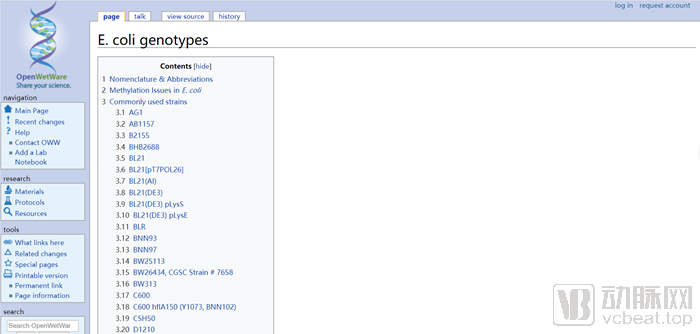
Complete Information on Different Strains of Escherichia coli. Image source: OpenWetWare website
Under normal circumstances, the human body maintains a mutualistic symbiotic relationship with Escherichia coli (E. coli), which plays a crucial role in stabilizing gastrointestinal function. It inhibits the growth of proteolytic bacteria in the intestine and reduces protein decomposition. Furthermore, E. coli synthesizes vitamin B and vitamin K in the body, both of which help maintain normal gastrointestinal function and promote gastrointestinal metabolism.
However, when human immune function declines and gastrointestinal flora (such as Escherichia coli) becomes imbalanced, E. coli can cause diseases such as gastrointestinal infections, urinary tract infections, arthritis, meningitis, and septicemia.
The functions of Escherichia coli are not limited to human metabolism; it has broader applications in genetic engineering, bioenergy, microbial industry, and model organism research.To date, multiple Nobel Prizes in Physiology or Medicine have been awarded to scientists who conducted research using Escherichia coli.
These studies include Joshua Lederberg, who won the Nobel Prize in 1958 for his discovery of genetic recombination and the organization of the genetic material of bacteria; Werner Arber and others, who won the prize in 1978 for their discovery of restriction enzymes and their application to molecular genetics; Paul Berg and others, who won the prize in 1980 for their development of recombinant DNA (deoxyribonucleic acid) technology; and Tomas Lindahl, Paul Modrich, and Aziz Sancar, who won the prize in 2015 for their mechanistic studies of DNA repair.
Given the substantial scientific contributions of *Escherichia coli*, where does it originate? Is it feasible to directly use *E. coli* derived from human or animal metabolic processes for experimental purposes? Certainly not; instead, specialized cell factories are required to mass-produce commercially viable *E. coli* strains better suited for research and industrial applications.
Scarab Genomics, LLC (hereinafter referred to as “Scarab”) was founded in 2002 and is located in Madison, Wisconsin, USA.
The company is a private enterprise founded by University of Wisconsin geneticist Fred Blattner. Its primary business involves the commercialization of the Clean Genome™ Multiple Deletion Series (MDS) Escherichia coli, leveraging technology developed by Dr. Fred Blattner during his tenure at the University of Wisconsin–Madison. As a result, Scarab has also been supported by the Wisconsin Alumni Research FoundationPatented Simplified Genomic Technology Worldwide.
Scarab Genomics engineers E. coli by deleting over 15% of the K-12 genome. Using synthetic biology approaches, it performs precise deletions, including the removal of unnecessary genes, recombinant and mobile DNA elements, and cryptic toxic genes, to optimize E. coli strains for production, yielding variants with enhanced genetic stability and superior metabolic efficiency.
Compared with traditional commonly used Escherichia coli strains, clean-genome E. coli strains offer the following unique advantages in laboratory cloning, plasmid DNA production, and recombinant protein expression:Advantages: Reduced host-mediated recombination and non-clonability, absence of IS elements to maintain clone integrity, streamlined genome for more concise editing, higher growth density, and increased yield.
Scarab has developed five series of products using its clean-genome E. coli technology, thisThe five series are the Carrier Protein Series, Chemically Competent Cells Series, Electrocompetent Cells Series, IS (Insertion Sequence) Detection Series, and Protein Expression System Series, comprising 17 product categories.
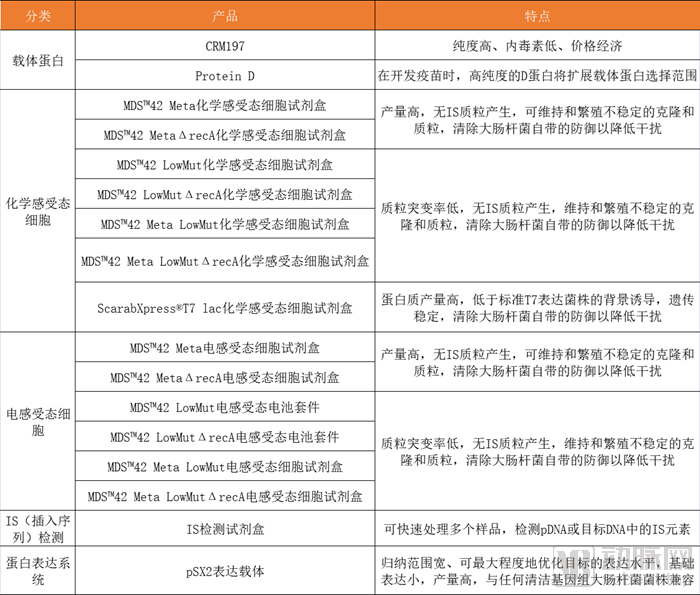
Five Series, 17 Products
These products are primarily applied in four areas:
Plasmid-Free Production
Plasmid DNA (pDNA) vaccines have garnered attention due to the resolution of low antigenicity issues. These vaccines are highly attractive owing to their rapid development cycles, thermal stability, and cost-effective production via Escherichia coli fermentation. However, conventional E. coli strains contain mobile DNA elements within their genomes, including up to 65 insertion sequences (IS) and up to 11 types of partially defective bacteriophages.
Both bacteriophages and insertion sequence (IS) elements can be activated during the production process, leading to inconsistent fermentation outcomes. IS elements can also transpose into plasmid products, altering the sequence and function of therapeutic agents, which raises the concern that bacterial IS elements may integrate into the mammalian genome after administration. These issues can be eliminated by using multiple deletion strains (MDS) of Escherichia coli at all stages of pDNA production. These strains are precisely engineered, namelyRemoves all phage and transposon sequences。
Protein Expression
Recombinant proteins have a wide range of applications, including use in diagnostics, disease treatment, or industrial processes. Recombinant protein production is one of the most powerful techniques used in life sciences.
Recombinant protein expression appears straightforward: clone the DNA encoding the desired protein into an expression vector downstream of a promoter. Introduce this construct into host cells, which then synthesize and produce the target protein. In practice, however, protein expression is highly challenging, as the process is susceptible to numerous influencing factors.
Scarab Genomics’ ScarabXpress product enables higher expression levels for any given target protein. It allows for tighter control of expression, which is particularly beneficial for periplasmic targets and “toxic” targets that are detrimental to the host.In side-by-side comparisons using the same test protein, ScarabXpress2 yielded 29–36 times more test protein than E. coli BL21(DE3), with a 3,000-fold induction range.
Clone
Modern life sciences rely on molecular manipulation of organismal genomes to study individual target genes. Since DNA structure is conserved within a species, genes can be excised and inserted into another organism to express the modified gene. Typically, cloning refers to the replication of DNA in an organism other than its source; DNA cloning involves the replication, modification, and amplification of the target DNA. Cloning has become fundamental to molecular biology, with broad applications including the isolation of single genes, the expression and preparation of engineered genes, and protein production.
Scarab Genomics’ products in this field offer the following advantages:3000x Inductive Range, thereby maximizing the expression level of the target;Basic Expressions (Small), target genes or periplasmically expressed targets that reduce adverse effects on the host;High Yield, achieving up to a 36-fold increase in target yield compared with standard expression vectors in wild-type Escherichia coli strains; the ScarabXpress®-2 systemCompatible with any clean-genome Escherichia coli strain。
Production of Retroviral, Lentiviral, and shRNA Vectors
A common challenge encountered in pDNA production is the presence of stem-loop DNA structures, such as viral long terminal repeats (LTRs) or short hairpin RNAs (shRNAs), which are difficult to replicate and unstable. Clean genomic E. coli can significantly enhance the capability to produce low-yield and unstable pDNA vectors.
Similarly, vectors derived from adeno-associated virus (AAV) contain two inverted repeat sequences that form a 40-bp stem. At the termini, two additional 9-bp stem branches further terminate in loop structures. These two stem-loops themselves contain direct repeat sequences, which are particularly prone to deletion when propagated in standard Escherichia coli hosts.
Scarab Genomics used the adeno-associated virus pT-ITR-IL2 vector to transform MDS™42 and the non-reduced parental Escherichia coli strain.This clean-genome Escherichia coli strain with extreme secondary structure can address the challenge of unstable production of biopharmaceutical pDNA.
Scarab Genomics exports its products overseas through its product portfolio spanning five series and four application areas. This success is driven by the broad market adoption of its *E. coli*-based products, which are utilized in fields such as molecular biology, cell biology, bacteriology, genetics, immunology, biochemistry, proteomics, cell therapy, and clinical applications.
Last October, Professor Li Aitao’s team at Hubei University employed an artificial biosynthetic pathway to prepare adipic acid, a key intermediate in nylon production. By using biocatalysts and oxygen from the air as the oxidant, they achieved this synthesis in an aqueous solution under ambient temperature and pressure. This technology will be used to manufacture green, pollution-free nylon. During the same period, the synthetic biology company AbSci utilized its Escherichia coli expression platform, “SoluPro,” for the large-scale production of proteins, including full-length antibodies and insulin. This platform enables the generation of soluble, correctly folded proteins at exceptionally high titers.
In the future, Escherichia coli will enable an expanding range of applications, contributing to the advent of the bioeconomy era.