

AstraZeneca's Entrepreneurial Journey in China: Building an Integrated Healthcare Innovation Ecosystem

AstraZeneca Investment China
Pharmaceutical Manufacturer
Compared to lean, innovative biotech startups, the Top 10 pharmaceutical giants always seem to carry an air of gravitas. This is partly because most of these pharma titans have long histories, and partly because their business scales are so vast that they cannot be fully elaborated upon in a brief article.
If the industry were to select the most innovative multinational pharmaceutical company, “AstraZeneca” would undoubtedly be the first name that comes to mind. From in-house drug development to licensed commercialization, from supporting enhancements in medical service capabilities to promoting early screening and diagnosis in county-level regions, from exploring single-channel models to diversifying distribution channels, and from innovation incubation to capital collaboration… AstraZeneca has shattered the stereotypical image of traditional big pharma, frequently extending its innovative “tentacles” to pursue cross-sector strategies and engaging in deep collaborations with partners across pharmaceuticals, medical devices, diagnostics, digital health, and investment sectors.
Based on the business performance of numerous multinational pharmaceutical companies in China, AstraZeneca firmly holds a leading position. According to the latest data,More than 20% of AstraZeneca’s global revenue comes from China.
With a broad strategic footprint and frequent cross-sector expansions, what is AstraZeneca’s overarching strategy in China? The AstraZeneca China Ecosystem Conference recently held in Wuxi has, to some extent, provided us with the answer.
Wang Lei, Executive Vice President of AstraZeneca globally and President of International Business and China, stated in his keynote speech at the conference that,Since 1993, AstraZeneca China has introduced more than 40 innovative drugs to the Chinese market, and over the next five years, 50 new drugs and new indications are expected to be successively approved in China.

Wang Lei Delivers Keynote Address at Conference
Through independent R&D and collaborative drug development with external partners, AstraZeneca China is accelerating the delivery of innovative medicines to patients in China and around the world. In China, AstraZeneca is collaborating to promote the development and incubation of eight new drugs. Furthermore, AstraZeneca China is actively introducing and promoting other high-quality innovative therapies through strategic partnerships with domestic and international pharmaceutical companies. These medications include cutting-edge PD-1 monoclonal antibodies from China’s life sciences sector, multiple oncology drugs from India, and even traditional Chinese proprietary medicines.
In Wang Lei’s view, the distinction between in-house R&D and collaborative R&D seems less significant, and the boundary between self-developed, self-marketed products and those developed by others and distributed under agency agreements appears equally blurred. As long as it meets patient needs, AstraZeneca will pursue it. The phrase “patient needs” is not only the key to unlocking AstraZeneca’s cross-sector expansion but also the underlying logic behind its construction of a full medical industry chain and an innovative ecosystem.
For China’s universal health insurance payment system, the primary care sector represents a vast long-tail market; only by capturing this segment can one truly establish a foothold in China. But how can this primary care market be captured?
In a post-conference interview, Wang Lei mentioned,The biggest challenge facing primary healthcare institutions is inadequate diagnostic and treatment capabilities.This shortfall in diagnostic and treatment capacity has eroded public trust in primary healthcare institutions, leading patients to delay seeking care and to opt for tertiary hospitals when their conditions become severe. This dynamic is also the primary reason why most pharmaceutical companies struggle to penetrate the primary care market, often resulting in failed market entry.
For AstraZeneca, success in the primary care market does not rely solely on product superiority; rather, it requires sustained investment, beginning with empowering primary care diagnostic and treatment capabilities and supporting the development of integrated diagnosis-and-treatment solutions, thereby enabling residents at the grassroots level to access high-quality medical services close to home.
In Wang Lei’s words, “Where there was no Chest Pain Center, we supported the association in helping to establish one; where there was no nebulization therapy room—making asthma treatment inadequate—we also supported its construction. For patients with the ‘three highs’ (hyperglycemia, hypertension, and hyperlipidemia), we support integrating diagnostic and therapeutic capabilities for blood glucose, blood pressure, and blood lipids, so that all ‘three highs’ issues can be addressed within a single hospital.”
This is a process of market shaping. Taking nebulization centers as an example, by supporting the establishment of such centers at the primary care level, patients have gained access to more convenient and high-quality treatment options for respiratory diseases. The success of these nebulization centers has further reinforced AstraZeneca’s commitment to supporting the development of more patient-centric, integrated diagnostic and therapeutic solutions covering the entire disease journey, thereby bolstering its confidence in frequent “cross-industry” initiatives.
Today, AstraZeneca supports authoritative associations in building integrated diagnosis and treatment solutions for whole-course disease management. These initiatives—including the Gastrointestinal Tumor Prevention and Treatment Center, the China Chest Pain Center, the National Standardized Metabolic Disease Management Center, the Integrated Prostate Cancer Diagnosis and Treatment Center, and the Integrated Lung Cancer Diagnosis and Treatment Center—have been implemented in more than 7,000 hospitals across China. They provide integrated diagnostic and therapeutic solutions to residents in both major cities and grassroots markets, with some projects also promoted to countries and regions along the Belt and Road Initiative.
At the Ecosystem Conference, AstraZeneca announced that the Wuxi International Life Science Innovation Park (iCampus) has welcomed 11 domestic and overseas enterprises, including ZhiZhong Medical, Bloomage Biotech, Cutia Bio, Sunovo Pharmaceutical, CloudCheck Medicine, Zhide Mingchuang, and Kaimanke Medical, which have successfully signed agreements to settle in the park. Since its opening in 2019, iCampus has attracted over 40 tenant companies, covering innovative enterprises from various fields such as pharmaceuticals, medical devices, diagnostics, digitalization, and platform services, both domestically and internationally.
At the event, AstraZeneca Investment China announced that its Wuxi Innovation Park iCampus has undergone another upgrade:The Industrial Development International Life Science Innovation Park Fund, initiated by Wuxi Industry Jufeng Investment Management Co., Ltd. and the Administrative Committee of Wuxi High-Tech Zone, with participating support from AstraZeneca, has been officially announced, with an expected total fund size of USD 100 million.Positioned as a dedicated supporting fund to empower the ecosystem enterprises within the industrial park, this fund will target high-quality innovative companies in the life and health sectors, including medical devices, medical diagnostics, and digital health.
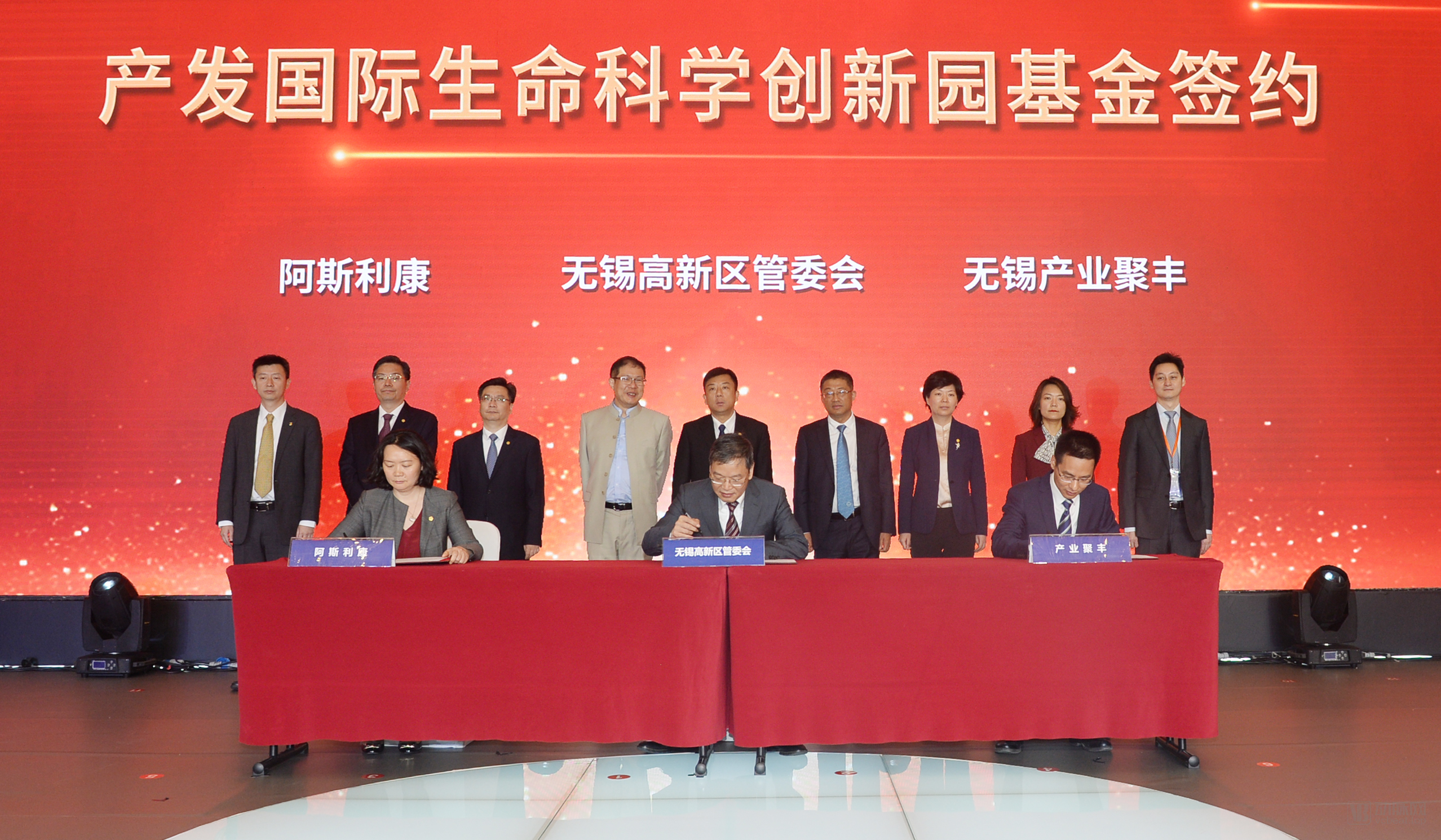
On-site Signing Ceremony
The global healthcare industry fund, jointly established by AstraZeneca and CICC Capital, signed investment intent agreements with three companies within the iCampus park—Abbisko Therapeutics, Deepwise Healthcare, and ZhiZhong Medical—during the conference. This also indirectly demonstrates that the $1 billion global healthcare industry fund set up by AstraZeneca and CICC Capital is actively open to promising projects within the iCampus park.
Furthermore, the Wuxi Innovation Park has officially unveiled its Phase II plan, with an estimated gross floor area of nearly 200,000 square meters. The Innovation Park model is also set to be implemented in Shanghai, Beijing, Hangzhou, Guangzhou, Chengdu, and Yixing. AstraZeneca Investment China will leverage Wuxi as a starting point to expand across China, continuously building an innovation ecosystem.
How Has iCampus, Open for Just Two Years, Rapidly Attracted Such a Large Number of High-Quality Domestic and International Enterprises?By examining the development trajectory of Guanhe Pharma, a star enterprise within the park, one can gain a deeper understanding of iCampus’s incubation and empowerment potential.
Guanhe Medicine is a central laboratory established as a joint venture between Dian Diagnostics and Tigermed, dedicated to providing one-stop central laboratory services for drug clinical trials from Phase I to Phase III, as well as post-marketing companion diagnostics. During the first half of 2020, amid the COVID-19 pandemic, Guanhe Medicine actively supported clinical trials for COVID-19 therapeutics including “Remdesivir,” “Kaletra,” and the “CanSino COVID-19 Adenovirus Vector Vaccine.” Collaborating with experts, it published research findings in top-tier medical journals such as The Lancet and The New England Journal of Medicine, establishing itself as a leading CRO central laboratory and medical testing institution in China.
On April 27, 2020, Guanhe Pharma signed an agreement to join iCampus. In June of the same year, Wuxi Guanhe Medical Laboratory officially commenced operations—less than two months after its formal entry into iCampus. In early August, Guanhe Pharma obtained qualifications for a medical testing laboratory. That November, Guanhe Pharma entered into a strategic agreement with AstraZeneca concerning homologous recombination deficiency (HRD) and companion diagnostic kits.
Xu Yi, General Manager of Guanhe Pharmaceutical, stated in a public interview,After settling into iCampus, the Wuxi municipal government provided extensive support, including tax and fee reductions, expedited approval processes, inter-enterprise exchanges, and investment and financing matchmaking services.These support measures have tangibly reduced corporate costs and improved the efficiency of resource integration, enabling Guanhe Pharma to devote greater energy to business development.
In addition,Leveraging AstraZeneca's omnichannel commercialization platform and global innovation network,Guanhe Pharma can receive support from AstraZeneca in areas such as domestic and international market insights, product concept validation, commercial innovation collaboration, sales licensing, and agency promotion. This will enable Guanhe to better understand market dynamics and patient needs, thereby fostering stronger synergy with ecosystem partners and accelerating business development.
Guanhe Pharmaceutical is undoubtedly a model of iCampus’s incubation success, with many similar cases to its credit. To further promote innovation exchanges between China and overseas markets, iCampus has leveraged the resources of AstraZeneca’s global innovation network to establish collaborations with eight internationally leading biopharmaceutical innovation parks.By linking internationally leading innovation parks and strategic partners, we gather innovative wisdom from home and abroad to provide an excellent platform for global collaboration.
>>>> Click the link to learn how iCampus empowers tenant enterprises
Among numerous cross-industry collaborations, internet healthcare is one of AstraZeneca’s key strategic priorities. At the 2020 China International Import Expo (CIIE), AstraZeneca announced a strategic partnership with Hillhouse Capital Group to support the development of its internet hospital projects.
Why Strategically Develop Internet Hospitals? Wang Lei stated that, on one hand, the deregulation of online prescription drug sales is a major trend, and internet healthcare platforms will play a crucial role; on the other hand, hospitals are overcrowded, and most patients discontinue medication because they wish to avoid hospital visits. Therefore, seizing the opportunity presented by “internet healthcare platforms” is an inevitable strategic move.
AstraZeneca’s internet hospital project, backed by Hillhouse Capital, aims to leverage the advantages of the internet and multi-channel marketing strategies to enhance the accessibility of medical services, rather than compete with traditional internet giants. In addition to this initiative, Wang Lei noted that the company will also engage in extensive collaborations with other major internet platforms and pharmaceutical partners to achieve complementary strengths and mutual growth.
We can see that AstraZeneca is frequently “crossing boundaries” and not playing by conventional rules. When asked whether AstraZeneca’s frequent forays into other sectors had gone beyond the scope of services typically provided by a pharmaceutical company, Wang Lei responded, “We are not concerned with how the outside world defines us. A pharmaceutical company’s business structure can remain unchanged or evolve accordingly; either way, it does not matter. We do whatever patients need.”
What kind of company will AstraZeneca become in the future? “It will certainly be an innovation-driven platform company that provides integrated services to patients. Of course, we will undoubtedly have commercial objectives. However, we believe that the starting point for any business innovation is to meet patient needs.”
In Wang Lei’s vision, the future AstraZeneca will also be a company that fulfills the diverse aspirations of young people. Young professionals at AstraZeneca can enjoy the stability of traditional employment, while also having the option to pursue their entrepreneurial dreams as the company leverages its platform advantages to drive business diversification.
Can this be interpreted as AstraZeneca itself embarking on an entrepreneurial path?
Note: AstraZeneca serves solely as a supporter for all innovative projects mentioned herein.