

Unlocking Smart Hospitals with Middleware: CHINC Interview with Alibaba Cloud VP Xie Wei
From April 23 to 25, the Hangzhou International Expo Center was abuzz with attendees as the 2021 China Hospital Information Network Conference (hereinafter referred to as CHINC) was in full swing. On the afternoon of April 23, Xie Wei, Vice President of Alibaba Cloud, delivered an insightful speech and granted an exclusive interview to VCBeat (WeChat ID: Vcbeat). In Mr. Xie’s view, multi-form “middle platforms” based on big data will be indispensable for the construction, management, and operation of smart hospitals in the future.
In July 2020, Liang Wannian, Director of the Department of System Reform under the National Health Commission, proposed the “Three Transformations and Three Improvements” for public hospitals at the State Council’s regular policy briefing held by the State Council Information Office on key tasks for deepening healthcare system reform in the second half of 2020.
The first shift is from a development model focused on expansion to one centered on connotative development, with an emphasis on improving quality. The second shift is toward connotative, intensive, and efficient management, primarily leveraging information technology to enhance efficiency. The third shift involves reallocating resources toward human resource development to boost motivation and improve the compensation and benefits of medical personnel.
On February 19, 2021, the 18th meeting of the Central Committee for Comprehensively Deepening Reforms approved the document “Opinions on Promoting High-Quality Development of Public Hospitals.” This further established “high-quality development” as the key developmental direction for public hospitals during the 14th Five-Year Plan period.
Xie Wei, Vice President of Alibaba Cloud, defined high-quality hospitals using the “Double U-Shaped” core framework. He posited that hospitals must first establish three fundamental baselines: quality and safety, equity and efficiency, and public welfare. Subsequently, specific core components encompass a series of detailed requirements, including organizational development, infrastructure and aesthetically pleasing environments, as well as modernized management and governance, ultimately achieving high-quality hospital development.
Meanwhile, hospitals must be capable of responding to a constantly evolving external environment. Guided by the goal of “high-quality development,” hospitals need to transform their service delivery systems and operational mindsets to adapt to industry reforms and development. Key areas of focus include external support and collaboration (involving policies, the broader environment, patients, etc.), changes in horizontal coordination (such as the development of medical alliances, medical consortia, and healthcare groups, as well as reforms in procurement and supply chains), and the introduction of new technologies (including novel management techniques, advanced clinical technologies and translational medicine, and emerging information technologies).
Furthermore, the public nature of hospitals in China necessitates that they also uphold their public welfare mandate. In particular, the COVID-19 pandemic has exposed certain shortcomings in China’s public health services. It is essential to strengthen the integration of administrative and functional systems, enhance emergency support and technological underpinnings for public health initiatives, and clearly define the framework of responsibilities for in-hospital public health services, thereby mitigating and resolving risks associated with major epidemics and sudden public health emergencies.
In alignment with these objectives, hospital administrators must place greater emphasis than ever on enhancing and strengthening the hospital’s brand, expanding and amplifying its service reach, bolstering and developing specialized clinical capabilities, improving and stabilizing staff performance, and increasing the proportion of high-value patients, thereby scaling up the hospital’s operations and strengthening its market position.
Xie Wei believes that while it is easy to talk about what makes a hospital “good,” putting it into practice is difficult. He stated, “Building a good hospital involves many factors; it must be multidimensional, multi-perspective, multimodal, and multifaceted. No single model can encompass all aspects of a hospital. Therefore, defining a good hospital and constructing its system is inevitably a highly complex endeavor.”
In the past, traditional hospitals adopted functional departments—such as human resources, finance, materials, facilities, and information technology—as their basic management units, resulting in a “siloed” organizational structure. This structure suffers from several critical pain points: it fails to accommodate changing demands, hinders the advancement of operational capabilities, lacks clear delineation of responsibilities, and cannot support rapid, high-quality, and efficient development.
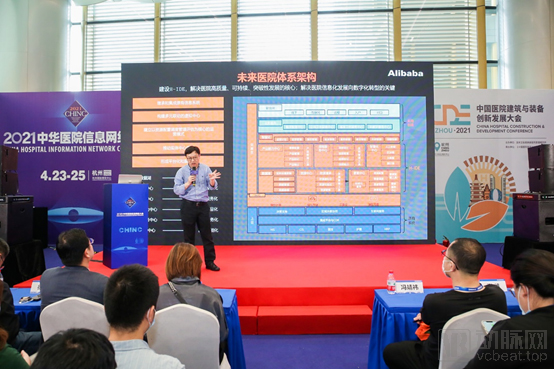
“Under this architecture, the hospital’s information technology infrastructure became locked in.” Upon recognizing this issue, hospitals adopting modern management practices have begun to transform. They are establishing centralized services with gradually unified standards in support areas such as logistics, physician management, patient services, payment processing, and pharmaceutical supply, thereby creating various “service centers.” Meanwhile, in clinical care, they are forming physical centers by directly allocating resources to these entities, establishing “business centers” to support the development of multidisciplinary and multi-specialty care. These “service centers” and “business centers” can be regarded as the early prototypes of the “middle platform” in smart hospitals.
Alibaba Cloud’s H-IDE (Hospital-Intelligent Development Engine, hereinafter referred to as H-IDE) further builds a “Future Hospital” operational model on top of the traditional middle-end platform. By transforming various resource elements—such as hospital beds, wards, operating rooms, and nurses—into standardized elements, productized offerings, and service-oriented solutions, it enables dynamic scheduling, adjustment, allocation, management, and evaluation. This approach establishes three critical services urgently needed by hospitals: the Product Capability Center, the Process Service Center, and the Intelligence Center.
According to Xie Wei, the H-IDE concept not only facilitates the reallocation of idle hospital resources but also analyzes the underlying causes of resource shortages, thereby identifying solutions that lay a solid foundation for achieving precision medicine and value-based healthcare. Alternatively, it enables healthcare institutions to further develop their core competencies, such as specialized centers, to gain competitive advantages.
“H-IDE focuses on the dynamic allocation, adjustment, and management of key resources across operational and managerial domains, followed by further monitoring, supervision, and evaluation. Building on this foundation, two major entity centers—business and service—are established, supported by numerous internal virtual centers. Taking the surgical center as an example, surgeons cannot perform effectively without adequate support from nurses and anesthesiologists. Therefore, these components must be integrated as essential elements managed and coordinated by H-IDE,” he stated.
Currently, Alibaba’s “middle-platform” concept has begun to be explored for application in the healthcare industry.
Tiantai County People's Hospital is a Grade III, Class B general hospital. In March 2019, the hospital comprehensively launched reforms of the Medical Community (Yi Gong Ti), taking the lead in establishing the only such consortium within the county. It manages all branch hospitals of Tiantai County as well as dozens of primary healthcare institutions. The Medical Community has set four objectives for its information architecture: unified top-down architecture, standardized service capabilities, efficient collaboration of business processes among all units within the consortium, and real-time monitoring and sharing of all data. These goals impose higher management requirements, necessitating that member units of the Medical Community achieve "integrated planning, a single cloud, and one network."
During the process of assisting hospitals in their development, XiNiu Medical, under Alibaba Health, and Alibaba Cloud proposed the implementation of business mid-end and data mid-end architectures. The business mid-end enables centralized management of all laboratory tests and diagnostic examinations within a unified resource pool across the medical consortium. This allows primary-level village clinics to schedule appointments with specialists at the main hospital or access test and examination results from the main hospital anytime and anywhere through the system. The data mid-end ensures standardized data protocols throughout the medical consortium. Previously, data standards varied among rural health centers; for instance, formats for complete blood count (CBC) data and department names differed across primary care institutions.

Alibaba Cloud Vice President Xie Wei
The digital transformation of The First Affiliated Hospital, Zhejiang University School of Medicine, addresses the challenges across its four main medical campuses. It was essential to establish network connectivity among these campuses. By leveraging Alibaba Cloud’s professional technologies, the hospital has implemented a three-tier network architecture and built a local active-active hybrid cloud platform with dedicated cloud data centers at both the Yuhang Campus and the main campus. This ensures secure, local active-active redundancy for both internal network application services and external network interface services.
The First Affiliated Hospital of Zhejiang University School of Medicine has also established a data quality monitoring system to ensure data integrity, consistency, integration, and timeliness. In terms of overall data governance, functional departments collaborate with data governance initiatives and pursue continuous improvement through a problem-oriented approach. Through top-level, multi-party collaboration, the hospital achieves data-driven decision-making and rational resource allocation, thereby enabling efficient and effective hospital management supported by extensive data.
In Xie Wei’s view, although smart hospitals have installed many large screens, this is only the first step.
“In the future, we must move from mere observation to tangible action. Our core philosophy is not only to inform administrators about key metrics such as total outpatient costs and the proportion of pharmaceutical expenses, but also to enable adjustments through optimized resource allocation. Of course, we do not aim to replace existing systems entirely; rather, we encourage migration to the cloud based on current infrastructure, leveraging the vast resources available in the cloud environment. Hospitals have traditionally been confined by physical walls, and their information systems by digital silos. Only by breaking down these barriers can meaningful exchange and deeper connectivity emerge. Cloud-based systems will offer richer resources, thereby further advancing the development of healthcare,” Xie Wei concluded.