

Experts Gather in Huanggang to Highlight the Success of WeDoctor's Digital Medical Consortium 'Huangzhou Model'
Recently, the “National Summit on County-Level Medical Community Construction and Traditional Chinese Medicine (TCM) Medical Community Development” was held in Huanggang, Hubei Province. Qin Kun, Director of the Policy Research Division under the Department of System Reform of the National Health Commission; Miao Yanqing, Director of the Research Office at the Health Development Research Center; Li Tao, Director of the Comprehensive TCM Affairs Division of the Hubei Provincial Health Commission; Lin Jie, Party Committee Member of the Huanggang Municipal Health Commission; Wang Lisan, Deputy District Mayor of Huangzhou District People’s Government; and Deng Guangrui, Party Secretary and President-General of Huangzhou General Hospital, along with other leaders and healthcare reform experts, gathered to discuss and share innovative experiences in building medical communities. As the digital platform builder for the Huangzhou Medical Community, WeDoctor, a digital healthcare service platform, was invited to present its new practices in leveraging digital technologies to empower the development of county-level medical communities.
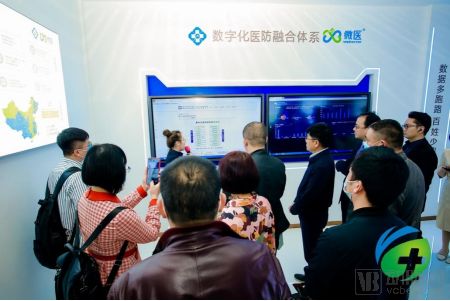
Participating Experts Visit Huangzhou General Hospital for Inspection
According to public information from the National Health Commission, in order to promote the sinking of high-quality medical resources, during the “13th Five-Year Plan” period, China promoted the construction of county-level medical communities in 567 counties, and has now built 4,028 county-level medical communities.
“Minor ailments are treated at the primary care level, serious conditions at hospitals, and rehabilitation takes place in the community.” As a pioneer in promoting the development of medical consortia, the Huangzhou District Committee and Government have, since late 2017, coordinated efforts to establish the Huangzhou General Hospital with Huanggang Traditional Chinese Medicine Hospital as its leading institution. This initiative integrated 17 public medical institutions and 98 village clinics across the district to form a comprehensive, tightly integrated regional medical consortium. By collaborating with WeDoctor to build a digital support system, Huangzhou has gradually established a digitally enabled, tightly integrated medical consortium focused on “prevention first and health promotion,” proactively safeguarding residents’ health. This approach better empowers county-level healthcare services with new concepts and technologies, thereby enhancing patients’ diagnosis and treatment experience.
Empowered by digitalization, Huangzhou General Hospital has upgraded its existing medical information system to achieve interconnectivity of various health information resources. The system connects upward with provincial and municipal tertiary hospitals, integrates downward with primary healthcare institutions, and facilitates horizontal coordination among medical care, health insurance, and pharmaceutical services (the “Three-Medical Linkage”), thereby supporting an integrated five-in-one health service model encompassing prevention, treatment, rehabilitation, health education, and management.
Meanwhile, to improve the public’s health status, family doctor contract service teams—comprising general practitioners, community nurses, public health personnel, information officers, and other professionals (such as specialists, village doctors, health promotion specialists, dietitians, and psychological counselors)—leverage intelligent terminals provided by WeDoctor, including 9 mobile hospitals and 98 cloud-based portable clinic kits, to deliver regular one-stop physical examination services for key populations such as the elderly, children, and pregnant and postpartum women. These teams also organize specialized prevention and control activities for chronic diseases, truly realizing the principle of “promoting prevention through screening.”
After years of implementation, the digital integrated medical consortium reform in Huangzhou District has achieved significant results. From July to December 2020, both outpatient visits and outpatient revenue at primary healthcare institutions across the district saw substantial growth. Outpatient visits exceeded 100,000, representing a 99.5% increase compared to the same period in 2019; outpatient revenue reached RMB 26.6766 million, marking a 303.93% increase over the same period in 2019. Additionally, from 2018 to 2020, Huangzhou District General Hospital achieved three consecutive years of decline in both the absolute amount and the proportion of out-of-pocket expenses borne by individuals under the regional medical insurance scheme.
“We have established small family doctor teams that go deep into villages to incorporate the health management of all residents into standardized, professional team-based care. By measuring blood pressure and blood glucose levels, providing medication guidance, and conducting health education, we aim to help people fall ill less often, later in life, or not at all. This approach not only saves national medical insurance funds but also alleviates the burden on medical institutions and reduces healthcare costs for the public,” said Deng Guangrui. He added that this year, they hope to leverage information technology to strengthen the integration of medical care and disease prevention within the medical consortium.
“The development goals of ‘strong district-level capacity, vibrant township-level services, stable village-level foundations, vertical integration, and seamless information flow’ have been initially implemented. The ‘last mile’ in delivering health services to the public is being bridged, and the ‘pain points’ and ‘difficulties’ faced by the masses in accessing medical care are receiving significant attention and are being effectively addressed.”
In the future, Huangzhou District will center on people’s health, innovate the management system and operational mechanisms of medical consortia, and collaborate with the digital healthcare service platform WeDoctor to fully leverage the advantages of digital technologies in efficiently matching resources and deeply connecting and integrating data. These efforts will promote the establishment of a new order featuring tiered diagnosis and treatment, appropriate care, and orderly medical-seeking behavior, truly realizing the goal of “initial consultation at the primary level, minor illnesses treated within the township, and major illnesses managed within the district.”