

Weimai Becomes First Chinese Company Certified by Digital Therapeutics Alliance, Files IPO Prospectus
Recently, VCBeat has exclusively learned that Weimai, a specialized innovative service platform for internet-based full-course disease management, has achieved another breakthrough in the field of digital therapeutics. Following review by the Academic Committee of the Digital Therapeutics Alliance (DTA), Weimai successfully completed its academic defense this month and officially became the first Chinese enterprise to receive certification from the DTA. This milestone marks a critical step forward in the development of China’s digital therapeutics sector.
According to reports, the Digital Therapeutics Alliance (DTA) is a non-profit industry association established in the United States in 2017. It comprises leaders from the global digital therapeutics sector, including digital therapeutics companies, universities, research institutions, and clinical experts. The alliance aims to improve clinical and health economic outcomes and elevate the standard of healthcare worldwide by advancing the development of digital therapeutics. Its primary mission is to enhance the understanding, adoption, and integration of digital therapeutics among patients, clinicians, payers, and policymakers through education, advocacy, and cross-industry collaboration.
The Digital Therapeutics Alliance (DTA) first proposed the definition of digital therapeutics and its 10 core principles globally. Digital Therapeutics (DTx) are evidence-based therapeutic interventions driven by software programs, used to treat, manage, or prevent diseases. The core principles include:
1. Prevent, manage, or treat a disease;
2. Interventions are software-driven;
3. It integrates best practices in design, manufacturing, and quality;
4. Enable user participation in product development and usability processes;
5. User privacy and security must be ensured;
6. It is the best practice for application product deployment, management, and maintenance;
7. Publish trial results, including those with clinical significance, in peer-reviewed journals;
8. Undergo review and certification by regulatory authorities in accordance with the requirements for product risk, efficacy, and intended use;
9. Make corresponding statements based on clinical evaluation and regulatory status;
10. Collect, analyze, and apply real-world evidence or product performance data.
Furthermore, the Digital Therapeutics Alliance (DTA) has developed a series of documents, including the DTx Industry Code of Ethics, Best Practices for DTx Products, and DTx Product Classification, laying the foundation for the long-term development of the digital therapeutics industry.
The Digital Therapeutics Alliance (DTA) maintains a rigorous review process. Since its inception, it has certified only 40 members worldwide, including global digital therapeutics industry leaders such as Pear Therapeutics, Akili Interactive Labs, Propeller Health, WellDoc, and Omada Health.
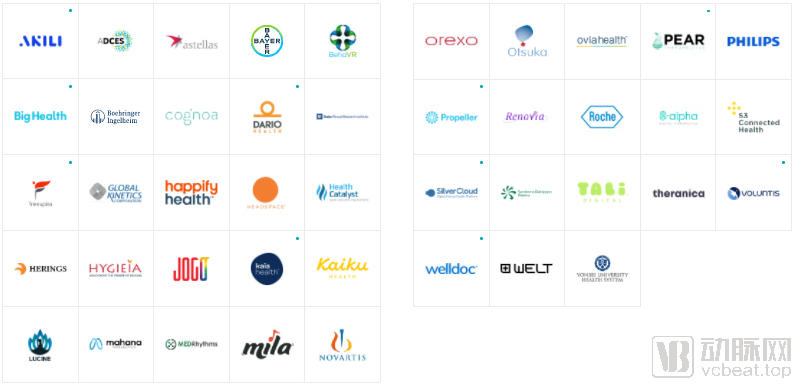 Certified Member of the Digital Therapeutics Alliance (DTA), Source: DTA Official Website
According to the DTA website, there were previously no Chinese enterprises among its member associations. This means that upon receiving certification, Weimai will become the first Chinese company certified by the DTA. Bai Yan, head of business at Weimai’s AI Digital Therapeutics Center, stated, “Weimai’s successful certification after six months of multiple rounds of defense and review is highly significant. It indicates that the international digital therapeutics industry has begun to recognize various aspects of domestic digital therapeutics platforms represented by Weimai, including their business models, technical capabilities, and academic strengths.”
VCBeat has learned from sources at Weimai that among the 10 core principles for digital therapeutics issued by the DTA, whether a product “produces a medical intervention that is driven by software” is the key criterion for determining if it qualifies as a digital therapeutic.
Leveraging its AI infrastructure, Weimai has developed patient-specific medical intervention models by integrating three patented technologies—natural language processing, semantic analysis, and medical knowledge graphs—with a medical ontology reasoning engine. This innovation transitions internet-based healthcare from simple doctor-patient connectivity to a software-driven digital therapeutic model for whole-course disease management, while validating the efficacy of digital therapeutics through real-world data studies.
Digital Therapeutics Show Promising Results in the Field of Rehabilitation
Taking digital therapeutics for children with autism spectrum disorder (ASD) rehabilitation as an example, Weimai recruited 70 pediatric ASD patients receiving treatment at a provincial children’s hospital as study subjects, in accordance with the corresponding inclusion and exclusion criteria, to conduct a randomized controlled trial. Both groups received four weeks of in-hospital intervention. These children with ASD underwent social skills training, including joint attention training and language therapy, under the accompaniment of family members and medical staff. The intervention duration was no less than 20 hours per week, followed by a four-week out-of-hospital observation period.
The control group received additional adjunctive interventions via internet-based approaches, including online guidance from physician treatment teams, push notifications of training demonstration courses, online scale assessments, and adjustments to treatment plans. Although there are currently no effective pharmacological treatments for autism spectrum disorder (ASD), early behavioral interventions have been proven effective. Internet-assisted intervention methods can help caregivers implement family-centered intervention training, thereby significantly improving the clinical condition of affected children.
Similar to the aforementioned digital therapeutics for rehabilitation, Weimai has partnered with over 100 hospitals across China to implement and validate digital therapeutic solutions for 32 specialized medical conditions. This achievement is attributed to Weimai’s sustained technological investments over the years, which have established a robust underlying technical architecture to support the more efficient delivery of its services.
AI-Enabled Foundational Capabilities for Digital Therapeutics
Recently, Weimai launched its AI-driven digital integrated follow-up system, Weimai e-Visit. Leveraging its self-developed medical-grade artificial intelligence system, Neumann Artificial Intelligence, the platform intelligently analyzes commonly exchanged information between doctors and patients—including text, voice, images, and body metrics. It digitizes four types of follow-up care—post-consultation, post-examination, post-surgery, and post-discharge—into structured records, thereby providing an effective pathway for hospitals to deliver comprehensive digital services to patients in these four post-care categories.
Meanwhile, Weimai integrates Electronic Medical Records (EMR) from public hospitals with Real-World Data (RWD) collected through its Weimai e-Visit platform, proposing a novel architecture for digital therapeutics based on comprehensive data from both in-hospital and out-of-hospital settings. Grounded in the theoretical framework of “(EMR + RWD) / Neumann AI = DTx,” it has developed digital therapeutic capabilities supporting computational inference for 3,550 vertical disease indications, thereby providing patients with whole-course disease management services powered by digital therapeutics.
The two initiatives reviewed by the Digital Therapeutics Alliance (DTA)—“Evaluation of the Effectiveness of Internet-Based Whole-Course Management in Improving Autism Rehabilitation” and “Research on the Prevention of Oral Mucositis After Chemotherapy in Patients with Malignant Tumors Based on Internet-Enabled Continuity of Care”—are derived from the aforementioned theoretical framework and received high acclaim from experts during the review process.
 Weimai - Academic Review Meeting of the International Digital Therapeutics Association
In recent years, innovations in China’s digital health sector have primarily focused on the periphery of healthcare, emphasizing “connectivity”—such as linking physicians with patients, physicians with other physicians, and healthcare institutions with one another. In contrast, digital therapeutics (DTx) are beginning to penetrate the core of medical practice by delivering disease treatment interventions grounded in evidence-based medicine, including randomized controlled trials (RCTs) and real-world evidence (RWE). Recently, VCBeat Research Institute released the “White Paper on China’s Digital Therapeutics Industry (2021 Edition),” which states that 2021 marks the inaugural year of digital therapeutics in China.
Although digital therapeutics in China are still in their nascent stage, the sector boasts broad development prospects, driven by the rapid advancement of next-generation information technologies and internet-based healthcare, as well as the country’s vast population base.
First, the state is accelerating digital development and building a Digital China, while fostering and expanding emerging digital industries such as artificial intelligence, big data, blockchain, cloud computing, and cybersecurity. It is constructing application scenarios and industrial ecosystems based on 5G, and carrying out pilot demonstrations in key areas including intelligent transportation, smart logistics, smart energy, and smart healthcare. This has created a high-quality industrial environment for the development of digital therapeutics.
Secondly, domestic medical institutions are vigorously promoting the construction of smart hospitals and advancing electronic medical record (EMR)-centered informatization. This effort has transformed previously disparate information systems across various hospital departments from a state of fragmentation to integration, and ultimately to deep interoperability, thereby resolving issues of information silos and vertical stovepipes. The result is a unified, platform-based EMR information system, which lays a substantial data foundation for the development of digital therapeutics.
Third, the implementation of digital therapeutics (DTx) products not only involves a wide range of foundational digital technologies—such as wireless devices, hardware and software sensors, microprocessors, integrated circuits, mobile/cellular networks, and body area networks—but also relies on key enabling technologies, including artificial intelligence, cloud computing, big data, and virtual reality (VR). In China, rapid development and growing maturity in these key technological areas, coupled with the government’s vigorous promotion of new infrastructure construction, have laid a solid technical foundation for DTx products.
Fourth, China’s internet healthcare industry has developed rapidly. In particular, since the onset of the COVID-19 pandemic in 2020, the adoption of internet healthcare among medical institutions, physicians, and patients has increased significantly. To date, 1,100 internet hospitals have been established across China, with an accelerating rate of physicians going “online.” According to the 47th Statistical Report on China’s Internet Development released by the China Internet Network Information Center (CNNIC), as of December 2020, the number of online healthcare users in China reached 215 million, accounting for 21.7% of all internet users, reflecting a continuous rise in penetration. Growing acceptance of internet healthcare applications among both physicians and patients has laid a broad user foundation for the future promotion and widespread adoption of digital therapeutics.
Of course, in the development of digital therapeutics, various stakeholders—including healthcare institutions, research organizations, technology-driven enterprises, and service-oriented companies—must actively explore opportunities and foster collaboration.
“It is understood that Weimai will further explore innovative pathways for digital therapeutics in China, continuously empowering hospitals, departments, and healthcare professionals to provide one-stop healthcare services covering all populations, aspects, and stages to a broader user base. ‘Weimai will also open its platform and channel capabilities to all digital therapeutics companies, facilitating the development and refinement of the digital therapeutics ecosystem in specialized disease areas in China,’ said Bai Yan.”