

Bolong Medical Files for IPO: Aiming to Become China's First Unicorn in the RMB 30+ Billion Coronary Intervention Precision Diagnosis Market
The “Report on Cardiovascular Health and Diseases in China 2019,” released by the National Center for Cardiovascular Diseases, shows that the total number of patients with cardiovascular diseases in China has reached 330 million. Among them, the number of patients with coronary heart disease exceeds 11 million, with morbidity and mortality rates ranking among the highest and continuing to rise.
Generally, when there is a suspicion of coronary heart disease (CHD), patients opt for coronary imaging examinations to estimate the extent of myocardial ischemia based on anatomical morphology, thereby guiding treatment planning. Among these, coronary computed tomography angiography (CTA) is a non-invasive diagnostic method suitable for outpatient or health screening purposes. Digital subtraction angiography (DSA) remains the most commonly used clinical imaging modality for CHD, enabling dynamic and accurate assessment of vascular stenosis severity. Intravascular imaging techniques, such as intravascular ultrasound (IVUS) or optical coherence tomography (OCT), provide precise visualization of fine intravascular structures and plaque characteristics.
However, single-modality imaging has its limitations. Borderline lesions, and even stenoses that appear severe on imaging, may not cause functional ischemia. Such patients can achieve optimal outcomes through deferred revascularization, medical therapy, and other conservative strategies, without the need for interventional treatment. In other words, while imaging helps clinicians assess the morphology of the cardiovascular system, it remains insufficient for determining the extent of myocardial ischemia caused by stenosis. Given current advances in the diagnosis and management of cardiovascular diseases, an integrated solution combining CTA, DSA, IVUS, OCT, and FFR is becoming the prevailing trend toward precise diagnosis of pan-vascular diseases.
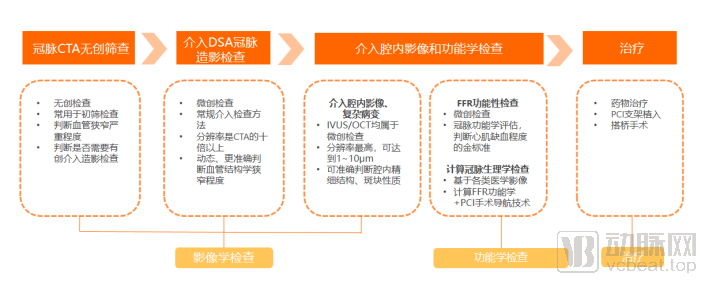
Routine Diagnostic and Treatment Process Recommended by Guidelines for Coronary Heart Disease
In recent years, the continuous advancement of intravascular imaging technologies such as IVUS and OCT, along with FFR-like techniques, has enabled physicians to obtain both structural and functional information about blood vessels. Numerous studies have confirmed that these technologies optimize the traditional diagnosis and treatment workflow for coronary heart disease. By incorporating functional data alongside anatomical information derived from CTA, DSA, IVUS, and OCT examinations, dual- or triple-modality comprehensive assessments can be performed. This approach helps physicians make more precise diagnoses and guides the planning of precision percutaneous coronary intervention strategies.
The emergence of new technologies has reshaped the value of coronary intervention diagnostics, facilitating their integration into precision medicine. Concurrently, a new market has emerged. Based on estimates from publicly available data, the market size for precision diagnostics in coronary interventions is projected to reach RMB 36.8 billion by 2023.
The vast incremental market has attracted numerous companies to enter and establish their presence. Since 2015, a wave of domestic startups specializing in novel coronary interventional diagnostic devices, represented by Pulse Medical Imaging Technology (Shanghai) Co., Ltd., has emerged. While exploring precision diagnosis in coronary interventions, these companies have deepened the integration of functional assessment with imaging technologies and gradually extended their product portfolios across the upstream and downstream segments of cardiovascular diagnosis and treatment. After nearly six years of catch-up development, Chinese enterprises have undergone a transformation from imitation to independent innovation and surpassing competitors, achieving maturity in both product sophistication and completeness of their pipelines.
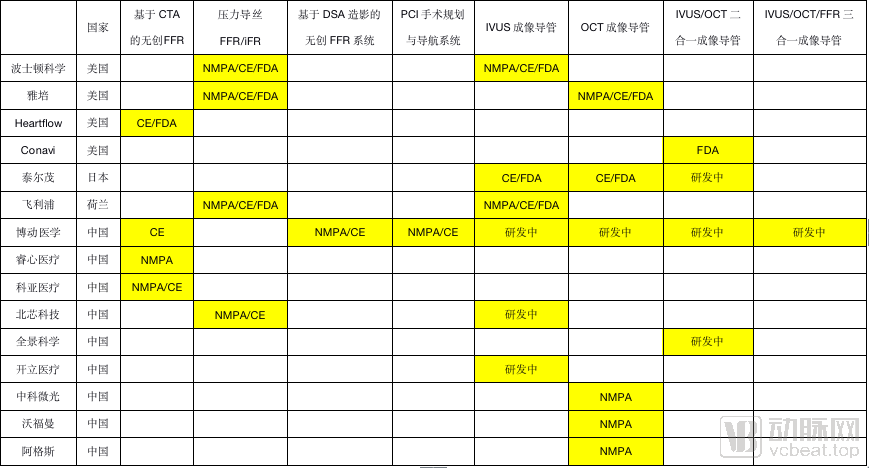
Completeness of Coronary Artery Precision Diagnostic Product Lines by Company (Yellow Sections Indicate Existing Product Lines)
As shown in the figure above, most companies specializing in precise diagnostic solutions for coronary interventions focus their product lines on FFR or IVUS/OCT catheters. A smaller number of enterprises are venturing into areas with higher technical barriers, such as combined IVUS/OCT imaging catheters, triple-function IVUS/OCT/FFR imaging catheters, and PCI surgical planning system design. Among these companies, Pulse Medical Imaging Technology is the only one that has simultaneously engaged in the research and strategic deployment of intravascular imaging catheters (IVUS and OCT) and FFR functional diagnostic systems.
The completeness of a company’s product pipeline can, to some extent, reflect its core competitiveness. Statistics clearly show that Pulse Medical Imaging Technology stands out for its in-depth capabilities in the field of precise diagnosis for coronary intervention, surpassing the strategic footprints of most domestic peers and even exceeding international medical device giants such as Terumo, Abbott, and Boston Scientific in terms of product line comprehensiveness. To gain deeper insights into its strategic layout, VCBeat interviewed Dr. Lin Xiaojie, Marketing Director at Pulse Medical Imaging Technology.
Pulse Medical Imaging Technology (Shanghai) Co., Ltd. was established in Shanghai in September 2015. Since its inception, the company has focused on precise diagnosis in coronary intervention as its core development direction, with the ambition of becoming the most comprehensive and original domestic enterprise in the field of pan-vascular precision interventional product lines. Based on this foundation, Pulse Medical has developed a range of products for precise diagnosis in coronary intervention, including QFR, CT-QFR, and IVUS/OCT/FFR triple-imaging catheters, all of which possess fully independent Chinese intellectual property rights. Six years later, this goal has been preliminarily achieved.
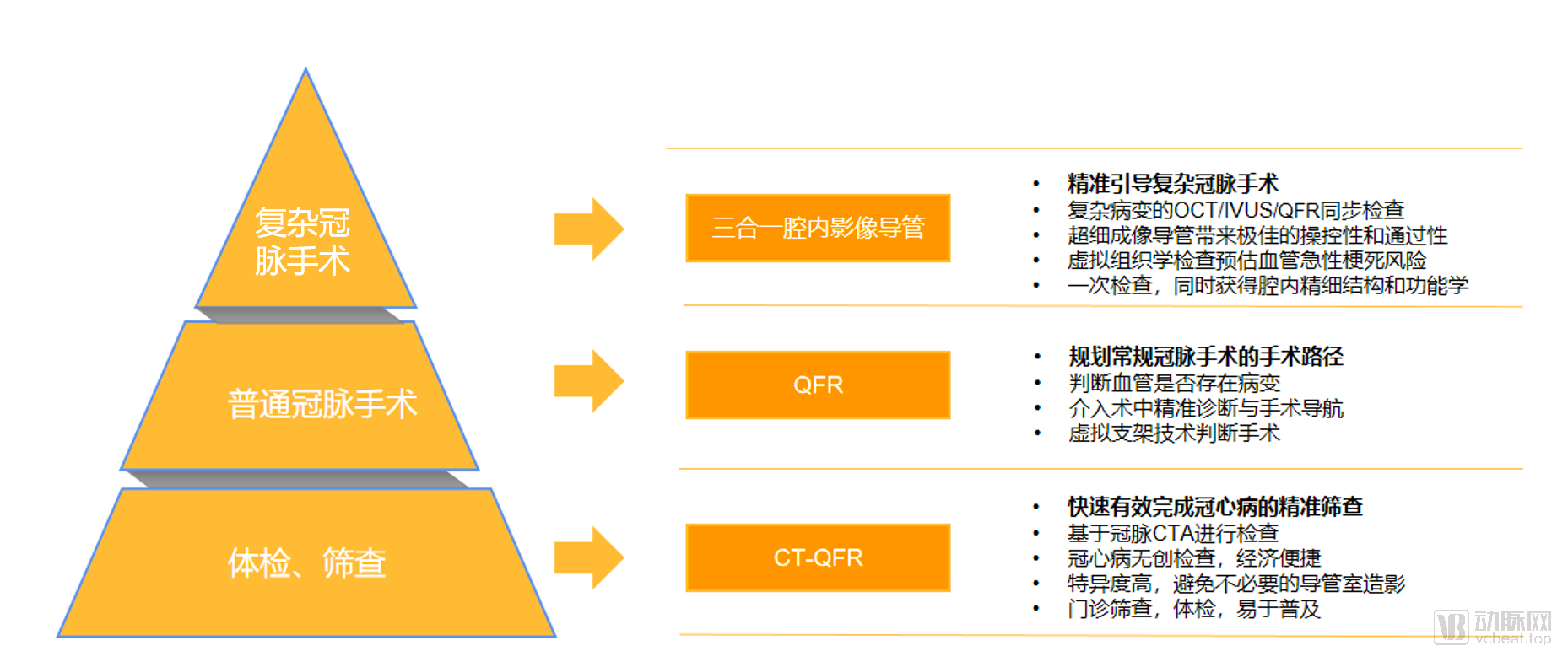
Pulse Medical’s Complete Precision Diagnostic Product Line for Coronary Arteries
Pulse Medical’s Quantitative Flow Ratio (QFR) is a wire-free, ultra-fast FFR calculation and PCI navigation system based on coronary angiography images. It requires no consumables or vasodilator drugs, and can accurately assess both the anatomical structure and physiological function of coronary vessels within one minute. The system provides precise guidance for percutaneous coronary intervention (PCI), assisting physicians in formulating more rational PCI strategies by addressing whether stent implantation is necessary, how to perform it, and predicting patient treatment outcomes.
Published clinical trials comprising over 100 studies and more than 20,000 cases both domestically and internationally have demonstrated that QFR significantly improves the diagnostic accuracy of percutaneous coronary intervention (PCI) for coronary artery disease by 33%, markedly reduces the incidence of postoperative adverse events in patients with coronary artery disease, and enhances patient prognosis. The QFR series of technologies has been incorporated into the official training curriculum for interventional cardiologists by the European Society of Cardiology and included in the Japanese expert consensus on interventional treatment for acute myocardial infarction. Pulse Medical Imaging Technology’s QFR product series has achieved a leading international position.
The first RCT study of QFR, and the first in the history of imaging-based FFR—FAVOR III China—will release its results this November, potentially directly advancing computational coronary physiology technology into guidelines for coronary intervention diagnosis and treatment.
Traditional FFR is generally only applicable for the functional assessment of coronary arteries in patients with stable coronary artery disease and borderline lesions. Its complex procedures also limit its use primarily to large tertiary hospitals. In contrast, QFR expands the range of applicable scenarios and indications, covering preoperative diagnosis, intraoperative navigation, and postoperative efficacy and risk assessment, thereby empowering physicians at all levels throughout the complete diagnostic and therapeutic process of vascular intervention.
It is roughly estimated that the market penetration of QFR will reach 50% of the total number of coronary angiography patients in 2023, with the expected market size reaching RMB 18.2 billion per year.
Beyond guiding PCI procedures, Pulse Medical Imaging Technology aims to extend the benefits of its QFR series technologies to a broader population. Guided by this vision, the company has developed CT-QFR, a CTA-based FFR calculation technology suitable for high-volume scenarios such as general health checkups and screening programs.
CT-QFR is a non-invasive functional assessment of the coronary arteries that is convenient and cost-effective. As long as medical institutions acquire cardiac CTA data, CT-QFR analysis can be rapidly completed. In the United States, 92% of commercial insurance plans have incorporated CT-based FFR testing into their coverage. This suggests that widespread adoption of CT-QFR in primary care settings could help physicians early identify patients who require further invasive coronary angiography, thereby promoting the development of precision medicine and tiered diagnosis and treatment systems.
By 2023, the number of patients undergoing coronary CTA in China is expected to reach 9.75 million. The population eligible for CT-QFR examination is projected to account for 50% of those undergoing CTA. With a market penetration rate of 50%, the potential annual market size for CT-QFR will reach RMB 13.6 billion.
According to statistics, approximately 30–40% of patients undergoing percutaneous coronary intervention (PCI) present with complex lesions, necessitating more precise simultaneous intracoronary imaging and functional assessment.
To this end, Pulse Medical has developed “Eagle Eye”—a triple-in-one IVUS/OCT/FFR imaging catheter and system that enables simultaneous intravascular imaging with IVUS and OCT and synchronous FFR calculation, thereby acquiring precise anatomical and physiological information to accurately guide complex coronary intervention procedures.

The “Eagle Eye” 3-in-1 imaging system not only promises to surpass the single-modality catheters of international giants such as Boston Scientific, Abbott, and Terumo in terms of technology, ensuring high-level image quality, but also features the industry’s thinnest catheter diameter, significantly enhancing maneuverability. Furthermore, its AI-enabled fully automated post-processing system substantially shortens the learning curve for interpreting IVUS/OCT images, enabling adoption even at county-level hospitals and thereby further driving market penetration into lower-tier regions.
Based on a 30% market share for complex coronary procedures, the patient volume for the IVUS/OCT/QFR triple-modality imaging catheter is projected to reach 500,000 cases in 2023, with the annual market size expected to exceed RMB 5 billion.
“Both ‘craftsmanship’ and ‘technological barriers’ are core elements pursued by Pulse. We not only aim to create sophisticated catheters that help physicians make faster and more accurate diagnoses, but also seek to reduce the financial burden on patients. Unlike in the past, when patients had to undergo three separate invasive examinations using high-value consumables—IVUS, OCT, and FFR—they can now complete multimodal imaging and functional assessments with a single angiography procedure using just one catheter. This will significantly reduce both the costs incurred during treatment and the suffering endured by patients,” Dr. Lin Xiaojie told VCBeat.
Pulse Medical will develop a comprehensive product portfolio covering the entire workflow of precise vascular diagnosis, establishing a true closed-loop system for precision diagnosis and treatment in coronary intervention. This initiative aims to facilitate inclusion in clinical guidelines and quality control standards for coronary heart disease (CHD) intervention, thereby setting industry benchmarks. By providing superior diagnostic and therapeutic solutions for CHD patients, Pulse Medical seeks to build robust product and commercial barriers in the niche sector of pan-vascular precision diagnosis.
While competitors are still in the early stages of product development, clinical trials, and regulatory review and approval, Pulse Medical’s QFR series technologies and medical service offerings have already received pricing approvals for new medical services in more than ten provinces, achieving a closed commercial loop. According to VCBeat, Pulse Medical’s products have been deployed in over 300 hospitals across China, achieving full coverage of the top 50 hospitals in the country.
Meanwhile, Pulse Medical Imaging Technology has established strategic partnerships with international medical device giants such as Philips and Medtronic to jointly accelerate the implementation and market promotion of innovative interventional diagnostic and therapeutic technologies, thereby expediting coverage from large tertiary hospitals to county-level hospitals. It is reported that Pulse Medical Imaging Technology achieved substantial revenue in 2020 and is projected to experience rapid growth in 2021.
To date, Pulse Medical Imaging Technology (Shanghai) Co., Ltd. has secured four national innovative/priority review medical device approvals (ranking among the top in China), obtained Class III medical device registration certificates from China’s NMPA for two products, and achieved CE certification in the European Union for four products, thereby establishing significant advantages in clinical validation, standard setting, and commercial implementation.
VCBeat’s 2019 “Industry Innovation Report on Image-Based FFR” asserted that, based on industrial trends reflected in patent data over the past decade, China would inevitably see the emergence of a unicorn company specializing in precision diagnostics for coronary intervention within the next three years.
Pulse Medical Imaging Technology (Shanghai) Co., Ltd. has already secured the first domestic Class III medical device certificate for image-based FFR in China and has exclusively completed randomized controlled trial (RCT) studies. With the ultimate goal of becoming a global leader in precision diagnosis and treatment for coronary intervention, can Pulse claim the top spot? The road to precision diagnosis and treatment in coronary intervention is long; we shall wait and see.