

Glytec Secures $21 Million in Funding to Advance Precision Insulin Dosing Platform
Silicon Valley Bank
Diversified Financial Services Institution
According to data released by the International Diabetes Federation, China had 116 million diabetes patients in 2019, with a prevalence rate of 10.9%, ranking first globally. Timely and precise blood glucose management can alleviate the burden on diabetes patients and prevent the onset of complications. How to provide intelligent, precision medication regimens for diabetes patients and ensure effective blood glucose management throughout the entire course of treatment has become an urgent challenge we need to address.
Glytec is an insulin management software company focused on delivering healthcare services. Founded in 2006, it is dedicated to improving insulin management and glycemic control.
On April 15, 2021, Glytec announced the completion of a new $21 million equity and debt financing round. Glytec’s new funding includesSilicon Valley Bank$9 million in debt financing led by andSavitr Capital$12 million equity investment led by the lead investor.

Robby Booth, Senior Vice President of R&D and Founder (left); Ed Furlong, President and CEO (right). Image source: Glytec official website
Robby Booth is Senior Vice President of Research and Development at Glytec, where he oversees the company’s innovation initiatives, patent inventions, and FDA clearances. With over 20 years of experience in solution development and commercialization, Robby is one of Glytec’s founders and leads the company’s technology and algorithm development. He is also an inventor on more than 20 patents.
Ed Furlong is the President and Chief Executive Officer of Glytec, with over 30 years of experience in operations and financial management. Prior to joining Glytec, Ed served as Chief Operating Officer and Chief Financial Officer at Kyruus, a company specializing in search and scheduling solutions for hospitals and health systems. Previously, he held similar positions at Exa Corporation, a manufacturer of engineering simulation and visualization software, where he helped guide the company through its initial public offering (IPO), secured private equity and debt financing, and achieved sustained growth and profitability. Ed holds a Bachelor of Science in Economics from the Wharton School of the University of Pennsylvania and a Master of Business Administration from Harvard Business School.
Edstated,Nowadays,Exceeding34 million Americans have diabetes, and88 million people are at potential risk of developing the disease. In hospitals, the need for insulin is not limited to patients with diabetes; stress-induced hyperglycemia commonly occurs in patients undergoing surgery or those in critical condition.
According to data from the Glytec website, approximately 30% to 40% of hospitalized patients require insulin during their hospital stay. Although insulin has a long history of clinical use, the drug itself carries inherent risks. Therefore, insulin is a medication that warrants a high level of vigilance. Its misuse can cause serious harm to patients.
Overtreatment and undertreatment of hyperglycemia may lead to hypoglycemia (an abnormally low blood glucose state), coma, renal failure, stroke, paralysis, sepsis, brain injury, cardiac arrest, and even death. Therefore, precise insulin administration will bring significant benefits to patients.
On June 15, 2020, Glytec, a provider of insulin management software, announced the first proof-of-concept study combining data from continuous glucose monitoring (CGM) systems with its Glucommander software—a computer-controlled method for inpatient glycemic management—to achieve precise insulin dosing. According to findings presented at the 80th Annual Scientific Sessions of the American Diabetes Association, just four weeks of precision insulin therapy increased the time patients spent within the normal blood glucose range by 26%, rising from 48% to 74%.
On March 30, 2021, Glytec announced the launch of the latest version of its eGlycemic Management System (eGMS) for insulin management. The latest version of the eGMS software enhances operational efficiency by streamlining clinician workflows and further improving patient safety.
The eGMS software is centered on the Glucommander algorithm, which leverages real-time data and historical records to predict future insulin needs and recommend dosages by learning each patient’s insulin sensitivity, thereby formulating personalized treatment plans. This algorithm can reduce the incidence of hypoglycemia and hyperglycemia, as well as shorten hospital stays, lower readmission rates, and decrease nursing care costs.
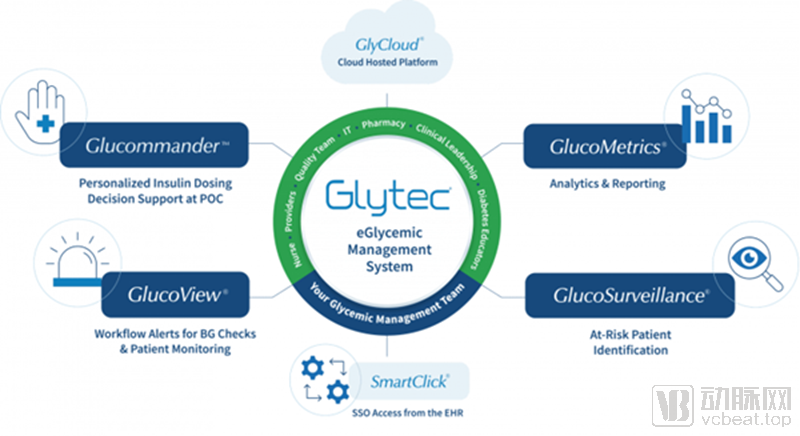
Schematic Diagram of the eGMS Management System. Source: Glytec Official Website
Upon receiving a patient’s order, the eGMS software can automatically capture the initial parameters. The confirmed medication dosage is then added to the electronic medical record and stored in the medication administration record. This allows nurses to review and document the administered dosage, and subsequently feed this information back into the eGMS software to verify the actual dosage administered.
The eGMS software offers a range of functionalities: enabling single sign-on and access to the eGMS software within the electronic medical record (EMR); automatically importing patient information, such as height and weight; automatically recording laboratory results, including blood glucose and anion gap; allowing the Glucommander algorithm to automatically receive initial parameters per provider orders and display this information when nurses initiate treatment; plotting data charts within the EMR to present a comprehensive care history for all patients in a single location, eliminating the need for multiple documents; and once medication charts are plotted in the EMR, the interface sends dosage information back to the eGMS software.
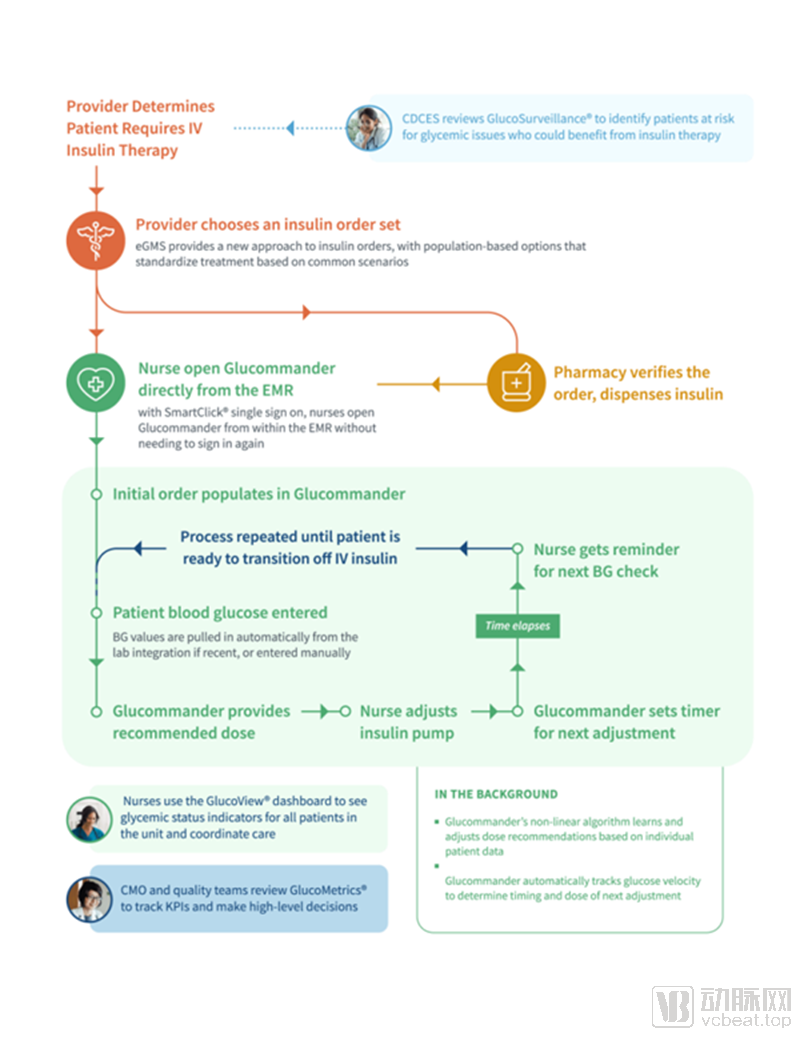
Workflow Diagram. Image source: Glytec official website
The Glucommander algorithm incorporates a series of safety features. These features assist clinicians in making faster decisions by leveraging existing data to alert them to potential hazardous situations, as follows:
Glucose Level Monitoring: Capable of alerting nurses to sudden drops in a patient’s blood glucose levels and prompting immediate retesting to ensure patient safety, prevent hypoglycemia, and mitigate other conditions that may induce hypoglycemia. For instance, cerebral edema can cause a rapid decline in blood glucose.
Anion Gap Analysis: Alert nurses to a high anion gap to prevent premature discontinuation of therapy before the resolution of diabetic ketoacidosis.
Glucometer Out-of-Range Warning: Nurses utilize this algorithm to recommend insulin dosages when blood glucose levels exceed the glucometer's normal limits, enabling timely and precise medication administration. This prevents significant drops in blood glucose and helps restore patients' blood glucose levels to a safe range as quickly as possible.
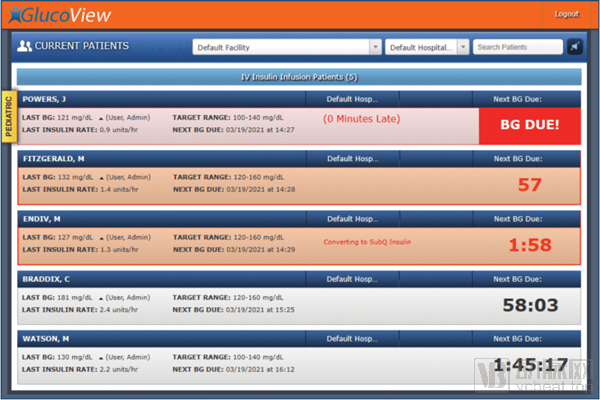
Timely Feedback on Blood Glucose Status. Image source: Glytec official website
The eGMS software includes a dashboard displaying all patients' blood glucose status indicators within a unit, capable of alerting caregivers to patients' blood glucose levels.
The eGMS software connects to the hospital's Laboratory Information System (LIS) database to continuously analyze all patients, thereby proactively identifying those at potential risk of hyperglycemia.
The blood glucose monitoring dashboard notifies designated clinicians of hyperglycemic patients experiencing adverse reactions. By leveraging continuous glucose monitoring, physicians can more rapidly identify patients requiring insulin therapy, thereby ensuring patient safety.
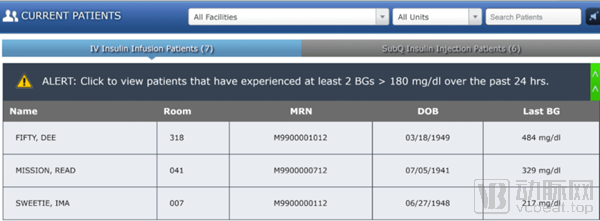
Patient Information and Blood Glucose Data. Image source: Glytec official website
According to data from the Glytec website, the eGMS software can reduce the incidence of severe hypoglycemia by 99.8%, shorten patients' average hospital stay by 3.2 days, decrease the time nurses spend caring for each patient (by up to 72 minutes when manual insulin injections are no longer required), and lower patient readmission rates by 36%–68%. To date, more than 90 studies have confirmed the safety and efficacy of Glytec’s eGMS software.
On April 15, 2021, Glytec announced the completion of a new round of $21 million in equity and debt financing.Following this round of financing, Glytec’s total funding reached $43.214 million.
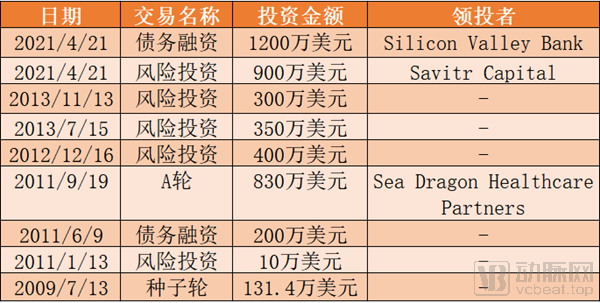 Glytec's Historical Financing Overview (Source: Crunchbase)
Silicon Valley BankLaura Scott, Market Manager for Life Sciences and Healthcare Practice, stated, “With a strong team dedicated to life sciences and healthcare, we have seen outstanding companies driving transformation in the management and delivery of medical care, and we are proud to partner with Glytec. As more people recognize the importance of glycemic management in patient care, Glytec has rapidly expanded within the U.S. market. This financing will further help solidify Glytec’s leadership position in the market.”
Ed Furlong, CEO and President of Glytec, stated, “As endocrinologists become increasingly scarce, they cannot be at every patient’s bedside. The Glucommander algorithm’s personalized approach to glycemic management helps alleviate their burden.”Silicon Valley Bank"With support from Savitr, we are preparing to provide personalized blood glucose management solutions to more hospitals."
Currently, insulin therapy in China is primarily delivered via insulin pumps, with open-loop devices being the mainstream option. Healthcare professionals calculate the patient’s daily dynamic insulin dosage based on their physical condition, inpatient blood glucose monitoring data, and caloric intake from their diet. It remains difficult to automatically and intelligently adjust insulin injection doses in response to daily fluctuations in the patient’s blood glucose levels.
According to the “2020 Global Insulin Pump Industry Market Status Research Report” released by NewSight Industry Research Center, China’s insulin pump market is currently dominated by foreign companies such as Medtronic and Dana. Chinese enterprises possess strong R&D capabilities and are poised to accelerate the localization of precision insulin delivery systems, leveraging supportive policies and expanding demand. Among these companies is Shunzhi Technology.
Shunzhi Technology is a company dedicated to the research and development of low-cost microfluidic chip-based insulin pumps. The company’s microfluidic chip pump enables pulsed digital output, allowing for precise control over the volume delivered per pulse. It ensures accuracy in both single-pulse infusion and cumulative multi-pulse delivery, thereby making it possible to more precisely mimic the 24-hour pulsatile micro-secretion of insulin by pancreatic beta cells.
In other words, Shunzhi Technology’s insulin pump can more accurately mimic the physiological pulsatile secretion of insulin by the human pancreas, thereby enabling more effective and safer blood glucose control while reducing the incidence of diabetic complications and hypoglycemia.