

Xinxing Tech's VarMix Next-Gen Hospital Information System: Application Practices and Product Overview
This is a window period for the transformation and upgrading of healthcare informatization.
At the National Healthcare Management Work Conference in early 2021, Ma Xiaowei, Director of the National Health Commission, pointed out that it is necessary to fully promote the high-quality development of public hospitals. In terms of development connotation and management, we should move towards intensive and efficient management with a focus on internal quality, and improve efficiency through information technology.
Subsequently, with the introduction of the tiered evaluation standard system for smart hospital management, smart management has become interconnected with electronic medical records (EMR) and patient services. These three tiered evaluation standards complement one another, forming a comprehensive assessment framework for the functional capabilities and application maturity of information systems in smart hospitals. This complete blueprint, which uses evaluation to guide development, clarifies that hospitals’ informatization initiatives must prioritize top-level design and integrated implementation.
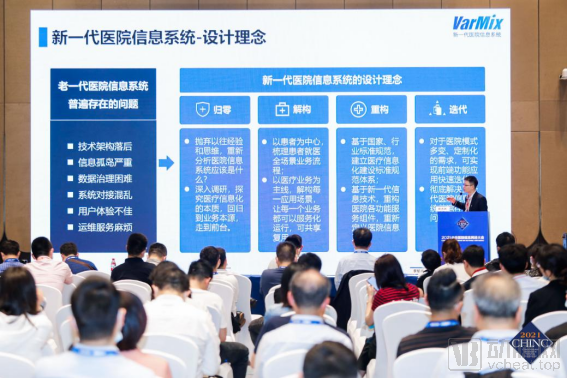
From April 23 to 25, 2021, the Chinese Hospital Association Network Information Conference was grandly held in Hangzhou. At this industry event, Xinxing Technology delivered a keynote presentation titled “Practical Applications of VarMix, the Next-Generation Hospital Information System,” sharing insights and reflections gained from its implementation.
1Data Standardization
The integration of emerging technologies such as big data and artificial intelligence with healthcare informatization is gradually transitioning from an exploratory phase to one of practical implementation, redefining the value of medical data. Advanced technologies, including 5G, the Internet of Things (IoT), and various cutting-edge devices, are imposing new requirements on the foundational infrastructure of informatization. Every role and every link in the data development chain—from production and extraction to governance and application—is critical.
NovaTech focuses on data producers, ensuring high-quality data at the source, which serves as the cornerstone for all imaginative applications built on top.
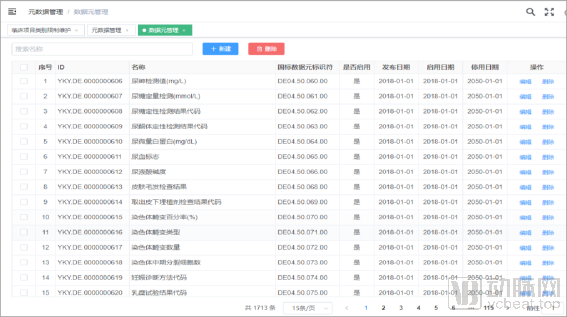
In terms of data standardization, VarMix implements standardization at three levels: datasets, terminology dictionaries, and data interaction. Through metadata management, VarMix defines over 5,000 datasets released by national and industry authorities within the system, complemented by hospital-defined standard datasets, thereby ensuring the standardization of minimal data units at the source. Through master data management, it enables terminology dictionaries to be defined and maintained in a single location while being shared and synchronized in real time across multiple points. Leveraging functional component services and interface services on the service layer, VarMix achieves front-end visualized management for data integration, with access controls managed independently by the hospital’s information management department.
2Scenario-Based Role
The development of information systems is typically “vertical,” delving deeply and meticulously into a specific business domain. It extends from the design of the central nervous system to the organization of capillary-level details, with clear priorities and a progressive, layered structure. However, in specific roles and scenarios, users interact with systems in a “horizontal” manner. To complete a task, users must navigate across multiple business systems, with the time spent and frequency of use varying by role and usage context. In most current hospital information systems, each such transition imposes additional burdens on users, including switching between systems, searching for functions, clicking, and opening or closing pop-up windows.
In terms of efficiency and user experience, this is clearly not the optimal solution.
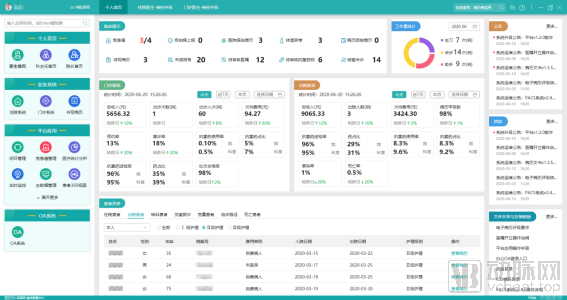
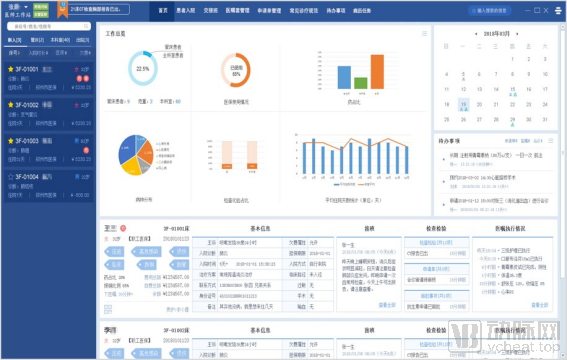
VarMix has established a functional application component library, where both its proprietary core components and integrated third-party components can be registered. Leveraging this library, the system automatically loads the functional applications required by different user roles in specific scenarios. It achieves deep, page-level integration of cross-system functionalities, eliminating all unnecessary pop-ups. This approach aims to meet users’ daily functional needs while maximizing ease of use, simplifying operations, and minimizing the number of clicks.
3Rapid Iteration
The only unchanging truth in the world is that everything is changing.
The same holds true for hospitals’ informatization needs. Internally, as operations expand, software usage deepens, and management becomes more refined, issues and improvement strategies are continuously identified and fed back. Externally, healthcare informatization policies are becoming increasingly systematic; as hospitals progressively align with construction and evaluation standards, phased objectives and requirements are continually updated and upgraded. Although the overall direction of development is largely consistent, each hospital will forge its own unique path.
VarMix adopts a distributed microservices architecture, featuring a loosely coupled model with complete separation between the front-end application and the database. Data services are exchanged through an intermediate service layer, granting the system substantial flexibility and adaptability. In practice, VarMix has achieved front-end page iterations within one month that would require at least three months under traditional architectures, and completed product-level rapid iterations within three months.
The best system is not defined by its ability to maximize the satisfaction of current clinical, service, and management needs in hospitals, but rather by its adaptability and scalability, enabling it to better respond to rapidly changing demands.
4Intelligent Operations and Maintenance
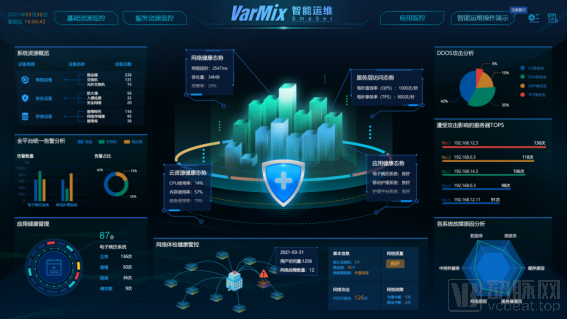
System operations and maintenance (O&M) have always been a key focus for hospital information centers. Building upon traditional O&M methods such as remote telephone support, on-site troubleshooting, and manual routine inspections, many hospital information centers have currently achieved large-screen monitoring for certain devices; however, real-time monitoring at the service and application layers remains difficult to achieve.
NovaTech has developed the VarMix Intelligent O&M Integrated Platform, enabling comprehensive management across the IaaS, PaaS, and SaaS layers. The operational status of the entire information system—spanning infrastructure, middleware services, and front-end applications—is fully visible on a centralized monitoring dashboard, facilitating unified IT resource monitoring and management. System health issues and error messages, traditionally recorded only in logs, are now displayed in real time and instantly pushed to relevant administrators. This shift transforms passive support into proactive service, realizing intelligent operations and maintenance for information systems.
New Star Technology’s VarMix, a new-generation Hospital Information System (HIS), has consistently adhered to the principle of “drawing from practice and applying back to practice.” Grounded in national standards and policy requirements, it ensures data integrity at the source. Centered on users and patients, and leveraging a next-generation distributed microservices framework, VarMix creates an integrated, role- and scenario-based business platform, as well as an intelligent operations and maintenance (O&M) platform that shifts from reactive to proactive management, thereby continuously supporting the long-term development of hospital informatization.