

Carmat's Aeson Total Artificial Heart Receives CE Mark and Set for Q2 2021 Launch, Eliminating Need for Immunosuppressive Drugs

Carmat
Total Artificial Heart Developer
A mechanical heart beats within a person’s chest; such an “iron heart” is, in modern society, a life-saving marvel.
In patients with advanced heart failure, the heart is no longer able to function properly, and heart transplantation is the optimal treatment. However, suitable heart donors are extremely scarce, and many patients may die from disease progression while awaiting transplantation.
Artificial hearts emerged in response to this supply-demand imbalance, replacing the native human heart to maintain pulsation and promote systemic blood circulation.
Carmat is dedicated to creating self-regulating total artificial hearts for patients with advanced heart failure, replacing hearts that are no longer functioning properly.
Previously, most artificial hearts were temporarily implanted to help patients survive critical periods, with heart transplantation ultimately required. In contrast, Carmat’s artificial heart is designed to permanently replace the natural human heart and function indefinitely within the body.
Carmat’s artificial heart not only resembles the human natural heart in appearance but also mimics its function.Its artificial heart incorporates electronic sensing technology derived from missile design, enabling automatic adjustment of blood pressure, blood flow velocity, and heart rate according to varying conditions. Furthermore, constructed from biomaterials, it mitigates immune rejection responses and reduces the risk of thrombosis.
The heart, the most vital organ in the human body, pumps blood throughout the system. Heart failure occurs when the heart is unable to pump sufficient blood to meet the body’s metabolic demands. For patients with end-stage heart failure, cardiac transplantation remains the only effective treatment option.
Heart transplant techniques are continuously improving. Currently, the 5-year survival rate for patients after heart transplantation can reach 80%–90%, and the 10-year survival rate can reach 70%.
However, cardiac donors are scarce in hospitals, and the wait is indefinite. Patients with end-stage heart failure can only await a suitable donor, during which time they remain at risk of sudden clinical deterioration.
The advent of artificial hearts has saved a group of patients awaiting a new lease on life. Broadly speaking, artificial hearts are categorized into Ventricular Assist Devices (VADs) and Total Artificial Hearts (TAHs). A total artificial heart replaces the two lower chambers of the human heart, maintaining normal cardiac function. In contrast, a permanent artificial heart is designed for long-term coexistence with the patient, truly serving as their heart.
From the outset, Carmat has been pursuing the development of a permanent artificial heart.
Carmat founder Alain Carpentier and engineers from the Airbus Group adapted fighter jet technology for civilian use, jointly designing the Carmat permanent artificial heart.
The artificial heart is made of biomaterials, with its surface covered by specially treated bovine cardiac tissue, which reduces the risk of postoperative complications and eliminates the need for recipients to take immunosuppressive drugs.Heart transplant costs are inherently high, so every possible saving counts.
Moreover, this artificial heart is the first to feature self-regulating capabilities. Drawing on electronic sensing technology from missile design, it is equipped with a sophisticated sensor and microprocessor system that can automatically adjust blood pressure, blood flow velocity, and heart rate according to varying conditions.When patients are in different states, the artificial heart adjusts the pumping rhythm to accelerate or decelerate the blood flow rate.
This artificial heart is expected to function continuously for five years, replacing the human heart and enabling patients to return to a normal life.
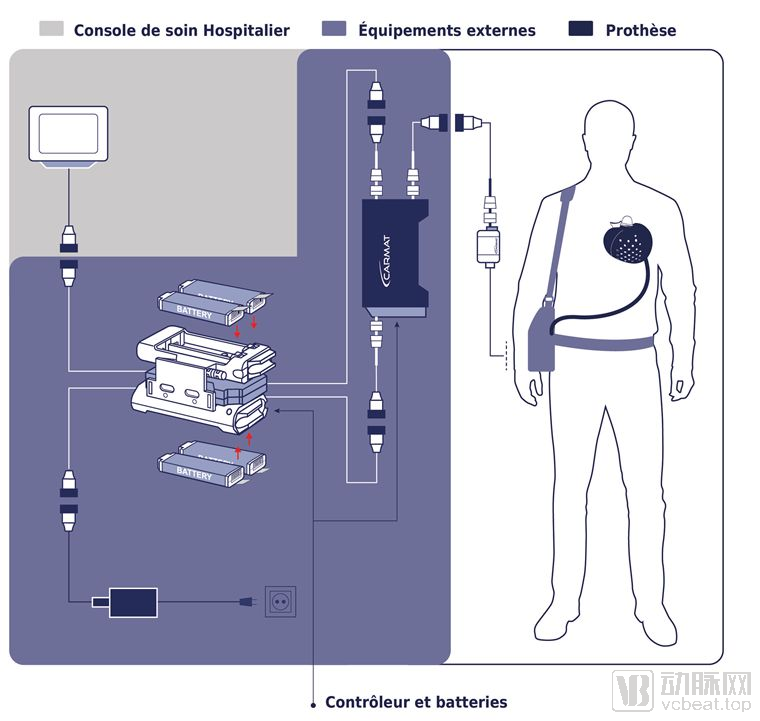
Currently, the Aeson artificial heart produced by Carmat consists of three components: an implantable prosthesis, external devices, and a hospital care console.
Source: Carmat Official Website
The implantable prosthesis is equipped with an electro-hydraulic system, comprising two ventricles, four biological valves, and other components. The external device consists of a controller and two battery holders, weighing 4 kilograms. Furthermore, the medical team can control and monitor the prosthesis via the hospital care console during the implantation procedure.
Carmat is a French medical technology company founded in 2008. With the support of the Airbus Group, Carmat was co-founded by Alain Carpentier, known as the father of modern valve surgery, and the venture capital firm Truffle Capital.
To secure a foothold in the emerging field of artificial hearts, concerted collaboration among talents from various disciplines is essential.
Alain Carpentier, the founder of Carmat, is regarded by the international community as the father of modern valve surgery and has made decisive contributions to heart valve surgery and heart failure treatment.He was awarded the Lasker Medical Award in 2007 for inventing bioprostheses and developing reconstructive/plastic surgical techniques for heart valves.
Stéphane Piat is an expert in the business development of medical devices. He joined Carmat as Chief Executive Officer in September 2016. Previously, he was responsible for the clinical and commercial development of MitraClip, a product for mitral valve repair, at Abbott’s vascular division.
Jean-Pierre Garnier is the Chairman of the Board of Directors of Carmat. He previously merged two major pharmaceutical groups, Glaxo Wellcome and SmithKline Beecham, to create GlaxoSmithKline (GSK).
In 2017, Carmat was listed on the AlterNext market in Europe, with an initial public offering price of €18.75 per share.
In 2013, the European Hospital Georges Pompidou in Paris performed the world’s first permanent artificial heart transplant, using Carmat’s artificial heart.This artificial heart weighs approximately 900 grams, three times the weight of a human heart. Such a large device is suitable for only 86% of male patients and 20% of female patients.
A 76-year-old patient was in very poor preoperative condition, essentially living on borrowed time, with no other option except artificial heart transplantation. The patient died 75 days after implantation due to a short circuit in the artificial heart.
Subsequently, Carmat completed its Phase I trial, implanting artificial hearts in four patients with end-stage heart failure. The four patients survived for a total of 21 months post-surgery; two died due to malfunction of the artificial heart’s electronic drive unit, while the other two continued to have normally functioning devices.
Subsequently, Carmat strengthened its management of postoperative patients to prevent them from being put at risk due to improper device operation.
In late August 2016, the first participant in Carmat’s Phase II clinical trial died. The French National Agency for the Safety of Medicines and Health Products ordered Carmat to halt all human heart transplant procedures and not to resume the relevant clinical trials until the cause of the patient’s death was determined.
To ensure the safety of its artificial heart products, Carmat is actively conducting various clinical studies.
The company is conducting the PIVOTAL study globally to evaluate the 180-day survival outcomes of patients implanted with its artificial heart, aiming to achieve commercialization of its artificial heart product.
In 2017, Carmat successfully launched the international PIVOTAL study through the first implantations of its bioprosthetic heart in Kazakhstan and the Czech Republic.
In the clinical results publicly released by Carmat in 2019, patients’ conditions continued to improve.In the PIVOTAL study, 73% of the first 11 patients achieved the study endpoint, defined as survival or successful transplantation within six months after artificial heart implantation.In the study, the longest duration of artificial heart implantation in patients exceeded 20 months.
In addition to a high 6-month survival rate, Carmat’s new protocol significantly reduced postoperative bleeding in the last three patients, while avoiding associated risks such as cerebrovascular accidents and gastrointestinal bleeding.
In April 2019, the French National Health Authority approved Carmat’s EFICAS study, a multicenter, non-randomized study involving 52 patients in France. Two-thirds of the total study costs were borne by the French government.France’s Ministry of Solidarity and Health has allocated €13 million to Carmat。
In September 2019, the FDA conditionally approved Carmat’s Investigational Device Exemption (IDE) application to initiate the U.S. early feasibility study of its total artificial heart.
Leveraging clinical experience gained from the PIVOTAL study, Carmat has improved its implantable prosthesis and portable system, developing a new version.In February 2021, the FDA granted conditional approval for Carmat to use its new version of the artificial heart in an Early Feasibility Study (EFS).
Carmat has long been striving to commercialize its artificial heart product.
In November 2017, Carmat entered into a partnership with AddUp, a subsidiary of Michelin. This collaboration aims to leverage AddUp’s 3D printing technology to enhance Carmat’s capacity for mass production of artificial hearts.
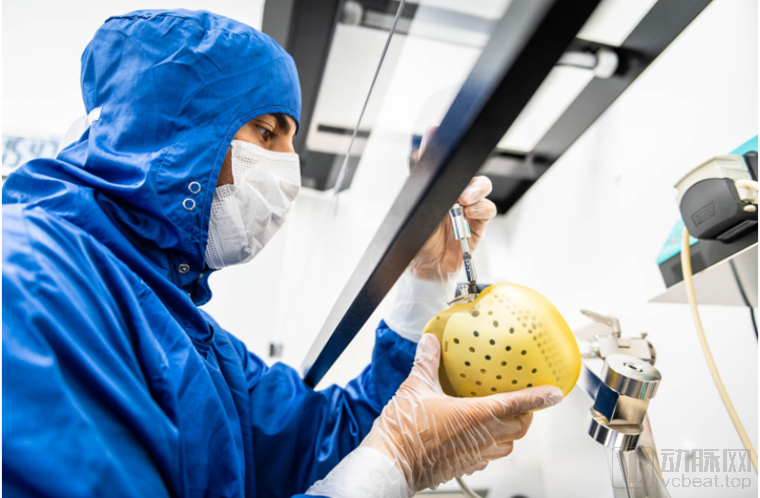
In December 2020, Carmat announced that its total artificial heart had received the CE mark, a certification related to safety controls in the European Union. This indicates that Carmat’s artificial heart can be used as a temporary treatment option for patients with advanced heart failure awaiting heart transplantation and can be sold in all countries that recognize CE certification.
Source: Carmat Official Website
Carmat’s artificial heart will be launched under the Aeson brand in the second quarter of 2021.The device costs more than $180,000, and Carmat needs to collaborate with insurance companies and governments to reduce R&D costs.
Constrained by technological limitations and the irreversibility of heart transplantation,Currently, artificial hearts are used only as a bridge to transplantation and cannot fully replace the human heart for permanent implantation.
Currently, Syncardia, a leader in the artificial heart industry, is conducting clinical trials for its permanent total artificial heart. Its Cardiowest artificial heart is the first total artificial heart certified for clinical application in the United States, Canada, and the European Union. It was once implanted in a 25-year-old patient, helping them survive for 555 days while awaiting a heart transplant.
Abiomed, the developer of the world’s first fully implantable artificial heart, has exited the total artificial heart market to focus on the ventricular assist device market, achieving success.
Currently, Chinese companies are primarily active in the field of ventricular assist devices.
Driven by the Chongqing Municipal Government, Chongqing Eternal Heart Medical Device Co., Ltd. introduced Japanese technology to manufacture the implantable left ventricular assist system—the “Eternal Heart” artificial heart—which successfully received market approval from the National Medical Products Administration on August 26, 2019.This is the first implantable ventricular assist device to be officially launched in China.
Suzhou Tongxin Medical Technology Co., Ltd., in collaboration with Fuwai Hospital, independently developed the third-generation fully magnetically levitated artificial heart, which weighs less than 180 grams. From June to October 2017, Beijing Fuwai Hospital obtained ethical approval under a humanitarian exemption and successfully used the fully magnetically levitated artificial heart to treat three critically ill patients.
According to the "Report on Cardiovascular Health and Diseases in China 2019" released by the National Center for Cardiovascular Diseases, the prevalence of cardiovascular diseases in China is in a continuous rising stage. It is estimated that there are currently 330 million patients with cardiovascular diseases, including 8.9 million patients with heart failure.
With technological advancements and improvements in quality of life, artificial hearts will no longer be limited to short-term bridging therapy prior to heart transplantation; instead, they will achieve permanent functionality through intelligent systems and multidisciplinary collaboration.