

Huiying Medical Secures China's First NMPA Class III Certification for X-ray Fracture AI Product, Expanding AI Footprint in Emergency, Trauma, and Public Health Care
Source: Leiphone; republished with permission from VCBeat.
On May 10, Huiyi Huiying officially announced that it had obtained the first Class III NMPA certification in China for an AI-based X-ray fracture detection product, marking the first approval of its kind in the country.
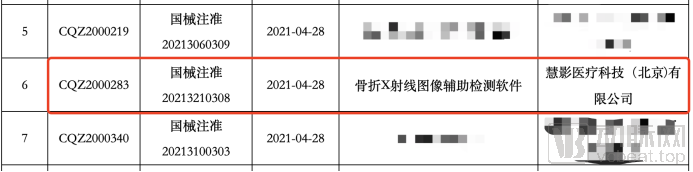
To date, Huiyi Huiying’s AI-powered DR fracture detection product has become the only X-ray fracture AI solution in China to hold both a Class III medical device registration certificate from China’s National Medical Products Administration (NMPA) and CE certification from the European Union. As early as May 2020, Huiyi Huiying’s computer-aided diagnostic software for fracture detection in X-rays was granted two invention patents by the China National Intellectual Property Administration. At that time, Guo Na, co-founder of Huiyi Huiying, stated to Leiphone.com, “In the previous two years, we focused primarily on CT imaging modalities. Starting this year, however, Huiyi Huiying has made a significant strategic shift by intensifying its product development efforts in the field of X-ray imaging.”
And such a transformation yielded results in less than a year.
With the official approval of its DR-based fracture detection products, Huiyi Huiying’s AI capabilities will unlock greater potential in fracture care scenarios, thereby becoming a key driver for AI-enabled development of trauma centers, emergency platforms, and primary public health infrastructure across China.
As China’s healthcare reforms deepen and the tiered diagnosis and treatment system is implemented, leading medical AI companies such as Huiyi Huiying will play a pivotal role in improving healthcare quality and service efficiency, as well as reducing misdiagnosis and mistreatment. By leveraging digital radiography (DR)—the most widely installed imaging modality—these companies will contribute meaningfully to the Healthy China 2030 initiative.
Huiyi Huiying has made a highly precise entry into the scenario of fracture diagnosis, as this area presents an urgent need that is “visibly apparent.”
Chai Xiangfei, Founder & CEO of Huiyi Huiying, shared the rationale behind entering the DR fracture detection market, stating, “Apart from cardiovascular and cerebrovascular diseases, fractures have become a highly prevalent condition, with no fewer than 5 million cases annually, representing a substantial market size.”
First, emergency and after-hours visits account for a high proportion of fracture cases, imposing stringent requirements on the timeliness of imaging diagnosis. Ensuring the accuracy of fracture screening under conditions of high fatigue and urgent decision-making is extremely challenging, particularly in precisely identifying fracture sites among the numerous joints of the hands and feet. Missed diagnoses can delay treatment, adversely affecting prognosis and functional recovery. In more severe cases, they may even trigger doctor-patient conflicts.
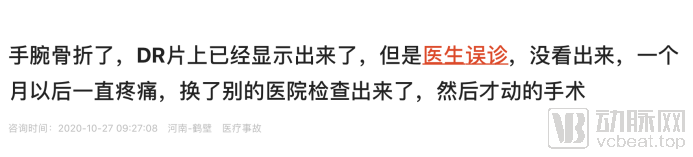

(Image caption: Screenshot of a post by a patient seeking legal advice online due to a missed fracture diagnosis)
Secondly, trauma is one of the major public health challenges faced by countries worldwide, encompassing injuries from high-altitude falls and fatalities in major disasters and accidents. In China, there are up to 62 million medical visits for trauma annually. To address this, China has established 360 regional trauma care systems across 28 provinces, with trauma care centers set up in 1,015 general hospitals, covering a population of 230 million.
How to establish a “rapid, efficient, and collaborative” trauma emergency care system based on such an extensive coverage network, enabling patients to receive diagnosis and treatment within the golden hour, thereby reducing mortality and disability rates, is the primary challenge in developing trauma centers.
In response to the high demands for “speed and accuracy” from emergency platforms and trauma centers, AI-based fracture detection products can maintain “professionalism” and “acuity” 24/7/365. Serving as assistants to physicians in time-critical departments such as emergency and trauma centers, these tools accelerate the diagnostic process while ensuring quality, which is crucial for fracture diagnosis scenarios.
The diagnosis of fractures represents a market with substantial volume and urgent demand. The key question is: which hardware modality should serve as the foundation—CT or DR? This decision involves multiple practical considerations, including equipment penetration rates and economic viability.
As early as four years ago, Professor Zhou Zijun from the School of Public Health at Peking University stated that, from a screening perspective, primary healthcare institutions should address the issue of early detection. If CT scans are used for this purpose at the primary care level, it is not a cost-effective approach from an economic standpoint. It would be more advantageous to employ AI-assisted digital radiography (AI-DR) as a low-cost solution, which then raises the question of how AI can effectively facilitate early detection.
Generally, the cost of a DR examination ranges from tens of yuan, whereas a CT scan costs between 200 and 300 yuan. Naturally, patients prefer the more economical option. Furthermore, for various types of trauma, particularly when bone injury is suspected, DR is the preferred initial choice due to its convenience and speed.
Therefore, during routine clinical visits, clinicians, from the patient’s perspective, would also prioritize digital radiography (DR) examination.
Furthermore, the installed base of DR equipment is a critical prerequisite for meeting primary healthcare needs.

Guo Na, Co-founder and COO of Huiyi Huiying, stated, “Frankly speaking, (this product) represents a significant attempt to achieve a breakthrough in imaging modalities, and is a crucial step in our concerted effort to expand our market presence from over 1,000 Tier-3 Grade-A hospitals to 30,000 primary healthcare institutions.”
This statement is backed by data.
According to statistics, by the end of 2019, the installed base of X-ray imaging equipment in China was approximately 90,000 units, far exceeding that of CT scanners (approximately 25,000 units) and MRI systems (approximately 10,000 units). As the DR market is relatively mature—with Chinese medical institutions having deployed X-ray machines for several decades—the annual replacement demand, coupled with the incremental market driven by the widespread adoption of DR equipment, is substantial.
Moreover, according to statistics from the National Health Commission, by the end of November 2019, there were 1.014 million medical and health institutions across China. Based on the configuration requirements for mobile DR (Digital Radiography) systems in hospitals of different tiers, the market demand for mobile DR units is estimated to be at least 44,925. According to data from “Yi Zhao Cai,” the total procurement volume of mobile DR systems in 2019 was 928 units. Given that the replacement cycle for DR equipment exceeds five years, it is projected that the current installed base in China is less than 5,000 units, indicating a substantial market gap.
Therefore, starting a few years ago, provinces and municipalities across China have successively launched large-scale centralized tendering and procurement programs for digital radiography (DR) systems, further driving substantial volume growth in the DR market.
In contrast, as large-scale medical imaging equipment, CT and MRI scanners currently have a low domestic production rate and high product prices. They are primarily configured in secondary hospitals and above, with limited penetration in primary care institutions and private hospitals.
Therefore, to capture the demand in primary healthcare, we must start with the most widespread and cost-effective devices, thereby turning the slogan of “AI-empowered medical devices” into reality.
In China, primary healthcare institutions serve as the peripheral nerves of the medical system. Low levels of informatization, coupled with shortages in funding and professional radiologists, are significant factors hindering the development of primary hospitals.
Statistics show that medical imaging data is growing at an annual rate of 63%, while the number of radiologists is increasing by only 2% per year. Guo Na candidly admits that what township hospitals and community health centers lack is not equipment, but diagnostic expertise among physicians. Under these realities, even with a high volume of imaging equipment, the accuracy of patient examinations cannot be guaranteed. Therefore, the integration of Medical Consortia and AI will become a new lever for tiered diagnosis and treatment.
Professor Zhou Zijun has stated that AI applications in primary-care medical imaging will require a comprehensive data solution to address the challenges facing grassroots healthcare. He remarked, “While the image acquisition capabilities of township health centers and the proficiency of their physicians can be brought up to standard through training, diagnosis remains a significant challenge. In the future, could cloud-based solutions leverage big data from primary care settings to facilitate diagnosis?”
Therefore, based on the actual conditions at the primary care level, Huiyi Huiying’s DR fracture detection product supports both cloud-based and on-premise hospital deployment, enabling primary care physicians to achieve diagnostic accuracy comparable to that of tertiary hospitals, even with existing hardware infrastructure.
Five years ago, when Huiyi Huiying was just established, it chose intelligent medical imaging as its entry point, merely conducting exploratory attempts centered on AI algorithm models and technological implementation.
Leveraging its core deep learning image analysis technologies and multiple patented technologies, and built upon cloud computing, big data, and artificial intelligence, Huiyi Huiying has currently launched NovaCloud®Smart Imaging Cloud Platform, Dr. Turing®The three major product systems—the AI-assisted diagnosis platform and the RadCloud® big data AI research platform—enable the digitization, mobilization, and intelligentization of medical imaging, completing a closed loop from screening and diagnosis to treatment decision support.
As a leading witness to the forefront of medical imaging AI, Professor Liu Shiyuan, Director of the Department of Radiology and Nuclear Medicine at Shanghai Changzheng Hospital, also stated that with the advancement of regulatory approvals, the rationalization of capital, and the deepening of corporate research, imaging AI is continuously developing in a positive direction. In the future, the trends in AI development will include multi-disease coverage, end-to-end workflow integration, platform-based solutions, the combination of software and hardware, and the integration of online and offline services.
The approval of DR products for fracture diagnosis aligns perfectly with the trend predicted by Professor Liu Shiyuan.
In April this year, Huiyi Huiying collaborated with the First People's Hospital of Kashgar, Xinjiang, to launch a tuberculosis awareness campaign. Its DR-based AI-assisted tuberculosis screening product has been deployed and put into use in Kashgar, Xinjiang.
The recent certification of this DR fracture detection solution further demonstrates Huiyi Huiying’s commitment to primary care and its dedication to leveraging AI to provide tangible support to grassroots hospitals.
The No. 1 Central Document of 2021 pointed out the need to strengthen the development of county-level hospitals, continuously enhance the capacity of county-level disease control and prevention institutions to respond to major epidemics and public health emergencies, and promote the construction of closely integrated medical consortia at the county level. As a leading enterprise in artificial intelligence, Huiyi Huiying is leveraging technology to support the “Healthy China” initiative, making AI-based products useful, usable, and preferred by physicians.