

Dunfu Medical Files for IPO: Complementing Oncology Care Scenarios and Expanding the Tumor Healthcare Ecosystem in a RMB 300 Billion Market
Whether in the film Go Away Mr. Tumor or A Little Red Flower, in addition to showcasing the living conditions of cancer patients to the outside world, they also highlight the trend of increasing incidence of cancer among younger populations. How to better improve the 5-year and even 10-year survival rates of cancer patients has become an urgent issue to be addressed.
Furthermore, cancer patients themselves face a host of challenges, including poor healthcare experiences, limited access to new drugs, significant financial burdens, lack of systematic care, and difficulties in obtaining information.
Within the healthcare ecosystem, the demands of various stakeholders are in fact far more complex:
Cancer patients seek access to the latest approved drugs and technologies, have a rigid demand for supportive and maintenance medical services during the post-treatment recovery phase, and express strong needs for precise screening and accurate triage prior to clinical treatment and following health check-ups.
Renowned medical institutions aim to increase bed utilization rates, enhance research efficiency, reduce the proportion of pharmaceutical costs, implement patient triage and stratification, and conduct more systematic out-of-hospital patient management.
Renowned experts aim to address the challenges of managing complex and critically ill patients, see more precisely matched patients, and achieve rational patient management.
Pharmaceutical companies aim to accelerate the promotion and adoption of new specialty drugs, obtain first-hand real-world data as soon as possible after market launch, and maintain ongoing patient engagement.
However, the traditional healthcare ecosystem often fails to meet the demands of various stakeholders due to a multitude of factors. Meanwhile, the market size for oncology treatment continues to expand, currently exceeding RMB 300 billion. With advancements in innovative technologies and increased involvement in new drug development, the oncology treatment market is poised for further growth.
In light of this, Zhuo Guangsong, who recognized the promising prospects of the oncology treatment market, embarked on a new chapter for Shanghai Dunfu Medical Investment Management Group (hereinafter referred to as “Dunfu Medical”) to better address existing challenges in the current healthcare ecosystem. Dunfu Medical is committed to building an oncology treatment ecosystem centered around China’s leading core public hospitals, integrating complementary medical scenarios, and enhancing patient management and other critical processes.
From Investor to Corporate Leader: Balancing Value Investing and Value-Based Healthcare
Before becoming the head of Dunfu Medical, Zhuo Guangsong had an impressive resume. He completed his undergraduate studies in Industrial Electrical Automation at Harbin University of Science and Technology, and later earned an EMBA from Nanyang Business School at Nanyang Technological University in Singapore and Antai College of Economics and Management at Shanghai Jiao Tong University. He also worked in the media industry and subsequently served as a senior executive at a national healthcare investment group.
In 2012, when Sinopharm Capital was established by Sinopharm Group, Zhuo Guangsong participated as the representative of the limited partners (LPs) and later served as Managing Director of Sinopharm Capital, overseeing investments in the healthcare services sector. Bullish on the growth prospects of the oncology field, he left Sinopharm Capital in November 2019. With the support of shareholders, he rebuilt the Shanghai Dunfu Medical Investment Management Group, using Shanghai Dunfu Hospital as its cornerstone asset, and assumed the role of CEO.

Zhuo Guangsong, CEO of Dunfu Medical
Currently, the middle management structure of Dunfu Medical Management is relatively young, yet all members possess advanced degrees and backgrounds in healthcare investment and medical operations. At its affiliated institutions, such as Shanghai Dunfu Hospital, key leadership roles—including General Manager, Executive Director of Operations, and Medical Director—are held by seasoned industry veterans. Dunfu Hospital has also established a tiered team of full-time physicians led by senior chief physicians, currently comprising nearly 35 full-time doctors and medical technologists.
From investor to corporate leader, Zhuo Guangsong’s role is also evolving. For him, whether adhering to the “value investing” philosophy proposed by Benjamin Graham in 1934 as an investor, or championing the “value-based healthcare” model introduced by Michael Porter in 2006 as the head of Dunfu Medical, both approaches emphasize “value.” In this process, he is committed to delivering the most cost-effective medical services to meet the needs of the demand side.
The key point is that Zhuo Guangsong, as an investor himself, recognizes the public-welfare nature of healthcare while placing greater emphasis on the hospital’s own development, balancing profitability, employee welfare, and growth. With his new identity, Zhuo Guangsong stated that he is more focused on how emerging technologies—such as biotechnology, artificial intelligence, and mobile internet—interact to drive the evolution of new healthcare models. He is also committed to meeting patients’ personalized service needs. Furthermore, he expressed his intention to balance the needs of both consumer-facing (C-end) and business-facing (B-end) clients, while leveraging the resources of a public-welfare foundation to address the needs of certain vulnerable groups.
Synergizing with the oncology treatment ecosystem of public hospitals to complement healthcare scenarios
“Dunfu Medical aims to ‘connect high-quality partners and build a responsible oncology healthcare ecosystem. Through its internet hospital and specialized digital matrix service platform, it manages and serves a larger number of cancer patients in urgent need of treatment and rehabilitation. Meanwhile, it generates vertical-domain oncology big data, particularly real-world data, to serve pharmaceutical companies and insurance providers,’ said Zhuo Guangsong.”
Shanghai Dunfu Hospital, under its umbrella, is currently collaborating with renowned medical institutions such as Fudan University Shanghai Cancer Center to establish a comprehensive oncology hospital specializing in “the application of novel tumor treatment technologies, oncology rehabilitation, and precise triage for cancer patients.” The cooperation between Dunfu Hospital and Fudan University Shanghai Cancer Center is structured in the form of a specialized medical consortium. In terms of applying cutting-edge oncology treatments, Dunfu Hospital has been continuously providing cancer immunotherapy and targeted therapy. As of April 2021, the hospital had administered immunotherapy (PD-1/PD-L1) to 40,000 patient visits.
Currently, Dunfu Hospital offers a diverse range of offline medical services, including immunotherapy, perioperative care, cancer screening, specialized disease outpatient clinics, multidisciplinary team (MDT) consultations, and nutritional management. Additionally, the hospital is gradually expanding its online medical services through its “Cloud PACS Platform” and “Patient Management Platform.”
In 2020, Dunfu Hospital signed an agreement with Zhongshan Hospital, Fudan University, to launch a research project on “Management of Cardiotoxicity Associated with Immune Checkpoint Inhibitor Therapy.” The medical team at Dunfu Hospital collaborated with Professor Cheng Leilei’s team (part of Academician Ge Junbo’s larger research group) to conduct domestic research on the management of cardiotoxicity associated with immunotherapy. In 2021, Dunfu Medical partnered with the Chinese core Category A journal *Chinese Journal of Clinical Research* and Sandu Medical Network to publish a special issue on “Cardio-Oncology,” which is also expected to be presented at the “Oriental Cardiology Conference.”
Addressing the challenges within the current oncology treatment ecosystem extends beyond merely serving tertiary A-grade cancer hospitals. Dunfu Hospital has also engaged in negotiations and established collaborations with major domestic and international pharmaceutical companies with marketed oncology drugs, as well as leading Chinese enterprises specializing in novel oncology therapies and cancer vaccines. Collaborations with pharmaceutical companies encompass patient education, academic activities, public welfare initiatives, and the promotion of specialized disease-specific departments. In terms of payment solutions, Dunfu Medical has secured direct-billing designated provider agreements with insurers such as Ping An Health Insurance, and is planning various operational collaborations with the Expert Center and Internet Hospital of Ping An Health (formerly Ping An Good Doctor).
Continuous collaboration has also driven revenue growth. Dunfu Hospital, which officially commenced operations in 2019, achieved a 32.8% year-on-year revenue increase in 2020 despite the impact of the pandemic. According to Zhuo Guangsong’s estimates, Dunfu Hospital’s revenue in 2021 is expected to approach RMB 250 million.
How does Dunfu Medical’s model differ from conventional approaches? According to Zhuo Guangsong, the key distinctions lie in two areas: first, its vertical focus on specialized oncology treatment; second, its horizontal emphasis on precise pre-hospital screening, in-hospital supporting services, and comprehensive post-hospital care. Currently, through an asset-light operational strategy, Dunfu Medical has successfully implemented a 5,000-square-meter flagship hospital model for Dunfu Hospital and continues to enhance revenue per square meter. Meanwhile, in the field of oncology treatment, Dunfu Medical maintains long-term exchanges with the founding teams of Hygeia Healthcare and Meizhong Jiahe, pursuing differentiated competition to jointly expand and standardize the private-sector oncology ecosystem.
Strategic Layout in the Beijing-Tianjin-Hebei Region and the Yangtze River Delta to Expand the Oncology Healthcare Ecosystem
For Dunfu Medical, the opportunity to partner with Fudan University Shanghai Cancer Center and Zhongshan Hospital Affiliated to Fudan University marks a promising start. The company is also actively expanding its presence in the Beijing-Tianjin-Hebei region and other areas. Its hospital in Tianjin is scheduled to commence operations in the fourth quarter of this year. By collaborating with China’s leading oncology hospitals, Dunfu Medical fosters synergistic development while leveraging superior medical expertise and patient resources. The company aims to serve “prestigious hospitals, renowned physicians, and leading enterprises,” integrate online and offline services, and consolidate resources within the oncology healthcare ecosystem. This strategy enables comprehensive patient management, facilitating deep vertical specialization in cancer treatment and advancing digital healthcare.
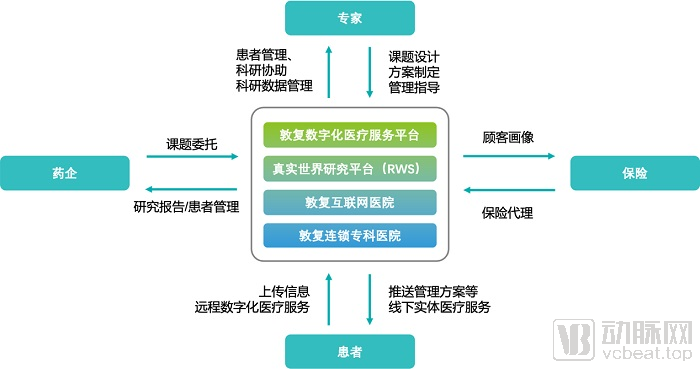
As its digital platform gradually takes shape, Dunfu Medical also plans to collaborate with pharmaceutical companies in multiple areas, including real-world studies (RWS), oncology-specific big data, project undertaking, support for principal investigators’ (PIs) scientific research, and market promotion in broad-tier markets.
The significance of digitalization cannot be underestimated. Currently, digitalization serves as the most critical infrastructure for Dunfu Medical. Dunfu Data Technology Company, a subsidiary of Dunfu Medical, will function as a technology integration platform. Its strategy involves three key steps: first, establishing the “Dunfu Internet Hospital”; second, building several specialized digital healthcare platforms focused on oncology through mergers and acquisitions, integration, and independent development; and third, undertaking the construction, development, and application of proprietary data resources while engaging in horizontal collaborations to create a platform that serves both business clients (pharmaceutical and insurance companies) and individual consumers.
Dunfu Medical is currently conducting its Series A financing round, with plans to close the round in Q3 2021. In terms of long-term planning, Dunfu Medical aims to recruit a mature talent team aligned with its strategic roadmap, refine its model of “connecting with high-quality partners,” and establish its digital infrastructure. Looking ahead, the company intends to expand into the Pearl River Delta market after establishing its presence in the Beijing-Tianjin-Hebei region, and following an IPO, focus on the Chengdu-Chongqing economic circle and central China. Dunfu Medical seeks to continuously deepen its expertise to maximize the value derived from oncology data.
Currently, as a special type of chronic disease, cancer care faces significant challenges in addressing patients’ personalized needs and empowering them to manage their health—particularly in overseeing medical care during post-treatment phases or treatment intervals. On the other hand, oncology is entering a golden age of development. Advances such as the evolution of PD-1 inhibitors from monoclonal antibodies to multi-target combination therapies, along with mRNA cancer vaccines, oncolytic viruses, CAR-T/CAR-NK cell therapies, and gene therapies, are gradually improving patients’ five-year survival rates. Digital solutions like telemedicine will also play a substantial role. However, significant challenges remain in achieving widespread adoption and promotion of these new technologies.
In this regard, Zhuo Guangsong expressed optimism about the development of the following three areas:
From the demand side, precise screening and triage in the pre-clinical phase following health check-ups will enhance the likelihood of detection and diagnostic accuracy; furthermore, comprehensive medical support services during the rehabilitation and intermittent phases after the completion of primary treatment will improve quality of life and extend survival. There is an opportunity to provide cost-effective medical services.
From the supply side, medical institutions with strong comprehensive capabilities in underdeveloped regions for oncology care will have opportunities.
From the perspective of value-based healthcare, there is significant potential and opportunity in leveraging internet and digital platforms to empower patients to achieve optimal medical outcomes while minimizing the time, financial, and psychological burdens throughout their care journey. Additionally, harnessing artificial intelligence, big data, and internet technologies can empower high-tech biopharmaceutical companies to develop superior products at minimal cost and ensure timely patient access.
And this is the direction that Dunfu Medical will be committed to in the future.