

Shukun Technology's 'Digital Chest' Empowers Early Lung Cancer Screening and Diagnosis in Grassroots Hospitals
In March 2021, Dechang County People's Hospital introduced Shukun Technology’s artificial intelligence (AI) system for assisted diagnosis of pulmonary nodules and put it into clinical use. The AI-assisted diagnostic system for pulmonary nodules can automatically identify CT images, detect various types of pulmonary nodules present in patients’ lungs, provide detailed descriptions of nodule characteristics, generate semi-structured diagnostic reports, assess the benign or malignant nature of pulmonary nodules, and assist physicians in interpreting CT imaging.
Within its product portfolio, the AI-assisted diagnostic system for pulmonary nodules is branded as “Digital Chest.” Dechang County People’s Hospital affectionately refers to this diagnostic system as the “AI Doctor,” praising it with the remark, “Its arrival has left pulmonary nodules nowhere to hide.”
An official article from the WeChat public account of Dechang County People’s Hospital stated, “Under normal circumstances, it takes a radiologist more than ten minutes to interpret a single lung CT scan, with complex cases requiring even longer. In contrast, the artificial intelligence (AI)-assisted diagnostic system for pulmonary nodules requires only one minute. While it is laborious for the human eye to detect small lesions with diameters of 1–3 mm, the system can identify them instantaneously. The detection rate for early-stage lung cancer reaches as high as 80.0%. Among screened patients diagnosed at an early stage, 80.0%–90.0% can be cured through minimally invasive surgical resection, without the need for further radiotherapy or chemotherapy. This reduces missed diagnoses of pulmonary nodules and significantly improves the quality and efficiency of pulmonary nodule screening and early lung cancer diagnosis, truly achieving ‘early detection’.”
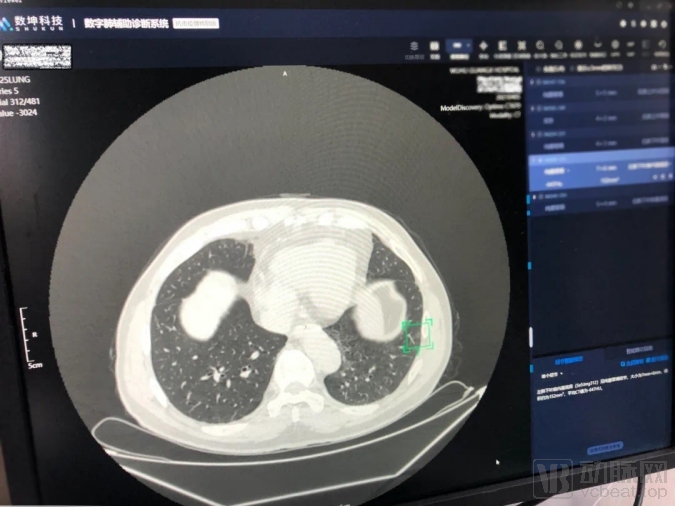
Pulmonary nodules are the “warning signal” for lung cancer. In the past, screening for pulmonary nodules relied entirely on physicians’ visual assessment. A single chest CT scan comprises 200 to 300 images, and it takes a senior radiologist more than ten minutes to review one set of chest CT images. This process is highly susceptible to misdiagnosis and missed diagnoses due to visual fatigue.
“AI Doctor” can perform a series of complex tasks, including intelligent nodule detection, intelligent classification of nodule types, intelligent identification of lung lobes and segments, automated analysis of historical reports, intelligent matching and analysis of historical lesions, and generation of structured nodule reports. These capabilities significantly reduce the rate of missed diagnoses and provide intelligent qualitative analysis of nodules to assist in determining benignity or malignancy. These features have substantially improved the quality and efficiency of pulmonary nodule diagnosis at Dechang County People's Hospital, bringing a comprehensive technological upgrade to pulmonary nodule screening across the county.
It is understood that the Shukun Pulmonary Nodule AI System is built upon hundreds of authoritative clinical guidelines and expert consensus statements, as well as millions of medical big data records deconstructed by artificial intelligence. The system automatically annotates suspicious regions, achieving a pulmonary nodule detection rate of over 95%. It truly enables early screening and diagnosis of lung cancer in clinical practice, providing a basis for early treatment, driving leapfrog development in the imaging diagnosis of pulmonary nodules, and holding significant implications for lung cancer treatment.
Benefiting from increased state investment in primary healthcare institutions, Dechang County People's Hospital has been equipped with advanced medical devices in recent years, including a 1.5T MRI scanner, a large C-arm digital subtraction angiography (DSA) system, and a 64-slice/128-layer CT scanner, thereby meeting the public’s needs for health check-ups and clinical diagnosis. Furthermore, in 2018, it became the first county-level hospital in the Panxi region to be upgraded to a Grade III Class B general hospital.
With the introduction of the “AI Doctor,” the diagnostic and treatment capabilities of Dechang County People’s Hospital have been significantly enhanced. Currently, Shukun Technology’s “AI Doctor” is being frequently utilized at the hospital. Furthermore, to help improve the hospital’s diagnostic capacity for cardiovascular diseases, Shukun’s “AI Doctor” has equipped the facility with non-gated calcium scoring and intelligent auxiliary diagnostic systems for head and neck CTA. These tools enable rapid assessment of cardiovascular calcium scores and reconstruction of head and neck vascular images, automatically generating structured intelligent reports for reference by diagnosing physicians.
It is reported that lung cancer currently ranks first in both incidence and mortality among all malignant tumors. It is projected that by 2025, the annual number of lung cancer patients in China will exceed one million, making it the country with the highest burden of lung cancer worldwide. “However, the early diagnosis rate of lung cancer in China remains very low, with a five-year survival rate of only 15.6%, primarily due to late detection.”
Relevant experts have stated that the average 5-year survival rate for early-stage lung cancer is 55%–70%. However, for patients with pulmonary nodules smaller than 8–10 mm (i.e., small pulmonary nodules) who receive accurate diagnosis and treatment, the 5-year survival rate can reach 75%–95%, with the majority of patients achieving radical cure. Early-stage lung cancer often presents as asymptomatic small pulmonary nodular opacities measuring 1 cm or even just a few millimeters in diameter. Therefore, lung cancer prevention and control must begin with early screening, differential diagnosis, and treatment of small pulmonary nodules.
For residents of Dechang County, located in the Liangshan Yi Autonomous Prefecture of Sichuan Province—a region with a high concentration of ethnic minorities—lung cancer is currently the disease with the highest incidence rate across the entire province.
The 2018 Report on Cancer Prevention and Control in Sichuan Province indicated that the incidence rate of malignant tumors in Sichuan Province was 251.55 per 100,000 population in 2015, meaning that an average of 25 out of every 10,000 individuals were diagnosed with malignant tumors. The incidence rate was 298.67 per 100,000 for males and 202.23 per 100,000 for females, with a higher incidence observed in males than in females. Lung cancer, liver cancer, colorectal and anal cancer, gastric cancer, and esophageal cancer were the most common malignant tumors in Sichuan Province. Lung cancer ranked first in incidence among both males and females.
For local governments and residents, lung cancer prevention and control is an urgent priority. Shifting the focus of lung cancer prevention and control upstream to maximize early detection, minimize patient mortality, and restore patients’ pre-illness quality of life as fully as possible are critical measures needed to address the pressing situation in lung cancer management and alleviate the burden on patients and their families.
Therefore, whether in primary care settings or major cities, early screening, diagnosis, and treatment remain the most effective strategies for preventing the further progression of lung tumors. However, although primary care hospitals see a considerable number of lung cancer patients, they face challenges such as insufficient medical staffing and limited experience in image interpretation. Additionally, fatigue from prolonged image review by physicians can easily lead to missed or misdiagnoses. Consequently, AI-assisted screening can significantly address the shortage of medical personnel in primary care institutions.
In recent years, AI-based solutions for lung cancer screening and pneumonia assessment have been integrated into routine clinical practice at many hospitals across China. Since last year, Shukun Technology has established a strategic partnership with Philips. By combining Philips’ leading CT equipment with Shukun’s proprietary AI technology, the two companies have developed a comprehensive “Digital Chest” solution suite, encompassing applications such as “Fever Clinic” and “Lung Cancer Screening.” This integration seamlessly merges routine scanning workflows with disease screening processes, enabling highly efficient and sensitive detection of lesions. To date, this solution has been deployed in dozens of hospitals throughout China and holds promise for benefiting more patients at primary care institutions in the future.
As a leader in the field of intelligent medical imaging, Shukun Technology has consistently adhered to the philosophy of originality and product differentiation. Its “Digital Chest” solution has carved out a distinct competitive path by leveraging its core competencies in cardiac analysis. Through a single chest CT scan, Shukun’s “Digital Chest” not only comprehensively detects pulmonary nodules but also provides assessments of cardiac function, non-gated calcium scoring on LDCT images, and evaluation of lung function for COPD. This approach achieves comprehensive AI-assisted diagnosis of chest imaging, integrating both structural and functional analyses.