

The 'Most Invisible' County in China Dominates 31% of the National Infusion Device Market and Aims for a 100-Billion-Yuan Medical Industry
According to the official website of the National Health Commission, as of May 7, 2021, a cumulative total of cases had been reported across 31 provinces (autonomous regions and municipalities) and the Xinjiang Production and Construction Corps.3,082.26 million doses of COVID-19 vaccine administered, officially surpassing the 300 million mark, China is accelerating its progress toward the goal of building a robust immune barrier.
However, it must be recognized that as the demand for vaccination across China continues to rise, the demand for related medical consumables is also increasing rapidly, particularly for infusion devices. The country has now entered a period of “accelerated production.” Recently, according to CCTV reports, a syringe manufacturer in Shandong Province has implemented a 24-hour production schedule, expanding its original two production lines to five. Despite this, the company’s orders are fully booked through July of this year, indicating a nationwide shortage of infusion devices.
When it comes to infusion devices, one cannot fail to mention Jinxian County in Nanchang City, Jiangxi Province, which is known as the “Home of a Single Needle.” Although it has little presence nationwide, it isThis “little-known” small county commands over 31% of the domestic market share for single-use infusion devices, with its annual output value of medical devices reaching RMB 16.22 billion in 2019 and poised to surpass the RMB 100 billion mark by the end of 2022.
As the era of universal vaccination arrives, Jinxian, a county previously unknown to the public, has begun to enter the spotlight and gain social attention. However, this has also sparked curiosity: What is the background of this small county that holds more than 31% of the domestic market share for disposable infusion sets? How does it plan to achieve a gross domestic product (GDP) of one hundred billion yuan within the next two years through its strategic layout? Furthermore, what references can its successful model provide for the development of China’s healthcare industry? In response to these questions, VCBeat will seek answers by examining Jinxian’s development trajectory.
In the “jianghu” of the medical device industry, Jinxian has many competitors, among which Changyuan is undoubtedly the most representative. As"China's Capital of Medical Consumables"Changyuan City, Henan Province, is currently home to more than 70 manufacturers of various medical consumables and over 3,000 related trading enterprises, employing more than 60,000 people. It accounts for over 50% of the sales volume in China’s medical device market, truly embodying the saying, “When Changyuan sneezes, China’s medical device market catches a cold.” This fully underscores Changyuan’s pivotal position in the national market for medical consumables.
However, Jianxian is by no means a “soft target.” Data show that, as of now,Jinxian County is home to 151 medical device manufacturers and over 600 local distributors, with five of these enterprises ranking among China’s Top 100 Medical Device Companies. Its product portfolio covers more than 100 major categories and over 3,000 varieties of Class I, II, and III medical devices, earning it the reputation as the “Home of Medical Devices in China.”
At first glance, there does appear to be some competition between Jinxian and Changyuan. However, a deeper analysis by subsector reveals that the two actually differ in many respects.
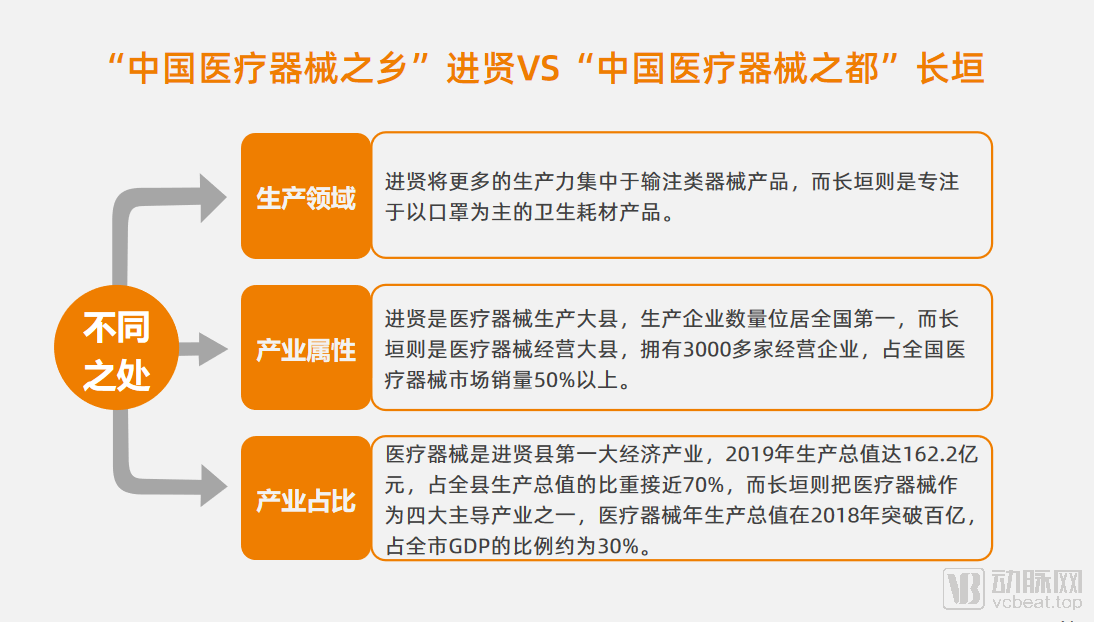
First, the production sector, Jinxian has concentrated more of its production capacity on infusion-related medical devices, while Changyuan focuses on hygiene consumables, primarily masks;Next is the industrial attribute.Jinxian is a major county for medical device manufacturing, with the highest number of manufacturers in China; Changyuan, on the other hand, is a major hub for medical device distribution, boasting over 3,000 distributors and accounting for more than 50% of the national medical device market sales volume;Finally, the industrial proportionMedical devices constitute the primary economic industry in Jinxian County, with a gross output value reaching RMB 16.22 billion in 2019, accounting for nearly 70% of the county’s total GDP. In contrast, Changyuan has designated medical devices as one of its four pillar industries, with annual gross output surpassing RMB 10 billion in 2018, representing approximately 30% of the city’s GDP.
Beyond these fundamental differences, the two share many similarities, which is why Jinxian and Changyuan have long been compared.
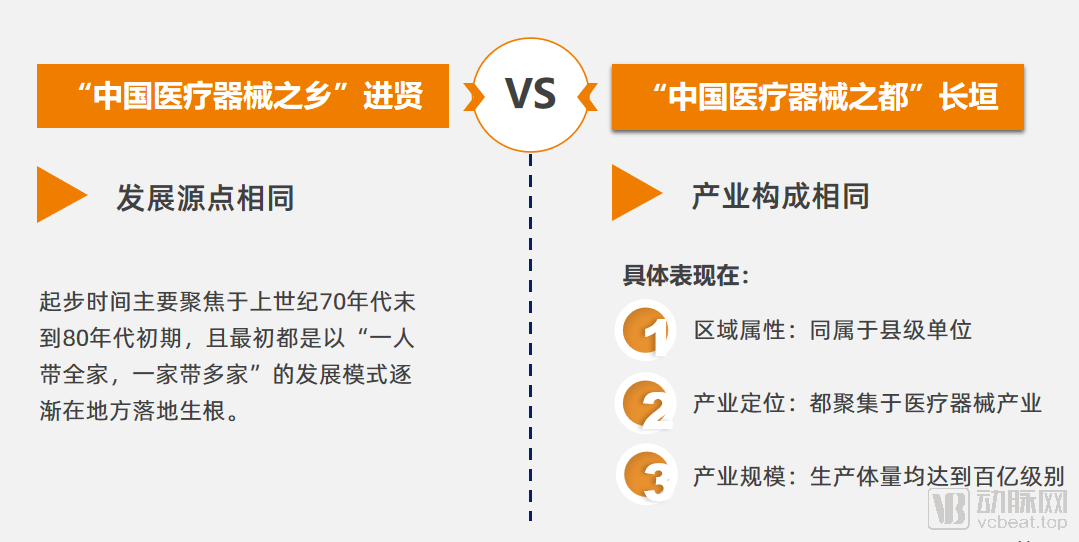
On the one hand, they share the same origin, both evolving from “family workshops.”Unlike today’s Zhangjiang Hi-Tech Park, Suzhou BioBAY, and Wuhan Optics Valley—medical and health industrial parks established under the leadership of national government departments—Jinxian and Changyuan both exemplify a “wild growth” model. Both have undergone a long and arduous evolution from family-run workshops into industrial clusters. Specifically, the development of Changyuan’s medical device industry can be traced back to the late 1970s, initially involving small, family-based workshops producing and selling medical cotton swabs. Meanwhile, Jinxian’s medical device industry began in the early 1980s, taking root through a development pattern described as “one person leading the whole family, and one family influencing many others.”
On the other hand, the industrial composition is identical, with similarities in regional attributes, industrial positioning, and industrial scale.First,Regional Attributes, although Changyuan officially transitioned from a county to a county-level city on September 28, 2019, it is still regarded as equivalent to a prefecture-level city in terms of industrial development trajectory, placing it on the same level as Jinxian; secondly,Industrial Positioning, although Changyuan and Jinxian focus on different niche segments, both belong to the medical device industry as a whole; finally,Industry Scale, according to the latest data, the total output value of medical devices in Changyuan City first exceeded RMB 10 billion in 2018, while the annual total output value of medical devices in Jinxian reached RMB 16.22 billion in 2019, with both production volumes reaching the tens-of-billions level.
Overall, while Jinxian and Changyuan share many superficial similarities in terms of regional attributes and industrial positioning, they exhibit significant differences in deeper aspects such as production capabilities and industrial characteristics. Therefore, the two are not directly comparable, as each possesses its own unique strengths within its respective domain.
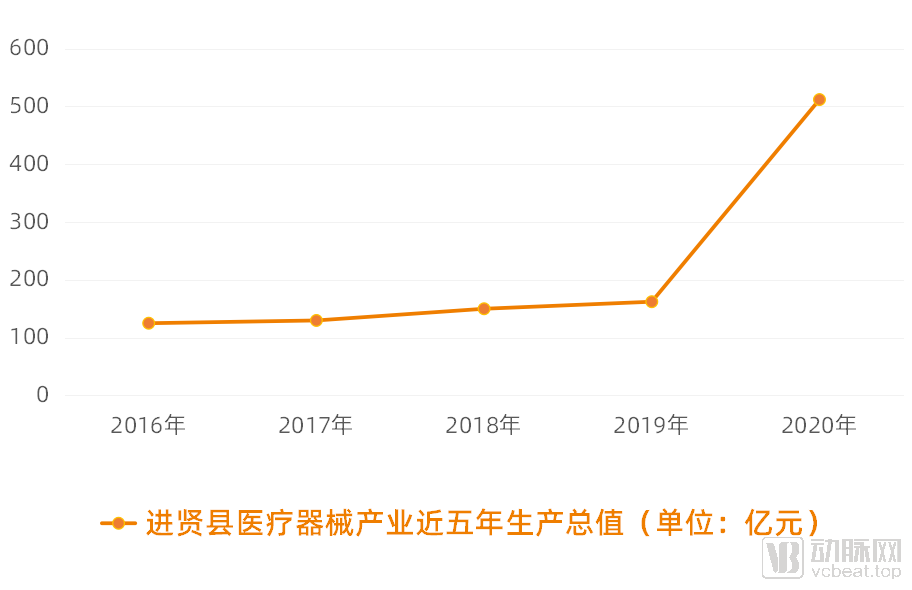
After nearly 30 years of navigating challenges and gaining experience, the medical device industry in Jinxian County has matured.Production output has exceeded the 10 billion yuan mark for five consecutive years, maintaining an average annual growth rate of approximately 15%., the industry as a whole demonstrates strong growth momentum. In 2019, the output value of the medical device industry in Jinxian County reached RMB 16.22 billion, accounting for nearly 70% of the county’s GDP, making it the primary pillar industry in Jinxian County’s economic structure.
Yet the development of all things follows discernible patterns. For Jinxian County, what exactly is the “foundation” that has enabled it to achieve a production output value in the tens of billions within 30 years while maintaining a trajectory of sustained high-speed growth?
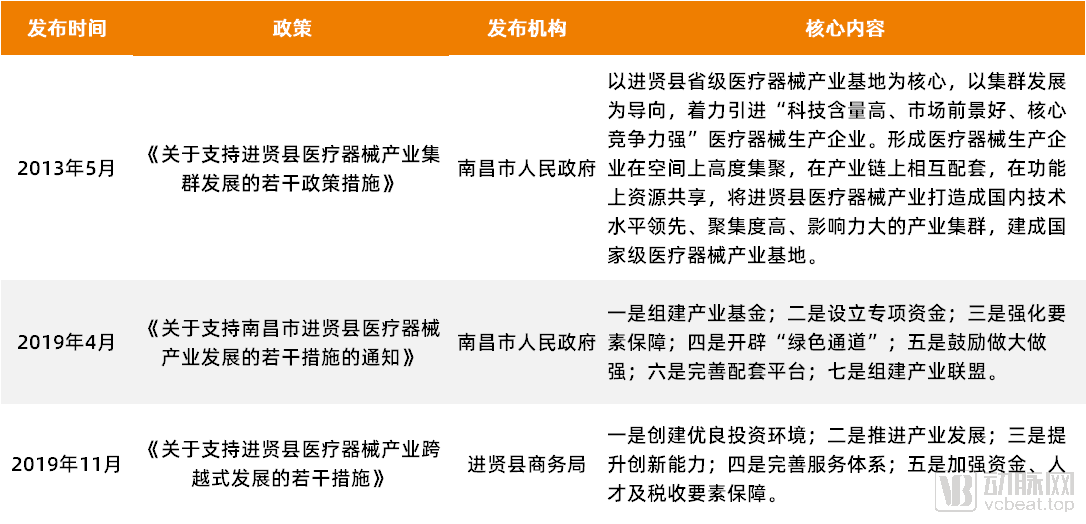
First, the government has provided strong support by successively issuing multiple guidance documents.To support the development of the medical device industry, the Nanchang Municipal Government and the Jinxian County Government have successively issued multiple guiding documents since 2013. These primarily include the “Several Policy Measures on Supporting the Development of the Medical Device Industry Cluster in Jinxian County,” the “Several Measures on Supporting the Leapfrog Development of the Medical Device Industry in Jinxian County,” and the “Notice on Several Measures to Support the Development of the Medical Device Industry in Jinxian County, Nanchang City.” These policies provide robust support in areas such as financial assistance, enterprise incubation, device regulation, channel development, and talent cultivation.
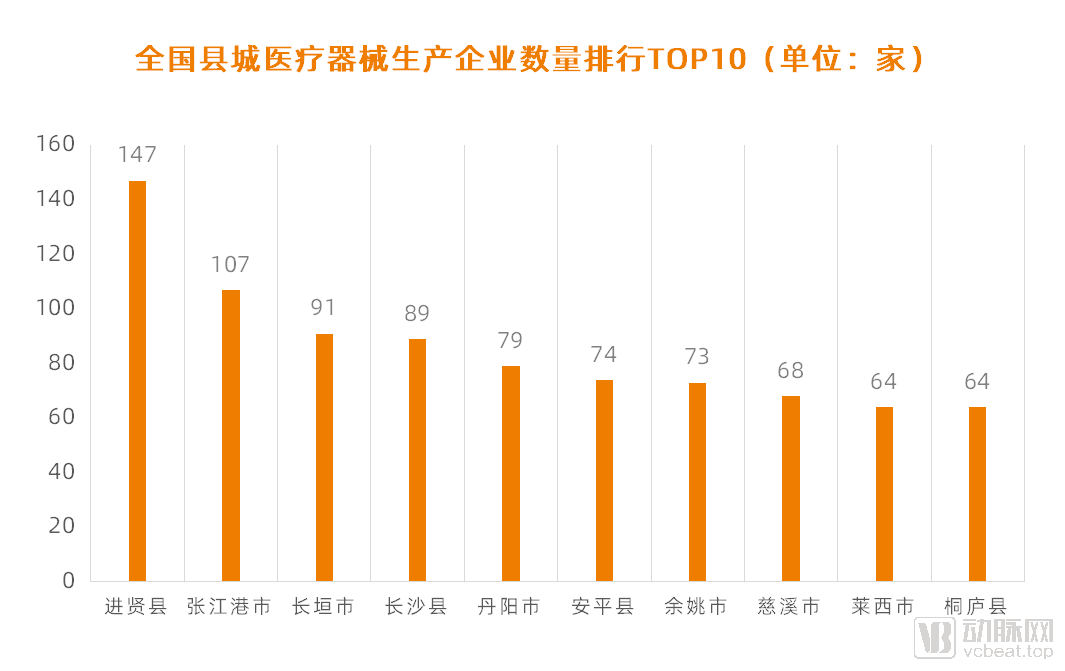
Data source: Zhongcheng Medical Devices; Chart by VCBeat
Second, leading enterprises drive development, further stimulating the industry's endogenous momentum.Industrial development relies heavily on the support of leading enterprises. As a flagship medical device company in Jinxian County, Jiangxi Hongda Medical Device Group is driving sustainable industry-wide growth through innovation-led strategies and industrial upgrading and transformation. In recent years, to fully leverage its role as an industry leader, Jiangxi Hongda Medical Device Group has successively established the “Jiangxi Jinchen Medical Project,” a public service platform integrating industry, academia, and research in the medical device sector, and “Yiqi Jiankang Wang” (Together Health Network), China’s first vertical platform dedicated to medical devices. The “Jiangxi Jinchen Medical Project” provides efficient and professional sterilization, disinfection, logistics distribution, and medical device leasing services through standardized management and specialized logistics, thereby filling a critical gap in Jinxian County’s medical device supply chain. Meanwhile, “Yiqi Jiankang Wang” adopts a new “Internet + Medical Devices” model that integrates production and sales, technical services, and platform promotion, continuously expanding new market frontiers for the industry’s sustained development.
Third, its market reach is global, supported by a sales force of over 60,000 people.。Production capacity determines the foundational depth of an industry, while sales capability defines its superstructure. According to official statistics, Jinxian County currently boasts a sales force of over 60,000 individuals and has registered more than 5,860 sales companies nationwide. These entities distribute over 6,000 types of medical device products, with marketing networks covering cities and towns of all sizes across China, and maintaining long-term, amicable cooperative relationships with more than 10,000 large and medium-sized hospitals nationwide. The products are exported to over 20 countries and regions in Asia, Europe, the Americas, the Middle East, and Africa. In 2019, total sales revenue exceeded RMB 200 billion, accounting for approximately 40% of the domestic market share.
The development of any industrial cluster encompasses both inevitable trends and contingent factors. In the case of the medical device industry in Jinxian County, the “inevitable trends” primarily include positive policy guidance and substantial government support, while the “contingent factors” refer to the radiating influence of leading enterprises and the presence of a large-scale sales team.
Just as enterprises must blaze a trail through thorns and brambles on their path forward, industries likewise encounter numerous challenges during their development. This is particularly true for county-level industrial clusters that have experienced “wild” growth, where the problems to be solved are often more numerous and complex. As we unfold the long and arduous history of the medical device industrial cluster in Jinxian County, it becomes evident that it has always been engaged in an iterative process of “identifying and resolving problems as they arise.”
First, the added value is low, and product profit margins are thin.In the early stages of industrial development, due to a lack of core technologies, the vast majority of enterprises in Jinxian County focused solely on producing low-value medical consumables, primarily injection-based devices. These products had low unit selling prices and thin profit margins, often leaving companies in the precarious situation of making ends meet. To address this issue, Jinxian CountyIntroduced a batch of high-end production equipment to facilitate industrial transformation and upgrading., gradually forming a linear industry covering the entire low-, mid-, and high-end value chain, fully meeting diverse market demands and driving rapid industrial growth.
Secondly, there are difficulties in financing, and funds cannot be effectively guaranteed.Jinxian County’s medical industry is predominantly composed of small and medium-sized enterprises (SMEs). Unlike large corporations, these SMEs cannot rapidly secure financial support during their development, facing relatively difficult financing conditions and lacking a robust capital system for backing. In light of this, the Jinxian County government has proactively intervened,By issuing multiple relevant regulations and establishing diverse financing platforms, substantial assistance has been continuously provided to enterprises in capital integration.
Then there is the difficulty in recruitment, with a pronounced “labor shortage.”Multiple enterprises have repeatedly stated that even when wages reach or even surpass those in provincial capitals, they still struggle to recruit staff. This shortage is particularly acute for scientific research and managerial talent, highlighting a significant “employee shortage” phenomenon. To effectively address this issue, the Human Resources and Labor Department of Jinxian County organizedRecruitment Team, actively coordinate with the personnel departments and employment bureaus of both local counties and other regions to facilitate inter-departmental liaison, thereby enabling the direct recruitment of employees from outside the area. In terms of research and management talent, the government encourages large enterprises to collaborate with major universities in Jiangxi Province, thus building a talent reserve.
Lastly, there is vicious competition and weak innovation in product development.After nearly three decades of development, medical device enterprises in Jinxian County have gradually become "homogenized," with prominent issues such as unscrupulous poaching of personnel, arbitrary hikes in material prices, and suppression of product prices, leading to intensifying vicious competition within the industrial cluster. To resolve this "contradiction," the Jinxian County government establishedMedical Device Industry Association, in addition to meeting various needs such as policy support, management improvement, and service follow-up, the most important role of this association is to build a platform for mutual exchange and learning among enterprises. By implementing a series of effective measures, it strengthens collaboration and cooperation between companies, thereby enabling resource sharing, promoting collective development, and ultimately maximizing industrial benefits.
Industrial development and corporate development share striking similarities. For small and medium-sized enterprises (SMEs), the challenges encountered during growth are more numerous and specific. Unlike large corporations that benefit from a “protective umbrella,” SMEs possess relatively weaker resilience to shocks. This logic equally applies to the development of county-level industrial clusters. Taking Jinxian County as an example, it has sequentially faced numerous obstacles in advancing its industries, including a lack of core technologies, relatively difficult access to financing, severe brain drain, and vicious internal competition. Each of these issues carries the potential to stall industrial progress. Fortunately, through close collaboration between the government and enterprises, targeted solutions were implemented for each challenge, enabling the industry to “break through” adversity and gradually advance toward high-quality development.
Crises Breed Opportunities: Only by Being Adept at Identifying Opportunities Can We Decisively Seize Them Amid the COVID-19 Pandemic. The head of the medical device industry in Jinxian County stated that in 2020 and the coming years, Jinxian County will actively carry out relevant work in line with the goal proposed by Liu Qi, Secretary of the Jiangxi Provincial Party Committee, to “jointly build a modern medical device industrial cluster through provincial, municipal, and county-level collaboration,” and in accordance with the requirements set by the municipal party committee for developing a hundred-billion-yuan medical device industry, so as to achieve growth and accelerated rise amidst the crisis.Strive to achieve breakthroughs in the main business revenue of the medical device industry, reaching over 50 billion yuan by 2020. By the end of 2022, establish a relatively complete industrial process from incubation to base production, build an industrial cluster led by leading enterprises to drive the development of small and medium-sized enterprises, and realize main business revenue of 100 billion yuan for the medical device industry.
To achieve the aforementioned goals and tasks, the Jinxian County Government will focus its efforts on these six levels.
First, focus on industrial park development to drive transformation and upgrading.Centered on the core objective of building a medical device industry worth RMB 100 billion, Jinxian County has implemented four key strategies: First, it is developing the Medical Device Science and Technology Industrial Park to establish a complete industrial chain and improve supporting service platforms. Second, it is actively applying for the designation of “China’s Public Health Industry Manufacturing Center,” with plans to construct one million square meters of standard factory buildings and logistics space, thereby facilitating channels for both production and export. Third, leveraging existing industrial advantages, it is promoting the transformation and upgrading of medical device enterprises in Lidu, Changshan, and Baixu Townships to enhance the technological content and market competitiveness of their products. Fourth, it is attracting manufacturers of mid-to-high-end active medical devices, as well as companies specializing in rehabilitation equipment, diagnostic testing, and reagents, to set up operations in the county.
Second, strengthen industrial planning to promote agglomeration and clustering.On one hand, scientific planning and rational layout should be implemented for the development of the county’s medical device industry, guiding enterprises to seize opportunities to adjust their product structures, promote industrial upgrading, avoid redundant construction, enhance brand effects, and improve risk resilience. On the other hand, following the principle of “centralized enterprise layout, clustered industrial development, intensive resource utilization, and integrated functional construction,” efforts should be made to attract medical device enterprises across the county to converge in the County Medical Device Science and Technology Industrial Park, thereby achieving industrial agglomeration and enterprise clustering within the park, and establishing a high-end industrial cluster zone.
Third, strengthen platform development to attract major and high-caliber investments.Robust collaboration with other institutions will further deepen the “moat” for industrial development. To support this growth, Jinxian County has adopted a three-pronged strategy: First, it is partnering with national health associations and industry-leading organizations to provide specialized division-of-labor services for enterprises, shifting project acquisition from a piecemeal approach to a clustered model. Second, it is establishing mechanisms such as big data-driven investment promotion, business-to-business referrals, platform-based attraction, and targeted recruitment, with a focus on introducing high-impact enterprises in sectors like medical healthcare and elderly rehabilitation that yield rapid results. Third, it is leveraging the internet to attract high-quality digital enterprises such as “Yilianwang” and “Wushitongtang,” gradually forming a sales pattern characterized by “buying globally and selling globally.”
Fourth, focus on enhancing quality to promote enterprise development.First, strengthen the development of entrepreneurs by organizing batches of medical device entrepreneurs from across the county to visit and study in advanced regions such as the Yangtze River Delta and the Pearl River Delta, thereby cultivating a group of modern entrepreneurs with strong market awareness and high professional competence. Second, establish modern corporate systems to guide medical device enterprises toward standardized operations, build modern corporate structures, achieve a transition from family-style management to scientific management in operational practices, shift from small-scale, fragmented, and all-encompassing models to specialized, corporatized, and group-based organizational structures, and transform property rights from individual ownership to modern corporate property rights systems. Third, encourage technological innovation by actively promoting increased R&D investment, the establishment of research institutions, stronger industry-university-research collaboration, and higher conversion rates of scientific and technological achievements, thereby comprehensively enhancing the overall competitiveness of enterprises. Fourth, establish industry associations to guide the formation of self-regulatory bodies within the medical device sector, implementing industry self-governance to effectively prevent the emergence of vicious competition.
Fifth, prioritize environmental optimization to drive service enhancement.First, streamline administrative approval items by further reducing the number of approvals, building on current practices and drawing on approaches adopted in developed regions. Second, simplify administrative procedures by implementing single-window processing and time-bound completion, ensuring that citizens need to visit government offices no more than once; explore the “Internet + Government Services” model to comprehensively optimize the business environment. Third, further clean up administrative and institutional fees, firmly abolishing unreasonable charges and applying the lowest possible rates for all fees and fines with discretionary ranges. Fourth, strictly enforce various protection systems; using the Medical Device Technology Industrial Park as a pilot, rigorously implement a “non-interference period” for production to enable enterprise owners to focus their efforts on management and operations with peace of mind.
Sixth, tackle difficult challenges to strengthen enterprises.Strictly implement the spirit of relevant policy documents, with a primary focus on policy measures. Fully leverage industrial funds to support the healthy development of incubated enterprises, mergers and acquisitions, and technological transformation and expansion projects. In terms of financing, establish corresponding risk compensation mechanisms, strengthen supervision over financial and guarantee institutions, increase financial support for medical device companies, and actively create favorable conditions to encourage capable medical device enterprises such as Hongda and Yikang to expand globally, pursue public listings for equity financing, and secure greater capital support. Regarding land use, adhere to the principles of securing new land quotas, revitalizing existing stock, and optimizing utilization, employing multiple measures to prioritize the resolution of land needs for medical device enterprises. In terms of workforce development, establish talent pools for both labor and specialized technical professionals. Adopt a dual approach combining political and economic incentives to attract managerial and technical talent. Furthermore, guide enterprises to integrate product development with scientific research conducted by universities and research institutes, fostering mutual promotion and accelerating the commercialization of research outcomes.
To seize development opportunities, Nanchang City has elevated the medical device industry to a municipal-level strategic priority, setting forth the goal of transforming Jinxian County into “China’s No. 1 County for Medical Devices” and developing the medical device industry into a trillion-yuan sector. To ensure these objectives are realized in the future, the Nanchang Municipal Government and the Jinxian County Government have already begun strategic planning and layout.
If we were to draw an analogy for the development of the medical and health industry, “schools” would undoubtedly be the best choice. On one hand, in terms of status, both education and industry play significant roles in regional development and are core areas where governments have long focused their efforts; on the other hand, in terms of composition,“Public schools” can be analogized to a group of biopharmaceutical industrial parks, such as Zhongguancun and Zhangjiang Hi-Tech Park, which were established under the leadership of national government departments., they possess distinct resource advantages and strong "faculty" strength, while“Private schools” can be equated to local industrial clusters undergoing “wild” growth., they receive relatively fewer resources, but have distinct characteristics and show a trend of gradually aligning with "public schools."
Currently, both domestically and internationally, national-level “public schools” with extensive coverage across the entire industry chain have moved beyond their initial development stage. Leveraging the advantages of group-based operations, they have established a certain influence at the top of the industry, making it unlikely that new industrial clusters will pose a significant challenge in the short term.
In contrast, local “private schools” are currently in their nascent stage, yet have already given rise to a cohort of industrial clusters with distinct regional characteristics. On a global scale, focusing on medical surgical instruments,Tuttlingenand those focused on the production of low-quality medical devicesSialkot Cityhave already achieved an annual production output value at the scale of tens of billions of U.S. dollars and gained a certain influence in the global market; focusing on China, in addition to those mentioned in this article“Hometown of Chinese Medical Devices” Jinxianand“China’s Capital of Medical Consumables” ChangyuanIn addition, it also gave birth to“National Endoscope Production Base” Tonglu、"China's Hub for Pathology Equipment Manufacturing": Xiaogan、“China’s Largest Orthopedic Production Base” Changzhou...and other specialized industrial clusters centered on the healthcare industry, which have leveraged regional industrial differentiation as a competitive advantage to forge a unique path of industrial development.
From these successful cases, it is easy to see that these county-level industrial clusters focus on creating distinctive features, mainly targeting a specific niche area, and using this as the focal point to promote the formation and optimization of the industry.
The reason this path is viable is that industrial development needs to align with local conditions. County-level industries lag far behind first- and second-tier cities in terms of policy support and resources, making them entirely unsuited to becoming the next “Silicon Valley” or “Zhongguancun.” However, this does not mean that county-level industries cannot “chart a new course.”Focusing on niche segments of the industry may be more conducive to building competitive advantages.