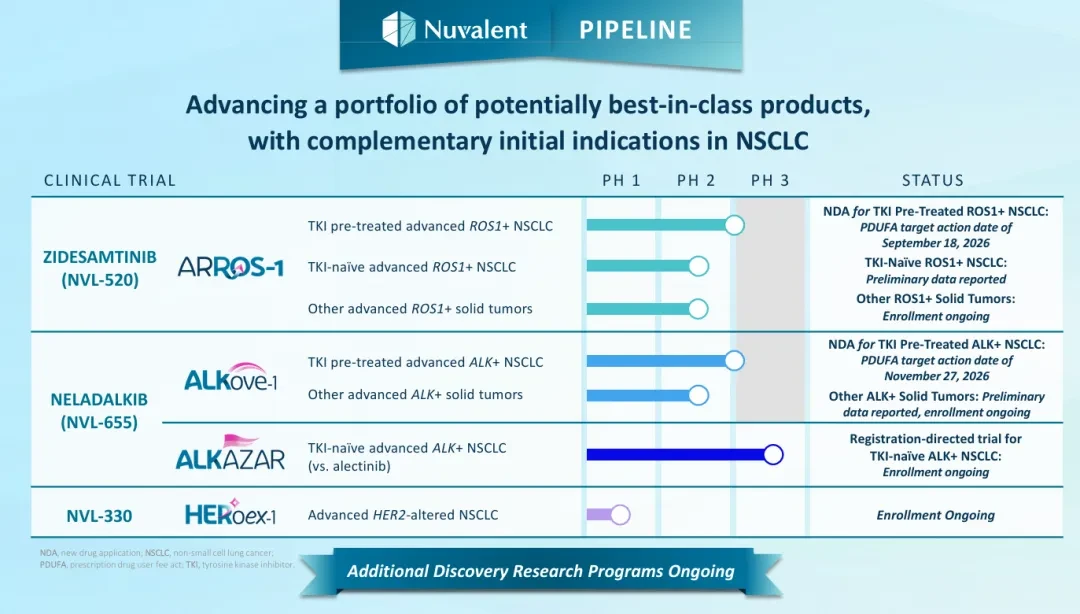
Recently, GSK (GlaxoSmithKline) announced a $10 billion acquisition, marking its largest deal in nearly two decades.On June 9, GSK announced on its official website that it had reached a final acquisition agreement with Nuvalent, a U.S.-based clinical-stage biopharmaceutical company, to acquire all outstanding shares of Nuvalent in an all-cash transaction, with a total deal value of $10.6 billion.Specifically, the acquisition price is $124 per share in cash, representing a premium of nearly 40% over Nuvalent’s closing price on June 8, 2026, and a 26% premium over its 30-day volume-weighted average price. Based on Nuvalent’s outstanding shares, the total equity value of the transaction amounts to $10.6 billion; after deducting approximately $1.2 billion in cash on Nuvalent’s balance sheet, GSK’s actual net investment is approximately $9.4 billion.Through this acquisition, GSK will gain access to multiple potential best-in-class drugs, including the next-generation highly selective ROS1 inhibitor zidesamtinib (NVL-520) and the next-generation highly selective ALK inhibitor neladalkib (NVL-655).This also marks the first major strategic acquisition since Luke Miels assumed office as the new Chief Executive Officer this year.Multiple Products Poised for Innovative GrowthThe deal that prompted GSK to invest billions of dollars was driven not only by the excellence of a single product but also by its alignment with GSK’s strategic development.GSK stated in its announcement that this acquisition aligns with its development strategy—Acquire assets with mature targets that can effectively address the efficacy limitations or tolerability shortcomings of existing therapies. The transaction also includes a portfolio of multiple products in the lung cancer field.GSK views this acquisition as an immediate catalyst for new revenue growth, with contributions to company income expected from 2027 onwards. Meanwhile, the assets acquired through this merger can be combined with its B7-H3 antibody-drug conjugate, Ris-Rez, currently in Phase III clinical trials, to jointly accelerate the expansion of its lung cancer treatment portfolio.GSK CEO Luke Miels stated, “This acquisition integrates multiple products and fully aligns with our M&A strategy: acquiring clinically validated, high-quality assets to address gaps in efficacy or tolerability left by existing therapies. Two core candidate drugs are expected to receive FDA approval and reach the market this year, providing new and important treatment options for two types of non-small cell lung cancer patients.”Image source: Nuvalent official websiteZidesamtinib (NVL-520) and neladalkib (NVL-655) are two next-generation highly selective inhibitors in late-stage development, with the potential to become best-in-class drugs targeting ROS1 and ALK, respectively, for the treatment of non-small cell lung cancer.Both drugs have received Breakthrough Therapy Designation and Orphan Drug Designation from the U.S. Food and Drug Administration (FDA) and are currently under FDA review. The target approval deadline for zidesamtinib is September 18, 2026, while that for neladalkib is November 27, 2026.If approved smoothly, the two drugs are expected to be officially launched in 2026, with the potential to become blockbuster drugs.Key clinical data presented at the 2025 World Conference on Lung Cancer (IASLC 2025) and the 2026 American Society of Clinical Oncology Annual Meeting (ASCO 2026) confirmed that zidesamtinib and neladalkib possess best-in-class potential.Leveraging high target selectivity, durable therapeutic responses, superior tolerability, enhanced blood-brain barrier penetration (for metastatic lesions), and broader coverage of various ALK and ROS1 mutations, these two drugs hold promise for addressing the suboptimal efficacy and prominent side effects associated with existing therapies.ROS1 and ALK fusion-positive non-small cell lung cancer predominantly occurs in non-smoking adults aged 40 to 50 years. This patient population is well-defined and demonstrates high treatment adherence. Leveraging clinical trials and patient assistance programs, both drugs have accumulated extensive real-world clinical application data.In addition, Nuvalent has several other potential blockbuster candidates. NVL-330 is a highly promising HER2 inhibitor currently in Phase I clinical trials for HER2-mutant non-small cell lung cancer (NSCLC).The acquisition also includes multiple preclinical R&D projects under Nuvalent, which are built upon the company’s mature precision drug development technology and the clinical experience accumulated by its top-tier medical scientists.Following the official announcement of the deal, Nuvalent’s stock surged nearly 39% in pre-market trading, approaching the $124 acquisition price; GSK’s shares experienced slight fluctuations, reflecting market caution toward the “high-premium acquisition,” although mainstream institutions remain optimistic about its long-term strategic value.“New Tricks” on Old Targets: $800 Million in Sales Within Two YearsNuvalent was founded in 2017 by Matthew Shair, Professor of Chemistry and Chemical Biology at Harvard University, and went public on the Nasdaq Stock Exchange in 2021.Matthew Shair has joined the Scientific Advisory Board of Manas AI. Reportedly, Manas AI is a full-stack, artificial intelligence-driven company focused on discovering and advancing next-generation therapeutics, having completed its Seed+ round of financing last year.But according to data from the London Stock Exchange Group (LSEG), Matthew Shair still holds a 2.16% stake in Nuvalent, meaning he will receive nearly $200 million from the sale of this biotech company.According to the MedAlpha New Drug Investment and Financing Database by Medicine Cube, Nuvalent has completed a total of six funding rounds since its inception. Following its IPO, it conducted three additional follow-on offerings, raising over $1 billion in total.Based on its shareholder composition, New York-headquartered healthcare investment firm Deerfield Management is Nuvalent’s largest shareholder and its sole founding investor. In 2017, the year Nuvalent was founded, Deerfield provided seed funding, and subsequently became the sole investor in Nuvalent’s $50 million Series A financing round in 2018. In 2021, after emerging from stealth mode, Nuvalent closed a $135 million Series B financing round in May, before embarking on its initial public offering (IPO) journey.Deerfield’s continued heavy betting on Nuvalent is no accident. Joe Pearlberg, Vice President of Scientific Affairs at the firm and a member of Nuvalent’s board of directors, mentioned in a report: “Nuvalent was founded on a compelling scientific premise“—By combining expertise in structure-based small molecule design with key clinical insights from physician-scientists, it is able to design highly selective ROS1 and ALK inhibitors to simultaneously overcome resistance and toxicity issues.”In short, Nuvalent’s differentiation lies in identifying clinical shortcomings of existing targets/drugs and addressing them through structural biology—such as designing drugs with greater precision and improved brain penetration.Cam Wheeler, a partner at Deerfield and member of Nuvalent’s board of directors, views the emergence of Nuvalent as an extraordinary opportunity. In addition to its technological differentiated advantages, “coupled with smart and capable researchers who are willing to work closely with us to identify and validate key hypotheses,” these factors have given Deerfield the confidence to invest throughout the journey.Regarding the acquisition, GSK’s Luke Miels also stated that the deal had been in the works for over a year and praised Nuvalent’s scientists as “an impressive group of people.” He said, “I am confident that this was a deal that had to be done.”Prior to the acquisition, Nuvalent was still in a loss-making position. Financial reports showed that in the first quarter of fiscal year 2026, Nuvalent's net profit was -$109 million, a year-on-year decrease of 28.87%. Of this, operating revenue was $0.However, a turnaround is imminent. Analysts project that if zidesamtinib and neladalkib are approved, these two products are expected to generate a combined annual revenue of $823 million in fiscal year 2029, serving as key pillars supporting GSK’s performance during the period from 2028 to 2030, when patents for core products such as dolutegravir are set to expire.Copyright © 2026 PHARMCUBE. All Rights Reserved. Disclaimer: The information in this WeChat article is for general reference only and should not be used directly as the basis for decision-making. PharmaCube accepts no liability for any losses incurred by any party arising from the use of the content herein.