

Elpiscience Biopharma Announces $105 Million Series C Financing to Advance Global Oncology Immunotherapy Pipeline

Elpiscience
Innovative R&D Provider of Tumor Immunotherapy
May 13, 2021. Elpiscience announced the completion of a $105 million Series C financing round. The company had previously completed a $55 million (nearly RMB 400 million) Series A round and a $100 million (RMB 700 million) Series B round, bringing its cumulative funding to $260 million.
This round of financing was led by the Greater Bay Area Co-Home Development Fund, with participation from Cormorant Asset Management, Maixing Investment, Superstring Capital, CITIC Securities Investment, and Qiandao Fund. Existing investors, including Lilly Asia Ventures, Hillhouse Capital, CDH Investments, Deyi Capital, and Yuanhe Holdings, continued to support the company.
The proceeds from this financing round will be used to expand Elpiscience’s strategic global R&D layout, including advancing clinical trials in the United States for innovative global projects in its development pipeline. Additionally, the company will leverage the raised funds to explore new immunotherapy mechanisms and broaden its global collaborations.
Dr. Ji Xiaohui, Co-founder of Elpiscience:We are delighted to continue receiving recognition and support from numerous top-tier investment institutions. Elpiscience is dedicated to product innovation in next-generation cancer immunotherapy, adhering to the sustainable development strategy of “Elpiscience Intelligent Manufacturing: One Molecule per Year,” to benefit cancer patients worldwide.
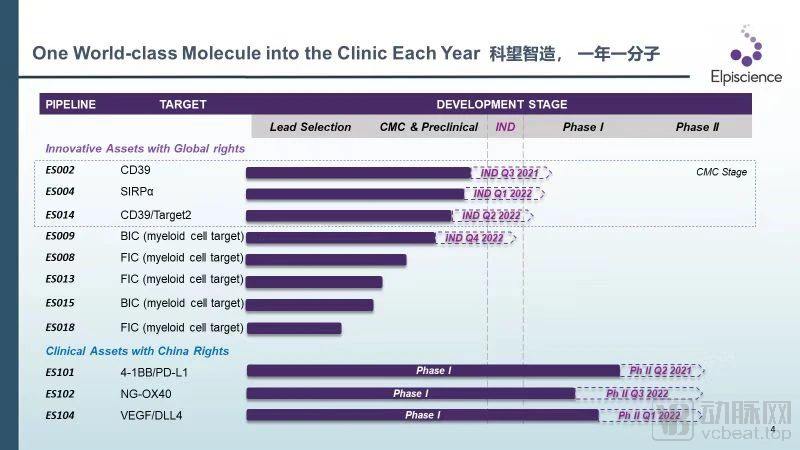
Elpiscience boasts a broad portfolio of 15 next-generation immuno-oncology drug candidates, with a strategic focus on innate immunity and tumor microenvironment modulation to convert “cold” tumors into “hot” ones, aiming to develop more effective next-generation immuno-oncology therapies.
ES101
A tetravalent bispecific antibody that simultaneously targets PD-L1 and 4-1BB. ES101 contains two identical heavy chains, with each arm capable of simultaneously targeting both antigens; that is, each arm of the antibody can bind to PD-L1 on the surface of tumor cells and 4-1BB on the surface of T cells at the same time.
Through ingenious design, three objectives were achieved: first, preferential targeting and binding to tumor cells via PD-L1; second, “releasing the brakes” by blocking PD-L1; and third, “pressing the accelerator” by activating T cells in a PD-L1 binding-dependent manner through 4-1BB.
ES102
It is a hexavalent antibody targeting OX40 with a “first-in-class” design concept. Its unique design enables potent activation of the OX40 pathway without the need for exogenous cross-linking.
Compared with traditional bivalent or tetravalent OX40 antibodies, ES102 exhibits more potent immune-activating capacity and has demonstrated significant antitumor efficacy as a monotherapy and in combination with PD-1/PD-L1 immune checkpoint inhibitors in preclinical studies. Meanwhile, it has also shown favorable safety profiles and preliminary antitumor activity in early-phase clinical monotherapy trials.
ES104
It is a bispecific antibody that simultaneously blocks VEGF and DLL4, featuring an anti-VEGF antibody as the backbone linked at its C-terminus to a single-chain variable fragment (scFv) targeting DLL4. It has demonstrated highly promising efficacy in patients with solid tumors, such as colorectal cancer and gastric cancer, who have failed multiple lines of therapy and developed recurrent disease with resistance to VEGF inhibitors.