

Biocomputing Era: Insights from Robert Langer, the 'Edison of Medicine,' for Aspiring Biotech Entrepreneurs
On May 10, the “Inaugural China Bioinformatics Conference” kicked off by Jinji Lake in Suzhou. Experts from industry, academia, research, and investment sectors convened around the theme of “BT & IT” to explore the definition and boundaries of bioinformatics, as well as the significance of AI for biological data, from their respective domains and diverse perspectives. The conference was co-hosted by Biotree Genomics, China’s first life sciences company driven by bioinformatics technology, and Bohe Innovation, an innovation incubation center dedicated to the cross-disciplinary integration of IT and BT.
New Incubation Session on Biocomputing from an International Perspective,Robert Langer, David H. Koch Institute Professor at the Massachusetts Institute of Technology, and Member of the U.S. National Academy of Sciences, National Academy of Engineering, and National Academy of MedicineVia video link, a dialogue was held with on-site experts on topics including the definition of biocomputing, the integration of AI with biological sciences, and the development of the biocomputing industry.
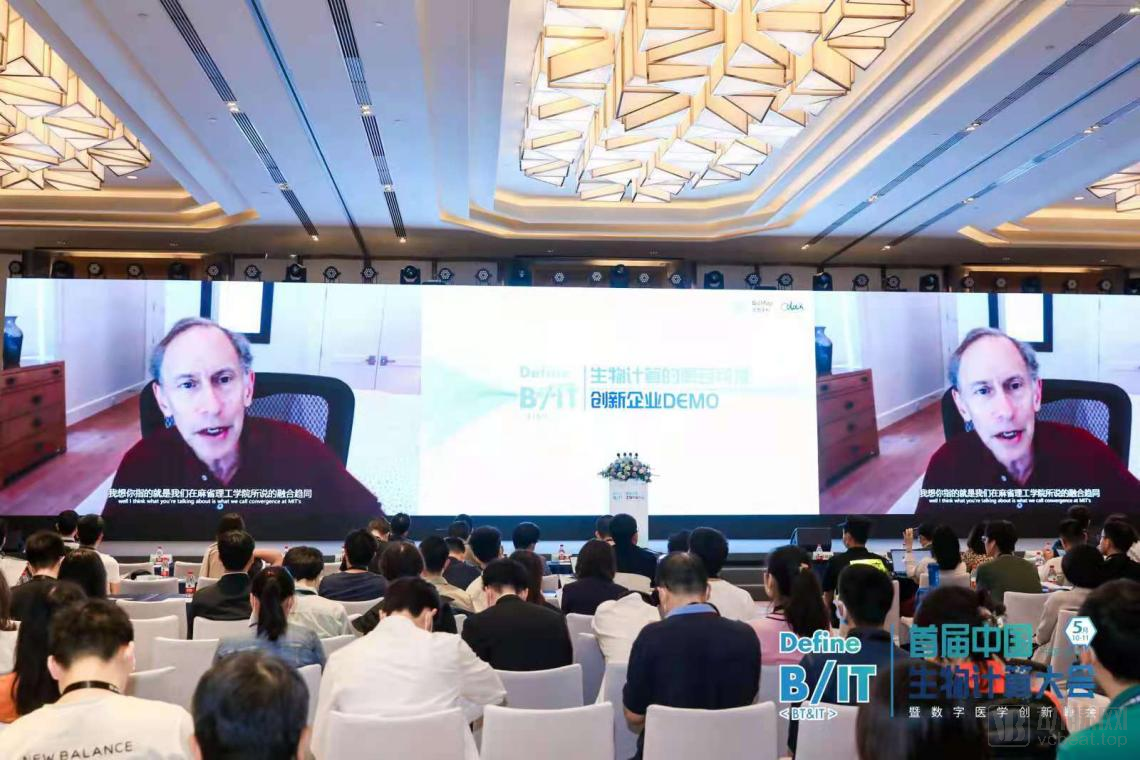
Guest Introduction: Professor Robert Langer conducts cutting-edge research in drug delivery systems, biomaterials, nanotechnology, tissue engineering, and regenerative medicine, earning him the reputation as the “Edison of Medicine.” At the age of 43, he became the youngest individual in history to be elected to all three U.S. National Academies. He is one of only 13 Institute Professors at MIT, a leading figure in the global field of tissue engineering, listed by Google Scholar as one of the seven most-cited researchers in history, and ranks among the wealthiest scientists in the United States. From 1995 to 2002, Dr. Langer served as a member of the Science Board of the FDA’s highest advisory committee, chairing the board from 1999 to 2002. To date, he has authored more than 1,180 papers and holds approximately 800 issued and pending patents worldwide. He has also mentored his students in founding over 20 companies in the biotechnology and medical device sectors.
The following is a verbatim transcript of the conversation, with edits made by VCBeat that do not alter the original meaning:
As a pioneer in the field of interdisciplinary applied sciences, you have achieved remarkable success in integrating chemical engineering technologies and expertise into the biomedical sector. Could you please share your insights on conducting high-quality scientific research, fostering the development of young talent, and navigating the growth of the technology industry?
I could share a great deal on this topic, but I believe the answer depends on your current stage. In my view, if you are currently a high school or undergraduate student, the most important priority is to build a solid foundation. At this stage, it is crucial to acquire robust foundational knowledge in biology, chemistry, mathematics, and physics. Even during doctoral and postdoctoral training, rigorous foundational preparation remains paramount.
However, given my personal circumstances at the time, the answer would have been different. In my view, for most people—perhaps until they complete their undergraduate education—others’ evaluations of them are largely based on their ability to answer questions well. For instance, scoring 99 or 100 on an exam merely demonstrates that you have answered others’ questions effectively.
But I believe,Those who are pioneering in certain fields and ultimately achieve success share a common trait: the ability to ask insightful questions.It is crucial to know how to ask good questions, which is distinct from knowing how to answer them well.
Perhaps when you are in graduate school, pursuing a postdoctoral fellowship, starting out as a new professor, or launching your first startup, external evaluations of you largely depend on your ability to answer questions well. But if you can only provide excellent answers to trivial matters, who will care? Therefore, it is crucial to create conditions that enable others to pose significant questions. So how can we achieve this?Learn to expand the boundaries of your capabilities.
When you truly seek to master the art of asking the right questions, you are venturing into uncharted waters, as no one has posed similar inquiries before you. Therefore,It is crucial to be the first to raise this question.
Furthermore, having excellent mentors is crucial, particularly when you are working on your master’s or doctoral dissertation. In the United States, I have found it highly beneficial to provide young scholars with opportunities to assist in writing research grant proposals. During this process, we effectively push them to think critically. I believe that as you begin your career as a young professor, you should genuinely start considering how to formulate truly significant research questions.
Returning to the second point mentioned earlier, it is also crucial to learn how to expand the boundaries of one’s scientific capabilities. Taking myself as an example, as a chemist, I am sometimes asked what I believe I did exceptionally well to achieve my current accomplishments. I consider myself fortunate and am certainly grateful, but I also attribute this in part to having done something different during my postdoctoral years. Approximately 50 years ago, I was a chemical engineer. Most of my classmates entered the petroleum industry after graduation, securing high-paying jobs, as there were abundant lucrative opportunities in the petrochemical sector at that time. Consequently, I also received numerous job offers during interviews. However, I did not feel excited about them. I believed that the problems they sought to address would not significantly change the world.
I ultimately chose to work in the hospital’s surgical department. As the sole engineer there, I interacted with a diverse array of biologists and clinicians, which was truly eye-opening. It became clear to me that everyone held perspectives on medicine and biology that differed from my own. During that period, I acquired substantial knowledge, and my experiences there also made me realize thatContinuously acquire new knowledge rather than merely performing repetitive tasks; strive to expand your capabilities and boundaries.This is merely my own experience and reflection; you have more options to achieve the same goal.
"If you were a manager at an AI-driven pharmaceutical company, how would you effectively enhance collaboration among professionals with diverse backgrounds, such as AI engineers, bioinformaticians, and biological scientists, within the organization?"
"In my lab, I place people with completely different backgrounds in the same office."In a small conference room at MIT that could accommodate only three or four people, I was deeply impressed by Dan, an outstanding molecular biologist, and David, an excellent synthetic chemist. Despite their different backgrounds, they became close friends.
David developed chemical synthesis, and Dan pioneered new assays; together, these efforts culminated in a novel high-throughput platform that has enabled the generation of new siRNAs, mRNAs, novel polymers, and more. Therefore, I believe it is crucial to bring individuals from diverse backgrounds together in a shared physical environment, fostering the expectation that they will become effective collaborators. This principle has been exemplified in my own experience. In 1970, together with two close friends—one a pediatric surgeon and the other a neurosurgeon—I helped develop some of the foundational principles of tissue engineering. That was fifty years ago, yet they remain my two best friends to this day, and we continue to work together. Thus, I believe thatIt is highly important to create opportunities for individuals from diverse backgrounds to interact in close proximity, enabling them to exchange ideas and build friendships.
Another example is the Robert Koch Institute, which encompasses seven engineering disciplines, as well as pharmaceutical sciences and biological sciences. Talent within each discipline spans diverse fields. I believe this structure is highly beneficial in helping individuals access areas that would otherwise be difficult for them to reach.
Many emerging technologies are currently centered around computing. How do you think technologies such as artificial intelligence or machine learning will impact the life sciences industry?
I believe computers will have extensive applications. In our laboratory, we have been utilizing them to publish papers. Many articles have been published in scientific journals on topics such as improving the release properties of microspheres and predicting outcomes in food science, among others. Some research that particularly excites me involves determining which structures offer the best biocompatibility for siRNA and mRNA delivery. I believe we first need a very large database.
This brings us back to the databases created by Dan and David, which they designed to facilitate computational analysis, thereby identifying which methods are truly effective. You can also apply these approaches extensively in artificial intelligence in a variety of ways.
MIT is establishing a College of Artificial Intelligence, and I believe there will be many opportunities to leverage in the future.Artificial intelligence enables faster and more accurate predictions, thereby accelerating the progress of various R&D projects.
How do you view our approach to balancing the use of AI for rapid predictions with the pursuit of greater predictive accuracy?
I believe the key is to have a high-quality, clean dataset.Without interference from contaminated data, which would otherwise corrupt the entire dataset.
For the students and young researchers present, especially those exploring interdisciplinary fields, what advice would you offer to help them navigate their career paths?
Exploring interdisciplinary fields, that is, expanding your multidisciplinary capabilities, is, in my view, of great importance.But you must consistently deliver outstanding work, always harbor lofty ideals and dreams that can change the world, and engage in work that truly transforms the world rather than merely adhering to convention.
This is no easy feat. As you know, engaging in work with limited disruptive potential is a safe bet, with a low risk of failure. However, personally, I would rather pursue highly innovative endeavors that carry a high probability of failure than strive for incremental success.
Let me elaborate further. If you are engaged in disruptive work, you are likely to face substantial criticism, which has been a common occurrence throughout my career. Moderna, one of the companies we founded, received various criticisms from both the media and the scientific community from its inception. Although their critiques may have been unfounded, it is evident that such commentary is all too common when pursuing disruptive innovations.
Therefore, my second suggestion is,If you wish to embark on transformative work, you must be mentally prepared for the criticism, difficulties, and failures that lie ahead.My advice is to not give up and to keep working hard for these dreams.
You just mentioned Moderna, and we would like to know more about your perspective. Could you share one or two stories to help other entrepreneurs understand how to build a successful company in the biotech sector?
First, Moderna possesses a transformative technology. Second, we have robust intellectual property protection and exceptional talent, particularly our outstanding CEO, Stéphane Bancel.
It is particularly important to highlight our platform technology. As you may know, we can continuously leverage similar manufacturing processes in a plug-and-play manner to develop the nine existing vaccines under exploration. These capabilities stem from the cutting-edge research conducted by our laboratory in the field of nanoparticles. Essentially, with 50 technologies available on the platform, we can continually generate diverse products and optimize methodologies.
What advice do you have for young founders during the operational phase of their startups?
When you establish a company, it is primarily a collaboration between scientists and businesspeople. Taking Moderna as an example, a key factor in its founding was that we had many outstanding scientists alongside Noubar, a visionary and exceptional businessman. Noubar, from Flagship Pioneering, possessed remarkable insight. Furthermore, we appointed Stéphane as the company’s Chief Executive Officer.
I believe they collaborated exceptionally well, jointly planning and outlining a highly effective corporate strategy. Therefore, I thinkRunning a successful company primarily relies on teamwork; in addition to a strong research and development team, a company must also have an excellent commercial team.
Final question: How do you perceive and define biological computing?
Using computer technology and algorithms to help predict different biological phenomena.