

Eko, Developer of the First FDA-Cleared Digital Stethoscope and Owner of the World’s Largest Heart Sound Database, Files for IPO

Highland Capital Partners
A Global Venture Capital Firm
“Outline of the National Plan for the Healthcare Service System (2015–2020)” points out that new-generation information technology should be applied to promote health information and smart medical services that benefit the entire population.
China has introduced a series of policies related to the Internet of Medical Things (IoMT), providing clear direction for its development. The rapid advancement of China’s “New Infrastructure” initiative has facilitated the extensive integration of 5G technology with smart healthcare, thereby strengthening the connectivity between 5G networks and medical devices. The emergence of digital medical devices has significantly enriched the scope and volume of medical information, improved diagnostic and treatment efficiency in hospitals, and reduced operational costs in healthcare delivery.
Eko is a digital health company specializing in cardiopulmonary care, dedicated to developing intelligent stethoscopes that provide users with smart, efficient, and convenient remote auscultation services.
May 6, 2021, Cardiopulmonary Digital Health PublicSiEkoXuanVCBeat won the “Best Use of AI in Healthcare” award at the 5th Annual MedTech Breakthrough Awards.
On November 9, 2020, Eko announced that it had raised $65 million in Series C financing, led by Highland Capital Partners and Questa Capital.

Connor Landgraf, Co-founder and CEO (left)
Jason Bellet Co-founder and Chief Customer Officer Taylor Crouch (center)
Tyler Crouch, Co-Founder and Head of Product Development (right)
Connor Landgraf is the co-founder and CEO of Eko. Connor founded Eko in 2013 while he was an undergraduate student majoring in bioengineering at the University of California, Berkeley. He is an ex-officio trustee of the University of California, Berkeley, and a researcher at the BioPOETS Laboratory.
Jason Bellet is the Co-founder and Chief Customer Officer of Eko. Jason has been named to the Forbes 30 Under 30 list. He was invited by the U.S. Department of Health and Human Services under President Obama to deliver a speech at the White House on emerging issues in cardiovascular care. Jason holds a Bachelor of Science in Business Administration from the Haas School of Business at the University of California, Berkeley.
Tyler is Eko’s Lead Mobile Developer, responsible for managing software engineers and collaborating with the Quality Assurance team to ensure product systems comply with regulatory requirements. Tyler holds a Bachelor of Science in Mechanical Engineering from the University of California, Berkeley.
In the early days of Eko, Tyler led the team in launching its first flagship product, the Eko Core. Following this success, Tyler shifted his focus to developing mobile application software capable of interacting with the company’s hardware products.
Currently, Tyler’s latest project is Eko Academy, an educational tool designed for medical students, clinicians, and other stakeholders that teaches the interpretation of abnormalities in audio and electrocardiographic signals (such as murmurs).
With the deep integration of 5G and smart healthcare, medical devices used by physicians are evolving toward greater intelligence and digitalization. For instance, the stethoscope invented in 1816 by the French physician Laennec primarily consisted of a hollow wooden straight tube. In contrast, modern digital stethoscopes mainly comprise acoustic sensors, audio codecs, and speakers. Nevertheless, their fundamental structure remains largely unchanged, consisting primarily of the sound-picking component (chest piece), the conduction component (tubing), and the listening component (earpieces).
Stethoscope types currently include single-head, double-head, triple-head, upright, multi-purpose, and the recently introduced digital stethoscopes. Digital stethoscopes utilize electronic technology to amplify body sounds, overcoming the high ambient noise limitation inherent in acoustic stethoscopes. They convert sound waves into electrical signals, which are then amplified and processed to achieve optimal auscultation quality. Despite these differences, both digital and acoustic stethoscopes are based on the same underlying physical principles.
The recognition capabilities of digital stethoscopes are categorized into three stages. In the first stage, the device distinguishes between normal and abnormal heart sounds; currently, most digital stethoscopes remain at this stage. In the second stage, it identifies specific diseases based on the distinct characteristics of heart murmurs. In the third stage, it records individual cardiac features and trends, constructs personal health models, evaluates cardiovascular health trends or the efficacy of cardiovascular disease treatments, and further provides diagnostic and therapeutic recommendations.
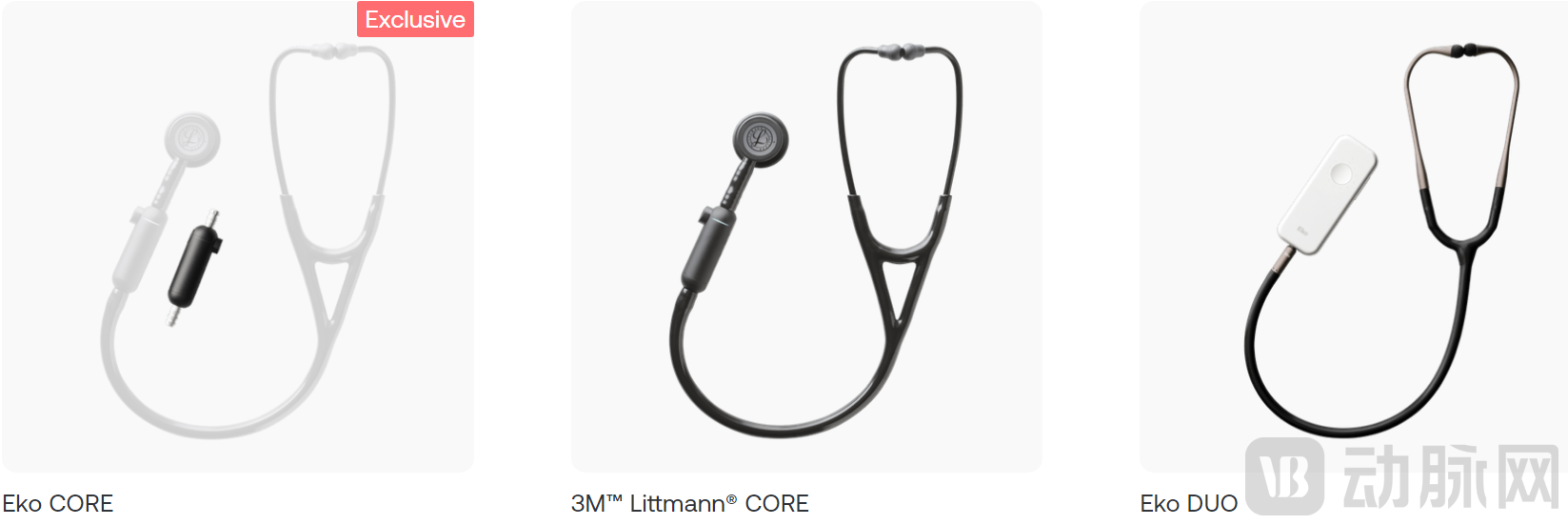
Eko’s Three Digital Stethoscopes | Image Source: Eko Official Website
Eko leverages smartphones and cloud data to monitor patients with cardiovascular disease. By establishing a platform that integrates non-invasive cardiovascular monitoring devices, clinical software, and point-of-care decision support algorithms, Eko has revolutionized the delivery of cardiovascular care.
In 2015, Eko launched the Eko Core digital stethoscope, the first FDA-cleared digital stethoscope on the market, which wirelessly transmits heart and lung sounds to software. Patient audio data can be integrated with electronic health records (EHR) to enable seamless referrals, documentation, and real-time monitoring of patient conditions.
Eko leverages these heart sound data to train its AI by establishing the world’s largest heart sound database. The trained AI can identify early symptoms of heart disease, which is of great significance for the early diagnosis and treatment of cardiac conditions.
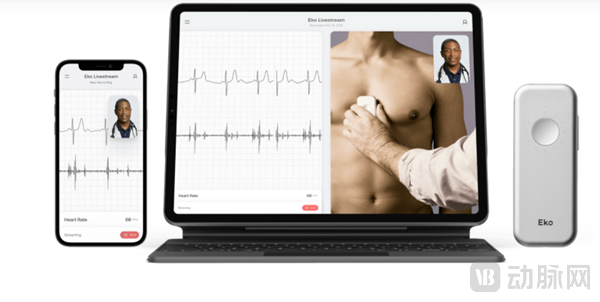
Diagram of the Eko Remote Monitoring Platform. Source: Eko Official Website
Through Eko, patients can use a stethoscope at home and transmit their heart sound data to healthcare providers (virtual care centers or hospitals) via the platform. Eko’s latest FDA-cleared device, DUO, is the first remote detection platform that integrates a digital stethoscope and an electrocardiogram (ECG) cardiac monitor with artificial intelligence (AI) for cardiac analysis. It enables remote outpatient consultations and smart home monitoring, allowing heart disease patients to send real-time cardiac data to their physicians. Healthcare professionals interpret the data through remote supervision and provide rehabilitation guidance to patients.
Healthcare providers can hear high-fidelity heart, lung, carotid artery, and other bodily sounds; analyze patients’ single-lead rhythm strips; and leverage Eko’s AI to automatically detect common abnormalities such as heart murmurs, atrial fibrillation, and tachycardia.
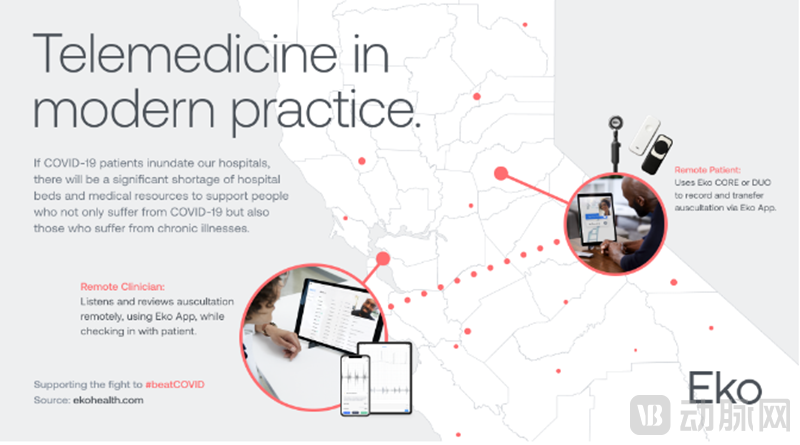
How the Eko Platform Prevents the Spread of COVID-19 Image source: Eko official website
Telemedicine consultations by clinicians can help reduce patients' risk of contracting COVID-19 in emergency departments or medical offices. For COVID-19 patients under home monitoring, this also reduces healthcare workers' workload and their risk of infection.
Eko Academy is a free educational mobile application that serves as a study guide for medical students and a reference for experienced healthcare professionals. It is a tool for learning and teaching auscultation, as well as for identifying and interpreting abnormal heart and lung sounds.
Traditional medical education faces challenges such as limited training opportunities for primary care healthcare workers, heavy clinical workloads and demanding research responsibilities for medical experts, difficulties in synchronizing coursework with internships at medical schools, and inconsistent educational quality. Eko Academy effectively addresses these pain points through telemedicine-based instruction.
Eko Academy combines classic and modern learning methods, including custom illustrations, clear anatomical diagrams, and relevant physiological explanations. It also utilizes high-fidelity cardiopulmonary sounds and visual waveforms to help learners hear and visualize different acoustic identifiers. Furthermore, the app provides an easy way to compare normal and abnormal heart sounds.
On August 4, 2020, AstraZeneca announced a global collaboration with Eko to accelerate the development of digital health tools for early screening of cardiovascular diseases, including heart failure.
Through collaboration, AstraZeneca and Eko will work to accelerate the development of Eko’s algorithms, striving to build new heart failure detection solutions in a digital environment.
On October 20, 2020, 3M and medical device company Eko announced the launch of the 3M™ Littmann® CORE Digital Stethoscope. This product combines best-in-class 3M Littmann stethoscope technology with advanced Eko digital innovations, providing clinicians with both analog and digital auscultation options to help them accurately identify heart sounds and detect heart murmurs. The collaboration between the two companies focuses on delivering comprehensive healthcare solutions to enhance the precision of patient treatment.
Today, Eko technology has been adopted by more than 4,000 hospitals, health systems, clinics, and cardiac and pulmonary screening practices, and was named “Best Invention of the Year” by TIME magazine.
On November 9, 2020, Eko announced a $65 million Series C financing round led by Highland Capital Partners and Questa Capital. The company’s total funding raised reached $95.5 million.
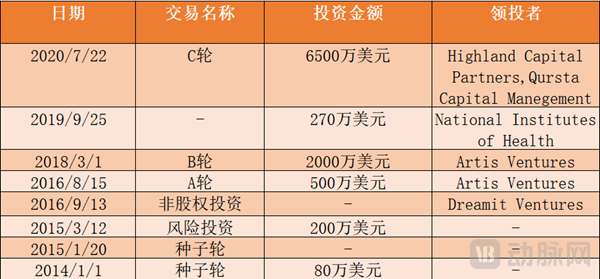
Eko's Historical Funding Rounds (Source: Crunchbase)
Rob Toews, a partner at Highland Capital Partners, stated, “The substantial market demand for telemedicine is not going away. Because Eko’s technology addresses critical clinical needs that other companies cannot meet, Eko holds a unique position in this field, and its platform is highly deployable and scalable. We are excited to partner with Eko.”
Dr. Ami Bhatt, Director of Telemedicine Cardiology at Massachusetts General Hospital, stated, “Telemedicine now plays a more critical role than ever before. Stethoscopes are routinely used in standard patient examinations; however, the lack of such capability in telemedicine has hindered our ability to deliver effective remote care. Eko bridges the gap between telemedicine and in-person care. Leveraging AI-powered insights from Eko, healthcare providers can now deliver remote care, facilitate early diagnosis in a cost-effective manner, and help enhance satisfaction for both patients and providers.”
Compared with foreign countries, China's digital stethoscope industry started later; currently, the common brands include Aotu Wireless and Chengdu Luobo Technology.
Otto Wireless Digital Stethoscope: Building upon conventional stethoscopes, it supports background noise filtering, amplification of faint heart sound signals, audio playback and graphical display, storage and analysis of heart sound signals, and remote data access via network. It is primarily designed for auscultation of heart sounds.
The Luobo Smart Stethoscope, developed by Chengdu Luobo Technology, is designed for auscultating lung sounds. Once the stethoscope’s hardware is paired via Bluetooth with the Luobo Doctor app on a smartphone, users can activate the auscultation function. The app provides step-by-step guidance throughout the procedure, displaying information such as auscultation sites and duration. After completing an auscultation session under the app’s guidance, the recorded audio files are transmitted to a cloud server for analysis. The identification results are sent back to the app within seconds, alerting users to the presence of any pathological auscultatory findings.
Digital stethoscopes enable users to monitor their physical condition anytime and anywhere, eliminating the need for costly electrocardiogram (ECG) tests at hospitals and unnecessary in-person consultations with cardiologists. With the widespread adoption of smart devices and continuous advancements in chip technology, digital stethoscopes are poised to become increasingly intelligent. Perhaps one day, they will become an essential item in household first-aid kits, allowing individuals to perform immediate self-assessments when experiencing any discomfort and consult doctors directly online.