

Philips Showcases Health Technology Achievements and Innovations at CMEF on the Fifth Anniversary of Its Strategic Focus

Philips Healthcare
Integrated service provider in healthcare, quality living, and lighting fields
On May 13, the 84th China International Medical Equipment Fair (Spring) (CMEF) was held in Shanghai as scheduled. Themed “Innovative Technology, Leading the Future with Intelligence,” the fair showcased the deep integration of technologies such as artificial intelligence, the internet, precision medicine, and big data with healthcare.
At this year’s CMEF, Philips made its scheduled appearance. As a medical equipment manufacturer with a century-long history, Philips has continuously introduced global innovations since formally focusing on “health technology” five years ago. By collaborating with the local ecosystem—including industry, academia, research, and clinical practice—and addressing the pain points and needs of local customers, Philips has launched solutions integrating intelligent devices, systems, software, and services for key disease areas such as cardiovascular and cerebrovascular diseases, oncology, and respiratory conditions, as well as for key departments including radiology and critical care.
At this CMEF, Philips not only brought its “3D Standard” DR system, the DigitalDiagnost C90, and the recently launched Incisive CT Plus Aurora Smart Heart 128-slice smart coronary CT, but also showcased a series of “upgraded” holistic solutions based on “value-based” healthcare.
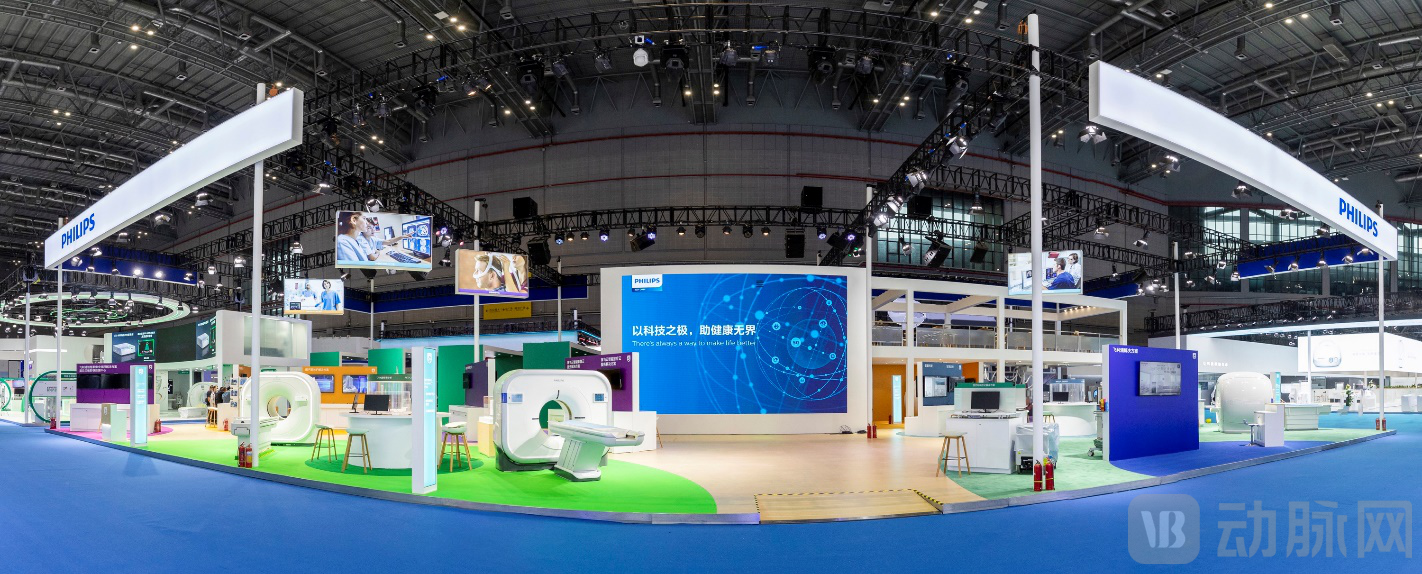
Philips Booth Fully Showcases Its “Upgraded” Solutions
Multiple Solutions Upgraded Again to Let “Technology” Serve Users
After five years of transformation, Philips has evolved from a pure medical equipment manufacturer and seller into a disease-centric solutions provider. In the post-pandemic era, the healthcare industry is accelerating its shift toward a “value-based” care model, presenting new challenges and opportunities for Philips’ development.
At this exhibition, Philips aimed to ensure that technology truly serves Chinese healthcare professionals and patients, enhancing the efficiency and quality of healthcare service delivery. Centered on “Holistic Health Care,” Philips launched multiple solutions, including the Smart Cardiovascular Care Solution, Smart Imaging Workflow Solution, Integrated Radiation Oncology Solution, and Smart Critical Care Solution, achieving comprehensive optimization and upgrades from patient care pathways to diagnostic and treatment workflows.
“The users of Philips’ products and services are physicians, who possess their own core competencies. Tasks falling outside these core competencies and primary responsibilities can be addressed by our solutions.” According to Liang Jianqiu, Vice President of Philips Greater China, General Manager of the Integrated Solutions Center, and Head of Strategic Partnerships, a physician’s core duty is the delivery of diagnostic and therapeutic services. Philips leverages its integrated solutions to optimize various systems and workflows, thereby enhancing physicians’ work efficiency.
Taking Philips’ showcased end-to-end intelligent cardiovascular solution as an example, by equipping the new-generation Incisive CT with a newly launched intelligent operation platform, Philips has reduced the processing time for fully automated structured coronary reports in coronary CT angiography (CCTA) for diagnosing coronary artery disease to just one minute. This achieves seamless workflow integration and provides precise anatomical information on coronary arteries and cardiac structures, significantly improving the clinical diagnostic success rate and efficiency of coronary CT.
The smart critical care solution is patient-centric, enabling seamless, end-to-end data management from admission, diagnosis, and treatment/nursing to outcomes. It integrates information exchange to achieve interdepartmental connectivity within the hospital, as well as interoperability between in-hospital and out-of-hospital settings. This approach yields comprehensive, continuous, high-quality, and systematic patient data, transforming data into insights to enhance the work efficiency of clinicians and nurses.
Overall, Philips has not only leveraged technology to perform data cleaning and structuring but also designed holistic solutions tailored to clinical scenarios and customer needs. Furthermore, it has systematically mapped out the challenges associated with each disease across clinical pathways and the entire human life cycle, thereby achieving an upgrade of its comprehensive solutions.
Innovative Online Mall, “My Shenfei Cloud,” Goes Live
Sales of large-scale medical equipment have always been a complex endeavor, characterized not only by numerous delivery projects but also by a heavy reliance on offline models for equipment maintenance, customer service, and training. The outbreak of the COVID-19 pandemic in 2020 accelerated the healthcare industry’s adoption of the “Internet Plus” model. As an increasing number of healthcare professionals experienced the convenience brought by information and internet technologies, demand has grown steadily for accessible, high-quality procurement solutions for medical equipment.
At this year’s CMEF, Philips launched the “Philips Healthcare Online Mall,” an e-commerce platform offering fully digital solutions to professional clients. The platform provides cloud-based services that encompass medical equipment procurement, access to equipment training demonstrations, specialized solution-oriented support, and post-purchase product upgrades and order management. Its seamlessly integrated cloud ecosystem effectively supports healthcare professionals in working more efficiently and facilitates streamlined hospital management.
Its specialized and customized service model can provide “personalized” menus based on customer needs and feedback, while the backend system can also push exclusive, convenient customer services tailored to the products selected by customers, thereby precisely meeting their demands. Moving forward, Philips will continue to update and iterate its online marketplace to address the pain points of hospital equipment and imaging departments, empowering hospitals with intelligent management capabilities.
It is understood that the Philips Online Store has also launched the “My Shenfei Cloud” solution, which not only provides customers with end-to-end cloud-based services covering pre-sales, in-sales, and after-sales stages, but also comprehensively enhances service accessibility, achieving zero-distance service, timely response to needs, and instant service responsiveness.
As early as 2018, Philips partnered with Shenzhou Medical to launch Shenfeiyun 1.0, transforming the traditional model that required healthcare institutions to purchase bundled solutions. This enabled healthcare institutions to select corresponding application modules from the “Philips Star Cloud Platform” based on their specific operational needs and budgets.
In the period that followed, Shenfei Cloud continued to undergo upgrades and iterations. At this CMEF, Philips showcased Shenfei Cloud 3.0, an upgraded version that leverages experience from Neusoft Medical’s National Oncology Big Data Project. The application scenarios for Shenfei Cloud 3.0 have expanded to include oncology radiotherapy, delivering a “cloud platform” solution for Philips’ Pinnacle radiotherapy planning system. This empowers primary-care hospitals to provide remote, precision radiotherapy, elevates the overall regional standard of radiotherapy care, and helps address the shortage of radiation oncologists and medical physicists at the grassroots level.
Undoubtedly, “Internet+” is bringing about significant changes to the healthcare industry. As a human-centric, integrated smart cloud platform, Shenfeiyun will continue to leverage digital and information technologies to deliver more diverse innovative diagnostic, therapeutic, and care experiences in the health and medical sector, benefiting a broader range of professional clients and patients in China. In the future, following Shenfeiyun’s lead, Philips’ integrated radiation oncology solutions will also extend to more healthcare institutions.
Open Collaboration, Building a Health Tech Ecosystem
Nowadays, both market demand and policy guidance are driving the expansion of high-quality medical services to more regions. Among these efforts, the integration of medical resources across all levels and the empowerment of primary healthcare by premium medical resources—supported by various solutions—are clearly achieving better implementation outcomes. This trend also brings additional growth opportunities for the future application of Philips’ overall solutions.
Of course, Philips’ comprehensive solutions are not limited to empowering primary healthcare. In response to diverse customer needs and specific circumstances, Philips also offers tailored product portfolios and solutions, enabling localized deployment and further expansion of its own product lines.
Meanwhile, in line with its vision of building a health technology ecosystem, Philips will actively establish partnerships with industry players to leverage complementary strengths and achieve synergistic effects where “1+1>2.” Going forward, Philips will continue to draw on its insights into diseases and clinical practice, integrating its superior medical imaging and digital products with partner resources. In compliance with data-related regulations, the company will work to establish unified standards for data management and security, thereby benefiting the entire industry.