

Kontour Medical Soars Over 450% on STAR Market Debut; Can It Maintain Leadership in China's Cranial Repair and Fixation Market?
Kontour Medical
Implantable Medical Device R&D, Manufacturing, and Sales Service Provider
Today, Xi'an Kangtuo Medical Technology Co., Ltd. (stock code: 688314; stock abbreviation: “Kangtuo Medical”) officially listed on the STAR Market of the Shanghai Stock Exchange. As of 9:35 a.m. on May 18, Kangtuo Medical had issued 14.51 million new shares in its initial public offering, bringing the total share capital to approximately 58.03 million shares post-issuance. The issue price was RMB 17.34 per share, with an opening price of RMB 100.20. At the time of press deadline, the share price stood at RMB 96.92, representing a surge of over 458%, and the company’s total market capitalization reached RMB 5.624 billion.

According to the prospectus of Xi'an Kangtuo Medical Technology Co., Ltd., the company meets the first set of listing criteria for the STAR Market. It plans to allocate RMB 423 million from the funds raised through its initial public offering to construct an industrial and R&D base for high-end Class III implantable medical devices, and RMB 100 million to supplement working capital.
Kangtuo Medical, established in 2005, is a high-tech enterprise dedicated to the research and development, manufacturing, and sales of Class III implantable medical devices. Its primary products are applied in the fields of cranial repair and fixation in neurosurgery, as well as sternal fixation in cardiothoracic surgery. Kangtuo Medical secured tens of millions of yuan in Series A financing from Honghui Capital and has extended its business layout into multiple areas, including oral care and neuro-spinal applications.
Currently, Kangtuo Medical has obtained 12 registration certificates for Class III implantable medical devices, covering pioneering products in multiple niche segments. It holds the largest domestic market share in the PEEK-based cranial repair and fixation product market, achieving import substitution. Kangtuo Medical is one of the few companies in China capable of providing diversified neurosurgical cranial repair and fixation solutions tailored to patient needs.
Neurosurgery is a major branch of surgery that primarily employs surgical interventions to treat diseases of the nervous system, including the brain and spinal cord, caused by pathological conditions or trauma. It also addresses injuries, inflammation, tumors, and malformations affecting associated structures such as the skull, scalp, and meninges.
Neurosurgical procedures involve high-value single-use medical devices, which are generally classified as high-value consumables, specifically referred to as neurosurgical high-value consumables. Based on product usage categories, neurosurgical high-value consumables can be divided into five major classes: cranial bone materials, dural materials, drainage and suture materials, neuromodulation and electroencephalographic (EEG) monitoring materials, and auxiliary tools.
According to Evaluate MedTech data, global sales of neurosurgical medical devices reached $8.6 billion in 2017, representing a year-on-year increase of 16.2%. The global market size is projected to reach $15.8 billion by 2024, with a compound annual growth rate (CAGR) of 9.1% from 2017 to 2024, making it the fastest-growing segment among all medical device subsectors during the forecast period.
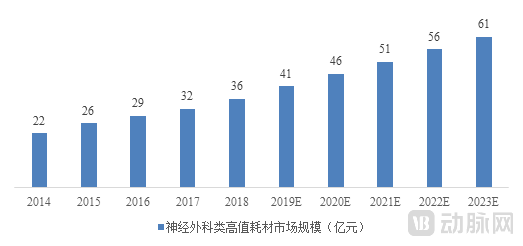
Market Size of High-Value Neurosurgical Devices in China, 2014–2023. Source: Prospectus of Xi'an Kangtuo Medical Technology Co., Ltd.
Cranioplasty and fixation represent one of the key application scenarios in neurosurgery. The fixation products primarily utilize autologous bone and synthetic materials. Synthetic materials are the predominant choice for cranioplasty and fixation in clinical practice, mainly including titanium and polyether ether ketone (PEEK).
Currently, titanium-based materials dominate the market for cranial repair and fixation products. According to data from the Southern Pharmaceutical Institute, titanium-based products accounted for approximately 93% of the market share in China’s cranial repair sector as of 2018. As a novel material, polyether ether ketone (PEEK) features low thermal conductivity, a thickness comparable to that of the human skull, and thermal insulation properties similar to natural bone. It is unaffected by ambient temperature fluctuations, thereby offering superior patient comfort, and is experiencing rapid growth.
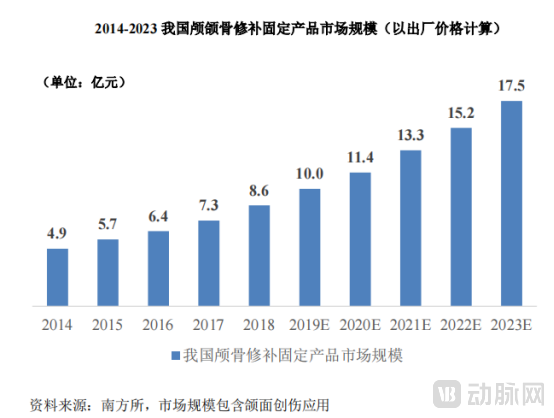
Source: Kangtuo Medical's IPO Prospectus
According to the prospectus data, Xi'an Kangtuo Medical Technology Co., Ltd.’s revenue relies primarily on its PEEK-based and titanium-based neurosurgical products, which together account for over 94% of total revenue.
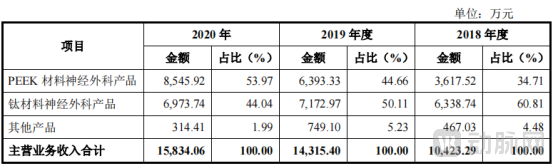
Image source: Kangtuo Medical's prospectus
Since obtaining the registration certificates for titanium cranial repair and fixation products in 2008, the company has successively developed processes such as 3D-printed trial molds and etching-based fabrication of titanium mesh plates, continuously upgrading its technology to enhance the performance of its titanium repair and fixation products.
In 2015, it obtained the first registration certificate for a domestically produced PEEK bone plate. In recent years, this product has consistently held the largest market share in its domestic industry segment, achieving import substitution. In the same year, the company also secured China’s first registration certificate for PEEK linking plates and subsequently developed a new injection molding process for these plates.
Compared with traditional titanium materials, the company's PEEK cranial repair and fixation products offer significant advantages, including high personalization, superior postoperative aesthetics, strong thermal insulation, excellent biocompatibility, outstanding biomechanical properties, and no interference with postoperative medical brain imaging. These benefits comprehensively enhance patients' postoperative recovery and quality of life.
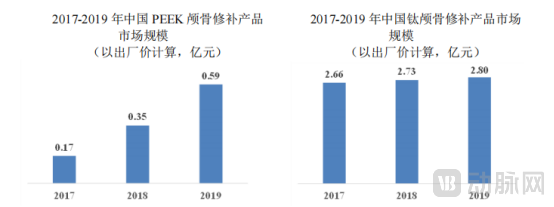
Image source: Kangtuo Medical’s prospectus
From 2018 to 2020, Kangtuo Medical’s PEEK-based cranial repair and fixation products achieved a compound annual growth rate (CAGR) of 53.70%, securing the largest market share among domestic PEEK cranial repair and fixation products in China. Compared with titanium-based counterparts, these products offer significant advantages; however, their current clinical adoption rate remains relatively low, indicating substantial potential for future growth.
In 2018, Kangtuo Medical ranked third in the market share of titanium cranial repair and fixation products, and first among domestic brands.
According to data estimates from the Southern Pharmaceutical Institute, the Company’s market share for titanium cranial repair products was 5.2%, 6.3%, and 7.3% in 2017, 2018, and 2019, respectively, while its market share for titanium cranial fixation products was 9.5%, 11.2%, and 11.7% during the same period. The market share has steadily increased, positioning the Company as a leader among domestic manufacturers.
Although Xi'an Kangtuo Medical Technology Co., Ltd. currently maintains a favorable market share, the domestic market for cranial repair and fixation products is crowded with numerous manufacturers, all of which are closely eyeing the competitive landscape.
Among them, domestic manufacturers of titanium materials mainly include Kangtuo Medical, Double Medical, Shuangshen Medical, and Kang'er Medical, while imported manufacturers mainly include Johnson & Johnson DePuy Synthes, Medtronic, Stryker, BIOMET, and Bieduya.

Image source: Kangtuo Medical's prospectus
Kangtuo Medical’s neurosurgical product portfolio is undiversified and accounts for an disproportionately large share of revenue, exposing the company to a constant risk of substitution. Financial data in its prospectus further reveal that Kangtuo Medical’s R&D investment lags behind that of its peers, its procurement relies heavily on foreign suppliers, and its overseas market expansion has been lackluster.
From 2018 to 2020, Kangtuo Medical’s R&D expenses were RMB 8.0887 million, RMB 10.5614 million, and RMB 16.8998 million, accounting for 7.39%, 7.15%, and 10.30% of its operating revenue, respectively. The company’s R&D expense ratio experienced a decline during this three-year period, with the cumulative total amounting to only RMB 35.5494 million.
Kangtuo Medical’s core PEEK raw materials are sourced from the UK-based company Invibio. From 2018 to 2020, the proportion of the company’s purchases of PEEK and other materials from Invibio surged to nearly 40%, with its supply of PEEK sheets relying almost entirely on Invibio as the sole supplier.
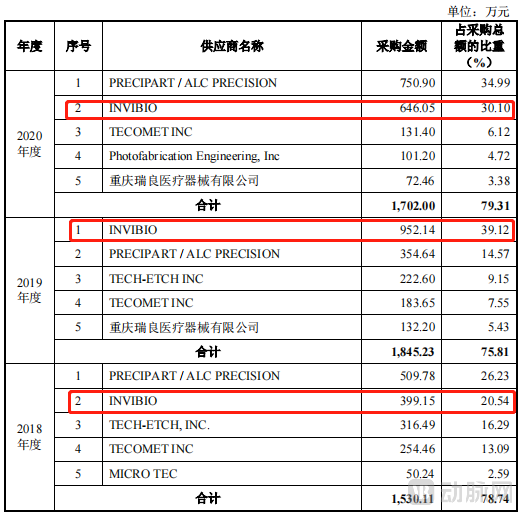
Image source: Kangtuo Medical prospectus
In terms of overseas expansion, although Kangtuo Medical acquired the overseas company BIOPLATE, this acquisition did not bring substantial growth to Kangtuo’s overseas market. The departure of Wellisz, the original actual controller of BIOPLATE, had a significant adverse impact on BIOPLATE’s research and development, production, and sales. In 2019, BIOPLATE even incurred a loss of approximately RMB 12 million.
In response to these issues, the prospectus of Xi'an Kangtuo Medical Technology Co., Ltd. indicates that the company is actively engaged in the research and development of related products, with multiple projects underway, including artificial dura mater, disposable neurosurgical drainage devices, and antimicrobial-coated drainage catheters.
Listing on the STAR Market may be just the first step for Kangtuo Medical to capture a larger share of the market. The company aims to further expand its product portfolio in niche segments and extend its presence into multiple fields, including dentistry and neuro-spinal care, thereby breaking away from reliance on a single product line and driving corporate performance growth.