

McKinsey Releases 'Trends and Outlook of New Pharma Retail' Report: How Ping An Health Empowers Innovation in the Integration of Medicine, Healthcare, and Insurance
In recent years, influenced by healthcare reform policies such as volume-based centralized procurement, the outflow of prescriptions from hospitals, and adjustments to individual medical insurance accounts, the pharmaceutical retail industry has faced a landscape characterized by both opportunities and challenges.
The outbreak of the COVID-19 pandemic highlighted the advantages of online healthcare. In the post-pandemic era, the internet healthcare industry has once again benefited from favorable policies. For instance, the "Guiding Opinions on Promoting 'Internet+' Medical Insurance Services During the Prevention and Control of COVID-19," jointly issued by the National Healthcare Security Administration and the National Health Commission, explicitly included eligible fees for "Internet+" medical services within the scope of medical insurance reimbursement. This move broke through the development bottlenecks of the internet healthcare industry, leading to a rapid surge in online clinical consultation services in China.
According to a report by Huatai Securities, the compound annual growth rate (CAGR) of China’s prescription drug sales market was 9.6% from 2014 to 2018. If this growth rate is maintained, the share of online prescription drug sales is projected to reach 10% in 2021, with the internet pharmaceutical market size expected to hit RMB 23.1 billion in the same year.
According to statistics from the Insurance Association of China, the gross written premiums for internet health insurance grew from RMB 1.03 billion in 2015 to RMB 12.29 billion in 2018, representing an 11-fold increase over the three-year period.
However, for the pharmaceutical retail industry, accurately seizing development opportunities, leveraging high-quality resources within the sector to drive in-depth reforms, and addressing pain points have become urgent challenges amidst continued market growth. What role has Ping An Good Doctor played in this industrial evolution? And how has it facilitated the integrated innovation of “pharmaceuticals, healthcare, and insurance”?
At the “Commercial Insurance Empowerment, Smart Leadership in New Pharmaceutical Retail” conference and Ping An Health Innovative Product Launch held on May 11, McKinsey, a globally renowned consulting firm, released an industry report on new pharmaceutical retail based on data from Ping An Health, providing an in-depth analysis of development trends in the pharmaceutical retail sector. Ping An Health also unveiled its flagship strategic product, “Yao Zhen Fu” (Medicine-Consultation-Payment), which leverages proprietary resources and traffic to empower pharmacies and pharmaceutical companies, driving integrated innovation across medicine, healthcare, and insurance. Additionally, industry leaders from the fields of pharmaceutical retail and commercial health insurance engaged in face-to-face dialogues, sharing their insights on current industry dynamics and future development trends.
“Where Did the New Retail Model in Pharmaceuticals Originate?” Wang Jin, Global Director and Partner at McKinsey & Company, stated at the conference that it was driven by policy on one hand, and by technology and consumer power on the other. “At the hospital level, the major changes in the industry include the drug-to-revenue ratio, zero-markup pricing, and volume-based procurement. Among these, volume-based procurement has been the most significant keyword in the industry over the past three years.”
According to the report on new retail trends in pharmaceuticals released by McKinsey, as the scope of China’s national volume-based procurement continues to expand, centralized procurement had covered 112 drugs by August 2020 and is expected to affect approximately 400 additional drugs.70% of the pharmaceutical market will be affected in the next three years.
Moreover, the trend of prescription outflow has begun to emerge.
According to the Health Statistics Yearbook and relevant data from McKinsey, drug revenue as a share of average medical revenue per public hospital decreased from 35% in 2017 to 33% in 2018, and further to 32% in 2019.
Furthermore, according to Ping An Securities’ report titled “Panoramic View of the Drug Retail Industry,” the proportion of drug sales through retail pharmacy channels in China gradually increased from 22.6% in 2017 to 23.1% in the first half of 2019. Survey results also indicate that the share of prescription drug sales at major domestic chain pharmacies rises by approximately 2 percentage points annually.
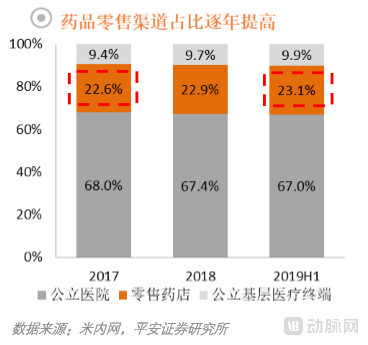
Source: Ping An Securities Report “Panoramic View of the Drug Retail Industry”
"Therefore, for insurance companies, consideration should be given to how to meet customers' out-of-hospital consumption needs through insurance product design; whereas for retail pharmacies, it is more critical to address the outflow of prescriptions, optimize operations, achieve precise positioning, and realize differentiated competition."
Additionally, the report points out thatAgainst the backdrop of volume-based procurement and the outflow of prescriptions from hospitals, China’s pharmaceutical retail industry is exhibiting three major trends:
1. Decentralization of Healthcare;Beyond the traditional hospital-centric pharmaceutical supply system, diversified forms and carriers of medical service delivery are rapidly emerging to meet personalized needs; highly internet-savvy healthcare consumers are beginning to appear;
2. Integration and division of labor between online and offline channels; differentiated focus between online and offline channels, with online channels primarily addressing the needs of minor ailments, while offline channels serve as a complement to online channels in the management of chronic and critical diseases;
3. Upgrading and Downgrading of Healthcare Consumption; Consumer demands are becoming increasingly differentiated and diversified, with the online-to-offline closed loop catalyzing three distinct customer segments, each with unique needs and characteristics.
Specifically,In terms of supply and demand, patient care channels have shifted from being exclusively hospital-based to a diversified model, where various channels coordinate with one another to form a closed loop. Approximately 10% of internet users with chronic diseases now have their medical needs primarily met through online channels, giving rise to a highly digitalized pharmaceutical consumer segment.
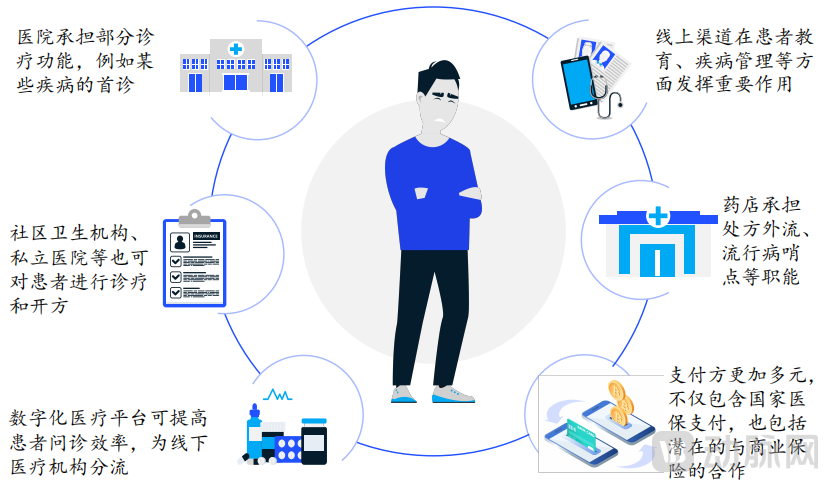
Image source: "New Retail Trends and Outlook in the Pharmaceutical Industry – McKinsey Report"
Regarding the integration and division of labor between online and offline channels, the report points out that, in terms of user engagement, taking patients with hypertension and hyperlipidemia as examples, users who only engage in offline behaviors have an average of only 13 consultations per person per year, with a repurchase rate of approximately 30% after three months. In contrast, users who utilize both online and offline channels have an average of 16 consultations per person per year, with a repurchase rate as high as 60% after three months, indicatingUsers with both online and offline engagement exhibit higher activity levels compared to those with only offline engagement.
AndFrom the perspective of departmental distribution, the demand scenarios for online and offline channels are both distinct and complementary.. Online consultations are concentrated in comprehensive departments such as Traditional Chinese Medicine, Obstetrics and Gynecology, and Pediatrics, while offline visits focus on specialty departments for specific diseases, including Cardiology, General Internal Medicine, and Respiratory Medicine.
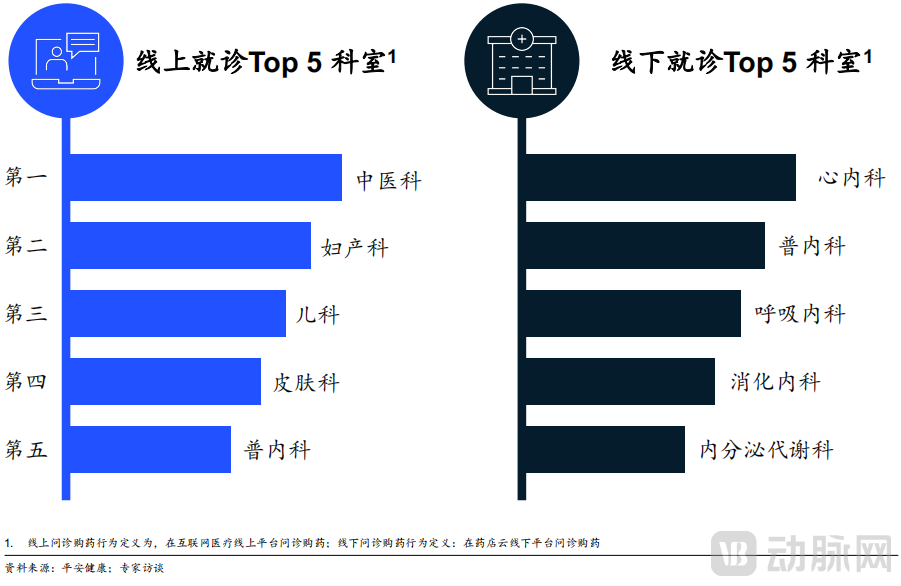
Source: “New Retail Trends and Outlook in the Pharmaceutical Industry – McKinsey Report”
“For the past decade, we have often asked whether technology can disrupt healthcare. However, the reality is that no single model, channel, or platform has truly achieved a disruption of healthcare, nor has it fundamentally altered consumers’ healthcare consumption behaviors,” said Wang Jin. “Yet, what is encouraging is that”The emergence of diversified channels has stimulated diverse demands across varied healthcare scenarios, serving as a key driver of decentralization in China’s healthcare system.
As for consumer demand,The report shows that the online-offline closed loop has catalyzed three distinct types of demand and customer segments.:
The first category is the "emergency-driven" customer segment., with diseases mostly presenting as "sudden onset and mild symptoms," there is a high demand for timely diagnosis and medication delivery. However, since online consultation and medication purchase are not essential needs, there is a stronger tendency toward using online platforms for these services;
The second category is the "Family Pillar" customer segment, this customer segment serves as the primary decision-maker for household purchases, demonstrating flexibility in channels for medical consultations and medication procurement by leveraging both online and offline platforms across multiple scenarios and channels for health-related consumption;
The final category is the “senior pioneers” customer segment., aged over 60, with strong purchasing power, high prescription spending, and a pronounced ability and willingness to pay premiums for originator drugs.
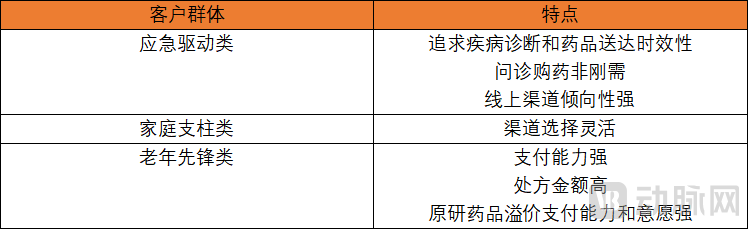
Graphic by VCBeat. Source: “New Retail Trends and Outlook in the Pharmaceutical Industry – McKinsey Report”
Based on an understanding of the current development trends in the pharmaceutical retail industry, this report also puts forward recommendations for the future development of insurance companies, pharmaceutical manufacturers, and offline pharmacies.A Few Reflections:
For insurance companies, on the one hand, commercial health insurance payments for medical expenses remain concentrated in the area of critical illnesses, leaving unmet payment needs for conditions other than critical illnesses; on the other hand, a complete system integrating online and offline medical services and consumption has already taken shape for minor ailments.Commercial health insurers should consider how to integrate with these emerging channels: on one hand, diversify benefit design to enhance product appeal; on the other, control costs through collaboration with platform providers.
For pharmaceutical companies, consumer behavior is undergoing significant changes,Pharmaceutical companies can integrate online and offline channels on one hand, while on the other hand, they need to fully leverage the richer data and diverse touchpoints across multiple channels to create a comprehensive, closed-loop, integrated online-offline experience for consumers;
As for offline pharmacies, amid the growing trend of integrating online and offline diagnosis, treatment, and medication purchasing behaviors, theirKey considerations include how to actively collaborate with online channels to adapt to consumers’ diverse needs, as well as how to establish a differentiated role that complements these online channels.
“Through consumer profiling, we have observed the value that industry convergence brings to patients, which is deeply gratifying; however, we also recognize the challenges involved in advancing new industry strategies,” said Wang Jin. He expressed hope that, under the new landscape of new retail in pharmaceuticals, leaders across various sectors would leverage resource integration to create more value propositions for both the healthcare system and consumers.
What role does Ping An Health play in the internet healthcare ecosystem?
“We aim to empower payers and suppliers—including hospitals, pharmacies, and pharmaceutical companies—through our connectivity effects, working together to provide patients with optimal solutions and valuable medical services. This is the mission that Ping An Good Doctor has positioned for itself,” said Fang Weihao, Chairman of the Board and CEO of Ping An Good Doctor, at the conference.“In the development of the pharmaceutical retail industry, Ping An Health serves as a connector.”
“There is another domain between commercial insurance and pharmaceuticals: prescriptions. The key lies in who can control prescriptions and establish connections based on them,” added Fang Weihao. Ping An Health aims to integrate online prescriptions with offline medical institutions, offering healthcare solutions that better meet patient needs, “truly connecting commercial insurance with pharmaceuticals.”
According to Fang Weihao, Ping An Health has currently connected with 151,000 pharmacies and over 3,700 hospitals offline, and has assigned additional responsibilities to doctors on its own platform to enable them to empower offline medical institutions.
“For example, in addition to providing triage and patient guidance services prior to consultation, Ping An Health aims to deliver comprehensive care spanning the pre-consultation, intra-consultation, and post-consultation phases through specialized medical services. This service scope also includes medication follow-ups and addressing post-medication inquiries. ‘These are services that traditional healthcare institutions may wish to provide but lack the capacity to do so. The integration of online and offline platforms can effectively improve patients’ healthcare experience,’ stated Fang Weihao.”
Furthermore, Ping An Health made a major announcement at the conference, launching its innovative strategic product “Yao Zhen Fu” (Drug-Diagnosis-Payment). Leveraging commercial insurance as a catalyst and integrating its proprietary resources, the product empowers pharmacies and pharmaceutical companies, driving the innovative convergence of healthcare, pharmaceuticals, and insurance.According to VCBeat, the “Yaozhenfu” platform currently covers 29 provinces and 291 prefecture-level cities, with over 50% of stores being daily active users. It has cumulatively served more than 4 million users in the past six months, demonstrating high platform engagement.
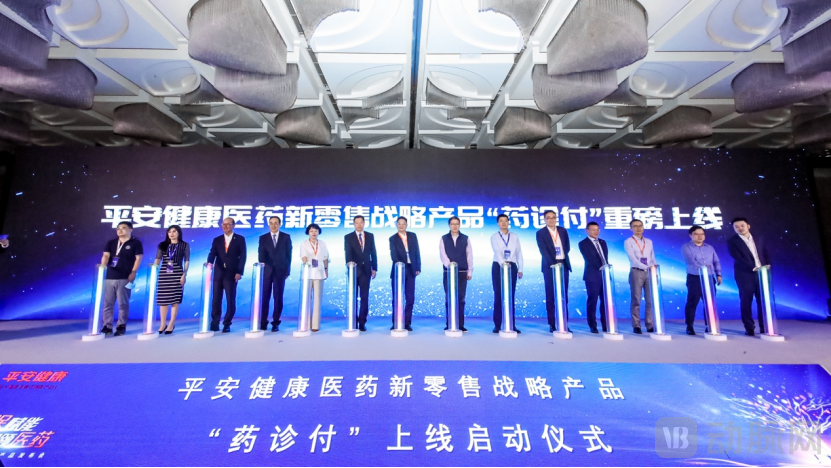
“Commercial Insurance Empowers, Smart Leadership in New Pharmaceutical Retail” and Ping An Health Innovative Product Launch Event, photo provided by Ping An Health
In recent years, retail pharmacies have faced significant impacts and challenges from various healthcare reform policies and the rise of pharmaceutical e-commerce. In this context, how does Ping An Health’s innovative “Pharmaceutical-Insurance” integrated model help pharmaceutical companies and pharmacies differentiate their products, control costs, and deliver superior services to users amidst homogeneous competition?
Specifically, this innovative integrated model can address three major user challenges: diagnosis and treatment, medication procurement, and payment.
In terms of pharmaceuticals, through collaborations with pharmaceutical companies, “Yao Zhen Fu” has established a drug formulary covering common specialty drugs, chronic disease medications, and general medicines, offering these listed drugs to members at discounted prices and with preferential benefits.
In addition, “Yao Zhen Fu” integrates Ping An Health’s premium online medical services with an enhanced private physician service. Leveraging a robust offline healthcare network, it provides users with a seamless, integrated online-to-offline (O2O) medical care experience, with payments facilitated through reimbursement-based, claims-based, or medical fund products.
Wang Lei, Executive Vice President of AstraZeneca and President of International Operations and China, delivered a presentation titled “Deepening Cooperation for Win-Win Development” at the conference. He stated that Ping An Group is a long-term partner of AstraZeneca in providing commercial health insurance for employees and has extensive operations in the fields of commercial insurance and general healthcare. Ping An Health focuses on online medical services, leverages commercial insurance as a strategic tool, and innovatively integrates “medical care, pharmaceuticals, and insurance.” By collaborating with pharmaceutical companies, it helps users address practical challenges related to prevention, diagnosis and treatment, and payment. “We highly anticipate innovative collaborations between commercial insurers and pharmaceutical companies to fully achieve mutual benefits and win-win outcomes.”
“Although the country currently implements volume-based procurement, some high-end novel anticancer drugs are not covered under these agreements, and many other medications are not included in the national medical insurance reimbursement list. This creates an urgent need for collaboration between commercial insurers and pharmaceutical companies to meet public demand and promote the healthy development of China’s healthcare enterprises and pharmaceutical industry,” said Li Hao, General Manager of Ping An Health Insurance.
Wu Xin, General Manager of UCB China, also stated, “The proportion of internet-based prescription drug sales has reached 15%, sending a strong signal to the industry. Meanwhile, specialty drugs are not yet covered by national medical insurance reimbursement, which actually presents certain opportunities.”
From the perspective of Li Gang at Ping An Tsumura Pharmaceutical Co., Ltd., the innovative “pharmaceuticals-insurance” integrated model launched by Ping An Health has provided new entry points and possibilities for enterprises to reach consumer (C-end) markets. “This model strengthens the stickiness between pharmaceutical companies and consumers, and has built up a substantial accumulation of data related to consumer needs. Therefore, we are full of expectations for this model from the standpoint of pharmaceutical companies.”