

WeMed Medical Breaks Import Dominance in China's $10B+ Interventional Imaging Market with Me-Better Innovations – CMEF Special Feature

WeMed
Interventional Medical Device Provider
The 84th China International Medical Equipment Fair (CMEF) has just concluded, drawing massive crowds. Among the many cutting-edge medical technologies on display, a domestically produced interventional surgical robot garnered significant attention. Integrated with Digital Subtraction Angiography (DSA) equipment, this system enables physicians to perform procedures without entering the catheterization laboratory, thereby addressing the critical issue of radiation exposure faced by surgeons. Attendees at the event were also able to easily simulate interventional procedures using the robotic system.
The company that developed this interventional surgical robot is not an international giant, but a domestic enterprise, WeMed. Founded in 2014, WeMed is a national high-tech enterprise specializing in full-process management of interventional imaging. In the field of interventional imaging, WeMed provides an integrated “eye-hand-brain” solution for the entire interventional workflow. The company has established multiple interventional product lines, including large C-arm digital subtraction angiography (DSA) systems, mobile C-arm fluoroscopy systems (medium C-arm), surgical C-arm systems (small C-arm), and interventional surgical robots, achieving technological synergy across these platforms.
The interventional imaging market in which WeMed operates is a large-scale, fast-growing sector with high entry barriers. Taking DSA equipment as an example, China accounts for 10% of the global market, with a market size reaching billions of U.S. dollars. However, China’s DSA equipment market has long been dominated by imported brands such as GE Healthcare, Siemens Healthineers, Philips Healthcare, Toshiba, and Shimadzu.At the CMEF, where manufacturers converge, domestically produced CT scanners are ubiquitous in the medical imaging section, whereas domestically produced DSA systems are scarce.
Currently, China’s interventional medicine industry is experiencing rapid development, with structural changes reshaping its industrial ecosystem. The domestic substitution of interventional consumables has remained a focal point in the sector, giving rise to multiple publicly listed companies. Today, as the “infrastructure” underpinning the growth of the interventional market, interventional imaging is witnessing the gradual rise of domestic players. As the leading provider of domestically produced DSA (Digital Subtraction Angiography) equipment, how does WeMed define new interventional treatment workflows? VCBeat (WeChat ID: vcbeat) conducted an exclusive interview with Yang He, CEO of WeMed, at the CMEF.
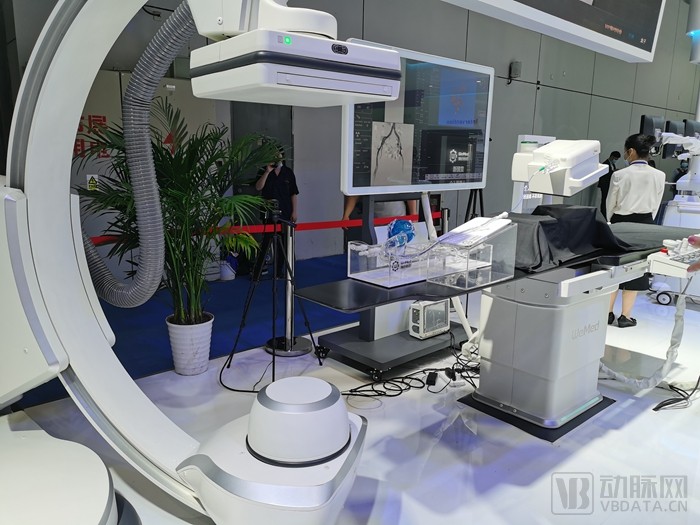
WeMed DSA Equipment and Interventional Surgical Robots
According to publicly released statistical data from the China Association of Medical Equipment, the installed base of imaging equipment in the Chinese market, including CT scanners, MRI systems, and angiography machines, has maintained rapid growth over the past five years.
In the rapidly growing medical imaging sector, WeMed’s founding team chose to focus on interventional imaging—a niche that has seen limited participation from domestic manufacturers and where the pace of import substitution has been relatively slow.
The pace of domestic substitution in interventional imaging is relatively slow, primarily due to the high barriers associated with interventional imaging equipment. Taking digital subtraction angiography (DSA) systems as an example, they require substantial technical reserves in mechatronics, software control, algorithms, and mechanical engineering. Furthermore, these devices must be highly integrated with clinical practice. As interventional imaging equipment is typically used during surgical procedures, it demands exceptionally high product stability.
In the high-barrier sector of interventional imaging equipment, WeMed has spent five years evolving from a breakthrough with a single product to establishing a comprehensive product portfolio, thereby meeting the diverse and differentiated demands for interventional imaging across various scenarios in China.
Among its product portfolio, WeMed’s flagship product—the floor-mounted intelligent flat-panel DSA system, Aurora—obtained both the Chinese registration certificate and the CE mark in 2020. Equipped with a third-generation large-field-of-view (FOV) flat-panel detector representing the highest international standard, the Aurora shares its technological lineage with GE Healthcare’s Discovery IGS 730 and Siemens’ ARTIS pheno. Leveraging this large-FOV flat-panel detector, the system supports cardiac, neurovascular, and non-vascular interventional procedures, making it a medical facility suitable for hybrid operating rooms across multiple departments.
High-end domestically produced DSA products can not only penetrate the existing installed base market for DSA equipment but also expand into the rapidly growing primary care segment, which represents a significant source of new demand. Currently, China’s DSA equipment market is experiencing rapid growth, accelerated by the removal of DSA devices from the Category B list of large-scale medical equipment under state management. In terms of market composition, survey data from the China Association of Medical Equipment indicates substantial disparities in DSA equipment adoption across hospitals at different levels. DSA installations are heavily concentrated in a small number of large comprehensive hospitals, while the primary healthcare market is witnessing a higher growth rate.
WeMed’s Aurora DSA has achieved a breakthrough from zero to one in domestic high-end DSA equipment, primarily targeting the premium market long dominated by imported brands, while also providing more cost-effective solutions for primary-care hospitals.
Yang He revealed that the Aurora DSA system has garnered strong market response within less than a year since its launch.
WeMed’s other core product is the mid-C mobile angiography system (Mid-C Alien E). The Mid-C Alien E has obtained dual CE and NMPA certifications, is exported to more than 20 countries worldwide, and has been highly acclaimed in clinical practice. This product is manufactured by EC, one of the top five global mid-C brands acquired by WeMed in 2016. It features leading technologies such as variable SID (Source-to-Image Distance), image fusion, and optimization, providing high-end interventional equipment for departments including oncology, gynecology, urology, and peripheral vascular medicine, thereby playing a significant role in the widespread adoption of interventional procedures.
Within the small C-arm product line, WeMed’s surgical C-arm (Small C-Genie 100), known as the Genie 100—a fully electric, high-end flat-panel detector surgical small C-arm—received NMPA certification in 2020 and secured continuous orders since its market launch. This fully electric large-sized C-arm system features laser positioning and 3D image acquisition capabilities, which are widely utilized in clinical departments such as orthopedics, general surgery, and pain management. The product demonstrates outstanding performance in enhancing surgical efficiency and safety.
Previously, there were many domestic manufacturers of mini C-arms, but their products could not directly compete with imported brands. WeMed has launched a high-end surgical C-arm (mini C-arm) in the mini C-arm market, with multiple parameters surpassing those of imported products, thereby accelerating product promotion.
Whether it’s the large C-arm, medium C-arm, or small C-arm, WeMed remains committed to leveraging high quality to drive market growth.
Yang He stated, “Domestic substitution should not rely on price or policy advantages, but rather accelerate through strength and core competencies. Moreover, WeMed will not limit itself to the Chinese market. As early as 2016, WeMed Medical acquired and integrated EC, one of Italy’s top three mid-to-high-end brands. Currently, WeMed Medical operates dual centers in China and Italy, with its products exported to more than 20 countries worldwide.”
WeMed’s goal is not merely to fill product gaps and catch up with foreign companies; it has also developed an interventional surgical robot, which serves as a key component of its integrated “eye-hand-brain” strategy.
Interventional surgical robots represent a revolutionary innovative technology that has transformed the practice of interventional procedures. They enable physicians to operate the system from outside the operating room, offering greater flexibility and higher precision compared to traditional methods. Furthermore, these robotic systems alleviate physician fatigue, significantly reduce intraoperative radiation exposure, and extend professional career longevity. In conventional interventions, doctors are required to wear lead aprons weighing over five kilograms while standing for several hours, often working long-term in high-radiation environments. In the future, surgical robots will also provide the technological foundation for remote surgery, contributing to the creation of "green" operating rooms.
Siemens, a global giant in interventional imaging, has also entered the field of vascular interventional surgical robots through acquisitions and has initiated clinical trials in China. WeMed is among the domestic companies with the most rapid clinical progress in surgical robots.
Yang He stated that WeMed’s surgical robot was designed from the outset to address numerous clinical pain points, offering advantages such as an integrated operation platform, force feedback, bionic design, rapid adaptability, and procedural compatibility.
WeMed’s interventional surgical robot has a broad range of indications, covering the entire process from angiography and guidewire navigation to stent placement. Additionally, WeMed’s surgical robot is equipped with a force feedback mechanism, rather than relying solely on mechanical propulsion devices, thereby enhancing the safety of interventional procedures. In chronic total occlusion (CTO) interventions, which involve significant blockages, the absence of force feedback can easily lead to accidental puncture into the true lumen, false lumen, or vessel wall.
Regarding the learning curve, Yang He stated that interventional surgical robots are not difficult to master, allowing physicians to become proficient quickly. This enhances the precision of interventional procedures while reducing the learning burden for doctors.
Currently, surgical robots are emerging as a new disruptive technology gaining global acclaim, while also providing Chinese enterprises with a pathway to “overtake on the bend.”
It is reported that WeMed’s interventional surgical robot has entered the clinical trial phase. Upon market launch, it will be marketed in conjunction with WeMed’s Aurora DSA system, providing a next-generation solution for full-process management of interventional procedures and leading industry development.
Yang He stated, “WeMed will also lay out R&D for remotely operable interventional surgical robots to achieve remote surgery and remote treatment, enabling patients in grassroots areas to share high-quality medical resources with those in first-tier cities. We believe this holds significant social value.”
In China’s vast interventional market, the explosive growth of cardiovascular interventional consumables is just the beginning. Moving forward, interventional departments will also place higher demands on basic equipment. Amidst this industrial trend, WeMed can provide comprehensive interventional catheterization laboratory solutions, delivering innovative products made in China. By offering diverse product portfolios, WeMed meets differentiated and multi-level needs while responding more rapidly to the requirements of local clinicians.