

Creo Medical Advances Global Expansion with Full CE-Certified GI Endoscopic Suite Five Years Post-IPO

Creo Medical
Medical Device Developer
Endoscopic Submucosal Dissection (ESD) is a minimally invasive treatment for early-stage gastrointestinal cancers and precancerous lesions. Due to its advantages, including being non-surgical, causing minimal trauma, resulting in less bleeding, and achieving high resection rates, it is highly regarded by both patients and physicians, demonstrating promising prospects for clinical application.
Endoscopic Submucosal Dissection (ESD) builds upon Endoscopic Mucosal Resection (EMR), enabling en bloc resection of lesions larger than 2 cm in diameter and thereby expanding the indications for endoscopic resection. However, ESD procedures are time-consuming and carry significant risks of complications such as perforation and bleeding. A more prominent challenge is the technical difficulty of ESD, which demands a high level of expertise; physicians typically require six months of training before they can perform the procedure independently. Consequently, there is a severe shortage of qualified physicians relative to the demand for these procedures.
Issues with ESD remain to be resolved.Creo Medical (hereinafter referred to as “Creo”), a medical device company specializing in the field of surgical endoscopy, has advanced endoscopic resection procedures through the combination of its Speedboat and CROMA products, offering solutions to address the steep learning curve of Endoscopic Submucosal Dissection (ESD) and the high volume of surgical demand.
How does the solution work, and how was it developed? This is closely tied to its developer, Creo Medical. This article provides a comprehensive overview of Creo Medical to explore the answer.
In 2003, Creo was founded by Professor Chris Hancock in the United Kingdom, initially as a company specializing in cancer treatment using high-frequency microwave energy and dynamic matching technology. Later, as its business strategy evolved, it transformed into a medical device research and design company, and was renamed Creo Medical in 2010.
Focused on the Gastrointestinal Field, All Four Series Are Certified
Creo Medical’s medical device design focuses on the field of surgical endoscopy, encompassing three specialties: the digestive system, the lungs, and the urinary system.However, the current focus is primarily on the digestive system, as it believes there is a significant unmet need in the field of therapeutic gastrointestinal endoscopy.
One Platform, Four Series
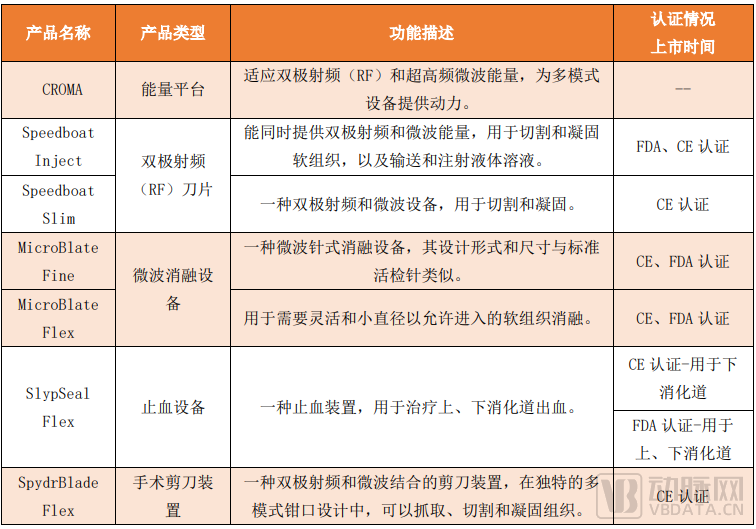
In 2020, Creo obtained CE certification for five new gastrointestinal (GI) devices and FDA 510(k) clearance for one product. These devices constitute a significant part of Creo’s product portfolio, spanning four series: Speedboat, MicroBlate, SlypSeal, and SpydrBlade. Its currently promoted products are listed in the table below.
Source: Creo Official Website
Among them, CROMA is an energy platform responsible for supplying the energy required by devices in endoscopic minimally invasive surgery, and it can be paired with all product lines under Creo.This platform is built on Creo Medical’s patented Kamaptive™ technology, which combines bipolar radiofrequency energy for localized cutting with microwave energy for coagulation. This integration enables the seamless combination of multiple energy sources, providing physicians with flexible, precise, and highly controllable devices that adapt to diverse surgical requirements.
Product Image 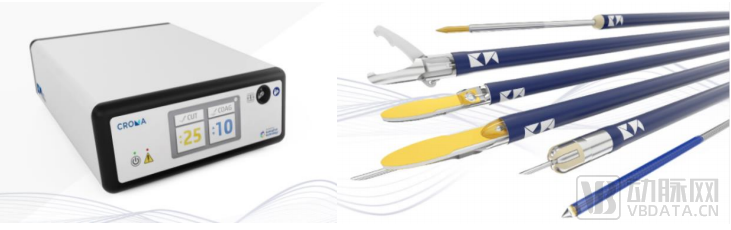 Source: Creo Official Website
All of the aforementioned products can be connected to the CROMA energy platform, leveraging its precise energy control to achieve high precision and flexibility during surgical procedures. This not only reflects Creo’s stringent requirements for technological R&D but also embodies Creo’s mission—to make medical devices simpler and safer, thereby enabling better patient outcomes.
According to Creo Medical’s publicly disclosed financial report for the first half of 2020, its product pipeline will continue to be updated. The company will continue to introduce new products to support its existing portfolio and develop new applications for other devices.
SSD Solution: Addressing Challenges in ESD Surgery
Only after gaining a preliminary understanding of Creo’s products can we better comprehend how they address the challenges faced in ESD procedures. In this regard, Creo has provided solutions primarily from two aspects: devices and clinical education programs.
The enhanced precision and integrated functionality of Creo Medical devices have reduced the operational difficulty for surgeons during procedures.Creo combines CROMA and Speedboat Inject to form the Speedboat Submucosal Dissection (SSD) solution.
On one hand, the CROMA platform enables precise control of device energy. It measures impedance to ensure consistent energy delivery, thereby optimizing cutting while minimizing the risk of thermal injury. On the other hand, Speedboat Inject combines bipolar radiofrequency and ultra-high-frequency microwave energy in a single device to provide multiple functions, including dissection, resection, coagulation, and injection.
The SSD approach can shorten the steep learning curve required for physicians to master ESD without compromising surgical safety. It makes ESD procedures simpler, faster, and safer, thereby alleviating, to some extent, the pressure from high surgical demand.
Clinical Education Programs: The Hidden Driver of Market Expansion
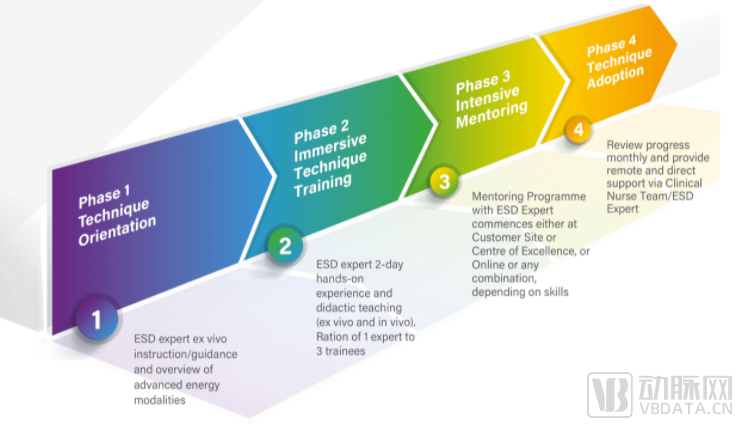
Creo Launches Clinical Education Program. This initiative is designed for healthcare professionals, providing point-of-care practical training for physicians and their teams.
Source: Creo Official Website
The program consists of four phases. First, technical guidance, involving written training and an introduction to the CROMA model conducted by ESD experts. Second, immersive technical training, featuring two days of written and hands-on instruction provided by one ESD expert to three trainees. Third, intensive mentoring, offering personalized procedural guidance tailored to each individual’s skill proficiency. Finally, technical practice, during which trainees’ progress will be reviewed monthly, with remote or direct support provided by ESD experts.
Under this program, physicians can not only participate in completing at least 10 cases but also further consolidate and refine their technical skills through team collaboration. For nurses or physician assistants, it enhances the efficiency of surgical preparation and enables better assistance during surgical procedures.
Creo’s clinical education program enables participating physicians and their teams to gain a comprehensive understanding of Creo’s medical devices. Therefore,This initiative goes beyond merely training clinicians to ensure the quality of device usage. Creo Medical can also leverage physicians’ status as key opinion leaders within the industry to promote its products.
Currently, this initiative has been successfully promoted in the UK, the US, Europe, and some Asian countries, and is further expanding into the Middle East and Africa. However, due to the impact of the pandemic, Creo Medical is adjusting its implementation approach.
Accelerating Commercialization Through Team Expansion and Acquisitions
Based on Creo’s product pipeline and clinical education programs, it is evident that the company is backed by a strong, experienced team. Indeed, Creo’s management team is diverse, with extensive experience in research and development, quality assurance, regulatory affairs, and product commercialization.
2020 was a year of significant transformation for the Creo team. First, the senior management team was further strengthened.In August 2020, Creo appointed David Woods as Chief Commercial Officer (CCO) to help the company transition from the early clinical adoption phase to a stage of global commercial expansion. Since assuming his role, David has built teams in the United States and the Asia-Pacific region to enhance the company’s market entry opportunities in these areas.
Creo has also appointed a group of senior managers responsible for sales, service, and commercial operations, who come from companies such as Medtronic, Pentax, and Philips Healthcare, bringing with them extensive professional expertise. In the early stages of its global commercial expansion, Creo aims to build a market-adapted team to cover the entire UK and EU markets, while cultivating its presence in the US and Asia-Pacific markets.
Secondly, Creo completed two acquisitions, bolstering its commercial network and continuing to expand its workforce.In 2020, Creo completed the acquisitions of Albyn Medical (hereinafter referred to as “Albyn”) and Boucart Medical (hereinafter referred to as “Boucart”). These two acquisitions directly saved Creo the substantial effort required to establish its own sales channels, thereby saving time.
Albyn is a company that manufactures and sells endoscopic products for the gastrointestinal and urological tracts, while also distributing third-party products in these fields. It maintains extensive commercial ties with hospitals across major European regions. In July 2020, Creo Medical acquired Albyn.
This acquisition has accelerated the development of Creo’s European business. Albyn provides Creo with a commercial distribution platform, offering direct market access for its full product portfolio. Furthermore, it expands Creo’s product range, as the two companies’ offerings in the gastrointestinal field are highly complementary, and Albyn also provides Creo with an opportunity to enter the urology market.
In November 2020, Creo acquired Boucart. Boucart is the largest independent supplier of gastrointestinal endoscopy consumables in Belgium and Luxembourg, distributing third-party products to 30 hospitals. The acquisition of Boucart also provides Creo with a robust commercial platform to facilitate the launch of its products. Craig Gulliford, CEO of Creo, stated, “This acquisition is a significant complement to the commercial and distribution platform established through the Albyn acquisition in July, and will accelerate the development of our business in Europe.”
With the expansion of its senior management team and the completion of acquisition plans, Creo’s workforce nearly doubled by the end of 2020, growing from 91 employees at the beginning of the year to more than 175.The expansion of the team size witnesses the acceleration of Creo's commercialization process.
According to its official data, in 2020, its commercial, marketing, and distribution resources increased tenfold, with business operations spanning five European countries, the United States, and select countries in the Asia-Pacific region. Despite pandemic-related restrictions, Creo Medical still received commercial orders from the United States, South Africa, and Australia. The business development aligned with management’s expectations for the early stage of Creo Medical’s commercialization, with Speedboat Inject delivering the strongest performance.
As of December 31, 2020, its annual revenue was projected to increase to over £9 million (2019: €1 million), with net cash flow exceeding £45 million.
Over a Decade of Dedication: Building Four Core Competitive Moats
Currently, Creo is experiencing strong commercial momentum. However, this success follows more than a decade of dedicated development. This article reviews Creo’s progress over the past 18 years, focusing on its financing history and competitive advantages.
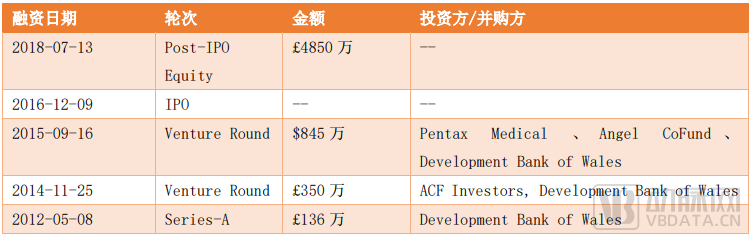
Capital conditions can reflect a company's development from an indirect perspective,Creo’s financing history reflects steady development with a focused mid-term strategy.Its financing history is shown in the table below.
Source: Creo Official Website
As shown in the table, after nearly a decade of development, Creo secured its Series A financing and began to emerge as a notable player. The period from 2014 to 2016 marked Creo’s first phase of rapid growth; following two consecutive rounds of funding, the company went public in 2016. After several more years of development, Creo initiated its global commercialization process.
From the perspective of Creo’s advantages, they are mainly reflected in four aspects: products, team, business model, and commercialization strategy.Given the prior introduction of the team, further elaboration is omitted here.
First, the product’s efficacy and pipeline advantages.In terms of product benefits, it demonstrates advantages in both time and cost. Regarding time efficiency, Creo’s products are simple and convenient to operate, which can shorten surgical duration. They also reduce the risk of mucosal injury, thereby facilitating rapid tissue healing and shortening the overall recovery time after surgery. In terms of cost, feedback data from early users of Speedboat Inject in the UK indicates that, compared with the outcomes of a single traditional surgery, using Speedboat Inject can save NHS (National Health Service) hospitals nearly £5,000.
In terms of its product pipeline, Creo boasts a robust intellectual property foundation. As of December 2020, Creo had 247 patents granted, with an additional 763 pending. These intellectual property assets enable Creo to build a broad and promising product pipeline, spanning from early-stage concept development to clinical application.
Second, the primary advantage of the business model lies in its scalability.From R&D and manufacturing to sales and distribution, Creo’s business model is flexible, allowing for adjustments in response to market conditions. With R&D at its core, Creo is evolving into a comprehensive, specialized medical device company that integrates product research and development, manufacturing, and sales.
Third, the commercialization strategy is clearly defined.Specifically, it focused on the gastrointestinal tract during the R&D phase and launched a series of products. It then established promotional relationships with key opinion leaders (KOLs), improved market penetration through clinical education programs, and expanded into adjacent markets. Finally, it signed distribution agreements with partners to begin its global market expansion.
All competitive advantages are built upon a foundation of valuable products.According to Creo Medical’s publicly disclosed financial report for the first half of 2020, its R&D expenditure amounted to £5 million, representing a £500,000 increase compared to the same period in 2019. These funds were allocated to continuously expand its product portfolio and support clinical trials of its products. This investment aligns closely with Creo Medical’s mission to “improve patient outcomes by applying advanced energy technologies to the emerging field of surgical endoscopy.”
What’s past is prologue. Regarding the future, CEO Craig Gulliford stated that Creo will continue to focus on its regulatory approval programs, aiming to expand the clinical use of its products across various markets.
In the long run, Creo believes that diligence and prudence are paramount to driving its sustainable growth. Guided by its enduring “can-do” values, the company will continue to advance along its established business strategy.