Digital Marketing Emerges as a Key Trend: Pharma Companies Deepen Collaboration with Pharmaceutical E-commerce Platforms
In recent years, the pharmaceutical industry has seen continuous policy innovations, ranging from the generic drug consistency evaluation and the revision of the Drug Administration Law to centralized volume-based procurement of drugs and reforms in medical insurance payment. Meanwhile, the pandemic-driven shifts in doctor-patient behavior have profoundly impacted pharmaceutical branding and drug distribution, while relevant authorities are accelerating the implementation of “Internet + Healthcare.” It is evident that China’s pharmaceutical and healthcare industry is undergoing significant transformation.
The rise of internet technology has transformed traditional interaction models across various industries, a trend that is also evident in the development of the pharmaceutical sector. As users seek more convenient and efficient medication purchasing experiences, pharmaceutical e-commerce has emerged to meet this demand. Born out of user needs, pharmaceutical e-commerce will continue to evolve in response to changing consumer preferences. Amidst this dynamic development, how far has pharmaceutical e-commerce come, and what stage has it currently reached?
To better analyze the current state of China’s pharmaceutical e-commerce industry and explore future innovative models, VCBeat Research Institute has partnered with JD Health to conduct user surveys and integrate market data analysis. Drawing on relevant research methodologies and theories, this report provides an in-depth review of the development trends in the pharmaceutical e-commerce sector over the past few years, summarizes future trajectories, and presents “The Pharmaceutical E-Commerce Revolution Responding to User Needs: 2021 China Pharmaceutical E-Commerce Industry Study,” aiming to provide reference and insights for the industry’s development.
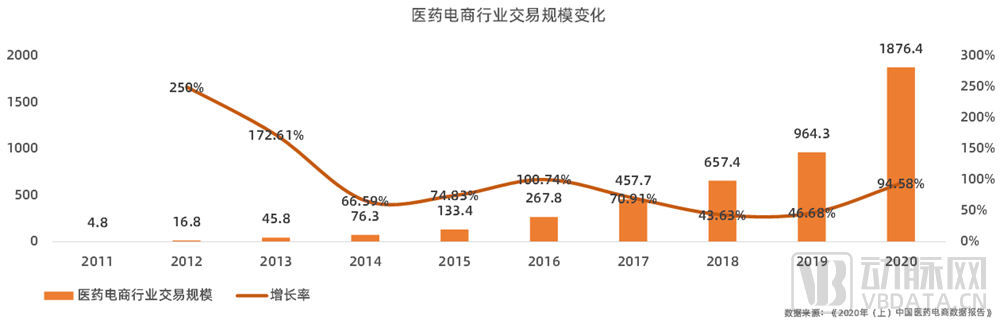
The pent-up market demand fully released during the 2020 pandemic, combined with a complete diagnosis and treatment chain formed through integration with clinical care processes, drove the transaction volume of the pharmaceutical e-commerce industry to surpass the RMB 100 billion mark and approach RMB 200 billion. Pharmaceutical e-commerce has gradually demonstrated its scale effects, building a communication bridge between patients and healthcare providers. Beyond the diagnosis and treatment chain, pharmaceutical e-commerce platforms have also begun collaborating with upstream partners, engaging in precise and efficient digital marketing through partnerships with pharmaceutical companies.
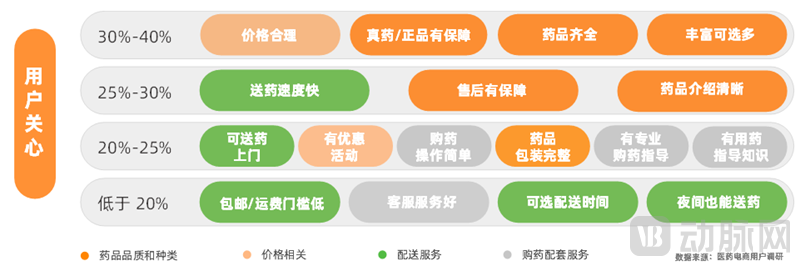
From the perspective of user needs, in addition to “reasonable pricing,” users are more concerned with issues related to drug quality and variety, such as “guaranteed authenticity/genuine products” and “comprehensive drug availability.” This may be because pharmaceutical e-commerce platforms have already established relatively mature supporting services for medication purchases (such as delivery and interface optimization), leading users to pay less attention to these aspects.
In response to user needs,Direct collaboration between pharmaceutical e-commerce platforms and pharmaceutical companies can, on the one hand, expand the range of medications available on these platforms, and on the other hand, provide better assurance of drug quality.Partnering pharmaceutical companies serve to endorse the quality of medications on online pharmaceutical e-commerce platforms, thereby alleviating consumer concerns during the purchasing process.
From the perspective of pharmaceutical companies' needs, policy impacts and shifts in user demand are driving increasingly intense industry competition, prompting pharmaceutical enterprises to undergo digital marketing transformation.
Guided by a series of policy factors, the pharmaceutical industry has begun to awaken to the imperative of cost reduction and efficiency enhancement. With the onset of the pandemic and the penetration of pharmaceutical companies into lower-tier markets, digital marketing upgrades centered on cost reduction and efficiency enhancement have officially become a key objective in the development of the pharmaceutical industry.
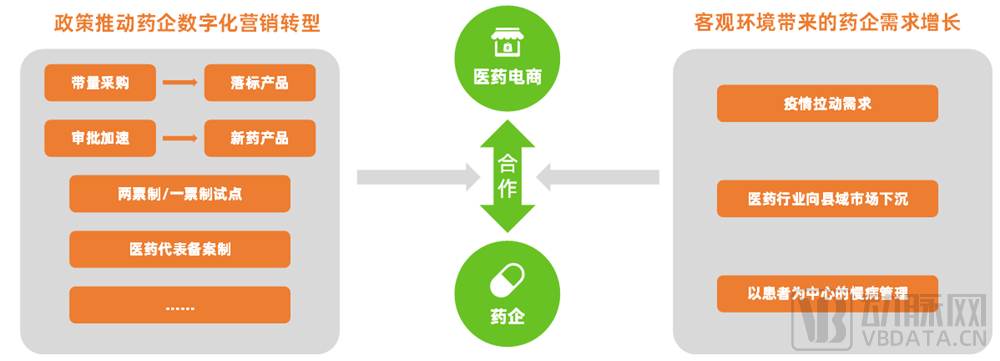
As a channel for the online distribution of pharmaceuticals, pharmaceutical e-commerce leverages its large user base to serve as an online gateway for pharmaceutical companies in digital marketing. It helps these companies establish their own online marketing channels, which integrate with their existing marketing models to create a synergistic promotional effect through online-offline collaboration. Through various cooperation mechanisms, pharmaceutical e-commerce platforms and pharmaceutical companies can achieve digital marketing collaboration across different types of products.
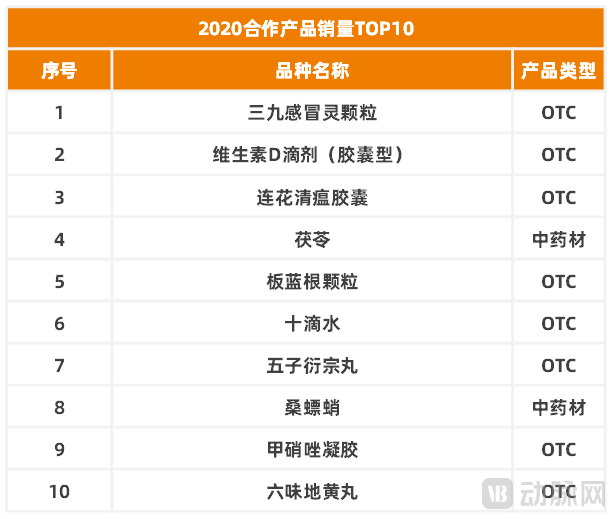
Clear regulations govern the online sales of OTC products. After extensive exploration and years of development, a stable collaborative model has largely taken shape between pharmaceutical e-commerce platforms and drug manufacturers, significantly driving product sales. Among the top ten best-selling products on a leading domestic pharmaceutical e-commerce platform, eight are OTC drugs (specific brand names are not disclosed).
Collaboration between OTC products and pharmaceutical e-commerce extends beyond mere channel promotion. The inherent characteristics of OTC products subject them to fewer restrictions in marketing and promotion, thereby placing greater emphasis on synergistic efforts within omnichannel strategies.
E-commerce platforms for pharmaceuticals can serve as online windows for OTC products, leveraging the brand equity accumulated through multi-channel promotion to drive user traffic to these platforms and directly convert it into actual online sales. As a core distribution channel for online drug sales, pharmaceutical e-commerce enables the ultimate realization of integrated branding and performance efficiency through its provision of big data management and user asset journey data.
In the future, OTC products will continue to serve as the foundation for collaboration between pharmaceutical companies and online pharmacy platforms, consistently providing users with high-quality, reasonably priced conventional medications.
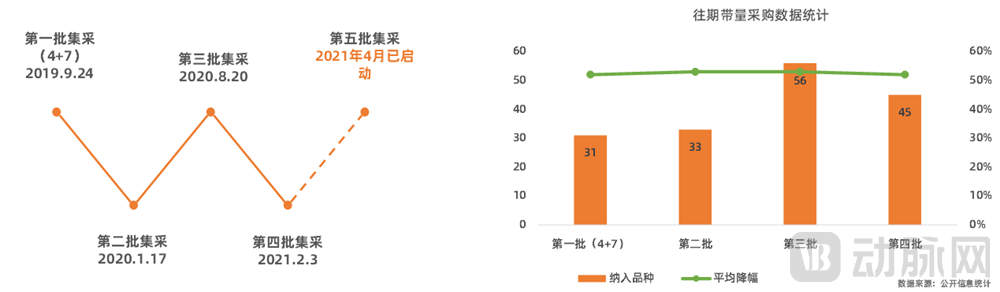
As volume-based procurement (VBP) initiatives are further implemented, competition in the generic drug sector has intensified. VBP has further compressed profit margins for domestic generic pharmaceutical manufacturers, heightening the industry’s imperative to reduce costs and enhance efficiency. Since the launch of the first round of centralized procurement (the “4+7” cities pilot), China has successively conducted four rounds of such procurement. The fifth round is already on the agenda and may surpass the third round to set a new record for the scale of national centralized procurement. Centralized procurement has gradually become routine, with drug price reductions remaining broadly stable while the number of included products has seen steady growth.
In the volume-based procurement programs implemented to date,The widespread failure of originator drugs to win bids in centralized procurement has become a key factor enabling the pharmaceutical e-commerce industry to enter the main battlefield of volume-based procurement products.After being excluded from the centralized procurement bidding, originator drug products, having lost their competitiveness within the national medical insurance coverage, urgently need new sales channels to maintain product sales volume. The rapidly growing pharmaceutical e-commerce industry has become the optimal choice for these originator drug products.
The role of digital marketing in cost reduction and efficiency improvement is widely recognized. By partnering with digital channels or implementing digital solutions within their marketing teams, pharmaceutical companies can connect more efficiently with physicians and patients, enhance the productivity of their sales forces, and thereby control costs incurred during the marketing process.By collaborating with pharmaceutical e-commerce platforms, pharmaceutical companies can integrate online and offline resources and achieve broad coverage of doctors and patients, thereby maintaining their influence among healthcare providers and patients with greater efficiency and lower costs in the context of centralized procurement.
The variety of new specialty drugs is increasing, yet their distribution channels are becoming increasingly narrow. Due to medical insurance caps and strict controls on the proportion of drug costs in total medical expenses, physicians exercise greater caution regarding the economic implications when prescribing medications. Since new specialty drugs are generally priced relatively high, physicians often advise patients to purchase these medications out-of-pocket when issuing prescriptions. As hospital supply diminishes, the primary offline purchasing options available to patients are hospital-adjacent pharmacies and Direct-to-Patient (DTP) pharmacies. However, hospital-adjacent pharmacies have limited scale and cannot ensure comprehensive product coverage, while DTP pharmacies are relatively dispersed in their distribution, failing to guarantee timely product availability.
With a comprehensive product portfolio and timely supply capabilities, pharmaceutical e-commerce aligns perfectly with these two key factors.Consequently, manufacturers of innovative specialty drugs are increasingly partnering with pharmaceutical e-commerce platforms, making them a key sales channel. This is particularly evident in specific indications such as oncology and rare diseases, where the low geographic constraints of pharmaceutical e-commerce fully leverage their advantages in drug supply, thereby unlocking substantial market potential in lower-tier regions.
Following the overall acceleration of drug review and approval processes, innovative drugs in China have entered a new stage of development. In recent years, as products previously backlogged in the approval pipeline have gradually gained market authorization, 10 Class 1 innovative drugs and 58 imported original research drugs were approved for marketing in 2019. Furthermore, the continuous implementation of national medical insurance negotiations has partially compressed the gross profit margins of innovative drugs, thereby generating strong demand for enhanced pharmaceutical marketing strategies.Innovative drugs that have entered the market in large volumes are generally seeking more diverse promotional channels, and pharmaceutical e-commerce is undoubtedly the most powerful online pathway.
Most innovative drugs fall under the category of new and specialized pharmaceuticals; therefore, they face the same distribution challenges encountered by such products. Furthermore, during the initial launch phase of innovative drugs, critical market education efforts are required to enhance physicians’ and patients’ understanding of the clinical value of these novel therapies. Collaboration between innovative drug manufacturers and pharmaceutical e-commerce platforms primarily serves two purposes: first, leveraging the extensive reach of e-commerce to ensure drug availability across broad geographic regions; and second, utilizing these platforms to communicate with physicians and patients, thereby providing patients with more treatment options.
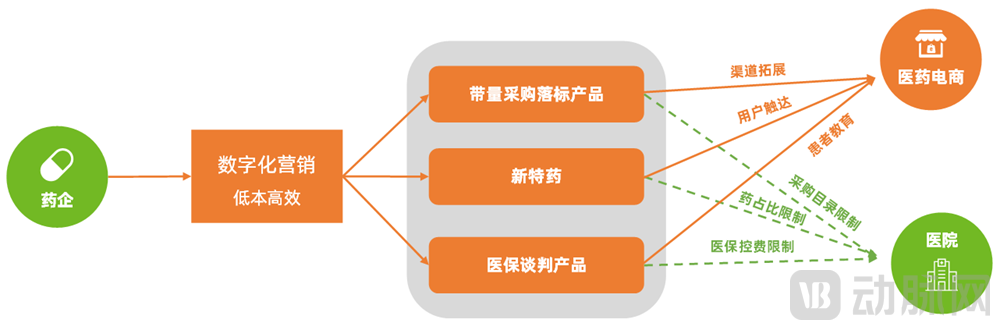
In the process of implementing digital marketing, pharmaceutical companies have recognized the importance of pharmaceutical e-commerce channels. For products sold through out-of-hospital channels, pharmaceutical e-commerce can provide corresponding solutions to reach new users and expand into new channels.
In the future, as an increasing number of pharmaceutical companies articulate their core needs for digital marketing, collaboration between pharmaceutical e-commerce platforms and drug manufacturers will deepen further, creating synergies to serve both healthcare providers and patients.
The above is an excerpt from “The Pharmaceutical E-commerce Revolution in Response to User Needs—China Pharmaceutical E-commerce Research Report 2021.” Scan the mini-program QR code below via WeChat to access the full report.