

Countdown to Liquidity Ebb? Biotech Firms Rush for IPO Amid Tightening Window
As 2021 quietly approaches its midpoint, the IPO frenzy that has swept through biopharmaceutical companies since 2019 appears to be cooling. Early movers have already gone public in the past three years, while those yet to list face increasingly complex market conditions amid shifting tides: expectations of Federal Reserve rate hikes and receding liquidity hang like a Sword of Damocles over the IPO gateway.
As market uncertainty emerges, Zhao Ershan, who oversees IPO services at Futu, has become even busier. Some companies have chosen to hit the fast-forward button, aiming to rush their listings during this window of abundant liquidity. Zhao’s days are filled with client meetings, and she works late into the night preparing materials; finishing work after 11 p.m. has become routine. “The entire IPO team’s pace has clearly intensified,” she noted.
According to Zhao Ershan, the current wave of IPOs among biopharmaceutical companies began three years ago.
In April 2018, Charles Li, then Chief Executive Officer of the Hong Kong Exchanges and Clearing Limited (HKEX), announced: “After four years of relentless efforts, the HKEX has finally launched a new listing regime today, ushering in an exciting new era for Hong Kong’s capital markets.” The newly amended provisions of the Rules Governing the Listing of Securities on The Stock Exchange of Hong Kong Limited officially took effect on April 30, 2018, permitting pre-revenue biotechnology companies to list in Hong Kong. This expansion of Hong Kong’s listing framework opened a golden window for biopharmaceutical IPOs that lasted for more than three years.
Subsequently, the once-loosened market environment pushed IPO activity during the window period to a climax. In early 2020, the outbreak of the COVID-19 pandemic rapidly spread its impact worldwide. As the global real economy suffered severe setbacks, central banks around the world injected liquidity to stabilize markets, ushering in an unprecedented boom in capital markets. After a brief decline in 2020, stock indices in the three major markets—U.S. stocks, Hong Kong stocks, and A-shares—rose steadily. The buoyant market conditions were a significant boon for pre-IPO companies, meaning they could raise more capital while diluting fewer shares.
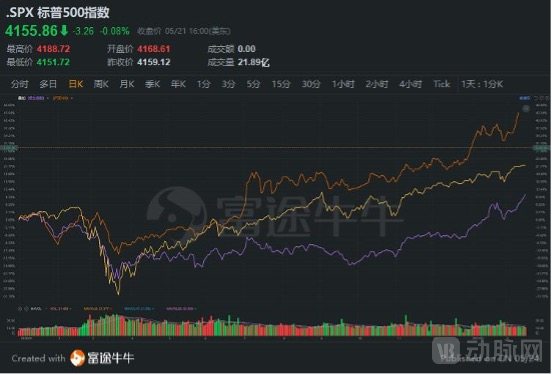
January 2020–February 2021: The three major stock indices rose steadily after a brief dip
In 2018, 2019, and 2020, two, eight, and thirteen pre-revenue biopharmaceutical companies that met the new listing requirements successfully completed their initial public offerings (IPOs) on the Hong Kong Stock Exchange, respectively. During this period, a number of high-profile companies, including Akeso, InnoCare Pharma, CanSino Biologics, and Peijia Medical, listed on the Hong Kong Stock Exchange.
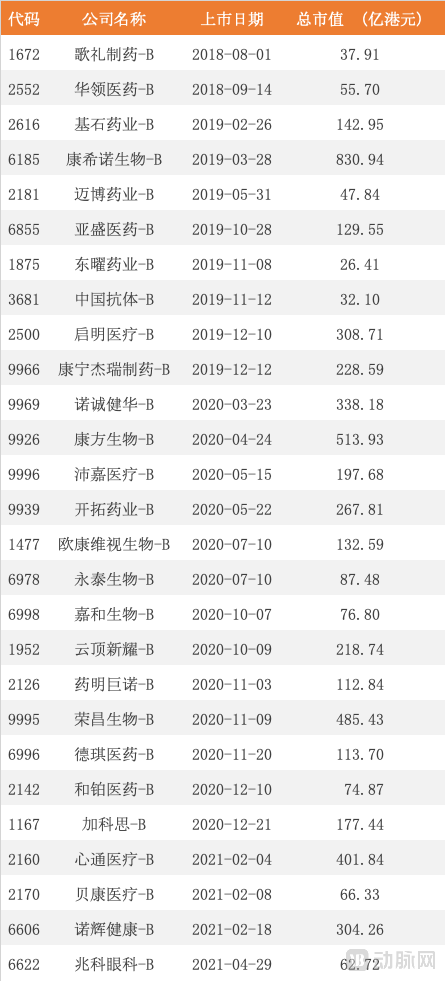
Unprofitable Biotech Companies Listed Since the Implementation of the HKEX’s New Rules in 2018
(Market capitalization as of after-hours trading on May 24; data source: Futu NiuNiu)
As the head of new share operations at Hong Kong’s largest retail brokerage, Futu, Zhang Kairui has gained profound insights into the current wave of IPOs among biotechnology companies. “The subscription demand for biopharmaceutical companies on Futu’s platform in 2020 can only be described as explosive. The time required to surpass HK$10 billion in subscriptions after the opening of public offerings has been growing shorter and shorter,” Zhang remarked with emotion. Since Akeso Inc.’s listing in April 2020 attracted over HK$10 billion in subscriptions from Futu users, an increasing number of new listings have achieved this milestone, with total subscription amounts repeatedly reaching new highs.
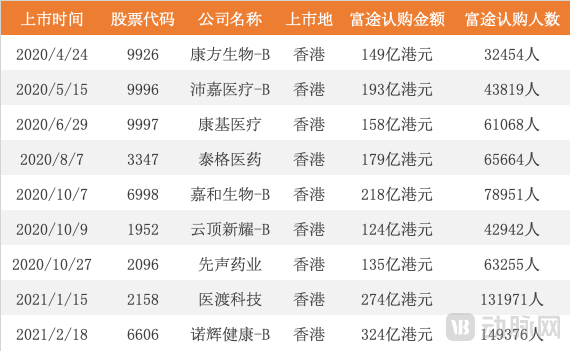
Biotechnology companies with over HK$10 billion in subscriptions on the Futu platform since 2020
(Data source: Futu NiuNiu)
Shortly after the 2021 Spring Festival, New Horizon Health’s stock surged on its market debut, with its market capitalization rapidly approaching HK$30 billion. In the grey-market trading session on the day before its listing, Futu’s grey-market closing price rose by 162%. As the underwriter for New Horizon Health’s IPO, Futu saw subscription amounts from its platform users exceed HK$32.4 billion, with over 149,000 subscribers, pushing the subscription volume for healthcare projects on its platform to a new high.
Amid shifting demographic and consumption patterns in China, the early cancer diagnosis and screening sector, where New Horizon Health operates, has attracted significant attention. As the first company in China to obtain a registration certificate for an early cancer screening product, New Horizon Health was already a star project in the primary market. News of its Hong Kong listing sparked a strong reaction among secondary market investors.
Internet Elements in IPOs
Zhao Ershan told VCBeat that the key factors for companies choosing to collaborate with internet-based brokerages during their IPOs are the brokerages’ more concentrated platform traffic and strong information distribution capabilities. It is understood that by the end of Q1 2021, Futu had accumulated over 14 million registered users, with more than 1.96 million funded accounts, and customer assets on the platform nearing $60 billion. Furthermore, the platform’s user profile is characterized by youth, high educational attainment, and high income; the majority are elites from various industries, demonstrating a significantly higher level of understanding and acceptance of new technologies and business models compared to average users.
“The RMB 10 billion subscription deal is a welcome outcome for companies, investment banks, and investors alike,” Zhao Ershan pointed out. In recent IPO underwritings, internet-based securities firms have played an increasingly significant role and captured larger market shares. “However, healthcare companies are somewhat unique.”
Since the Hong Kong Stock Exchange opened its gates, healthcare and life sciences have become a key strategic sector for Futu’s corporate services. However, compared with new-economy sectors such as TMT and consumer entertainment, healthcare companies are characterized by deep technological sophistication and a high barrier to understanding, presenting Futu with considerable challenges in the early stages of its service rollout.
On one hand, healthcare projects are highly specialized, and even for young investors on the platform—many of whom come from major internet companies (19% of Futu’s users work in the internet sector)—there is an objective technical barrier. To address this, Futu regularly conducts investor education through in-depth analytical articles, live video streams, and other formats, providing users with clear and accessible insights into the industry and individual companies.
On the other hand, healthcare and medical projects often fail to achieve profitability, or their profit margins are insufficient to reflect future value, resulting in valuation methods that differ from those used for conventional projects. This renders mainstream enterprise valuation approaches in the secondary market, such as profitability analysis and discounted cash flow (DCF), inapplicable. In response, Futu’s research team has systematized valuation analysis dimensions for various types of healthcare and medical enterprises, providing investors with analytical models tailored to different sub-sectors. For instance, when evaluating vertical medical device projects, the analysis focuses on innovation and regulatory compliance advantages; whereas for new drug R&D companies, the emphasis is placed on R&D pipeline and investment analysis.
“Through these measures, investors are able to gain a clearer and more objective understanding of the commercial value of biopharmaceutical companies,” Zhao Ershan pointed out. “However, achieving such communication efficiency would be difficult in a purely offline setting.”
However, the hot window for healthcare IPOs may be reaching a turning point.
As the COVID-19 pandemic is gradually brought under control and economic recovery looms, inflationary pressures are becoming increasingly pronounced. U.S. Treasury Secretary Janet Yellen has stated that “interest rates may have to rise to some extent.” The Federal Reserve’s monetary policy has always served as a bellwether for liquidity in global mainstream capital markets. In fact, by early 2021, the market had already reacted to expectations of inflation and interest rate hikes. As the anticipated rate hikes remained delayed, investor anxiety triggered significant market volatility, leading to sharp valuation corrections for many unprofitable, high-valuation, high-tech companies.
Some companies that have just initiated their IPOs face a dilemma: whether to accelerate the IPO process before the liquidity feast comes to an end, or to pause the IPO for now.
Wu Biwei, a senior partner at Futu, has extensive experience in capital market operations. He believes that companies should go public as soon as they meet the listing requirements. It is difficult for companies to artificially “time the market” to select the optimal IPO window, as there is often a six- to twelve-month gap between initiating the listing process and completing the actual IPO, making it hard to predict market conditions on the listing day. Moreover, financing efficiency in the secondary market is significantly higher than in the primary market; after going public, companies can access various financing instruments such as follow-on offerings and convertible bonds.
He cited Futu as an example: “When Futu listed on the Nasdaq in March 2019, its pricing and overall market capitalization did not meet expectations. However, after going public, Futu’s business grew more rapidly. Since 2020, we have completed three follow-on offerings, raising $314 million, $260 million, and $1.4 billion, respectively—each amount exceeding the $174 million raised in its IPO.”
Wu Biwei told VCBeat that, based on his experience serving multiple IPO cases, many companies’ IPO processes are delayed due to unforeseen structural issues.
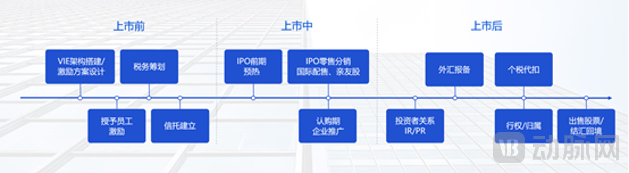
Pre-IPO: Properly Handle Employee Equity Incentives
A key task following the launch of an initial public offering (IPO) is to clarify equity relationships, with particular attention to the proper handling of employee stock ownership plans (ESOPs). For new economy enterprises, equity incentives are a widely adopted tool for talent retention and motivation.
According to PwC statistics, among the 337 Chinese companies that listed in the United States and Hong Kong between January 2016 and July 2019, 136 implemented equity incentive plans prior to their IPOs, while 175 did so after going public, accounting for 40% and 52% of the surveyed companies, respectively. The core teams of biotechnology firms are often composed of world-class experts, who naturally command high compensation. Granting equity incentives to these core teams not only helps to deeply align the interests of these experts with the company but also alleviates cash flow pressure on the enterprise.
“Biotech companies exhibit two distinct characteristics when addressing equity incentive issues. First, they are relatively unfamiliar with equity allocation and incentive mechanisms, requiring seasoned experts to provide comprehensive plan design recommendations and clear guidance throughout the entire implementation process,” said Zeng Shanshan from the Futu ESOP Equity Incentive Services Team in an interview with VCBeat. “Second, most top-tier experts in the sector come from various parts of the world, and foreign executives are commonly present, which inevitably involves tax compliance issues for employees of different nationalities.”
Cao Shanshan stated that Futu is already capable of providing a one-stop ESOP solution. “Futu offers services covering every stage, from plan design, trust establishment and tax planning, data management, and exercise implementation, to share reduction after the lifting of lock-up periods for listed stocks.” To date, Futu’s ESOP services have served more than 200 companies, including well-known enterprises such as Akeso, RemeGen, InnoCare Pharma, and Kintor Pharmaceutical. Among biotechnology companies listed on the Hong Kong Stock Exchange in 2020 under the new regulations, 62% were clients of Futu’s ESOP services.
IPO in Progress: Friends-and-Family Shares Race Against the Market
The allocation of "friends and family shares," which many companies need to finalize during their IPO process, is also a thorny issue. "Friends and family shares" refer to shares that founders request investment banks to reserve prior to an overseas IPO, which are then sold at the IPO offering price to designated employees, relatives, and friends. The complexity of this issue stems primarily from tight timelines.
When subscription demand for an IPO is extremely heated, each share of the new stock becomes a highly contested asset, making it difficult for issuers to guarantee how much allocation can ultimately be reserved. On the other hand, individuals with access to “friends and family” subscription quotas often cannot confirm until shortly before the listing how much capital they can mobilize and what amount they can subscribe for. This requires companies to formulate their friends-and-family allocation plans within an extremely short timeframe prior to the IPO, yet this involves complex procedures ranging from opening private banking accounts to obtaining accredited investor certification, which typically take more than one month.
Zhao Ershan stated that, regarding employee and affiliate share allocations, Futu can leverage the responsiveness advantages of an internet-based brokerage, “completing account opening, eligibility verification, and other procedures within one week.” It is understood that Futu has extensive cooperation experience with major lead underwriters and investment banks, and possesses in-depth familiarity and rich expertise in the entire operational process for such share allocations. This is also why many companies listed on the U.S. and Hong Kong stock exchanges in recent years—including Beike, Kuaishou, Xiaomi, Tencent Music, and XPeng Motors—have chosen to partner with Futu.
Post-IPO: How to Activate Secondary Market Liquidity in the Post-Pandemic Era
In the Hong Kong and U.S. stock markets, where institutional investors with relatively small numbers but highly concentrated shareholdings dominate, post-listing trading activity for new-economy and healthcare innovation projects with modest overall market capitalizations tends to be very low, thereby dragging down stock liquidity.
As the post-pandemic economic recovery accelerates, it is only a matter of time before the major market rally subsides. Zhao Ershan points out that for newly listed companies, increasing exposure is a key pathway to rapidly boosting trading activity. However, unprofitable biotechnology firms, characterized by highly innovative products and services with relatively low relevance to daily life, do not naturally attract significant market attention.
Investors tend to proactively pay attention only after gaining an understanding of the industry and the enterprise.
In emerging sectors, many investors place even greater emphasis on direct engagement with companies. For instance, in the case of certain high-tech manufacturing enterprises, initial investors are often consumers of the products or services themselves; they only gain confidence in the company’s market prospects after personally validating the underlying demand and innovation. However, biotechnology firms typically do not address high-frequency, everyday needs, and some do not even target end consumers directly. Consequently, the cycle from consumer validation to investor conversion is exceptionally prolonged.
In Zhao Ershan’s view, this is another scenario where internet-based brokerages can play a significant role. Taking Futu as an example, the platform has gathered a large number of investors, including analysts from professional investment institutions and key opinion leaders (KOLs) in the secondary market such as influential investment bloggers. Data shows that Futu’s daily active users (DAU) exceed 100,000, with an average of over 310,000 pieces of user-generated content (UGC) produced each day; these figures multiply during periods of market volatility or when there is a concentrated release of corporate earnings reports. “We have created new investor interaction scenarios beyond traditional consumption contexts,” said Zhao Ershan. “When companies gain visibility on the platform, they can generate substantial buzz and achieve direct, vertical influence among potential investors.”
In addition, Futu’s “Corporate Account” service provides companies with a platform for proactive communication with investors. It is understood that the primary use case for “Corporate Accounts” currently is live-streaming earnings calls. During these broadcasts, companies directly address investor questions regarding their financial performance, enabling investors to form more accurate valuations based on first-hand information. Reportedly, during the most recent earnings season for U.S. and Hong Kong-listed stocks, over 200 companies participated in Futu’s earnings season activities, with nearly 100 companies hosting live earnings broadcasts. To date, more than 500 companies have joined Futu’s Corporate Account platform.
In fact, for most companies, the true market test only begins after the spotlight of their IPO; navigating this phase requires both corporate wisdom and the support of professional services.