

Sustainable Development of Internet-Enabled Healthcare: Insights from Yuan Fang, Director of the Information Department at Yinchuan First People's Hospital
In recent years, the impact of the “Internet Plus” mindset on the healthcare industry has been enormous.
According to the 47th “Statistical Report on China’s Internet Development” released by the China Internet Network Information Center (CNNIC), as of December 2020, the number of online medical service users in China reached 215 million, accounting for 21.7% of the total internet population. Moreover, the penetration rate of online medical services continues to rise, with the user base expanding from young people to all age groups.
The outbreak of the COVID-19 pandemic has accelerated the development of the internet healthcare industry. According to the report "Reality and Future of Internet Healthcare in the Post-Pandemic Era," recently released by the Yangtze River Delta Health Research Institute of Shanghai Jiao Tong University, the number of mobile healthcare users in China exceeded 635 million during the pandemic, with as many as 74.4% of internet users having accessed or learned about online consultations during this period. However, only 22.07% of users constitute the group of intensive internet healthcare users. Issues such as "lack of understanding," "distrust," and "immature existing technologies, legal frameworks, and operational systems" remain prominent.
In the post-pandemic era, how should the internet healthcare industry continue to deepen its development? As a pioneer in domestic internet healthcare infrastructure, what lessons can be drawn from Yinchuan’s experience? What are the future development strategies for internet healthcare, and how should they be concretely implemented?
At the Internet Hospital Innovation Forum, part of the 5th Future Healthcare Top 100 Conference hosted by VCBeat, Yuan Fang, Director of the Information Management Department at Yinchuan First People’s Hospital, delivered a presentation titled “Exploration and Practice of ‘Internet + Medical Health’ Development in Yinchuan.” He shared Yinchuan’s experiences in building its “Internet + Medical Health” infrastructure and discussed strategies for the sustainable development of the internet healthcare industry, along with specific areas for future growth.
“The principal contradiction in healthcare lies between public demand and effective supply, with the supply side being the principal aspect of this contradiction.”Yuan Fang stated that the primary direction of healthcare reform is to address the imbalance in the allocation of high-quality resources and to facilitate the decentralization of such resources.
The uneven distribution of medical resources has long been a major issue in the reform of China’s healthcare system. For instance, the Outline of the National Plan for the Healthcare Service System (2015–2020) pointed out that China currently faces a relative shortage in the total volume of healthcare resources, with room for improvement in quality. Moreover, the spatial distribution of resources is unreasonable; the quality of healthcare resources in western regions is relatively low, the structure of resource allocation is imbalanced, and service capacity remains weak in fields such as pediatrics, rehabilitation, and geriatric care.
“From the perspective of medical development, the challenges currently facing China’s healthcare sector are inadequate development in terms of quality and content, as well as imbalances in resource distribution, service capacity, and population coverage.”Yuan Fang pointed out,In addition to the imbalance in the allocation of medical resources, China's healthcare sector currently faces the following contradictions:
In terms of public demand, in recent years, the public's needs have escalated in terms of levels towards equalization, specialization, convenience, and cost-effectiveness, while in terms of connotation, they have shifted from treatment to health management;
In terms of medical development, the current healthcare industry has shifted from a shortage in quantity to a deficiency in quality on the supply and demand side. Technologically, it has transitioned from traditional medical techniques to modern medical technologies. Furthermore, resource allocation in areas such as clinical care, primary care, emergency response, prevention, integrated medical and elderly care, and health education now possesses the conditions necessary for the future development of the health industry.
How to Effectively Resolve the Current Major Contradictions in Healthcare? Yuan Fang Believes That “Internet+” Is an Effective Approach to Addressing Healthcare Issues. Furthermore,Yuan Fang emphasized, “‘Internet + Healthcare’ is not merely about optimizing processes or methods through informational technologies. Its essence should lie in applying Internet thinking and leveraging new technological tools to optimize resource allocation, enhance healthcare supply, and reconstruct the healthcare delivery model.”
In 2017, the collective onboarding of 15 internet hospitals, including DXY, PKU Health Information, and Chunyu Doctor, into the Yinchuan Smart Internet Hospital Base triggered a major sensation in China’s internet healthcare industry, sparking the first wave of internet hospital construction.
Subsequently, according to public information released by the Yinchuan Municipal Bureau of Network Informatization in February, a total of 95 "Internet + Medical Health" enterprises have settled in Yinchuan, with more than 64,000 registered doctors. Moreover, China's first regulatory platform for internet hospitals has been established, further highlighting the cluster effect of the industry.
Why Is Yinchuan Favored by Internet Healthcare Companies? This Is Primarily Due to Policy Dividends.
According to VCBeat’s “Policy Research Report on Internet Hospitals,” as early as August 2016, Yinchuan City issued two documents: the “Notice of the Yinchuan Municipal Health and Family Planning Commission on Printing and Distributing the Supervision and Management System for Yinchuan’s Internet Medical Institutions” and the “Notice on Printing and Distributing the Work Management System for Yinchuan’s Internet Hospitals,” thereby ushering in large-scale pilot programs for internet hospitals.
As of September 2020, the Yinchuan Municipal Health Commission had issued a total of 19 supporting policies spanning three dimensions—guidance, supervision, and payment—establishing a relatively comprehensive institutional framework.
According to Yuan Fang, under the guidance and coordinated support of government departments at all levels, Yinchuan City has not only continuously introduced new policies to safeguard the robust development of the “Internet + Healthcare” ecosystem, but also built policy, innovation, application, and service highlands for the “Internet + Healthcare” industry by constantly optimizing service processes and strengthening application innovation, thereby establishing an influential “Internet + Healthcare” industrial base nationwide.
For example, the “Yinchuan Health Square” WeChat mini-program, launched by the Yinchuan Municipal Health Commission in 2019, not only addresses common healthcare challenges such as difficulties in appointment registration and cumbersome, time-consuming medical processes, but also integrates medical resources from municipal healthcare institutions in Yinchuan. Residents can use this mini-program to schedule outpatient appointments at any of these facilities, check test reports online, and complete payments directly during consultations. Furthermore, “Yinchuan Health Square will integrate nationwide resources to provide the public with AI-driven healthcare services covering the entire process—pre-diagnosis, during diagnosis, and post-diagnosis,” introduced Yuan Fang.
When seeking medical care, citizens inevitably face decision-making challenges and may encounter situations requiring transfer to another hospital for treatment. However, the lack of interoperability among traditional hospital systems invisibly increases both the decision-making and time costs for patients. The launch of “Yinchuan Health Plaza” aims to break down barriers between hospital systems, presenting municipal medical resources clearly and transparently to users. This not only reduces the time spent on making healthcare decisions but also eliminates the hassle of switching among multiple hospital systems, thereby optimizing the healthcare service process and enhancing citizens’ medical experience.
In terms of application innovation, Yinchuan has established a comprehensive diagnosis and treatment system.
According to Yuan Fang, the remote outpatient care system in Yinchuan currently has 23,700 specialists providing online medical services. The cumulative number of patients served nationwide has exceeded 60 million, and the number of patients with complex and critical conditions treated through remote consultations by national experts has reached 24,100. Meanwhile, the remote diagnostic systems for imaging, electrophysiology, ultrasound, and pathology have achieved comprehensive coverage in terms of time, geography, and service content in Yinchuan, truly implementing the healthcare philosophy that patients with complex and critical conditions should not need to leave their province, those with major illnesses should not need to leave their county, and those with common diseases should be treated at the primary care level.
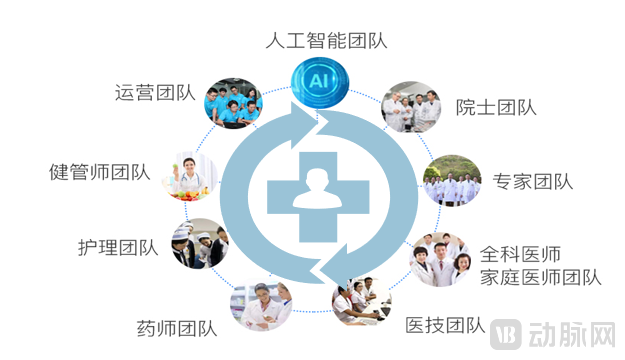
“Nine-Specialist Co-Management” Schematic Diagram, Provided by Yinchuan First People’s Hospital
“In terms of team building, the academician team, expert team, general practitioner and family physician team, medical technology team, pharmacist team, nursing team, health manager team, operations team, and artificial intelligence team work in concert to create a ‘nine-specialist co-management’ model, thereby truly achieving end-to-end, fully closed-loop, and lifecycle-spanning Internet-plus healthcare services.”Yuan Fang emphasized that Yinchuan City has initially established the “Six Masters” framework and is currently integrating nursing resources. However, effectively combining all social resources—including health management teams, artificial intelligence, telecom operators, and insurance companies—remains a key issue in developing a complete ecosystem for “Internet + Healthcare.”
“Internet + Healthcare” is not merely about the application of technology itself; rather, it should leverage Internet thinking and new technological means to optimize resource allocation, enhance the supply of medical services, and reconstruct healthcare delivery models. This constitutes the core rationale for developing “Internet + Healthcare.”Yuan Fang stated.
Specifically,Yuan Fang believes that there are three development orientations for building a complete "Internet + Healthcare" ecosystem in the future:
First, adopt a problem-oriented approach by focusing on the prominent issues arising from the current supply-demand imbalance in the healthcare industry to consider the definition and future development of the "Internet + Healthcare" ecosystem;
Second, guided by demand, we must accurately understand and grasp the primary contradictions in current healthcare reform from both macro and micro perspectives, addressing key issues such as how to meet the public’s quality-oriented expectations for medical care, how to optimize medical service processes, how to innovate medical service models, and how to reflect the value of physicians.
Third is the development orientation. In the face of the new technological revolution and the advent of Industry 4.0, the internet healthcare industry must also plan ahead and make corresponding adjustments to adapt to the times.
Additionally, it is worth noting thatYuan Fang further emphasized that developing “Internet + Healthcare” is a systematic endeavor that requires a focus on innovating healthcare service models. “Internally, we need to consider how to systematically advance the development of ‘Internet + Healthcare’ across the entire process; externally, we must address how to foster interdepartmental collaboration and jointly build an ecosystem and strategic platform.”
“As for innovation, what needs to be considered both within and outside the industry is how to achieve innovation in mechanisms and models, and then combine it with future innovations in internet healthcare business models to systematically promote the construction of future ‘Internet Plus’ medical health models,” Yuan Fang added. The medical industry must have a bottom-line mindset. “How to hold the line, accurately grasp policies, and promote the positive development of ‘Internet Plus’ medical health are also issues we need to seriously consider.”
Once the development orientation and strategic approach are established, what are the specific areas of development within the “Internet + Healthcare” industry?
In response, drawing on several years of industry exploration, Yuan Fang summarized the experience gained in Yinchuan.Development Content of the Four Major Systems:
IThe public convenience service system should advance toward regional integration, resource sharing, and end-to-end process reengineering.“Reshaping the entire closed loop of prevention, screening, and management, breaking through regional limitations, and integrating resources from both public and private medical institutions—this is the approach to developing a patient-friendly healthcare system.”
Second, the remote diagnostic system features cloud-based personnel, virtualized platforms, and market-oriented mechanisms.Specifically, platform virtualization refers to leveraging the Internet to achieve cross-spatial and cross-temporal information sharing, while market-oriented mechanisms involve applying systematic approaches to rationally allocate resources and integrate non-public sector resources to collaboratively innovate healthcare service models;
Third, the development of the outpatient care system should adhere to a multi-tiered, platform-resource-oriented approach;
Fourth, the health management system should feature a “multi-disciplinary co-management” team, an innovative institutional framework, a virtualized platform, and a suite of IoT devices.“There are many shortcomings in the current construction of health management systems. How should they be developed in the future? Undoubtedly, it will inevitably rely on a mechanism integrating Internet and Internet of Things (IoT) technologies.”
“From a vertical perspective, the future development of ‘Internet + Healthcare’ will provide individuals with full-lifecycle health services ranging from eugenics and childbearing to chronic disease management, integrated medical and elderly care, and hospice care; from a horizontal perspective, it will trend toward extension, cross-sector collaboration, and integration.”Yuan Fang concluded, “In the course of future development, many issues still require our continuous exploration and research. For instance, the relationship between hospitals and platforms, that between the government and the market, and the interplay between informatization and the Internet are all critical topics bearing on the sustainable development of the future healthcare ecosystem, necessitating collaborative efforts across the entire industry.”