

Allgens Medical Soars Over 472% on STAR Market Debut, Leading China's Biomimetic Bone Graft Material Innovation

Allgens Medical
High-end regenerative medical materials and implantable medical device R&D provider
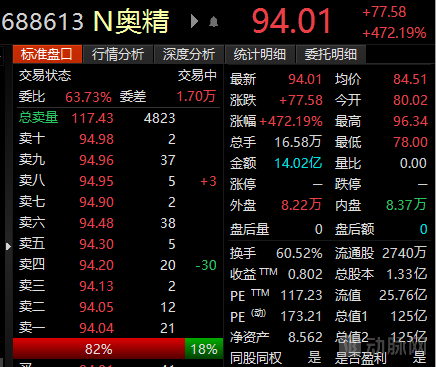
Today, Allgens Medical Technology Co., Ltd. (Stock Code: 688613; Stock Abbreviation: “Allgens Medical”) officially listed on the STAR Market. As of 11:00 a.m. on May 21, Allgens Medical had issued over 33.33 million shares in its initial public offering, bringing the total share capital to approximately 133.33 million shares post-issuance. The issue price per share was RMB 16.43, with an opening price of RMB 80.02. At the time of going to press, the stock price stood at RMB 94.01, representing a surge of more than 472%, and the total market capitalization reached RMB 12.5 billion.
Allgens Medical's prospectus indicates that the company meets the first set of listing criteria for the STAR Market. The company raised RMB 789 million in this IPO, with RMB 559 million earmarked for the Allgens Health Technology Industrial Park construction project, RMB 45.855 million for the R&D project on mineralized collagen/polyester artificial bone and collagen sponges, RMB 84.3035 million for the marketing network development project, and RMB 100 million to supplement working capital.
Allgens Medical (formerly Beijing Allgens Pharmaceutical Technology Co., Ltd.) was established in 2004. As a national high-tech enterprise specializing in high-end biomedical materials and related medical device products, the company has primarily focused on the research and development of mineralized collagen artificial bone repair materials since its inception.
Currently, Allgens Medical has established an in vitro biomimetic mineralization technology platform with complete intellectual property rights. Its mineralized collagen artificial bone repair products are primarily used for the repair of bone defects caused by a range of etiologies, including tumors, trauma, necrosis, and congenital malformations.
This mineralized collagen artificial bone repair product has obtained three Class III medical device registration certificates in China and one U.S. FDA 510(k) market clearance. It is the first and currently the only domestically produced artificial bone repair product from China to have received U.S. FDA 510(k) market clearance.
Biomedical materials refer to a class of high-tech new materials used for diagnosing, treating, repairing, or replacing human tissues or organs, or for enhancing their functions. These materials can be natural, synthetic, or composites of natural and synthetic materials, with most falling under Class III medical devices. Due to the diverse clinical demands, there is a wide variety of biomedical materials, categorized as shown in the figure below:
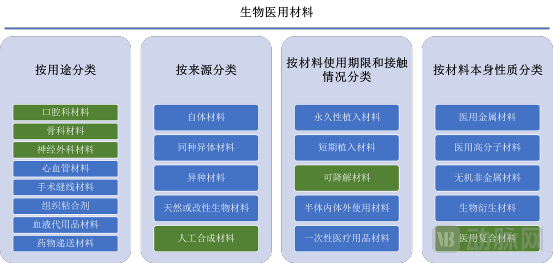
Categories of Allgens Medical’s products currently on the market are indicated within the green box. Source: Prospectus
According to Markets and Markets, the global market size of biomedical materials is projected to grow from $105 billion in 2019 to $207 billion in 2024, with a compound annual growth rate (CAGR) of 14.5% from 2019 to 2024, significantly exceeding the overall growth level of the global medical device industry.
In the future, as domestic biomedical material companies continue to achieve breakthroughs in key technologies, the technological gap between China and other countries is expected to gradually narrow, and Chinese biomedical material products will capture an increasing market share.
Statistics from the Southern Institute show that from 2015 to 2020, the compound annual growth rate (CAGR) of China's biomedical materials industry market size was 29.6%, with the potential to grow into the world's second-largest biomedical materials market.
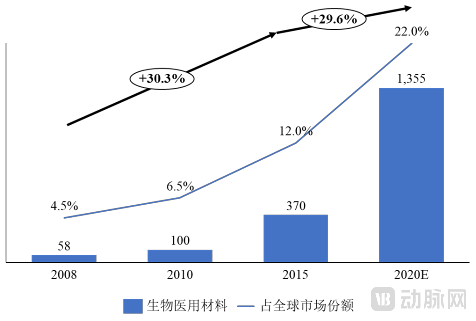
Market Size of China's Biomedical Materials Industry, 2008–2020 (USD Billion) Source: Prospectus
Among these, artificial bone repair materials have evolved from acrylic resins, calcium sulfate, calcium phosphate, and bioactive glass to collagen/hydroxyapatite blends and biomimetic mineralized collagen. The overall development trend of these products has shifted from single-component to composite formulations, from simple to complex structures, and increasingly toward biomimicry, with the mainstream direction being biomimetic composite materials that closely resemble natural human bone.
Allgens Medical’s mineralized collagen artificial bone repair materials, produced using biomimetic mineralization technology, represent cutting-edge advancements in the field of synthetic bone grafts and offer significant performance advantages. Furthermore, Allgens Medical boasts a multidisciplinary R&D team with expertise spanning biomedicine, new materials, and medical devices. Its Chief Scientist, Professor Cui Fuzhai, formerly served as a Professor at the School of Materials Science and Engineering, Tsinghua University, and as Vice Chairman of the First Council of the Chinese Society for Biomaterials.
Since 2011, Allgens Medical has successively launched a series of mineralized collagen artificial bone repair products, including “Gejin,” “Chibei,” and “Lurui,” which are respectively applied to bone defect repair in the fields of orthopedics, oral and maxillofacial surgery or plastic surgery, and neurosurgery. These three categories of products have been clinically used in over one million cases across more than 400 hospitals, including many well-known Grade A tertiary hospitals in China.
Meanwhile, Allgens Medical’s “BonGold” product, launched in the U.S. market for orthopedic bone defect repair, is the first and currently only domestically produced artificial bone repair product to have obtained U.S. FDA 510(k) market clearance.During the reporting period, the sales proportion of neurosurgery and stomatology products increased year by year:
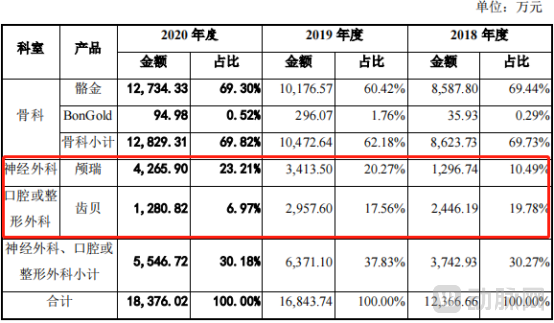
Breakdown of Main Business Revenue During the Reporting Period | Source: Prospectus
According to statistical data from the Southern Institute, the market size of China’s bone repair materials industry is projected to reach RMB 9.69 billion in 2023, with a compound annual growth rate (CAGR) of 19.8% from 2018 to 2023. Specifically, the market size for orthopedic bone defect repair materials is expected to reach RMB 5.34 billion, that for dental bone implant materials is projected to reach RMB 2.60 billion, and that for neurosurgical cranial defect repair materials is anticipated to reach RMB 1.75 billion.
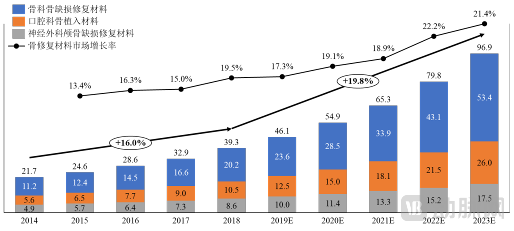
Market Size of China's Bone Repair Materials Industry (2014–2023) (Unit: RMB 100 Million) Source: Prospectus
Although bone repair materials are primarily applied in orthopedics, stomatology, and neurosurgery, preferences for their characteristics vary due to the distinct clinical needs of each specialty. Furthermore, differences among industry players in terms of financial strength, core products, R&D focus, and market strategies have led to diverse competitive landscapes within the bone repair material market across different application areas.
In the Orthopedic Bone Defect Repair Materials Industry, currently characterized by a fragmented competitive landscape with coexisting domestic and foreign enterprises, no clear industry leader has emerged, and allogeneic bone remains the most widely used material for repairing orthopedic bone defects.
With the continuous improvement in technological standards and clinical outcomes of synthetic bone graft materials, these materials accounted for approximately one-third of the market share in China’s orthopedic bone defect repair industry in 2018.
Allgens Medical’s main competitors in the artificial bone repair materials industry include domestic companies such as Shanghai Ruibang, Hangzhou Jiuyuan Gene, Sichuan Guona Technology, and Shanghai Bio-Lu, as well as foreign companies such as Biomet, Wright Medical, and Johnson & Johnson.In 2018, Allgens Medical’s products accounted for approximately 13% of the market share.
The Dental Bone Implant Materials Industry,The market share is predominantly held by imported products, with a low level of import substitution. Geistlich’s Bio-Oss bone graft and Bio-Gide resorbable collagen membrane product series account for approximately 70% of the market share in China’s dental bone implant materials industry.
Domestic products account for only about 15% of the market share in China's dental bone implant materials industry,In 2019, Allgens Medical's products accounted for approximately 16% of the market share.
Neurosurgical Cranial Defect Repair Materials Industry, Currently, apart from artificial dura (spinal) membrane products which have achieved import substitution, other categories of products are still dominated by imports, indicating a similarly low level of import substitution.
The major manufacturers of cranial defect repair materials in neurosurgery include foreign companies such as Johnson & Johnson, Medtronic, and Stryker, as well as domestic companies including the Issuer, Xi'an Kangtuo Medical, Tianjin Kang'er Medical, and Shanghai Shuangshen Medical.In 2019, Allgens Medical products accounted for approximately 3% of the market share.
Currently, the market share of Allgens Medical’s various products remains to be increased. However, in the future, as the market size of the orthopedic bone defect repair materials industry expands and clinical application demands grow, allogeneic bone grafts—due to limited sources and existing legal and ethical issues—will struggle to meet the needs of large-scale clinical applications. Consequently, the market share of Allgens Medical’s synthetic bone repair materials is likely to further increase.
The prospectus of Allgens Medical Technology Co., Ltd. shows that the company's main business income is derived from mineralized collagen artificial bone repair products, with orthopedic mineralized collagen artificial bone repair products ("Gejin", "BonGold") as the main products.
During the reporting period, the proportion of sales revenue from the Company’s mineralized collagen artificial bone repair products for orthopedics to its total operating revenue was 69.73%, 62.18%, and 69.82%, respectively, while the proportions attributable to mineralized collagen artificial bone repair products for neurosurgery (“LuiRui”) and for oral or plastic surgery (“ChiBei”) were relatively small.
Not only is product homogenization a prominent issue for the company, but Allgens Medical’s R&D expenditure as a percentage of total revenue has also declined year after year. Of the funds raised in this offering, only 5.81% was allocated to R&D for product upgrades, approximately half of the amount invested in marketing network development.
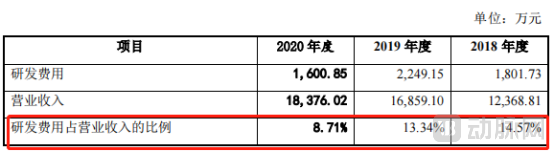
Proportion of R&D Expenses at Allgens Medical. Source: Prospectus
If significant adverse changes occur in the market for artificial bone repair materials or orthopedic bone defect repair materials in the future, or if the Company’s insufficient R&D capabilities hinder the continuous development of new products, or if the competitive landscape shifts unfavorably, the revenue from the Company’s existing main products is highly likely to decline, thereby adversely affecting its operational performance.
In response to these challenges, Allgens Medical also disclosed its strategic plans in its prospectus: with the expanding market size of domestic bone repair materials, an increasing revenue share from products other than “Gejin,” the successive launch of R&D products, and further expansion into overseas markets, Allgens Medical will achieve diversified development across multiple dimensions, including product portfolio, application departments, and target market regions.
Rich Product Line:Allgens Medical will leverage its in vitro biomimetic mineralization technology platform to further enhance product performance and expand application scenarios by comprehensively adjusting raw material ratios and other production parameters, as well as compounding with other polymers such as polylactide. The company has achieved certain phased results in the research and development of mineralized collagen/polyester artificial bone repair products and initiated clinical trials in 2020.
Expanding Overseas Markets:For the U.S. market, Allgens Medical planned to initiate the FDA 510(k) application process in 2021 for its bone defect repair products intended for spinal applications; for the EU market, the company has commenced market access applications for its bone defect repair products covering orthopedics, oral and maxillofacial or plastic surgery, and neurosurgery.
Such measures help mitigate the policy risks and the risk of failing to win bids for a single product that Allgens Medical faces due to the concentrated application of its products in specific clinical departments and its focused market regions. Meanwhile, as pipeline products are gradually launched, they will create new profit growth drivers for the company, thereby enhancing its sustainable profitability.