Pulmonary Artery Denervation: A Breakthrough Therapy for Pulmonary Hypertension – Insights from Recent Clinical Evidence and PADN Device Innovation

Pulnovo Medical
Developer of Medical Devices in the Field of Pulmonary Hypertension Treatment
Journal of the American College of Cardiology(abbreviated asJACC) is the journal of the American College of Cardiology, a renowned publication in the field of cardiovascular medicine. According toElsevierDatabase Citation Rankings, inCardiology and Cardiovascular Medicine(Ranked first among peer journals in the (Cardiovascular) category, it is one of the most influential and authoritative journals in the international field of cardiology, with an impact factor exceeding20Score。
Published inJACCIn Issue 8, Volume 76 (2020), the Editorial Comment titled “Pulmonary Artery Denervation: The New Kid on the Block?” published findings from studies conducted by the Nanjing team, the Romanov team, and the Rothman AMK team. These results clearly demonstrate that the treatment of pulmonary hypertension has been continuously evolving over the past few years, with pulmonary artery denervation (PADN), as a novel and superior therapeutic option for pulmonary hypertension, gradually gaining widespread attention.

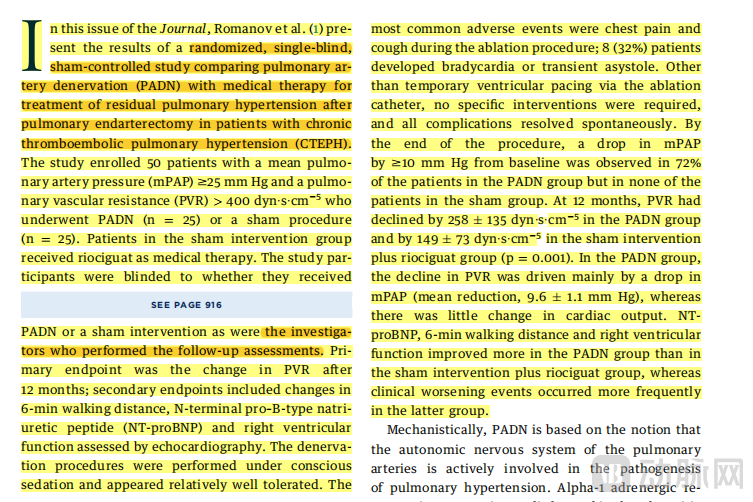
A randomized, single-blind, sham-controlled study designed by the Romanov team compared the effects of pulmonary artery denervation (PADN) versus medical therapy on residual pulmonary hypertension in patients with chronic thromboembolic pulmonary hypertension (CTEPH) following pulmonary endarterectomy. The study enrolled a total of 50 patients with mean pulmonary arterial pressure (mPAP) ≥25 mm Hg and pulmonary vascular resistance (PVR) >400 dyn·s·cm⁻⁵; 25 patients received PADN, while 25 received riociguat as a sham control. Both participants and investigators were blinded to the study procedures. The primary endpoint was the change in PVR at 12 months; secondary endpoints included changes in the 6-minute walk distance, N-terminal pro-brain natriuretic peptide (NT-proBNP) levels, and right ventricular function assessed by echocardiography.
Denervation procedures were performed under conscious sedation and demonstrated relatively good tolerability. The most common adverse events were chest pain and coughing during ablation. Eight patients (32%) experienced bradycardia or transient asystole. No special interventions were required other than temporary ventricular pacing via the ablation catheter, and all complications resolved spontaneously.
In the PADN group, 72% of patients experienced an immediate postoperative reduction in mean pulmonary arterial pressure (mPAP) of more than 10 mm Hg from baseline, whereas no changes were observed in the sham surgery group. At 12 months, pulmonary vascular resistance (PVR) decreased by 258 ± 135 dyn·s·cm⁻⁵ in the PADN group, compared with a decrease of only 149 ± 73 dyn·s·cm⁻⁵ in the riociguat control group. In the PADN group, the reduction in PVR was primarily attributable to the decrease in mPAP (mean reduction: 9.6 ± 1.1 mm Hg), while cardiac output remained largely unchanged. Compared with the riociguat control group, the PADN group demonstrated greater improvements in NT-proBNP levels, 6-minute walk distance, and right ventricular function, along with a lower frequency of clinical worsening events.
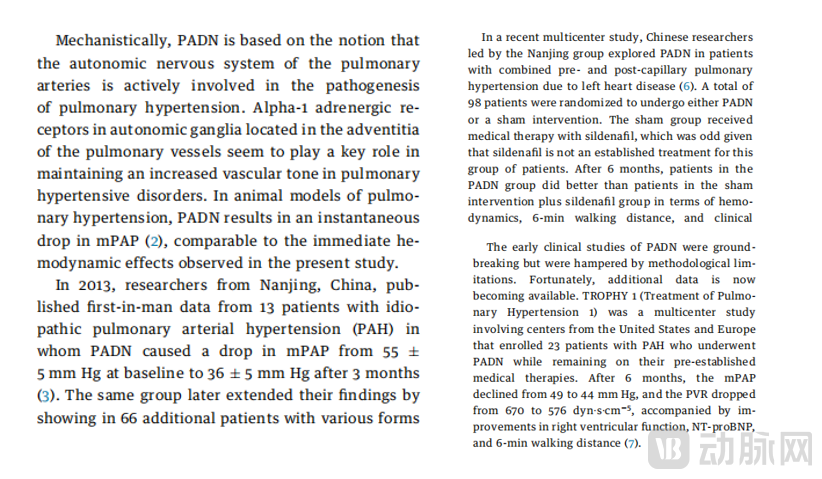
From the perspective of pathophysiological mechanisms, PADN is a therapeutic approach based on the active involvement of the pulmonary arterial autonomic nervous system in the pathogenesis of pulmonary hypertension. The α-1 adrenergic receptors located in the autonomic ganglia within the adventitia of pulmonary arteries appear to play a key role in maintaining the increased vascular tone associated with pulmonary hypertension. In animal models of pulmonary hypertension, PADN resulted in an immediate postoperative decrease in mean pulmonary arterial pressure (mPAP), consistent with the acute hemodynamic effects observed in this study.
In 2013, researchers from Nanjing, China, published the initial clinical data for 13 patients with idiopathic pulmonary arterial hypertension (PAH): in these patients, PADN reduced mean pulmonary arterial pressure (mPAP) from a baseline of 55±5 mm Hg to 36±5 mm Hg at three months. The research team extended their findings by including an additional 66 patients with various forms of pulmonary hypertension (primarily PAH, but also including pulmonary hypertension due to left heart disease and chronic thromboembolic pulmonary hypertension [CTEPH]): six months after PADN, mPAP decreased from a baseline of 53±19 mm Hg to 45±16 mm Hg.
In a recent multicenter study, the Nanjing research team continued to investigate the therapeutic efficacy of pulmonary artery denervation (PADN) in patients with combined pre- and post-capillary pulmonary hypertension due to left heart disease. The study enrolled 98 patients who underwent either PADN or a sham procedure (with the control group receiving medical therapy). At six months, the PADN group demonstrated superior outcomes compared to the sham control group in terms of hemodynamics, six-minute walk distance, and adverse clinical events.
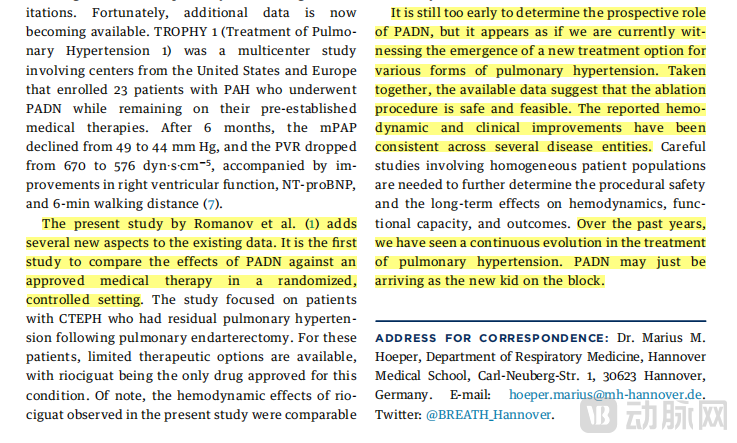
Early clinical studies on PADN were pioneering but still subject to certain methodological limitations. Fortunately, an increasing body of data is now validating the efficacy of PADN. TROPHY 1 (Treatment of Pulmonary Hypertension 1) was a multicenter study involving sites in the United States and Europe, which enrolled 23 patients with pulmonary hypertension who underwent PADN while continuing their existing pharmacological therapy. After six months, mean pulmonary arterial pressure (mPAP) decreased from 49 mmHg to 44 mmHg, and pulmonary vascular resistance (PVR) decreased from 670 dyn·s·cm⁻⁵ to 576 dyn·s·cm⁻⁵. Right ventricular function, NT-proBNP levels, and the six-minute walk distance all showed improvement.
The study by the Romanov team adds several new dimensions to the existing data. It is the first study to compare the efficacy of PADN with an approved pharmacological therapy in a randomized controlled setting.
Although existing data are still insufficient to fully demonstrate the efficacy of PADN, it is evident that PADN, as a novel therapeutic approach for multiple types of pulmonary hypertension, is gradually gaining public attention. Synthesizing the aforementioned research findings, current data adequately substantiate the safety and feasibility of the ablation procedure. The reports also confirm that hemodynamic and clinical improvements are consistent across various types of pulmonary hypertension.
About Pulnovo Medical
Pulnovo Medical, established in 2013, specializes in the field of pulmonary hypertension. As the first Chinese company in this field to receive FDA Breakthrough Device Designation, Pulnovo Medical’s originally developed PADN procedure has been featured multiple times on international stages in Europe, the United States, and Asia, where theoretical instruction and surgical demonstrations have been conducted. An increasing number of comparative studies are actively validating the efficacy and safety of PADN. In the future, PADN, as a therapeutic approach effective for multiple conditions associated with pulmonary hypertension, is poised to become a formidable adversary to PAH and a beacon of hope for patients. Its two major product categories—high-frequency ablation devices and intravascular catheters—are both global innovations, backed by numerous domestic and international invention patents.
Follow the “Pulnovo” WeChat Official Account for more information: