

MedLarynx Medical Targets the Blue Ocean Market of Airway Management with Next-Generation Emergency Devices
For entrepreneurs, airway management is not only a promising business opportunity but also a noble endeavor that safeguards the lives of hundreds of millions.
According to reports, the process by which physicians employ various methods to maintain a patient’s respiratory oxygenation is referred to as airway management. Evidently, the primary objective of airway management is to ensure the patency of the patient’s airway and sustain normal gas exchange.
Public data indicate that 70% of anesthesia-related deaths are attributable to airway issues, primarily airway obstruction, difficult intubation, and accidental esophageal intubation. Among other critical care fatalities, airway problems also rank as one of the leading causes of death. Some experts have even stated, “Anesthesia, emergency care, and ICU management can all be distilled into a single overarching objective: maintaining patient respiratory oxygenation.”
Furthermore, airway issues such as respiratory obstruction can reduce a patient’s oxygen intake, which is highly likely to induce hypoxemia. Hypoxemia can cause severe harm to patients and may even be life-threatening.
Clinical experts state: “Within 10 seconds of the onset of hypoxemia, the patient’s available oxygen reserves are depleted, and aerobic metabolism ceases; within 8–15 seconds, the patient will lapse into coma; within 2–4 minutes, anaerobic metabolism also stops, and ATP production halts; within 4–5 minutes, the patient’s ATP stores are exhausted, and all energy-dependent reactions cease; within 4–6 minutes, irreversible damage occurs to the cells in the posterior brain. More critically, the sequelae of hypoxemia are equally devastating, including difficulties with concentration, impaired judgment, and motor incoordination, while more severe outcomes include coma, a vegetative state, or brain death.”
Airway management can rapidly improve patients' hypoxic conditions, preventing and treating tissue damage and functional impairment of vital organs. Meanwhile, airway management is also a critical intervention in the resuscitation of patients with respiratory failure. Therefore, strengthening airway management is a crucial component in preventing hypoxemia and ensuring safety during emergency care.
Shandong Medlary Medical Technology Co., Ltd. (hereinafter referred to as “Medlary Medical”) is an innovative enterprise specializing in airway management. Based on “high-frequency jet ventilation technology” and the “theory of apneic oxygenation,” the company is dedicated to the research, development, and production of clinical emergency devices for oxygenation, ventilation, and drug administration in the management of urgent difficult airways, for use both in-hospital and out-of-hospital.
Currently, Medlary Medical has filed 18 related patents based on its technological innovations. Meanwhile, its high-frequency jet laryngoscopy technology has obtained PCT international patent authorizations in 14 countries and regions. In addition, Medlary Medical is actively pursuing comprehensive patent protection for its products.
Data indicates that airway management encompasses the establishment and maintenance of artificial airways, respiratory tract suctioning, extubation, tube replacement, and the use of ventilators and humidifiers. Among these, laryngoscopes for intubation, endotracheal tubes, suction devices, suction catheters, ventilators, and corresponding connecting circuits are the primary medical devices required for airway management.
Medlerui Medical stated, “Currently, there are still many pain points in airway management with medical devices on the market. For example, existing medical devices cannot prioritize ventilation during airway management, nor can they provide continuous oxygen supply throughout the procedure to maintain synchronized gas exchange. Taking endotracheal intubation as an example, hypoxic intubation practices available on the market increase operational risks for licensed physicians. If emergency oxygenation cannot be provided to critically ill patients within 15–20 seconds, patients face the risk of hypercapnia. Furthermore, in cases of difficult airways, this significantly increases the likelihood of resuscitation failure.”
Building on this, Medlary Medical has developed the next-generation Lairui Comprehensive Airway Management System, leveraging its high-frequency jet ventilation technology and apneic oxygenation theory. Featuring a design that integrates high-frequency ventilation for oxygen delivery and medication administration, the system eliminates the need for intubation without ventilation, enabling healthcare professionals to perform resuscitation with greater composure and improving the success rates of cardiopulmonary resuscitation (CPR) and endotracheal intubation.
Medlerui Medical Introduction: “The Lairui Airway Comprehensive Management System provides portable ventilation solutions for various clinical scenarios. For instance, oxygenated intubation enables effective oxygen delivery immediately upon blade entry into the oral cavity; transnasal supraglottic high-frequency assisted ventilation offers a specialized auxiliary function of transnasal preglottic high-frequency jet ventilation; cricothyroid membrane puncture combined with percutaneous high-frequency ventilation utilizes the high-frequency jet ventilation function in conjunction with a cricothyroid membrane puncture kit to provide invasive oxygenation for patients who cannot be intubated and cannot breathe; and safe intubation using an oxygenated elastic bougie can be performed by leveraging the high-frequency jet ventilation function of the Lairui system handle to complete the oxygenated elastic bougie operation mode.”
In terms of application, traditional emergency care follows a four-step protocol: maintaining airway patency, providing rescue breathing, performing chest compressions, and defibrillation. MedLary Medical offers a new alternative: opening the airway, administering oxygen and medications, and defibrillation. This system not only simplifies the procedure for easier learning but also improves the success rate of resuscitation and shortens the time to restore spontaneous breathing.
This is achievable because Medlary Medical synchronizes high-frequency jet oxygen delivery in real time, eliminating the anoxic phase, extending the safety window, and preventing cerebral hypoxia caused by asphyxia.
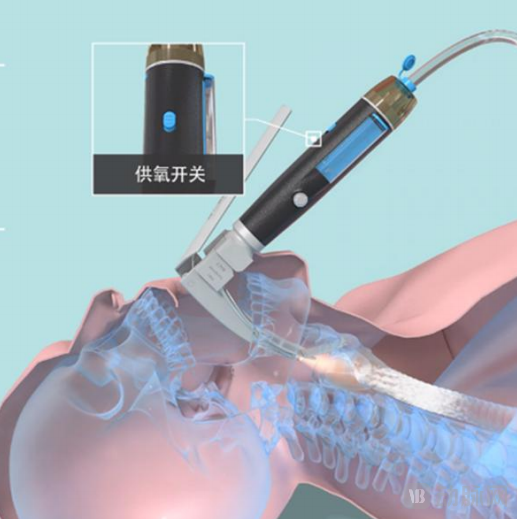
In addition, Medleray Medical has developed a new generation of functional laryngoscope (oxygenator). The functional laryngoscope (oxygenator) is one of the most important devices for airway management, with functions including resuscitation from asphyxia, tracheal intubation, and establishment of artificial mechanical ventilation. Therefore, during resuscitation from asphyxia and anesthetic intubation, the functional laryngoscope (oxygenator) occupies the most primary and critical position.
The functional laryngoscope (oxygenator) developed by Medlary Medical is an upgraded version of traditional laryngoscopes, evolving from a single intubation function to a multifunctional device capable of oxygen delivery and medication administration. The product line comprises three series—electronic jet laryngoscope, electronic video laryngoscope, and video jet laryngoscope—along with compatible disposable blades, and holds multiple invention and utility model patents.
Electronic jet laryngoscopes, electronic video laryngoscopes, and video jet laryngoscopes can meet the requirements of different clinical settings. Different product series should be selected based on the specific usage environment and the patient’s actual condition. Medlair Medical stated, “The new generation of high-frequency ventilation visual laryngoscope is an inevitable trend to replace traditional visual laryngoscopes, and it is the preferred medical device for modern emergency medicine and anesthesia intubation.”
In addition to product R&D, Medlary Medical has established a comprehensive sales system, partnering with numerous domestic and international pharmaceutical distributors to secure extensive commercialization channels.
Data show that hypoxic emergencies are common during surgery, in the postoperative period, in prehospital and in-hospital emergency care, and in the ICU. Among these, 21% of postoperative patients experienced oxygen saturation below 90% for 10 minutes, and 8% had oxygen saturation below 90% for more than 20 minutes.
This is because China currently lacks comprehensive emergency measures for providing oxygen to critically ill patients whose lives are at immediate risk. In primary care hospitals, the promotion of endotracheal intubation faces certain difficulties due to limitations in emergency skills; in large tertiary hospitals, complications arising from airway management constitute a significant contributor to increased mortality rates.
Fortunately, China’s emergency and critical care medical system has been largely established. Hospitals at the county level and above nationwide have set up independent emergency departments, forming a seamless “green channel” for life-saving care that links pre-hospital emergency services (120), hospital emergency departments, and Emergency Intensive Care Units (EICUs).
In the coming years, the construction of emergency medical facilities—including 120 emergency response systems, emergency departments, and intensive care units (ICUs) for critical and severe cases—will enter a new phase. Medical devices related to these areas, such as pre-hospital on-site emergency equipment, devices for establishing emergency artificial airways in out-of-hospital settings, emergency ventilators, emergency oxygen supply and ventilation equipment, compact biochemistry/immunoassay analyzers, hematology analyzers with CPR detection capabilities, blood gas analyzers, pulse oximeters, patient monitors, ultrasound systems, infusion pumps, mobile digital radiography (DR) units, portable ultrasound devices, hematology analyzers, infectious disease protective consumables, infrared forehead thermometers, and emergency medical consumables, will usher in significant development opportunities.
With the development of the industry, airway management devices with clear demand and a broad market will also experience explosive growth. Medlair Medical will benefit from this trend and achieve rapid expansion.
Medlerui Medical finally told VCBeat, “Currently, the company is launching a new round of financing and hopes like-minded partners will join us to build something great together!”