

SIG and Longling Capital Continue Backing Wangle Technology as It Files IPO Prospectus to Advance Psychiatry-Focused Digital Therapeutics

WonderLab
Developer of Digital Therapeutics Products for Mental Disorders
Mental illness has become an unavoidable social issue, with enormous market demand; the rise of digital therapeutics offers a novel treatment approach for mental disorders.
The vast market demand has provided fertile ground for growth in the field of mental disorder treatment. In terms of patient numbers, the China Mental Health Survey released in 2017 indicated that the lifetime prevalence of any mental disorder (excluding dementia in the elderly) among adults in China was 16.57%, with a 12-month prevalence of 9.32%. By disease category, anxiety disorders constituted the largest proportion among the five major types of mental disorders, at 4.98%, followed by mood disorders at 4.06%. Furthermore, drug abuse is a significant cause of damage to the human nervous system; the estimated number of actual drug users has exceeded 10 million, affecting a broad population in terms of mental health.
Digital therapeutics serve as a side-effect-free "electronic medication" for patients with mental disorders. Digital therapeutics are clinically validated, serious diagnostic and therapeutic interventions. They are software- and algorithm-driven treatment and assessment products that require a physician’s prescription for access and use.
Digital therapeutics products that deliver genuine value to patients require clinical evidence and must undergo rigorous review, approval, or certification by regulatory authorities before they can be prescribed to patients by physicians, akin to pharmaceutical drugs. Currently, the U.S. Food and Drug Administration (FDA) has approved multiple prescription digital therapeutics products, covering more than 30 indications. Among these, psychiatric digital therapeutics constitute the largest category of approved products, addressing various mental health conditions such as substance use disorders, insomnia, attention-deficit/hyperactivity disorder (ADHD), and post-traumatic stress disorder (PTSD). As of May 21, 2021, five of the nine companies with approved products were specialized in psychiatric digital therapeutics.
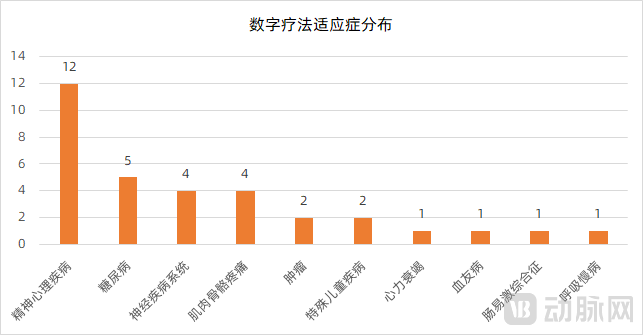
Treatment, assessment, and prevention are the three functional categories of digital therapeutics. Among these, the treatment function for specific diseases is the fundamental reason behind the initial rise of digital therapeutics. This also explains why psychiatric digital therapeutics have garnered significant attention from authoritative bodies such as the U.S. Food and Drug Administration (FDA).
Digital therapeutics in psychiatry hold significant clinical value, with their most critical role being the improvement of core symptoms of mental disorders.Among the more than 30 indications for digital therapeutics (DTx) products, the primary value of DTx for most chronic diseases lies in enhancing patient adherence rather than directly alleviating core disease symptoms.However, rigorous clinical studies have demonstrated that psychiatric digital therapeutics can directly improve the core symptoms of mental disorders, serving as an adjunct to conventional treatments rather than merely enhancing adherence to them. Moreover, psychiatric digital therapeutics are free of side effects, enable self-administered treatment anytime and anywhere, and are suitable for patients in the early stages of illness, those with mild conditions, or individuals for whom pharmacotherapy is inappropriate.
In the capital markets, psychiatric digital therapeutics companies are also highly favored; it has become commonplace for renowned institutions to enter the field, for financing rounds to occur at later stages, and for individual funding rounds to exceed RMB 100 million.
Pear Therapeutics is the first psychiatric company globally to receive FDA approval for a prescription digital therapeutic. Following its initial round of financing in 2015, the company experienced rapid growth and has now completed its Series D financing, bringing total funding to $234 million, with Temasek Holdings and SoftBank both serving as lead investors. Akili specializes in the field of cognitive impairment, received FDA Breakthrough Device designation in June 2020, and is one of the founding members of the Digital Therapeutics Alliance. It has completed its Series C financing led by Temasek, with total funding reaching $140.9 million.
Beyond capital bets on digital therapeutics for psychiatry, the inherent compatibility of digital therapeutics with pharmacological treatments has significantly spurred large pharmaceutical companies to expand their ecosystems through investment and partnerships. For instance, the Swiss pharmaceutical giant Novartis participated in every funding round of Pear Therapeutics in 2018, totaling $70 million; other prominent publicly listed pharmaceutical companies, such as Takeda Pharmaceutical and Orexo, have also actively entered the digital therapeutics sector.
Digital therapeutics are gaining momentum abroad. Encouragingly, whether viewed from the perspective of the vast patient base requiring diagnosis and treatment or the proliferation of mobile internet-enabled smart devices, the development momentum of China’s digital therapeutics market is also significant and should not be underestimated.
Wangli Technology is one of the few digital therapeutics companies in China that directly tackles the challenge of improving the core symptoms of psychiatric disorders.After years of dedicated development, a diversified product pipeline has been established in the field of psychiatric disorders, including depression, addiction, and PTSD.
Through in-depth collaborations with three leading domestic psychiatric institutions—Peking University Sixth Hospital, the Second Xiangya Hospital of Central South University, and Shanghai Mental Health Center—as well as numerous other psychiatric healthcare facilities, certain products from Wangli Technology have been adopted for hospital use and entered clinical trials. The company is poised to become one of the first digital therapeutics enterprises for psychiatric disorders in China to receive certification from authoritative institutions.
To avoid having an overly narrow product line and limited technological reserves become a bottleneck for future corporate development, Wangli Technology established a multi-pipeline business strategy from the outset. To this end, the company has built a scalable technology platform for assessment and intervention based on artificial intelligence and multi-parameter physiological data. Leveraging this platform, Wangli Technology adopts tailored technical approaches and task designs according to the specific nature of various psychiatric disorders and psychological issues, thereby developing two major product lines—intervention and assessment—along with more than ten disease-specific products. Data and algorithmic models accumulated through the platform drive software applications across diverse carriers, including mobile apps, PC clients, and VR/AR interfaces.
After years of dedicated development, Wangli Technology has accumulated tens of thousands of intervention and assessment cases, significantly enhancing the accuracy of its product models and establishing a substantial competitive lead in the industry.
Wangli Technology’s addiction treatment products have accumulated data from tens of thousands of cases in the early stages, establishing comprehensive data models and patient learning curves. Based on this foundation, the developed adaptive algorithms can deliver personalized intervention content to patients, thereby achieving precise interventions. In a controlled trial involving 100 individuals undergoing drug rehabilitation, 79% demonstrated a significant reduction in attentional bias toward drug cues and an enhanced ability to resist cravings. Regarding cognitive training products, favorable intervention outcomes were also achieved through accumulated data and adaptive algorithmic models; 77% of participants showed effective improvements in memory performance and overall cognitive function. Furthermore, Wangli Technology has completed large-scale data accumulation and model development for depression and post-traumatic stress disorder (PTSD), yielding promising research results.
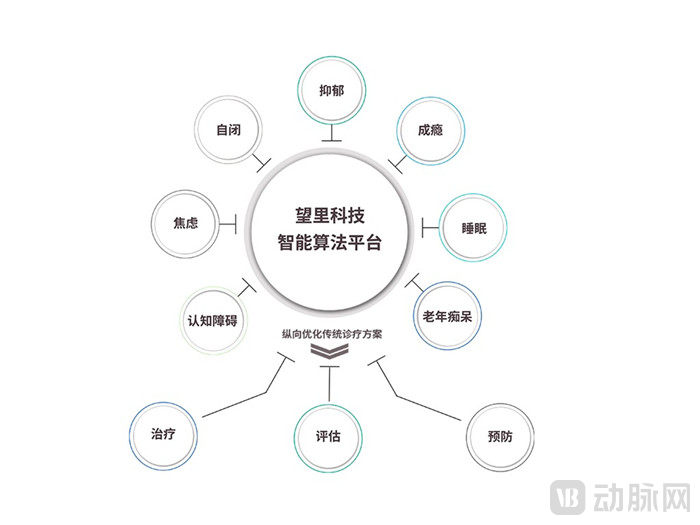
Wangli Technology has achieved remarkable results, particularly in the field of depression. In recent years, the frequent occurrence of personal and public safety incidents caused by depression has brought about numerous tragedies for families and society. Depression is often highly concealed; in some cases, patients may not wish to reveal their suicidal tendencies to others, while in other cases, they are reluctant to disclose their condition or seek professional treatment from doctors or psychological counselors. Consequently, traditional subjective assessment methods struggle to identify depressed patients who are at genuine risk of suicide, leaving many individuals without access to necessary intervention and treatment.
To address the aforementioned two challenges, Wangli Technology has developed an objective assessment system based on physiological data and a mobile digital therapeutic product grounded in online cognitive behavioral therapy (CBT). Taking the digital therapeutic as an example, it is a mobile app designed for smartphones that delivers CBT to patients through clear operational steps and highly structured, multi-media interactive methods, including animations, videos, audio, and interactive training. Such products break through temporal and spatial constraints, enhancing patient engagement and adherence through gamification and other interactive formats. Their inherent convenience and privacy also help reduce patient stress and improve therapeutic outcomes.
It is worth noting that, from the perspective of product development, this is not merely a matter of developing an app; rather, it entails medical-grade product design and validation. There are three main challenges: First, patient learning curves can only be established after accumulating large-sample data, which enables better design of interventional treatment content for truly “targeted therapy.” Second, in transforming traditional face-to-face cognitive behavioral therapy into an interactive program, the selection of content tools and interaction design are critical; improving patients’ comprehension and adherence poses significant challenges and requires iterative refinement through trial and error. Third, after the product takes shape, large-scale data collection and validation must be conducted; only after clinical confirmation of its efficacy can the product be launched on the market.
Wangli Technology’s depression-related product, having just completed its development phase, has garnered widespread attention from diverse clients, including schools and fire departments, with a strong consensus on the desire for rapid deployment. This demand indirectly underscores the extensive reach of depression.
This is indeed the case. Given the characteristics of mental disorders, therapeutic environments for patients cannot be confined to inpatient settings; professional interventions in outpatient and community settings are also crucial for symptom improvement and relapse prevention. In light of this, Wangli Technology has strategically aligned its business model to center on patients while addressing the needs of professional medical institutions, communities, and government entities—including sectors such as education and justice, as previously mentioned—thereby establishing a commercial pathway that integrates in-hospital and out-of-hospital care.

Focusing on mental disorders and adhering to a development strategy centered on multi-pipeline R&D and multi-scenario outreach, Wangli Technology has truly realized a data-driven, patient-centric approach. All of this is closely tied to the capabilities and industry expertise of the Wangli Technology team.
First-mover advantage is a key competitive strength of Wangli Technology.Wangli Technology was founded in 2017. At that time, the domestic digital therapeutics market was still a blue ocean, and early entry allowed Wangli Technology ample time to refine its capabilities.
The support of a highly professional team is the foundation that empowers Wangli Technology to pursue a multi-pipeline strategy.The R&D team at Wangli Technology is primarily composed of talent from prestigious domestic and international universities, including Peking University, the Institute of Drug Abuse at Peking University, the State Key Laboratory of Cognitive Neuroscience and Learning at Beijing Normal University, the Chinese Academy of Sciences, and Stony Brook University in New York. The team covers a wide range of professional fields such as clinical psychology, cognitive neuroscience, and computer algorithms, bringing together expertise across various specialized domains. In terms of psychiatric experts, the Principal Investigators (PIs) who collaborate closely with Wangli Technology are leading authorities in the field of mental illness, possessing profound insights into both clinical experience and industry development.
Blue-ocean markets and competitive technologies and products have always been favored by capital.Among the investors in Wangli Technology are prominent funds such as SIG (Susquehanna International Group) and Changling Capital.
SIG is the Series A investor in Wangli Technology, having invested tens of millions of RMB. Regarding Wangli Technology’s market positioning, SIG Managing Partner Gong Ting commented, “Wangli Technology has accumulated extensive scientific research and clinical findings, and leverages artificial intelligence and internet product thinking to conduct digital analysis and diagnosis of core symptoms of mental disorders. It is a rare digital health company.” Jiang Xiaodong, Managing Partner at Changling Capital, also stated that the potential of AI-driven digital therapeutics innovation at Wangli Technology has long been evident. “Changling Capital has long been bullish on the digital therapeutics sector. As the inaugural institutional investor in Wangli Technology, we will continue to firmly support the company’s development.”
Li Dai, founder of Wangli Technology, stated, “We are not a company that chases trends. We began this work before digital therapeutics had gained traction in China. Our vision from the outset has been to explore the human brain by developing products with high clinical and commercial value.” As a leading enterprise in China’s digital therapeutics sector, operating within a rapidly emerging field, Wangli Technology will collaborate with industry partners to jointly advance the development of digital therapeutics for psychiatric disorders.