

Three IVD Raw Material Firms Rush to IPO as Redpoint Bets Big on This 'Bottleneck' Sector
On May 25, the Shanghai Stock Exchange announced that Nanjing Vazyme Biotech Co., Ltd. had passed the review for its initial public offering (IPO). Vazyme is one of the leading domestic manufacturers of in vitro diagnostics (IVD) raw materials.
The IVD raw materials sector has recently surged in popularity. In May 2021, Mindray Medical made a significant acquisition of Hytest, a globally renowned IVD raw material manufacturer, for €545 million (approximately RMB 4 billion), marking its substantial entry into the upstream IVD raw materials industry.
In 2020, Mindray Medical’s in vitro diagnostics (IVD) business generated RMB 6.64 billion in revenue. Chemiluminescence is a key segment of Mindray’s IVD portfolio. Through this acquisition, Mindray has strengthened its core R&D capabilities for chemiluminescence products and raw materials, while optimizing the global layout of its upstream and downstream industrial chain.
Hytest, selected by Mindray this time, is one of the most renowned global suppliers of in vitro diagnostics (IVD) raw materials and the most specialized supplier of cardiac biomarker raw materials.Prior to its acquisition by Mindray, Hytest was already a hot M&A target; Mindray Medical’s substantial purchase further underscored the fervor in the IVD raw materials industry.
The pandemic has further highlighted the vulnerability of China’s IVD industry, which relies heavily on imported upstream raw materials. In response, the domestic IVD reagent sector has experienced a sudden boom, with numerous companies emerging to seize the opportunity.
VCBeat has learned that several powerful IVD companies, such as Mindray Medical, have begun to lay out their upstream raw material businesses. Meanwhile, a number of domestic IVD raw material companies have secured substantial financing and pursued IPOs. Two major domestic IVD raw material manufacturers, Fapon Biotech and Vazyme, are striving for listings on the ChiNext Board and the STAR Market, respectively, while Nanomicro Technology has passed the review for the STAR Market. In the primary market, multiple IVD raw material companies have obtained financing. Among them, Abclonal, an IVD raw material company, received RMB 600 million in investment from institutional investors including JF Capital, Sequoia China, and Yuanhe Chenkun.
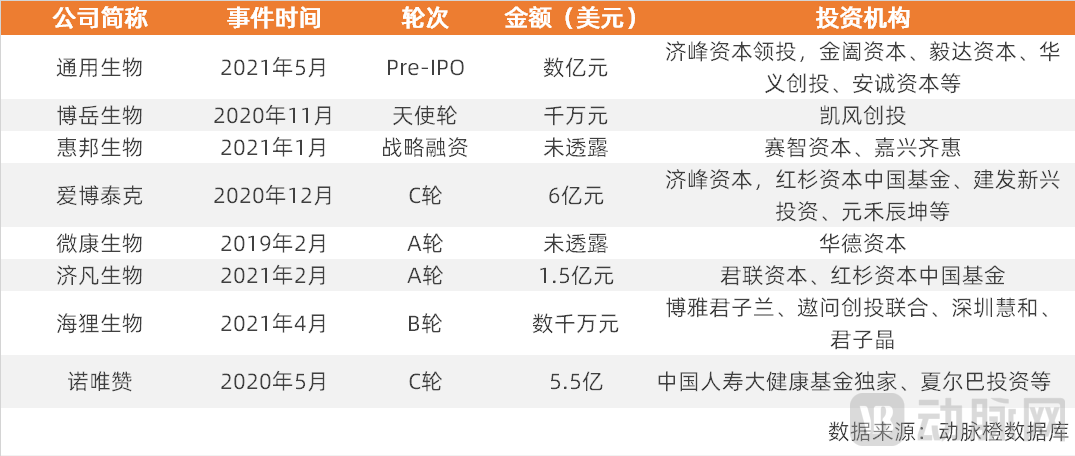
Financing Situation of IVD Raw Material Companies
The production of in vitro diagnostic (IVD) raw materials has long been a critical bottleneck in China’s IVD industry. The quality of these raw materials plays a decisive role in the accuracy of IVD products. To ensure consistent quality, although there are domestic manufacturers of IVD raw materials, approximately 90% of the market remains dominated by imported materials. Major global suppliers of IVD raw materials and reagents include Roche, HyTest, and Meridian, among others.
Although IVD raw materials constitute a critical segment of the IVD industry chain, the overall market for IVD raw materials is not particularly large. In 2029, the market size of IVD raw materials in China reached RMB 8.2 billion, remaining below the RMB 10 billion threshold. Moreover, in the global market,Even the global market share of leading companies such as Hytest, BBI Solutions, and Meridian (Meiding Bio) is less than 5%. This may suggest that it is difficult for major giants to emerge within the market.
In a market with a limited ceiling, why has industry attention surged recently? Will the entry of major players reshape the landscape of this niche market, and will the future IVD raw materials market undergo changes? VCBeat has analyzed these trends.
The recent surge in demand for IVD raw materials is, in fact, one of the ripple effects of the COVID-19 pandemic on the IVD industry. When the outbreak first emerged, few could have anticipated that it would accelerate the rise of Chinese-made IVD raw material manufacturers.
On the one hand, many domestic IVD companies rely on imported raw materials. During the COVID-19 pandemic, supply disruptions and price hikes for these imported materials placed significant production pressure on Chinese IVD enterprises. This has also led the domestic industry to recognize that core supply chains must be kept under their own control.
Industry insiders have stated that although the United States had not yet been affected by the COVID-19 pandemic in February and March 2020, U.S. companies had already begun restricting raw material exports. The global flow of certain raw materials encountered significant obstacles. Therefore, domestic supply chains are considered more reliable for ensuring security.
A PCR manufacturer once shared this experience: following the outbreak of the COVID-19 pandemic, raw materials were either unavailable or subject to price hikes—not merely by 10%, but by tenfold. In the post-pandemic era, most companies have begun to consider how to build more resilient supply chains.
Li Yishi, Partner at Haoyue Capital, stated, “During the COVID-19 pandemic, companies that suffered losses due to rising raw material prices and supply disruptions have come to recognize the importance of controlling the supply chains for core products. The trend toward domestic substitution has significantly intensified, a phenomenon akin to the chip boom.”
On the other hand, the COVID-19 pandemic has generated substantial demand for testing, expanded the market for in vitro diagnostics (IVD) products, and consequently driven growth in China’s domestic IVD raw materials market, thereby creating growth opportunities for Chinese IVD raw material suppliers.
According to the prospectuses of mainstream domestic IVD raw material manufacturers, all experienced rapid performance growth in the first half of 2020.
Fapon Biotech is one of the leading suppliers of raw materials for COVID-19 nucleic acid testing reagents and COVID-19 antigen immunoassay reagents. Prior to 2020, Fapon Biotech experienced slow revenue growth, with its net profit growth rate declining by 70.33% in 2017. However, in the first half of 2020 alone, the company’s revenue reached RMB 490 million, and its net profit hit RMB 300 million, which was 5.28 times its full-year net profit for 2019.
In 2020, Vazyme, another IVD raw material supplier, reported operating revenue of RMB 1.564 billion, a year-on-year increase of 482.92%. During the same period, its net profit attributable to shareholders surged by 3,085.62%, reaching RMB 822 million.
Historically, midstream IVD manufacturers exhibited a high degree of brand dependence on upstream raw material suppliers, as verifying the reliability of raw materials required substantial time and cost. Once partnerships were established, this led to significant brand stickiness. However, the COVID-19 pandemic reduced this stickiness and lowered the brand barriers for domestic brands entering the raw material market.
The COVID-19 pandemic has drawn the industry’s attention to the market for IVD raw materials. In fact, domestically produced products in China now cover virtually all categories of IVD raw materials.
Raw materials for in vitro diagnostic (IVD) reagents can be categorized into: antigens, antibodies, enzymes and coenzymes, and other raw materials.Antigens, antibodies, and diagnostic enzymes are the most critical upstream components of the in vitro diagnostics (IVD) reagent industry. As the core constituents of IVD reagents, antigens, antibodies, enzymes, and coenzymes play a pivotal role in determining reagent performance and collectively account for more than 75% of the IVD reagent market.
Antigens and antibodies can be categorized into prokaryotic recombinant, eukaryotic recombinant, and natural antigens. Common techniques for antigen preparation include protein purification and genetic recombination. Antibodies are classified into monoclonal and polyclonal antibodies, with common preparation methods encompassing immunization techniques, hybridoma technology, humanized antibody technology, and cell fermentation. Antigen and antibody raw materials are widely used in immunoassay diagnostics. Currently, immunoassay diagnostic technology holds the largest market share in China’s in vitro diagnostics (IVD) sector and maintains a growth rate exceeding 15%. Consequently, the market for antigen and antibody raw materials has attracted significant attention and is viewed favorably.
Enzymes and coenzymes are primarily used in molecular diagnostic technologies such as fluorescent PCR, as well as in immunoassays and biochemical diagnostics. Molecular diagnostics require hot-start polymerases, conventional polymerases, and reverse transcriptases, while immunoassays utilize enzymes such as alkaline phosphatase and horseradish peroxidase. Among these enzyme categories, molecular enzymes possess the highest value and present the greatest technical challenges. There are very few domestic manufacturers capable of providing high-quality molecular enzymes, with the market being largely monopolized by foreign giants. However, driven by the rapid development of molecular diagnostic technologies in recent years and the technological catch-up by Chinese enterprises, the molecular enzyme market holds significant potential for future growth.
Other raw materials include magnetic beads, microspheres, primers, probes, etc.
For antigens and antibodies, Fitop Biotech is a major domestic manufacturer; for molecular enzymes, there is Vazyme; and for microspheres, there is Suzhou Nanomicro Technology. From the perspective of broad categories, Chinese manufacturers can nearly cover all major IVD raw material categories. However, for certain high-tech specialized products, imported alternatives remain more stable.
Taking molecular enzymes as an example, while domestic companies in China have long been capable of producing standard PCR amplification enzymes, product categories such as high-fidelity enzymes, enzymes that maintain consistency under variable temperature conditions, and one-step amplification enzymes present significantly higher technical barriers.
This is also why the majority of raw materials in this important market rely on imports. In 2019, China’s total imports of IVD raw materials reached RMB 7.3 billion, with imported products accounting for 88% of the market. Domestic IVD raw materials held only about RMB 1 billion in market share in 2019.
The domestic reagent raw material industry in China is currently facing multiple challenges, with generally low product efficacy and diversity, and a large number of raw material companies lacking large-scale production capabilities. In the IVD raw material market, the true barrier lies in large-scale production, as ensuring stability and consistency during mass production is a significant challenge.
Li Yishi pointed out: In the IVD raw material industry, it is not difficult to produce products; the real barrier lies in large-scale production—how to ensure product consistency and stability while maintaining cost control capabilities.
Taking Proteinase K as an example, its production technology is not particularly challenging; even an average PhD student in a relevant field can perform gram-scale small-batch expression following textbook protocols. Prior to the COVID-19 outbreak, annual domestic consumption of Proteinase K for diagnostic purposes was approximately 200 kilograms, with Roche commanding the vast majority of the market. At that time, only one or two suppliers in China had kilogram-scale production capacity capable of meeting IVD requirements. Imported products have accumulated extensive experience and proprietary know-how in ensuring product consistency and stability.
Certainly, domestic manufacturers are also developing rapidly. In terms of some flagship products, Chinese-made products can match the quality of imported ones.
The global market for IVD raw materials has reached a scale of tens of billions, but the characteristics of the IVD raw materials market make it a business that is difficult to scale up.Currently, the global market for raw materials used in in vitro diagnostic (IVD) reagents is characterized by a large number of participants, small individual company sizes, and a highly fragmented industry.
Even the global market share of industry leaders such as Hytest, BBI Solutions, and Meridian is less than 5%. A significant portion of this RMB 100 billion market is held by numerous small and medium-sized laboratories. In the IVD raw materials market, many small and medium-sized laboratories contribute several specialized assays, thereby securing their place in the industry.
The highly fragmented competitive landscape is primarily due to the multitude of technical pathways and processes involved in reagent raw materials, making it difficult for small and medium-sized laboratories to master all of them, thereby limiting their expansion. In vitro diagnostics encompasses various diagnostic methodologies, each involving multiple test items. This results in a wide variety of core reagent ingredients, reagents, and instruments required, as well as differences in the technical systems that need to be mastered.
Taking expression systems as an example, there are various types such as the Escherichia coli expression system, yeast expression system, baculovirus-insect cell expression system, and mammalian cell expression system. Mastering multiple expression systems simultaneously poses significant challenges, thereby limiting the product expansion capabilities of small and medium-sized laboratories.
In this highly transparent market, leading manufacturers have chosen to establish a presence in routine and key testing areas while continuously launching innovative and premium offerings, thereby creating comprehensive competitive advantages through both horizontal and vertical integration. Meanwhile, small and medium-sized laboratories and raw material suppliers focus on specialized tests, pursuing a strategy of differentiation.
In this fiercely competitive market with a limited ceiling, how will IVD raw material companies break through these constraints? What are the future development directions and trends for China’s domestic IVD raw materials industry? VCBeat has identified two major trends.
First, the highly fragmented market offers participants ample room for growth and consolidation, with mergers and acquisitions expected to become more frequent in the future.Especially in the more fragmented domestic market for IVD raw materials, more consolidation deals similar to Mindray’s acquisition of HyTest are likely to emerge in the future.
Amid the historical opportunities presented by globalization and import substitution, high-quality domestic IVD raw material suppliers are more likely to stand out by leveraging their robust technical systems, strong capabilities in product development and iterative innovation, and comprehensive sales networks.
Second, there is widespread market demand for total solutions encompassing in vitro diagnostic (IVD) reagents and instruments, yet few suppliers offer such comprehensive solutions.Integrating instruments and reagents to provide integrated solutions is a major development trend. By supplying both instruments and reagent raw materials and optimizing parameters mutually, more precise solutions can be delivered. Turnkey solutions comprising raw materials, reagents, and instruments can reduce redundant R&D investments for downstream customers, facilitating rapid reagent development and accelerating industrialization. This represents the development trend among mainstream global IVD raw material manufacturers.
China’s in vitro diagnostics (IVD) market is continuously expanding. Clinical laboratory testing demand in China is primarily driven by approximately 1,100 routine tests, supplemented by more than 3,000 specialized tests. Tiered hospitals typically offer around 300–500 test items, while primary care institutions provide fewer than 100. In contrast, U.S. reference laboratories such as Quest Diagnostics offer more than 4,000 test items. Consequently, the number of routine clinical tests available in China amounts to only one-quarter of those offered by U.S. diagnostic centers. The domestic clinical laboratory testing market is poised for further expansion, and the integration of specialized tests into routine practice represents a significant driver for growth in China’s IVD industry.
The continuous expansion of the in vitro diagnostics (IVD) market will also drive growth in the upstream raw materials market. China’s IVD raw materials market is experiencing rapid growth. According to Frost & Sullivan, the market size for IVD raw materials in China increased from RMB 3.3 billion in 2015 to RMB 8.2 billion in 2019, representing a compound annual growth rate (CAGR) of 25.8% from 2015 to 2019.
In this continuously expanding market, Chinese companies have been in a passive position in the IVD raw materials sector. However, as domestic IVD enterprises now seek greater control and dominance over the industrial chain, the demand for localization of IVD raw materials has become increasingly urgent. This has driven industrial transformation in the IVD raw materials sector. Nevertheless, building a stable and comprehensive IVD raw materials supply chain requires long-term accumulation of experience and rigorous quality control. Achieving domestic substitution in the upstream segment of the IVD industrial chain is no easy task. Yet, with collective breakthroughs by Chinese manufacturers, it is believed that domestically produced IVD raw materials will eventually secure a place in the global market.
References:Fapon Biotech Prospectus
Vazyme IPO Prospectus
The Soaring IVD Sector: The 3 Most Anticipated Sub-Segments! — Haoyue Capital