

TCL Medical Imaging Deepens Strategic Collaboration with Siemens Healthineers Shenzhen R&D and Manufacturing Center to Redefine the Future of Independent Imaging Centers
Since the 21st century, the healthcare industry has been advancing at an accelerating pace. Whether in medical services or medical technology, transformations have been profound and far-reaching every five years.
Among the various sectors, independent imaging centers stand out as particularly distinctive. Since the State Council issued the first policy on the establishment of independent imaging centers in March 2015, this capital-intensive, high-margin industry has maintained a steady growth trajectory.
Stability does not imply a lack of innovation. Over the past six years, dozens of companies have entered the race, each exploring its own independent medical imaging model. These efforts range from startups pioneering solutions from scratch to bold initiatives by established medical imaging professionals.
TCL Medical Imaging stands out as a leader in the field. Its extensive experience in the R&D, manufacturing, and sales of large-scale medical imaging equipment has helped it establish a positioning as “a robust complement to public hospitals,” allowing it to quickly gain a firm foothold in the market. In less than three years, TCL Medical Imaging has achieved annual revenue nearing RMB 100 million.
Recently, TCL Medical Imaging has taken a significant step forward by signing strategic cooperation and research collaboration agreements with Siemens (Shenzhen) Magnetic Resonance Ltd. (SSMR). Following its positioning as “a robust supplement to public hospitals,” TCL’s independent journey in medical imaging is now seeking to introduce new dimensions to its mission.
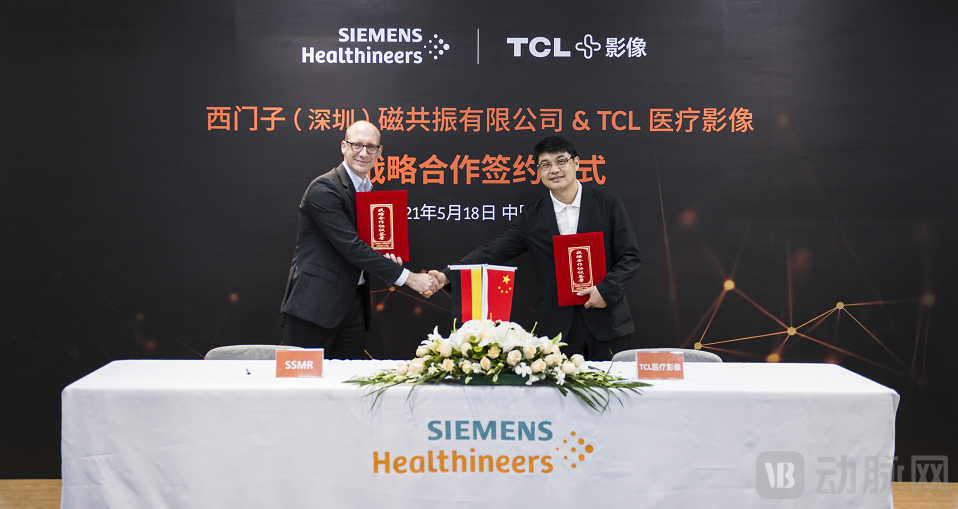
Mr. Andreas Schneck, General Manager of Siemens (Shenzhen) Magnetic Resonance Ltd. (far left), and Dr. Lu Hongliang, CEO of TCL Medical and CEO of TCL Medical Imaging (far right), signed a strategic cooperation agreement at the Siemens (Shenzhen) Magnetic Resonance Park.
This is not the first time that TCL Medical Imaging has collaborated with Siemens Healthineers. In December 2020, TCL Medical Imaging and Siemens Healthineers signed a strategic cooperation agreement to engage in extensive and in-depth collaboration and alignment in areas such as advanced clinical applications, differentiated diagnostic and treatment solutions, telemedicine guidance, and scientific research technologies.
Compared to previous collaborations, the contracting party has changed from Siemens Healthineers to the Siemens MRI R&D and Manufacturing Center. This shift reflects a deepening of the partnership, with both parties set to pioneer a new model of collaboration between device manufacturers and center operators in the field of independent imaging centers.
Andreas Schneck, General Manager of Siemens (Shenzhen) Magnetic Resonance Ltd., stated that Siemens Healthineers’ magnetic resonance imaging (MRI) business currently accounts for nearly half of the global MRI market. Notably, 70% of the products manufactured at its Shenzhen facility are exported to more than 100 countries and regions worldwide.
Siemens (Shenzhen) Magnetic Resonance Co., Ltd. is the largest research and development (R&D) and production base for magnetic resonance imaging (MRI) outside of Siemens’ German headquarters, adhering to R&D and manufacturing processes and standards unified with those in Germany. This R&D and production center manufactures the full portfolio of Siemens Healthineers MRI products, excluding 7T systems. Approximately one-third of Siemens Healthineers’ MRI systems are produced at this facility and distributed globally from here. In terms of staffing, the center employs more than 1,000 personnel, with the R&D team comprising over one-fifth of the total workforce at SSMR; more than 70% of these employees hold a master’s degree or higher. Overall, this facility has achieved comprehensive R&D capabilities spanning complete systems, components, and even magnets and software systems.
Previously, Siemens Healthineers achieved remarkable results in the integration of industry, academia, and research through extensive collaborations with public hospitals in China. Today, by engaging in in-depth partnerships with leading private healthcare institutions amidst China’s burgeoning private medical sector, the company can gain a deeper understanding of China’s healthcare service industry and better implement its strategic principle of “In China, for China, while serving the world.”
Currently, TCL Medical Imaging is the only imaging center that has directly signed a strategic cooperation agreement and a scientific research cooperation agreement with the R&D and production center.
“Our past collaboration has primarily focused on procurement and after-sales services. For TCL Medical Imaging, the integration of Siemens’ medical imaging equipment provides certain support to the service quality of our imaging centers, ensuring high-quality and cost-effective imaging services,” Lu Hongliang, CEO of TCL Medical and CEO of TCL Medical Imaging, told VCBeat.
“This collaboration focuses on the deep integration of industry, academia, and research. We will hold regular seminars with Siemens’ MRI R&D and Production Center, bringing together top-tier R&D experts, clinical support specialists, and research support experts to explore the latest clinical research applications. Meanwhile, these experts will also visit TCL’s Imaging Center and Imaging Outpatient Clinic to provide imaging guidance to physicians, technical staff, and operational personnel. This means that TCL’s Imaging Center will deliver scanning and diagnostic services that surpass those offered by other private institutions.” In fact, the first round of these two collaborative initiatives was already conducted concurrently with the signing ceremony, yielding significant mutual benefits.
To date, the TCL Imaging Center has assumed multiple roles, with its core positioning being “a supplement to public hospitals.”
On one hand, TCL Medical Imaging has established independent third-party medical imaging centers in municipalities directly under the central government and at the provincial and municipal levels. Building upon national standards, these centers offer advanced PET-CT imaging examinations and provide professional imaging services, including PET-CT, magnetic resonance imaging (MRI), and computed tomography (CT). Additionally, they supply physician resources and technical support to nearby outpatient imaging clinics.
On the other hand, TCL Medical Imaging has also established independent imaging outpatient clinics in collaboration with local Grade 3A hospitals, providing imaging services primarily focused on professional MRI examinations. These clinics can operate independently while also driving patient referrals to nearby independent imaging centers, thereby jointly forming a regional medical consortium.
Currently, the operational advantages of many other third-party imaging centers lie in their ability to alleviate patient volume pressures on public hospitals and improve the quality of imaging examinations. However, they struggle to meet the diverse healthcare service needs of patients in the new era. Siemens Healthineers’ involvement can help TCL Medical Imaging address the lack of differentiated medical services.
“For example, physicians typically diagnose fatty liver disease using ultrasound; however, this method can only provide a rough assessment of whether the liver disease is mild, moderate, or severe, without offering precise quantitative data on hepatic fat content,” explained Lu Hongliang. “In contrast, magnetic resonance imaging (MRI) can provide specific data on fat fraction, accurately assess the extent of liver pathology, and monitor changes in hepatic fat content. This approach more effectively guides subsequent treatment and improves patient adherence to lifestyle interventions, such as exercise and dietary modifications.”
In principle, the concept is straightforward, but its practical implementation faces numerous challenges. Obtaining a personalized magnetic resonance imaging (MRI) examination at a public hospital is no easy task; many hospitals are heavily burdened with clinical workload, and scheduling such an examination often entails prolonged waiting times. More importantly, because personalized examinations impose specific requirements on hospitals’ software infrastructure and service pricing structures, many institutions lack the necessary pricing frameworks for these services, or do not have the requisite software and technically qualified personnel to deliver them.
This is where TCL Medical Imaging holds its competitive advantage. As a supplement to public hospitals, TCL Medical Imaging can not only handle imaging workloads that exceed hospital capacity but also, through its collaboration with Siemens Healthineers, provide innovative services that hospitals are currently unable to prioritize. Under this model, residents can complete imaging examinations conveniently and access medical services better tailored to their individual needs through independent imaging centers.
Collaboration also holds significant importance for Siemens Healthineers. With the continuous advancement of technologies such as artificial intelligence and big data, imaging equipment will no longer be positioned merely as a tool that integrates hardware and software to generate imaging data; instead, these devices must also perform certain processing and analysis on the generated data. However, to develop such solutions, the first step for medical imaging equipment manufacturers is to acquire medical data suitable for algorithm modeling.
However, public hospitals tend to provide standardized imaging services. This means that when conducting clinical research on challenging organs such as the heart or advanced techniques like quantitative imaging scans, medical imaging equipment companies are unable to obtain sufficient de-identified clinical data from hospitals that match their algorithms. In other words, at the current stage, while AI can address the recognition of routine CT and MR images, it fails to generate specialized solutions, thereby significantly limiting its value.
In this context, TCL Medical Imaging, which provides personalized imaging services, has undoubtedly supported the R&D efforts of Siemens Healthineers. Through their collaboration, both parties can customize imaging service solutions that are in high demand among residents but are not yet offered by public hospitals. This model not only addresses patient needs but also generates ample de-identified source data to support joint R&D activities.
Overall, after reaching an agreement with TCL Medical Imaging, Siemens Healthineers will be able to carry out targeted imaging projects to accelerate the intelligent development of imaging equipment.
Zhao Bin, Director of the Shandong Provincial Institute of Medical Imaging, once stated that independent imaging centers represent an excellent practice. By separating this service from hospitals, their organizational structure can be streamlined, thereby facilitating hospital operations. However, the key to the success of independent imaging centers lies in whether they can provide patients with high-quality services that deliver commensurate value.
Following its deep collaboration with Siemens Healthineers, TCL Medical Imaging can undoubtedly establish a substantial barrier in terms of service. However, to capture greater market share, it must further enhance public recognition of independent imaging centers, which will require time to build.
The market size of independent third-party imaging centers in the United States is approximately $17 billion, accounting for about 40% of the entire imaging services market. Drawing on U.S. experience, China is expected to have a substantial market of no less than this scale.
Challenges come with opportunities. If TCL Medical Imaging’s services gain patient recognition, the company may, within a few years, break away from the American and Japanese models and write a uniquely Chinese chapter in the development of independent imaging centers through differentiated services.