


Recently, Xbiome andProfessor Shen Lin from Peking University Cancer Hospital (hereinafter referred to as: PKUCCH)The joint research team has once again achieved success. The research results of the cooperation between the two parties《Fecal microbiota transplantation combined with anti-PD-1 therapy in refractory microsatellite-stable gastric cancer: a phase I feasibility and safety study》(Phase I Study on the Feasibility and Safety of Fecal Microbiota Transplantation Combined with Anti-PD-1 Therapy for Refractory Microsatellite-Stable Gastric Cancer) published in a prestigious journalJournal for ImmunoTherapy of Cancer under BMJ Journals(abbreviated as JITC, JCR Q1, CAS 1, Impact Factor 10.6) was officially published.
JITC is one of the most influential professional journals in the field of international tumor immunotherapy. It is hosted by the Society for Immunotherapy of Cancer (SITC) and serves as an important platform for publishing innovative achievements in tumor immunotherapy and understanding the cutting-edge advancements in this field.
The team's research results show that fecal microbiota transplantation capsules produced from Xbiome's rigorously screened and managed healthy donor bank, using Xbiome's self-developed precision matching technology, and manufactured within Xbiome's pharmaceutical-grade production system,Can significantly enhance the sensitivity of patients with advanced gastric cancer to immunotherapy, reverse previous resistance to immunotherapy, and thereby substantially extend patient survival, bringing new hope to a population with extremely limited treatment options.This publication also systematically answers a key question for the first time in both academic and clinical fields: Can FMT help gastrointestinal cancer patients regain their response to immunotherapy, andFills a long-standing research gap in this field.
Fecal Microbiota Transplantation: Aiming to Overcome Immune Resistance in "Cold Tumors"
In recent years, the emergence of immune checkpoint inhibitors has transformed the landscape of cancer treatment. These drugs work by activating the body’s own immune system to attack tumor cells and are hailed as the "fourth major cancer treatment modality" after surgery, radiotherapy, and chemotherapy. However, immunotherapy is not effective for all types of tumors. In gastrointestinal cancers, which are typical "cold tumors" highly prevalent in Asia, especially in China, the overall response rate to immunotherapy is only 11%-15%. More discouragingly, even among patients who initially respond to immunotherapy, as many as 42%-71% eventually develop "acquired resistance"—where the drug gradually loses efficacy and the tumor begins to regrow. Once immunotherapy fails, the patient’s life often enters a countdown.
In the face of this clinical challenge,Xbiome and the Peking University Cancer Hospital Joint Team Set Their Sights on the Often-Overlooked "Invisible Organ" – Gut Microbiota.A large number of studies have already proven that the gut microbiota is closely related to the human immune system. As early as 2021, a study published in the journal *Science* found that transplanting the gut microbiota of patients who responded well to immunotherapy into drug-resistant patients via FMT could restore an immune response in the latter. However, past research has generally focused on "hot tumors" such as melanoma, and whether this strategy is equally applicable to gastrointestinal cancers like gastric cancer has long been a gap in academic and clinical fields.
Note: "Hot tumors" refer to tumors with a large infiltration of immune cells and tend to respond well to immunotherapy; "cold tumors" refer to tumors lacking immune cells and typically show poor response to immunotherapy. Most gastrointestinal tumors, such as gastric cancer and colorectal cancer, belong to the "cold tumor" category.
Breakthrough Results: Significant Extension of Survival Period in Some Patients
This is precisely the innovation of this study — for the first time throughXbiome's Self-developed Precision Matching Algorithm for Healthy Donor Gut Microbiota, applied to patients with advanced gastrointestinal cancer. The study enrolled a total of 10 patients with advanced tumors who were resistant to anti-PD-1/PD-L1 therapy, including 8 cases of gastric cancer and 2 cases of colorectal cancer. According to the research team's plan, the patients received 12 fecal microbiota transplantation (FMT) treatments over a period of 14 months. The results of the study were encouraging.
In terms of efficacy, the objective response rate reached 20%, and the disease control rate reached 40% —— Two gastric cancer patients achieved partial response (PR). As of the submission of the academic paper,Patient LH008 had a progression-free survival of 15 months, while patient LH010’s PR lasted for more than 19 months. According to the research team, after the data cutoff for submission, patient LH010 remained very stable, with the PR status still ongoing, spanning at least two years.For these patients with advanced cancer who are already resistant to multiple treatments, every moment of extended survival is precious. In terms of safety, no serious treatment-related adverse events occurred during the entire study, and only 30% of patients experienced mild gastrointestinal reactions that required no special intervention.
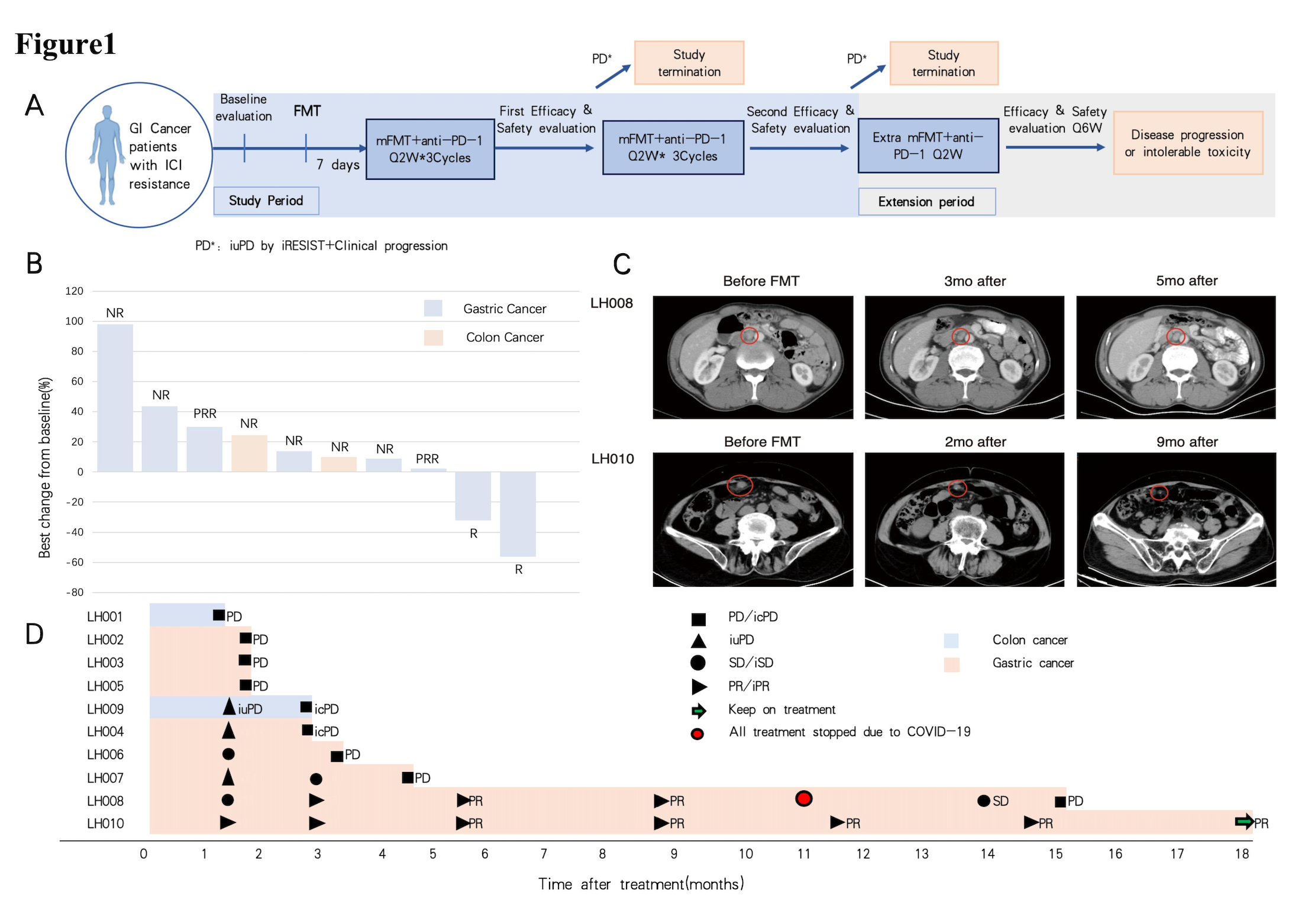
Behind FMT's reversal of drug resistance lies the significant role of gut microbiota in the human body. Through high-precision metagenomic sequencing and bioinformatics analysis, the research team identified two distinct sets of microbial signatures: one named "responder-enriched microbes," including 14 bacterial species significantly enriched in patients who responded to treatment; the other named "non-responder-enriched microbes," comprising 25 bacterial species enriched in patients for whom treatment was ineffective. The study found that "responder-enriched microbes" possess a stronger capacity to produce short-chain fatty acids (SCFAs). SCFAs are crucial metabolites of the gut microbiome, and extensive research has shown that they can enhance the cytotoxic activity of CD8+ T cells, modulate the immune microenvironment, and thereby improve anti-tumor immune responses.The above-mentioned effective donor characteristics will also be further utilized to iterate and optimize Xbiome's self-developed precision matching algorithm.
More encouragingly, the research team also validated these findings using an independent cohort of 63 gastric cancer patients. The machine learning model established by Xbiome's scientific team using the aforementioned microbial signatures could effectively predict patients' responses to immunotherapy. Data showed that the prediction accuracy (AUC) reached 0.71. This further confirms the reliability of the research findings and lays the foundation for future personalized cancer treatment strategies based on microbial characteristics.
| Graphical Abstract |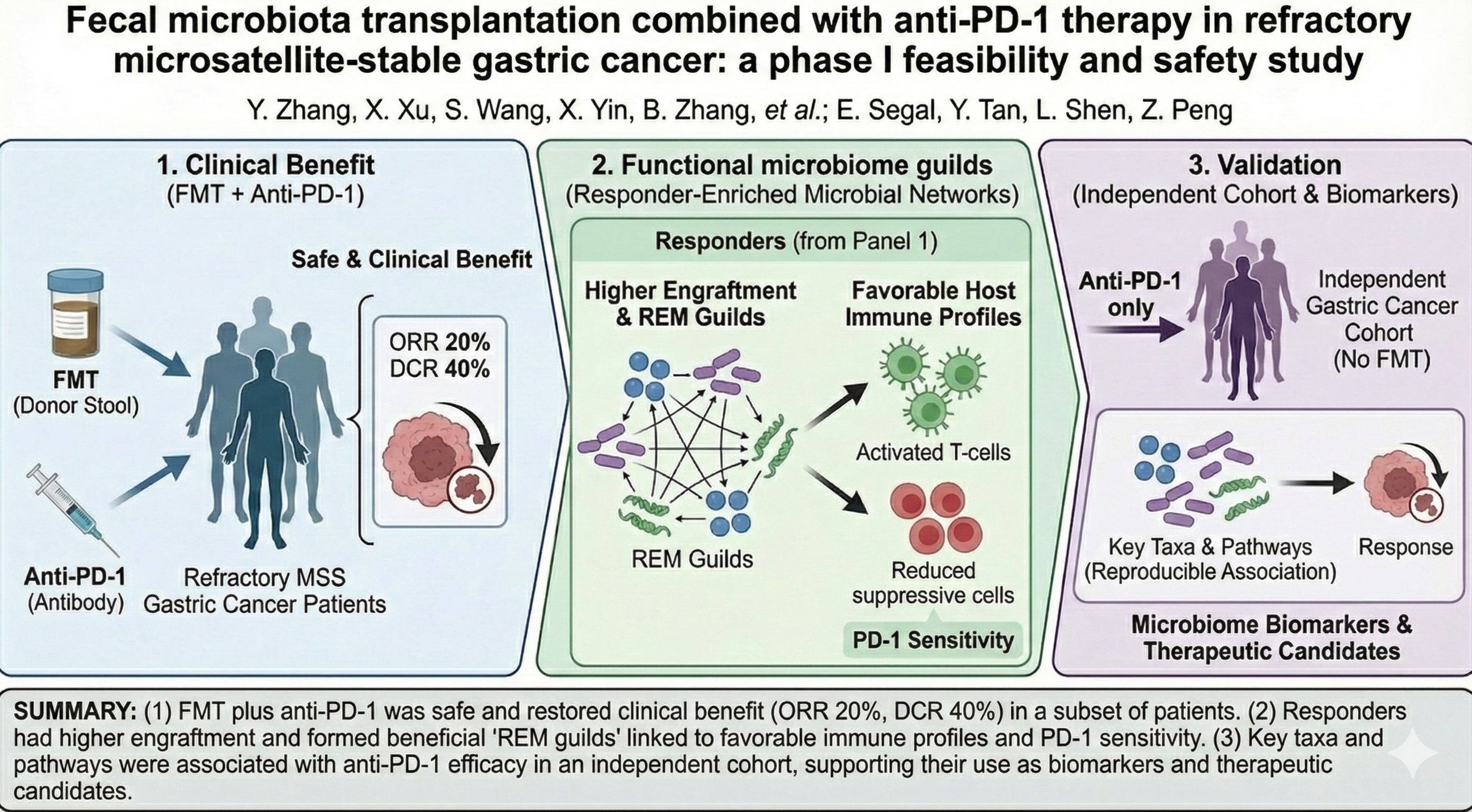
Xbiome: Leader in Gut Microecology Cancer Treatment
Cancer has always been one of the key disease areas studied by Xbiome. Since 2018, the company has become an academic research partner with Beijing Cancer Hospital. Over the past eight years, both parties have continuously produced highly influential academic achievements in the direction of cancer treatment. As early as the beginning of 2023, the preliminary results of this research were published in abstract form at the American Society of Clinical Oncology Gastrointestinal Cancers Symposium (ASCO-GI).
The fruitful cooperation reflects the trust of top hospitals and authoritative experts, represented by Beijing Tumor Hospital, in Xbiome's AI+BT technology platform and FMT production management system.In this study, Xbiome's AI platform played a crucial role — the team used AI algorithms to precisely match the optimal donor from an extensive proprietary donor database and conducted in-depth analysis of massive metagenomic data to identify key microbes associated with immune responses. They then built machine learning models to predict patients' responses to treatment, ultimately guiding clinical decision-making. Following this, Xbiome utilized an FDA-regulated pharmaceutical-grade FMT manufacturing system to produce gut microbiota capsules, helping patients comprehensively restore their gut microbiome.
Moreover, Xbiome is also a leader in the research of Live Biotherapeutic Products (LBP) for cancer. By 2025, the strains isolated and developed by XbiomeXA-511Officially granted a national patent, revealing its tremendous potential in anti-cancer treatment; meanwhile, the team overcame the technical bottleneck of strain gene editing, laying a solid foundation for the development of the next generation of live biotherapeutics. This also marks that Chinese technology enterprises have entered the international forefront in the field of precision medicine for live bacterial drugs.
In the field of cancer prevention and treatment, with each scientific research breakthrough,The gut microbiota is moving from being a "bystander" to a "participant," and is expected to become an indispensable new therapeutic pivot in the future precision diagnosis and treatment system for tumors.
-End-