

Yidu Tech Featured in Nature's 'Nature Index China 2021' Supplement for Advancing Medical Intelligence
On May 27, 2021, the prestigious international journal Nature published a supplement titled “Nature Index China 2021,” drawing significant attention from the science and technology sector. The publication highlighted discoveries, breakthroughs, and technologies driving innovation within China and abroad while shaping the future of the world, and featured outstanding Chinese technology companies represented by Yidu Tech (HK.2158).
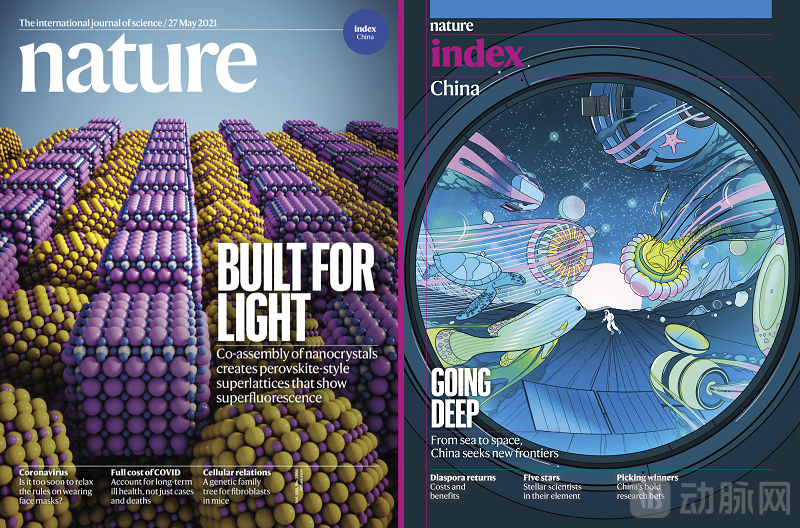
This published supplement, based on Nature Index data, highlights China’s updated research output in the natural sciences and reveals the changes occurring in the mobility of Chinese scientific talent and international research collaboration. The Nature Index shows that the United States, as the country with higher Nature Index output, is facing increasingly close competition from China. Among the four major disciplines tracked by the Nature Index, China’s share of contributions in chemistry surpassed that of the United States in 2018, while its shares in earth and environmental sciences and physics are also approaching those of the United States.
To this end, the “2021 Nature Index China” supplement delves deeply into areas where China demonstrates stronger scientific research capabilities, particularly in chemistry and the physical sciences. It analyzes the factors behind these impressive achievements and examines the contributions of individual scientists, collaborative teams, and institutions. Taking institutional contributions as an example, the publication features an article titled “Leading a New Era of Intelligent Medicine,” which focuses on Yidu Tech, a leading Chinese healthcare artificial intelligence enterprise. The article provides an in-depth analysis of the company’s diversified healthcare solutions based on AI technology, as well as its social responsibility and contributions.
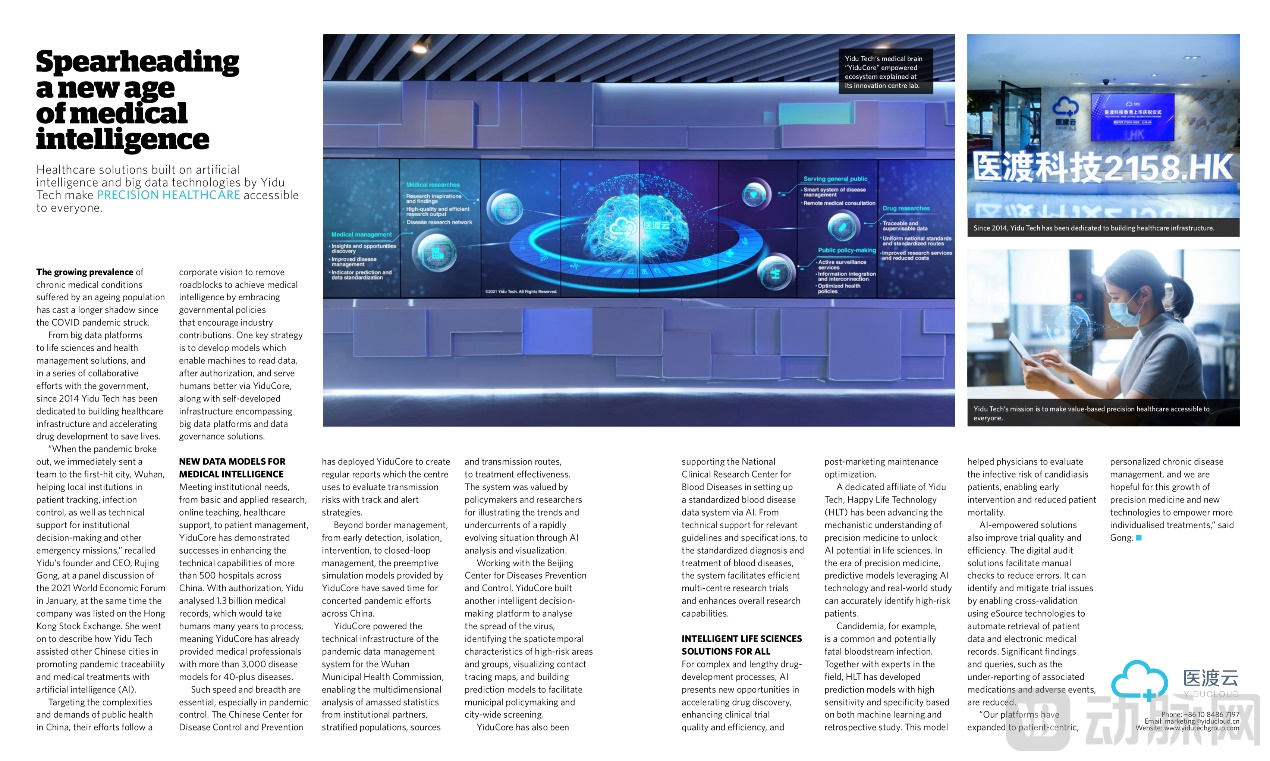
The article states that the COVID-19 pandemic has exacerbated the already growing burden on patients with chronic diseases. From building big data platforms to providing life science and health management solutions, and furthering a series of collaborations with government departments, Yidu Tech has not only advanced medical infrastructure development but also improved the efficiency of new drug R&D, contributing to saving more patients’ lives.
The article highlights Yidu Tech’s rapid response following the outbreak of the COVID-19 pandemic: from rushing to aid Wuhan and supporting Beijing’s epidemic control efforts, to enabling the Chinese Center for Disease Control and Prevention (China CDC) to generate regular reports by deploying “YiduCore” (the Healthcare Brain). Yidu Tech’s experience in leveraging medical artificial intelligence to combat the pandemic and enhance the efficiency of healthcare services has gained recognition from prestigious international journals.
The article evaluated the value and significance of YiduTech’s development of “YiduCore” and its related infrastructure, describing it as a “key strategy” that can “provide people with better healthcare services.” Furthermore, in response to the complex and lengthy drug development process, artificial intelligence offers new opportunities to accelerate drug discovery, improve the quality and efficiency of clinical trials, and enable continuous post-marketing optimization. The article also highlighted YiduTech’s practices and achievements in these areas, stating that they have “advanced the understanding of precision medicine mechanisms and unlocked the potential of artificial intelligence in the life sciences sector.”
“Yidu Tech leverages artificial intelligence and big data technologies to provide healthcare solutions, making precision medicine readily accessible.” The article posits that, in response to the complex demands of China’s public health sector, Yidu Tech has adopted a holistic perspective, overcome challenges, and actively responded to government policies encouraging industrial participation and contribution, thereby advancing medical intelligence.
Publicly available information indicates that the Nature Index was first released in November 2014. It is a database based on leading global journals, tracking the number of papers published by universities, research institutions, and countries in highly influential international academic journals. Using this database, rankings and journal indices can be generated based on the volume and categories of publications from each institution. The real-time online version of this database is freely accessible to the public. Currently, the Nature Index has evolved into an internationally recognized key indicator for measuring high-quality research output and collaboration in the natural sciences among institutions, regions, and countries, wielding significant influence worldwide.
[Introduction] By leveraging artificial intelligence and big data technologies to provide healthcare solutions, Yidu Tech is making precision medicine accessible.
Population aging has brought about challenges related to chronic diseases, and the onset of the pandemic has further exacerbated the already growing burden of these conditions. Since 2014, Yidu Tech has been committed to strengthening healthcare infrastructure, advancing new drug development, and striving to save more patients’ lives—progressing from building big data platforms to providing life science and health management solutions, and engaging in a series of collaborations with government agencies.
“After the outbreak, we immediately dispatched a team to Wuhan to assist local institutions in this city that bore the brunt of the epidemic, tracing patient movement trajectories and controlling infections, thereby providing technical support for institutional decision-making and the arrangement of other emergency tasks,” recalled Gong Rujing, Founder and Chairman of Yidu Tech, during her speech at the World Economic Forum in January 2021. She also shared Yidu Tech’s experience in leveraging artificial intelligence to help other cities in China trace the epidemic and advance medical solutions. That same month, Yidu Tech was officially listed on the Main Board of The Stock Exchange of Hong Kong Limited.
In response to the complexity and demands of China’s public health landscape, Yidu Tech has adopted a holistic approach, overcoming challenges and actively aligning with government policies that encourage industry participation and contribution, with the aim of achieving healthcare intelligence. A key component of its strategy is the development of models that enable machine reading of authorized data, leveraging YiduCore (the Healthcare Brain) and self-developed infrastructure—including big data platforms and data governance solutions—to deliver superior healthcare services to the public.

YiduTech’s medical AI brain, “YiduCore,” is showcased at its Innovation Center
To meet the needs of various institutions, ranging from basic and applied research to online teaching, medical support, and patient management, YiduCore has successfully enhanced the technical capabilities of more than 500 hospitals in China. Authorized to analyze 1.3 billion medical records—a task that would take years if performed manually—YiduCore has already provided healthcare professionals with over 3,000 disease models covering more than 40 diseases.
Such speed and breadth are critically important, particularly for epidemic prevention and control. The Chinese Center for Disease Control and Prevention has deployed YiduCore to generate regular reports, integrating tracking and early warning mechanisms to assess transmission risks.
The simulation models provided by YiduCore, in addition to boundary management, have saved time for joint epidemic control efforts across China by enabling early detection, early isolation, and early intervention, leading to closed-loop management.
YiduCore powered the technical infrastructure of the Wuhan Municipal Health Commission’s epidemic data management system, enabling multi-dimensional analysis of statistical data on institutional partners, stratified populations, sources and routes of transmission, and treatment outcomes, thereby improving healthcare efficiency. By leveraging AI-driven analytics and visualization, the system revealed evolving trends and underlying dynamics during the rapidly changing course of the outbreak, earning recognition from policymakers and researchers for its value.
YiduCore, in collaboration with the Beijing Municipal Center for Disease Control and Prevention, has developed another intelligent decision-making platform to analyze viral transmission, identify the spatiotemporal characteristics of high-risk areas and populations, visualize contact tracing networks, and build predictive models, thereby supporting government decision-making and city-wide screening efforts.
YiduCore also supports the National Clinical Research Center for Hematologic Diseases in establishing a standardized hematologic disease data system through artificial intelligence. By providing technical support for relevant guidelines and standards, the system facilitates the standardization of diagnosis and treatment for hematologic diseases, promotes the effective conduct of multicenter clinical trials, and enhances overall research capabilities.
In response to the complex and protracted drug development process, artificial intelligence offers new opportunities to accelerate drug discovery, enhance the quality and efficiency of clinical trials, and enable continuous optimization post-market.
Yidu Tech’s subsidiary, Happy Life Technology (HLT), is advancing the understanding of precision medicine mechanisms and unlocking the potential of artificial intelligence in the life sciences. In the era of precision medicine, predictive models based on AI technology and real-world research enable the precise identification of high-risk populations.
For instance, candidemia is a common and potentially fatal bloodstream infection in clinical practice. HLT collaborated with experts in the field to develop a prediction model with high sensitivity and specificity by incorporating machine learning methods into retrospective studies. This model assists physicians in assessing patients' risk of candidemia, enabling early intervention and treatment, thereby reducing mortality associated with the disease.
AI-powered solutions can also enhance the quality and efficiency of clinical trials. Digital audit programs complement manual reviews to reduce errors by automatically retrieving patient information and electronic medical records for cross-validation via eSource technology, thereby identifying and mitigating issues in clinical trials. This approach reduces the occurrence of major clinical events, such as underreporting of adverse events and concomitant medications.
“Our platform has expanded to patient-centered, personalized chronic disease management. We hope that advances in precision medicine and new technologies will enable more personalized treatments,” said Gong Rujing.