

From Topical to Edible: Experts Call for Enhanced R&D and Application of Hyaluronic Acid and Other Novel Food Ingredients
Bloomage Biotech
Developer of bioactive substance products, producer of hyaluronic acid raw materials
“Novel food ingredients not only enrich the variety of food products and meet diverse health needs, but also promote the rapid development of the industry, holding significant importance.”
“Functional foods serve as a bridge between the food and pharmaceutical industries, improving and enhancing health levels.”
“A review of numerous authoritative literature and studies has found that orally administered hyaluronic acid can be partially absorbed and utilized by the body after metabolism.”
“Expanding the application of hyaluronic acid to a variety of conventional foods is conducive to product innovation and industrial upgrading in the food industry.”
……
On May 28, the roundtable forum titled “Promoting the Application of New Food Raw Materials and Developing the Food Nutrition and Health Industry: Trends in the Development of Functional Foods,” co-hosted by People’s Daily Health Client and Health Times, was held in Beijing. Zhang Fenglou, former Vice Minister of the Ministry of Health, officials from the Department of Food Safety Standards and Monitoring of the National Health Commission, as well as authoritative experts in food and nutrition and industry representatives from institutions such as the Chinese Center for Disease Control and Prevention, the Chinese Nutrition Society, China Agricultural University, Shandong University, and Jiangnan University, attended the event. Participants jointly discussed the industrial development of functional foods and called for strengthened research, development, and application of new food raw materials such as hyaluronic acid.
On January 7, 2021, the National Health Commission of China issued an announcement regarding 15 types of "new foods," including sodium hyaluronate. The commission reviewed and approved three new food raw materials, including sodium hyaluronate, permitting their use as additives in general food products.
Zhang Fenglou, former Vice Minister of the Ministry of Health, stated, “As early as 1983, during the trial implementation of China’s first Food Hygiene Law, it was first proposed that new resource foods be subject to approval by health administrative departments. In January this year, the National Health Commission approved sodium hyaluronate and a batch of other products as new food raw materials, which can be added to ordinary foods such as milk, bread, and chocolate. After more than 30 years of development, health authorities have approved many new resource foods, or so-called new food raw materials. This has not only enriched the variety of food products and met the diverse needs of the general public at different levels and in various aspects of health, but also promoted the rapid development of the industry. The application of new food raw materials is of great significance.”

Former Vice Minister of the Ministry of Health, Zhang Fenglou. Photo by Cao Zihao
“In recent years, in accordance with the State Council’s reform principles of ‘streamlining administration, delegating power, and improving services,’ we have continuously advanced the reform of approval and management for new food raw materials. The overarching approach is to optimize review procedures and enhance approval efficiency while ensuring food safety.” Discussing the ongoing deepening of reforms in the management of new food raw materials, Zhang Lei, First-Level Inspector at the Department of Food Safety, National Health Commission, stated, “On one hand, we strictly define the scope of ‘new.’ For certain plant parts such as flowers, stems, leaves, and roots, as well as animals, we do not recommend submitting applications under the category of new food raw materials. On the other hand, we are making substantial efforts to improve the quality of reviews. This includes establishing the second Expert Panel for the Review of New Food Raw Materials following last year’s reappointment, further optimizing review processes, and significantly boosting approval efficiency.”

Zhang Lei, First-Level Inspector of the Food Department of the National Health Commission. Photo by Cao Zihao
Hyaluronic Acid (HA) has long been widely known to the public in the fields of skincare and medical aesthetics under the name “sodium hyaluronate.” Zhai Fengying, former Executive Vice Chairman and Secretary-General of the Chinese Nutrition Society, introduced that hyaluronic acid is a natural component of the human body. It possesses exceptional water-retaining properties and is currently recognized as one of the most effective moisturizing substances found in nature, often referred to as an ideal natural moisturizing factor. HA can improve skin nutritional metabolism, rendering the skin soft, smooth, and wrinkle-free, while enhancing elasticity and preventing aging. In addition to its moisturizing effects, it serves as an excellent penetration enhancer for transdermal absorption. When used in combination with other nutrients, it can achieve optimal results in promoting nutrient absorption.
Is it safe to add hyaluronic acid to food, and can it be absorbed? This is a topic of significant public concern. At this forum, Zang Hengchang, Director of the Key Laboratory for Research and Evaluation of Drug Formulation Technology under the National Medical Products Administration and Deputy Dean of the School of Pharmaceutical Regulatory Science at Shandong University, stated that a review of extensive literature and research indicates that orally administered hyaluronic acid (commonly known as sodium hyaluronate) undergoes metabolism and can be partially absorbed and utilized by living organisms. Among these studies, three reports published in internationally renowned journals are particularly representative: a 2014 study by the R&D Department of Japan’s Kewpie Corporation titled “Pharmacokinetic Study of C-14 Labeled Hyaluronic Acid after Oral Administration in Rats,” published in *The Scientific World Journal*; a 2017 study by Tokyo University of Agriculture and Technology and the R&D Department of Kewpie Corporation on the degradation and absorption of oral hyaluronic acid in the gastrointestinal tract, published in the *Journal of Medicinal Food*; and a 2020 study by Hokkaido University in Japan on the transfer of orally administered hyaluronic acid into the lymphatic system and bloodstream, published in the *European Journal of Pharmaceutics and Biopharmaceutics*.
Literature reports indicate that approximately 76.5% of orally administered high-molecular-weight hyaluronic acid is metabolized by the liver and consumed as energy, while about 8.8% is distributed to various tissues and organs to exert biological effects. Oral hyaluronic acid can function in protecting gastrointestinal health, eye care, alleviating osteoarthritis, and improving skin efficacy. Multiple clinical studies have found that oral hyaluronic acid has the effects of protecting gastric mucosa, alleviating intestinal inflammation, and regulating gut microbiota. Regarding eye health, Korean scientists have discovered that oral hyaluronic acid can alleviate dry eye syndrome. Additionally, Japan published the earliest clinical study on oral hyaluronic acid improving skin dryness in 2001; hyaluronic acid can also improve skin dryness, enhance skin firmness, and boost skin moisture retention.

Zang Hengchang, Director of the Key Laboratory for Research and Evaluation of Pharmaceutical Preparation Technology under the National Medical Products Administration, and Deputy Dean of the School of Drug Regulatory Science at Shandong University. Photo by Cao Zihao
Guo Xueping, Chief Scientist at Bloomage Biotech, introduced that hyaluronic acid has been used as a food ingredient abroad for many years. Japan early on applied hyaluronic acid in ordinary foods and beverages, while the United States primarily uses it in products for joint repair. Since the 1980s, China’s hyaluronic acid industry has evolved from nonexistence to prominence, growing from small beginnings to its current scale. Currently, China’s share of the global hyaluronic acid market exceeds 80%. Bloomage Biotech began supplying food-grade hyaluronic acid raw materials to countries such as Japan and the United States in 2003, with products complying with the food ingredient standards of these nations. Starting in 2004, after a 16-year application process, Bloomage Biotech’s sodium hyaluronate was officially approved by the National Health Commission of China in January 2021 as a new food raw material for use in ordinary foods, thereby opening up new avenues for the application of hyaluronic acid.
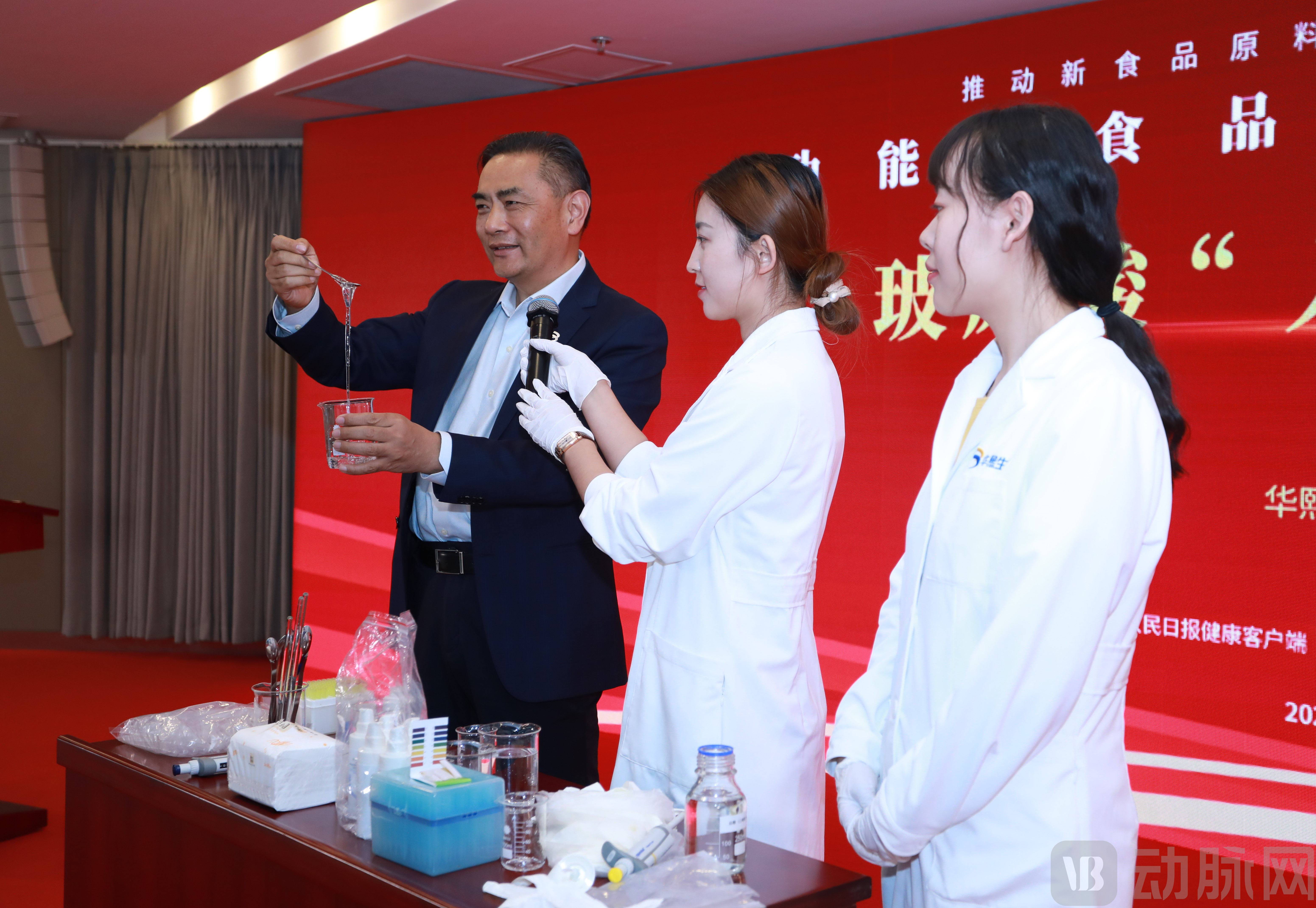
Bloomage Biotech’s Chief Scientist and Deputy General Manager, Guo Xueping, conducts a simulated experiment on the gastrointestinal response to hyaluronic acid in the human body at the forum. Photo by Cao Zihao
“The past 40 years have witnessed the most significant changes in the lifestyles of Chinese residents, characterized by a substantial increase in food availability and a marked decrease in physical activity, which have also given rise to new nutritional challenges,” stated Ding Gangqiang, Director of the National Institute for Nutrition and Health at the Chinese Center for Disease Control and Prevention. He explained that nutritional imbalance or excessive intake of certain nutrients can lead to health issues such as overweight, obesity, and the “three highs” (hypertension, hyperglycemia, and hyperlipidemia). Therefore, it is crucial to adopt lifestyle changes and achieve a balance between dietary intake and physical activity.

Ding Gangqiang, Director of the National Institute for Nutrition and Health at the Chinese Center for Disease Control and Prevention. Photo by Cao Zihao
Professor Zhang Yan from the College of Food Science and Nutritional Engineering at China Agricultural University also stated, “Our diet is improving, yet we are seeing a rise in many diseases, which need to be addressed through dietary improvements. From the perspective of processed foods, in addition to prioritizing traditional functional components such as proteins and minerals in raw materials or ingredients, new bioactive compounds—such as hyaluronic acid, chlorophyll, and anthocyanins—should also be fully considered. This approach can enable daily diets to play a significant role in promoting residents’ health.”

Professor Zhang Yan, College of Food Science and Nutritional Engineering, China Agricultural University. Photo by Cao Zihao
Currently, there is no statutory term for “functional foods” in China’s food classification system. “It is generally believed that functional foods refer to those that possess physiological regulatory functions, such as enhancing the body’s defense mechanisms, regulating physiological rhythms, preventing diseases, and promoting health,” stated Zhai Fengying, former Executive Vice Chairman and Secretary-General of the Chinese Nutrition Society. “Functional foods are highly significant in an era characterized by a high prevalence of chronic diseases and a rising incidence of lifestyle-related conditions. They may play a role in preventive healthcare—addressing health issues before they manifest—thereby helping to prevent various diseases and supporting clinical treatment.”

Zhai Fengying, Former Executive Vice Chairman and Secretary-General of the Chinese Nutrition Society. Photo by Cao Zihao
“Conceptually speaking, functional foods are food products that possess specific nutritional and health-promoting properties,” stated Professor Lu Wenwei from the School of Food Science and Technology at Jiangnan University, who also serves as Deputy Director of the National Engineering Research Center for Functional Foods. He noted that, within the industry, functional foods may serve as a bridge between food and pharmaceuticals, addressing individual health needs and helping to improve overall health status through their consumption.

Lu Wenwei, Deputy Director of the National Engineering Research Center for Functional Foods and Professor at the School of Food Science and Technology, Jiangnan University. Photo by Cao Zihao
Currently, functional foods are entering a phase of rapid development worldwide. According to the “Analysis Report on Market Demand Prospects and Sales Channels of China’s Functional Food Industry (2020–2026)” released by Zhiyan Consulting, the market size of functional foods in China reached RMB 358.58 billion in 2019.
The "National Nutrition Plan (2017–2030)" points out that national nutrition is related to the improvement of national quality and economic and social development. It is necessary to vigorously develop the food nutrition and health industry, focus on developing new types of nutritional and healthy foods such as health supplements, fortified foods, and dual-protein foods, and promote the coordinated development of production, consumption, nutrition, and health.
“The announcement on new food raw materials, which expands the application of hyaluronic acid to a variety of conventional foods, represents the conclusion reached by national health authorities in accordance with the Food Safety Law. This decision was made by entrusting professional evaluation institutions to follow statutory procedures, conduct detailed examinations of international standards and regulations, and perform scientific food safety risk assessments. The development and application of new food raw materials are conducive to product innovation and industrial upgrading in the food industry,” emphasized Liu Ming, Assistant Director of the National Food Fermentation Standardization Center and Professor-level Senior Engineer at the China National Research Institute of Food and Fermentation Industries. He pointed out that recognizing its application in foods is merely the beginning; further research and formulation of standards are required for aspects such as raw material quality specifications and product testing methods to ensure scientific and rational application from raw materials to final food products.

Liu Ming, Assistant to the Director of the National Food Fermentation Standardization Center and Professor-level Senior Engineer at China National Research Institute of Food and Fermentation Industries. Photo by Cao Zihao
In the future, hyaluronic acid will be incorporated as an ingredient into a wider range of innovative food products, such as chocolates, beverages, and frozen desserts. Only by scientifically developing standards for raw materials and production methods, and establishing an effective quality control and testing system, can the content and efficacy of these products be ensured. This will safeguard consumer rights and health, while preventing issues such as substandard products being passed off as high-quality ones and false labeling, which may arise after large-scale market entry.
Regarding the reasons behind the successful approval of the new food ingredient application led by Bloomage Biotech, Zhao Yan, Chairman and General Manager of Bloomage Biotech, pointed out that in the past, Chinese consumers mainly relied on overseas online shopping and purchasing agents to buy foreign dietary supplements or functional foods. However, the raw materials for these products were almost entirely produced and supplied by Chinese enterprises. Since we can produce the raw materials for such products, why can’t our consumers purchase them domestically? Therefore, to promote the inclusion of such new food ingredients—such as hyaluronic acid—in food, Bloomage Biotech dedicated 16 years to this effort. The recent approval of hyaluronic acid for use in food aims to ensure that people not only have enough to eat but also enjoy high-quality, fulfilling diets.

Zhao Yan, Chairman and General Manager of Bloomage Biotech. Photo by Cao Zihao
Zhao Yan emphasized that introducing new substances into conventional foods indeed requires a science popularization process for the general consumer base. For industrial development, scientific foundation is the core. It begins with support from basic scientific research, which is then translated into technological support, and subsequently leveraged to underpin product development. With high-quality products in place, it is essential to cultivate domestic brands to truly meet the market demands of Chinese consumers.